Table of Contents
Mistakes 1 to 3: The Starter Pack Itself
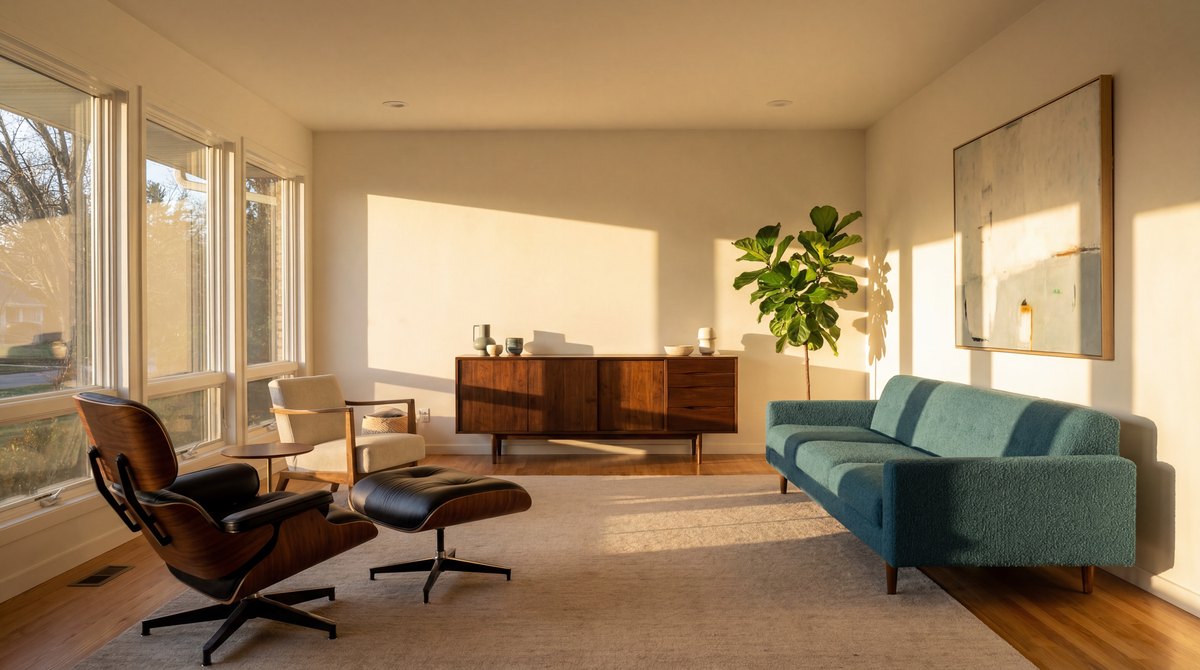
1. Assembling the starter pack all at once from one source. The walnut credenza, the teal couch, the Eames knockoff, the sputnik light, the one plant, bought together from the same catalogue. The fix: introduce each element separately over time, with personal objects between them.[1]
2. Pure white walls instead of warm white. Pure #FFFFFF reads clinical and makes walnut look yellow. The fix: warm white near #FAF9F6.[2]
3. All-walnut everything with no wood-tone variation. The bought-the-whole-showroom-floor look. The fix: let a teak, lighter ash, or vintage rosewood piece break up the matched set.
Mistakes 4 to 6: Color and Lighting
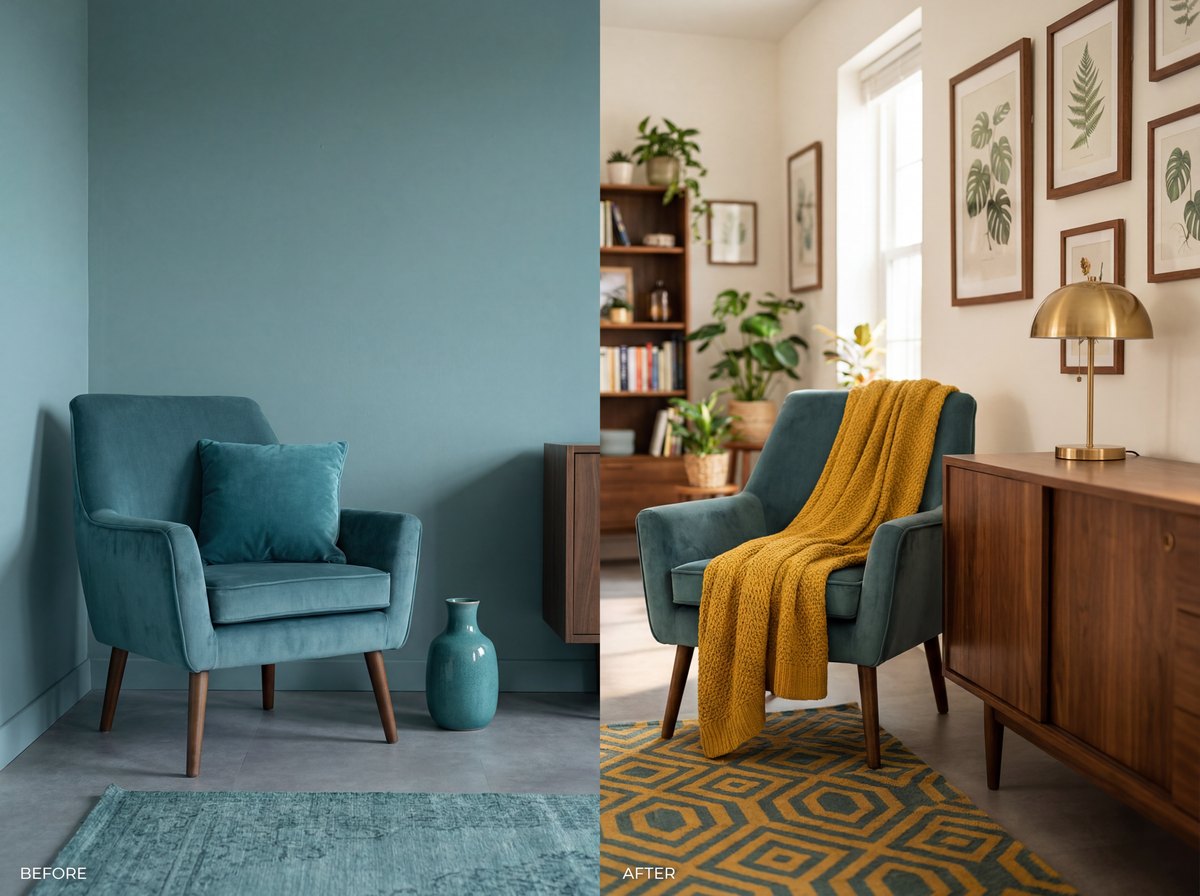
4. Teal as the only color with no warm counterbalance. Teal run against white and walnut alone is the dated 2015 look. The fix: add a mustard or terracotta warm element, or choose mustard or burnt orange as the accent instead.[1]
5. Over-buying cheap replicas. The Eames lounge knockoff that wobbles after six months. The fix: spend up on the one or two pieces where construction is the whole point, and buy replicas only where the piece is simple.[3]
6. More than one statement light per room. Sputnik plus Edison pendants plus globe fixtures, all at once. The fix: one sculptural fixture per room, chosen deliberately.[1]
Mistakes 7 to 8: Scale and Personality
7. Wrong scale for the room. Low MCM sofas look lost in tall lofts and oversized in standard apartments. The fix: measure first, choose the footprint that fits, and scale pieces down without losing the low, ground-hugging line the style depends on.
8. No personal objects, so the room reads like a set. Coherence without personality is the staged look r/malelivingspace keeps describing: "my whole apartment looks like a set." The fix: books you have actually read, art you chose because you liked it, and objects that came from somewhere specific.[1]
Mistakes 9 to 10: Warmth and Vocabulary
9. Cold execution. White walls plus minimal textiles plus no plants equals a catalogue photo. The fix: deliberate warm layering, warm neutrals, wool and leather texture, and at least one large plant. Large plants, a fiddle leaf or a monstera, are the fastest way to make MCM feel lived-in.[1]
10. Calling it retro or 70s style. MCM is 1945 to 1969, and the kitsch framing makes the room read as a joke about the period rather than a room designed in it. The fix: treat it as a design period, not a costume, and the buying decisions get more disciplined.
A few of these mistakes are worth ranking, because not all ten cost the same. Mistakes 1 and 8, buying the starter pack at once and skipping the personal layer, are the two that most reliably produce the Airbnb look, and they are also the cheapest to fix because the fix is mostly about timing and editing rather than spending. Mistakes 5 and 7, cheap replicas and wrong scale, are the expensive ones, because correcting them usually means re-buying a piece. If you are going to be careful about anything, be careful about the buying schedule and the personal layer first, and measure before you buy the large pieces.
The Anti-Airbnb Framework
The 10 mistakes collapse into one root cause and one fix. The root cause is doing MCM by the template, every recognizable piece, all at once, from one place, with nothing personal in between. That is what makes a room read as an Airbnb listing photo, because Airbnb staging is literally the template executed efficiently.
The fix is five moves. First, avoid the teal-walnut-Eames-knockoff combo bought all at once, introduce each element separately. Second, add personal objects, the books, plants, and art that are specific to you. Third, use one statement light, not three. Fourth, mix MCM with an adjacent style for warmth or restraint, pure MCM from one source is the catalogue. Fifth, use large plants to introduce the scale and life that staging always lacks. The starter pack is the entry point to MCM, and these five moves are how you escape it.[1] A room that is coherent and specific reads designed. A room that is coherent and generic reads like a hotel lobby.
How to Audit a Room You Already Built
If you already have an MCM room and it feels generic, you do not have to start over. Walk the room with the ten mistakes as a checklist. Are the walls pure white, are the wood tones all identical, is the accent only teal with nothing warm to balance it, is there more than one statement light, is there anything in the room that is specifically yours. Each yes is a single fixable thing, and most of the fixes are cheap, a warmer bulb, a thrifted piece in a different wood tone, a mustard throw, removing a fixture, adding a real object and a large plant.
The reassuring part is that the difference between a starter-pack room and a designed one is usually small in dollars. The starter-pack room already has the expensive bones, the sofa, the credenza, the chair. What it lacks is the cheap layer, the variation, the warmth, and the personality, and that layer is the inexpensive one to add. Most generic MCM rooms are two or three weekend changes away from looking intentional.
What Each Fix Actually Costs
The fixes do not cost the same, and seeing them ranked by price makes the audit less intimidating. Most of the work that escapes the Airbnb look sits at the bottom of this table, not the top.
| Fix | Mistake it solves | Rough cost | Effort |
|---|---|---|---|
| Warm-temperature bulbs | Cold execution, pure white walls reading clinical | $15 to $30 | 10 minutes |
| One mustard or terracotta accent (throw, pot, art) | Teal as the only color | $25 to $70 | One afternoon |
| A large plant | Cold, catalogue-staged feel | $30 to $90 | One afternoon |
| A thrifted piece in a different wood tone | All-walnut showroom look | $40 to $150 | One weekend of looking |
| Removing a surplus light fixture | More than one statement light | $0, or a small electrician fee | 30 minutes |
| Personal objects already owned | Room reads like a set | $0 | One afternoon of editing |
| Re-buying a wobbling replica | Over-bought cheap replicas | $200 to $1,200 | A real purchase |
| Re-buying a wrong-scale sofa | Wrong scale for the room | $600 to $2,000 | A real purchase |
Six of the eight common fixes cost under $150 and several cost nothing at all, because they are about editing and timing rather than spending. Only two fixes, the replica that failed and the sofa that never fit, are genuinely expensive, and both trace back to a rushed first purchase. The takeaway for anyone budgeting a fix is to spend the careful money up front on the two or three pieces where scale and construction matter, then treat everything else as a cheap, reversible layer that can be adjusted over a few weekends.
Three Things Worth Settling First
Three questions are worth settling before any of the shopping starts, because each one changes what you buy. Can mid-century modern work in a small apartment. Yes, but the low, large-footprint furniture has to be chosen for the room rather than bought at standard showroom size, so measure and favor fewer pieces with breathing room. Is it fine to mix MCM with what is already owned. Yes, and it usually helps, because the inherited and the secondhand are exactly the personal layer that breaks the template. Does going all-vintage avoid the Airbnb look. Not on its own, a room of matched vintage walnut can look just as staged as a room of matched new walnut, the variation and the personal objects still have to be there.
See Also: More Mid-Century Modern Guides
- mid-century modern vs. contemporary
- mid-century modern living room ideas for real apartments
- The complete Mid-Century Modern guide
Where to Go Next
Ten mistakes, and most of them trace back to the same habit: buying the look in one order instead of assembling it. The Complete Mid-Century Modern Interior Design Guide covers the whole style room by room, including the room-by-room layouts and how MCM differs from contemporary.
Sources.
- [1] apartment therapy: How to Avoid the Mid-Century Modern Airbnb Look
- [2] housebeautiful.com: Mid-Century Modern Room Ideas
- [3] curatedinterior.com: Authentic vs. Replica Mid-Century Modern Furniture
Frequently asked
Why does my mid-century modern room look like an Airbnb?
Because it is the template executed efficiently, every recognizable piece, all at once, from one source, with nothing personal in between. Airbnb staging is literally the MCM starter pack done fast.
What is the mid-century modern starter pack?
The community name for the generic MCM template: a walnut credenza, a teal couch, an Eames knockoff, a sputnik light, and one token plant, usually bought together from one catalogue.
How do I make a mid-century modern room not look generic?
Introduce pieces separately over time, add personal objects, use one statement light instead of three, vary the wood tones, balance the accent color, and use large plants for life and scale.
Is mid-century modern overdone?
It is the most overused interior style, which is exactly why the generic version reads as staged. The style itself still works, the fix is escaping the template with personal, varied, and warm choices.
What is the biggest mid-century modern decorating mistake?
Buying the whole starter pack at once from one source with nothing personal added. Coherence without personality is what makes an MCM room read like a hotel lobby instead of a designed space.
There are 15 more Mid-Century Modern guides.
This is one room of the set. The pillar links to all of them, and new guides go out by email first.
Read the Mid-Century Modern guide