Table of Contents
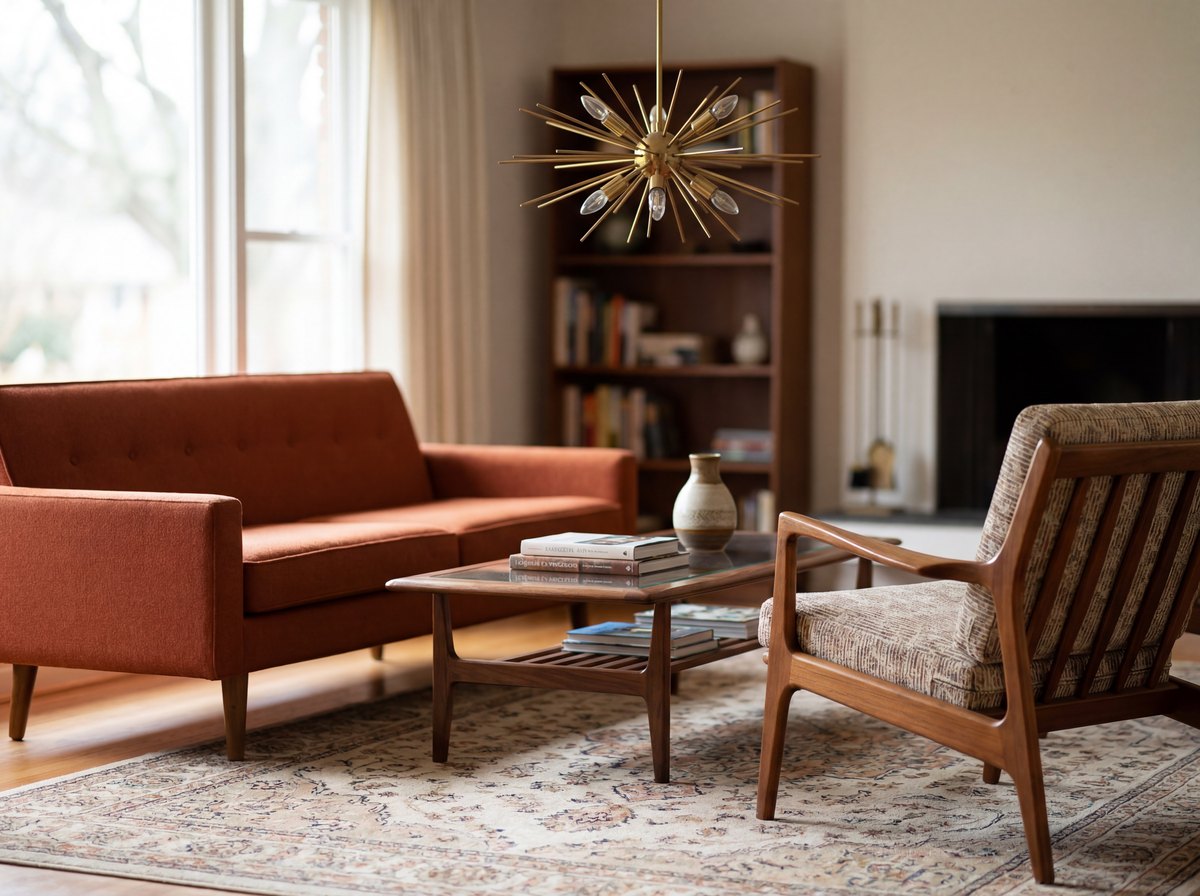
The Five-Layer Living Room Setup
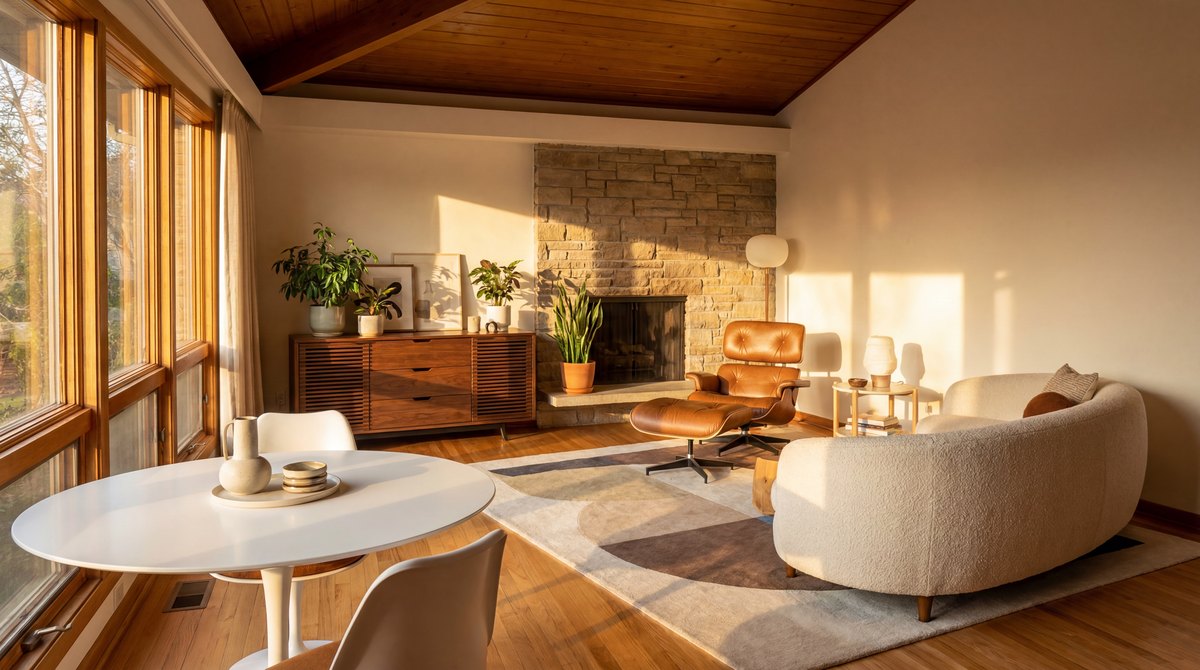
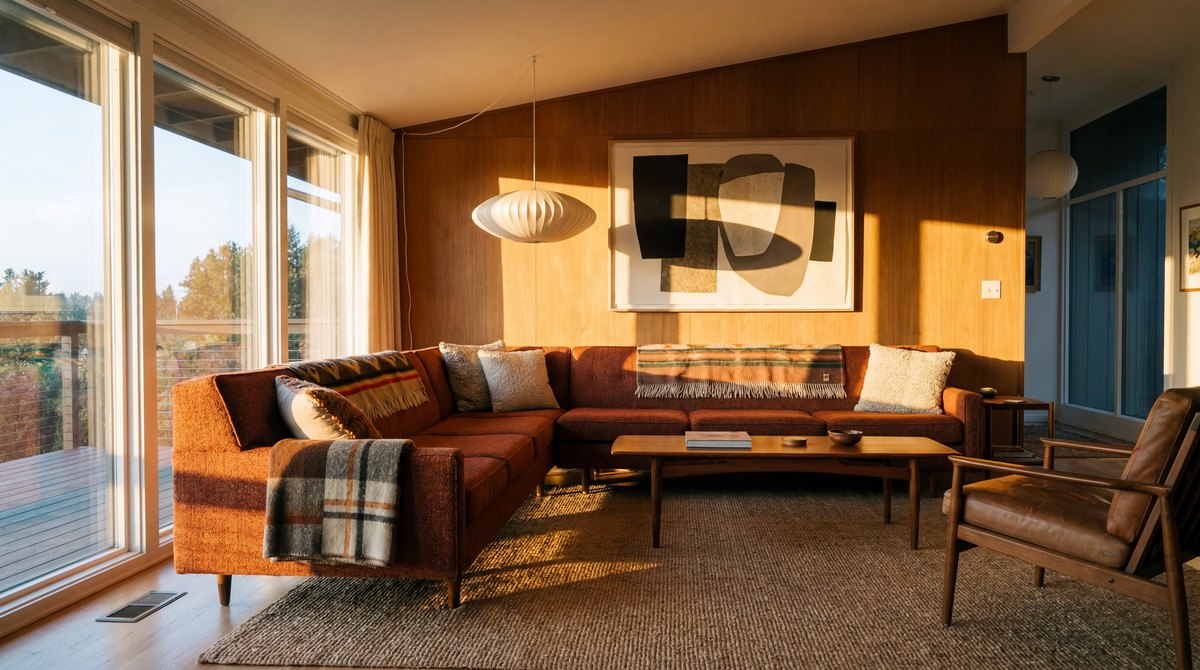
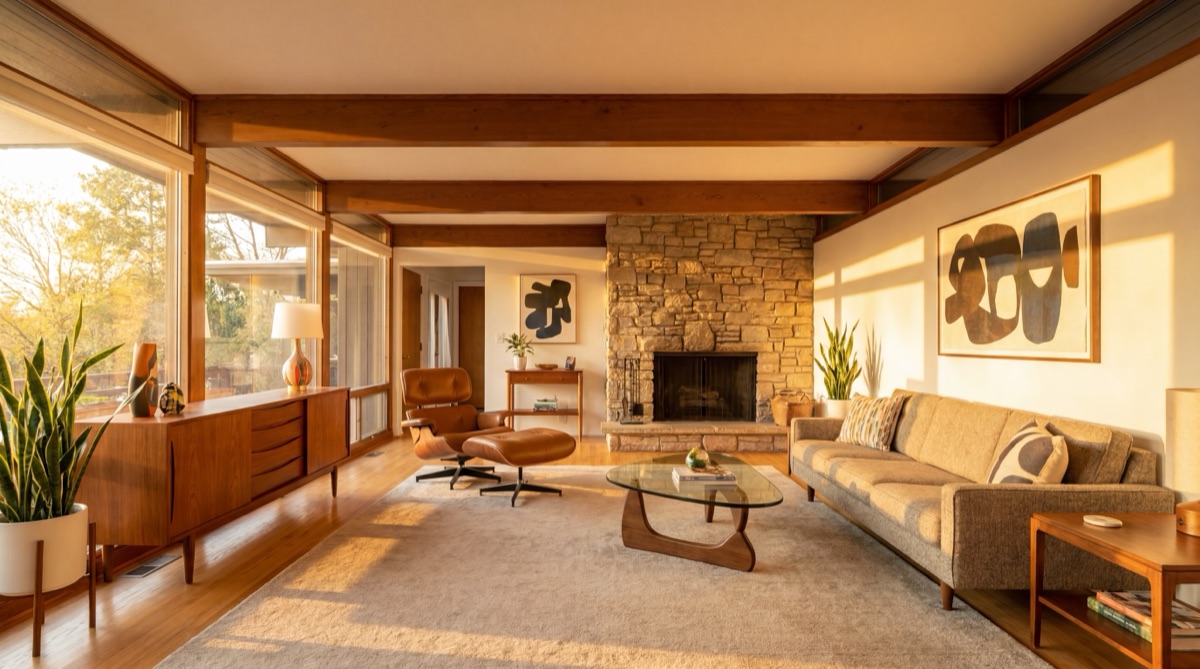
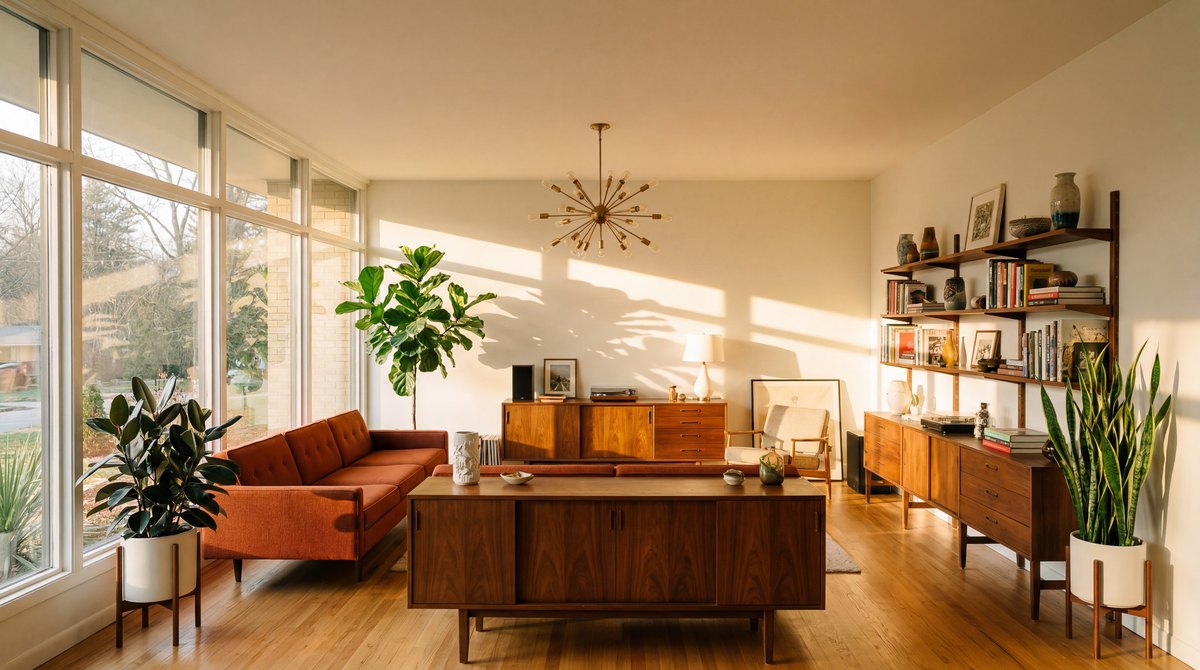
A working mid-century modern living room is built in five layers, each one a section of the room.[1]
The warm wood anchor. A walnut credenza or sideboard along one wall, low and horizontal. This is the piece the whole room hangs off.
The organic form layer. The seating, a low-profile sofa on tapered wood legs, plus one sculptural chair, an Eames-style lounge or a Bertoia wire chair. This is the curve against the credenza's flat plane.
The bold accent color. One color, done genuinely boldly, carried through pillows, a rug, or one piece of art. Teal, mustard, or burnt orange, never more than one.
The statement lighting. One sculptural fixture, a sputnik chandelier, a Nelson bubble pendant, or an arc floor lamp. One, not three.
The personal object layer. Books actually read, plants actually cared for, art actually chosen. This is the layer that breaks the set.
Layout Rules for Real Apartments
Mid-century modern living rooms were designed for open-plan California homes, so a few layout rules adapt them to a real apartment.
Float the seating, do not line the walls. MCM seating works best pulled slightly into the room, facing the credenza or a coffee table. Furniture pushed flat against every wall reads like a waiting room.
Anchor with a rug big enough for the front legs. The sofa and chair front legs should sit on the rug. A rug that floats too small under the coffee table is the most common MCM living room scale error.
Keep the sightlines low. The MCM living room is horizontal. Avoid tall bookcases and high-backed chairs that break the low, long line. If you need storage height, a credenza plus low shelving beats one tall unit.
One statement light, placed deliberately. A sputnik over the seating, or an arc lamp arcing over the sofa. Do not also add Edison pendants and globe fixtures, one sculptural fixture per room.
Build a conversation area, not a TV wall. MCM living rooms were designed around people facing each other, not around a screen. You do not have to hide the television, but the seating should make sense as a conversation grouping first. A sofa and a sculptural chair angled toward each other across a low coffee table is the canonical MCM arrangement. If the room is built entirely around the TV, the MCM furniture ends up lined against walls, which is the waiting-room look again.
The Personal Object Layer in Detail
This is the layer that separates a real living room from a catalogue photo, and it is the one most people skip.[2] The fix for the looks-like-a-set problem is specificity. A stack of books you have actually read, spines out. A piece of art you chose because you liked it, not because it matched the sofa. An object from a trip, a mug from a potter whose name you know, a record collection if you have one.
Plants do the most work here. Large plants, a fiddle leaf fig, a bird of paradise, a monstera, are the fastest way to make an MCM living room feel lived-in.[2] They introduce scale and life that catalogue staging always lacks. One large plant in a corner does more for the room's warmth than another piece of walnut would.
The Anti-Set Checklist
Before you call a mid-century modern living room finished, run it against five questions. Is everything from the same source and the same buying trip? If yes, the room reads staged, mix in a vintage piece. Is there more than one statement light? If yes, remove one. Is the accent color on more than three things? If yes, pull it back. Are there any objects in the room that are specific to you? If no, that is the actual problem. Is there at least one large plant? If no, add one before adding anything else.
The MCM living room is beautiful when it is coherent and personal at the same time. Coherent without personal is the set. Personal without coherent is a room that never resolves into a style at all. You want both, in that order. The five layers give you the coherence, the personal object layer and the plants give you the rest.
The Order to Build It In
If you are starting an MCM living room from nothing, the build order matters as much as the piece list. Start with the sofa, it is the largest piece, the biggest spend, and the one the low MCM profile depends on most. Then add the walnut credenza, which gives the room its wood anchor and a surface to style. Third, the sculptural chair and the coffee table, which complete the seating group. Fourth, the one statement light. Only then the accent color and the personal layer.
Building in this order has a hidden benefit: it forces the staggered timeline that breaks the staged look. By the time you reach the accent and personal layers, you have lived in the room long enough to know what it actually needs, which plant fits the corner, which art you genuinely want on the wall. The rooms that read as designed are almost never bought all at once. They are built in roughly this sequence over a few months, and the gaps between purchases are part of why they end up feeling personal.
Living Room Budget Tiers
The five-layer setup scales to any budget. The three tiers below are the same ones that work for a whole apartment, applied to one room.[3] The point of the tiers is not that more money buys a better room. It is that each tier has a different smartest move.
| Tier | Approach | Estimated Cost |
|---|---|---|
| Entry | IKEA STOCKHOLM sofa, a walnut-toned coffee table, a sputnik or bubble pendant, and one bold accent color carried through pillows and a rug | around $699 |
| Standard | Five elements: an Article or Castlery sofa, a walnut credenza, statement lighting, a sculptural accent chair, and an area rug sized for the front legs | around $2,800 |
| Luxury | An authentic Herman Miller or Knoll anchor piece, custom built-ins, and the rest filled in with quality replica and vintage | $15,000 and up |
At the entry tier the smart move is restraint. One bold accent, one statement light, and the personal layer doing the heavy lifting beats a room crowded with budget furniture. At the standard tier the smart move is the credenza, it is the piece that pulls the entry-tier room from looks-fine to looks-designed. At the luxury tier the smart move is the opposite of buying everything authentic, it is buying one authentic anchor and resisting the urge to make the whole room a showroom, because an all-authentic room with nothing personal in it is still the set.
Three Things to Settle Before You Buy
Three questions are worth settling before any of the shopping starts, because each one changes what you buy.
Do I have to hide the TV? No. The MCM living room was designed around conversation, not around a screen, but that is a layout instruction, not a ban on televisions. Mount it low, keep it off the credenza so the credenza stays a styling surface, and build the seating as a conversation group first. The TV can be in the room. It just should not be the thing the room is organized around.
Can the sofa be a sectional? It can, if it keeps the MCM traits, a low profile, visible tapered legs, clean structured lines. The risk is scale. A large contemporary-proportioned sectional fights the low horizontal line. A compact sectional with the right legs and profile works fine in an open-plan room.
What if the room is small? Small rooms are where the float-the-seating rule gets hard, but it still holds, even two inches off the wall reads better than flush. Skip the second large piece, lean on one good sofa, one sculptural chair, and the plant layer, and let the walls carry the art instead of more furniture.
See Also: More Mid-Century Modern Guides
- the 12 essential mid-century modern furniture pieces
- the mid-century modern sofa sourcing guide
- The complete Mid-Century Modern guide
Shop the Look
The pieces below cover credenza, planter, shelving, floor lamp and coffee table for a mid-century modern living room, and every one is priced and linked, from $29 to $185.
Prices move, and we re-check them whenever this post is updated. These are affiliate links: if you buy through one, Amazon pays us a small commission and you pay the same price you would have anyway.
Where to Go Next
The living room is the room MCM is easiest to get right and easiest to overdo. The difference is almost always one or two objects that are yours. The Complete Mid-Century Modern Interior Design Guide covers the whole style room by room, including sofa sourcing and the other rooms.
Sources.
- [1] housebeautiful.com: Mid-Century Modern Room Ideas
- [2] apartment therapy: How to Avoid the Mid-Century Modern Airbnb Look
- [3] YouTube: Mid-Century Modern Apartment Tour: How to Layer MCM Without Going Generic (DesignedForReal, ~287K views)
Frequently asked
What does a mid-century modern living room look like?
Five layers: a warm walnut wood anchor like a credenza, a low-profile sofa with a sculptural chair, one bold accent color, one statement light, and a personal object layer of books, art, and large plants.
How do I make a mid-century modern living room not look staged?
Add the personal object layer. Books you have read, art you chose, objects specific to you, and at least one large plant. Mix in a vintage piece so the room is not all from one buying trip.
How should furniture be arranged in a mid-century modern living room?
Float the seating slightly into the room facing the credenza or coffee table, anchor it with a rug big enough for the front legs, keep sightlines low, and use one deliberately placed statement light.
What size rug for a mid-century modern living room?
Large enough that the front legs of the sofa and the accent chair sit on it. A rug that floats small under just the coffee table is the most common scale mistake.
How many lights should a mid-century modern living room have?
One sculptural fixture, plus low ambient sources. Combining a sputnik, Edison pendants, and globe fixtures in one room is a common over-lighting mistake.
There are 15 more Mid-Century Modern guides.
This is one room of the set. The pillar links to all of them, and new guides go out by email first.
Read the Mid-Century Modern guide