Table of Contents
The Period: 1945 to 1969
Mid-century modern covers a specific design window, roughly 1945 to 1969, the two decades after the Second World War.[1] The modern in MCM refers to the post-war modernist design movement, not to anything currently in production. That is the detail most people miss. When a furniture retailer labels a brand-new sofa mid-century modern, they mean it references the period, not that it belongs to it.
The era had a clear design philosophy: form follows function, but function can also be beautiful.[1] Designers worked with clean lines, minimal ornamentation, organic forms, and honest use of materials. Honest materials is the key phrase. Wood shows its grain, metal shows its structure, and nothing is disguised as something else. A walnut credenza looks like walnut. A steel chair frame looks like steel. The period did not hide its construction, it celebrated it.
The other defining trait was new manufacturing. Post-war factories could mold plywood and fiberglass at scale for the first time, and designers used that freedom to make organic, sculptural shapes that earlier furniture could not achieve. The Eames molded shell chair exists because the technology to mold it existed.
There was also an economic argument built into the period. The post-war years brought a housing boom, smaller homes, and a generation of new buyers who wanted furniture that felt fresh rather than inherited. Mid-century modern answered that demand: it was lighter than the heavy traditional furniture that came before it, easier to move, and visually it made a small post-war house feel open rather than crowded. The low profiles and lifted legs were not only an aesthetic choice, they made rooms read larger. That practicality is part of why the style still works in apartments today, it was designed for modest spaces from the start.
The Designers Who Defined It
Five names carry most of the style, and knowing them is the fastest way to tell authentic MCM from generic modern furniture.
Charles and Ray Eames. The husband-and-wife team behind the Eames Lounge Chair and Ottoman of 1956, the molded plywood chairs, and the fiberglass shell chairs.[1] The Eames Lounge is the single most recognizable MCM object in the world.
Eero Saarinen. Designer of the Tulip table and chairs of 1956 and the Womb chair. Saarinen wanted to clear the clutter of table and chair legs, so he gave the Tulip a single pedestal base.[1]
Harry Bertoia. Creator of the Diamond chair of 1952, a sculptural seat made entirely of welded steel wire.
Florence Knoll. The designer who brought the modernist aesthetic into corporate and residential interiors through the Knoll sofa system and the Knoll Planning Unit, the in-house team she ran that laid out the interiors of postwar American offices.[1]
Hans Wegner. The Danish Modern master behind the Wishbone chair, the Shell chair, and the Papa Bear chair. Danish Modern is the Scandinavian branch of MCM, and Wegner is its anchor.
These five are worth memorizing for a practical reason. The mid-century modern community recognizes designer names and recognizes knockoffs, and it actively debates the difference. When someone says a piece is MCM-authentic rather than MCM-inspired, they usually mean it traces back to one of these designers or their licensed manufacturers. You do not have to own an original to use the style well, but knowing whose work a piece references tells you whether it belongs to the period or just borrows its look. A chair with an organic molded shell on splayed wood legs is speaking the Eames language. A pedestal-base table is speaking the Saarinen language. The vocabulary is the designers.
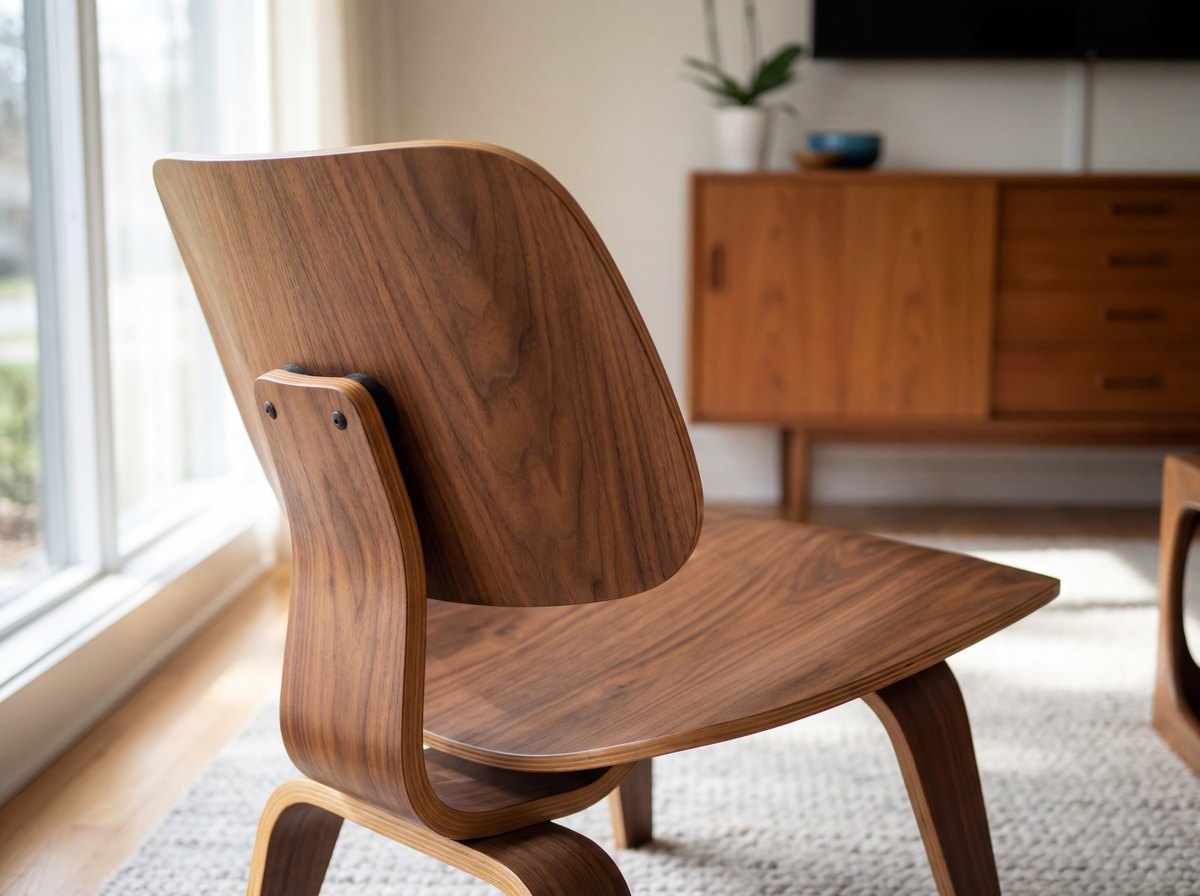
Organic Forms Meet Flat Planes
The MCM signature is a contrast, organic curves set against flat planes.[2] A Tulip table base curves like a stem. A Bertoia chair curves like a basket. An Eames shell curves to the body. Then those organic pieces sit in rooms full of flat planes, the rectangular credenza, the slab coffee table, the flat-front sideboard.
That tension is what makes a room read as mid-century modern rather than just modern. Pure straight lines feel contemporary or minimalist. Pure curves feel retro or space-age. MCM lives in the combination, and it sits low. Mid-century furniture is built closer to the floor than contemporary pieces, with a strong horizontal emphasis. Credenzas hug the ground on tapered legs. Sofas sit low and long. The community vocabulary, low-profile, tapered legs, splayed legs, all describes that horizontal, ground-hugging stance.
How MCM Reached the American Home
The style did not stay in design studios. Herman Miller and Knoll licensed the major designs and put them into American production, which moved MCM out of museums and into living rooms.[3] At the same time, California modernism was building the architecture to match: Eichler homes, the postwar California tracts built with glass walls and open plans, and the Case Study Houses, an architectural program that commissioned experimental modern homes in Los Angeles, gave MCM furniture the indoor-outdoor spaces it was designed for.[3]
Then came the revival. The 2010s brought MCM back hard, and that is both why the style is everywhere and why it now carries a reputation problem. The look got so popular that it became a template, the walnut-and-teal combination you can assemble from one catalogue order. That saturation is why the hard part of mid-century modern today is not finding the pieces. It is putting them together so the room looks like yours rather than a showroom's.
The Materials That Define the Period
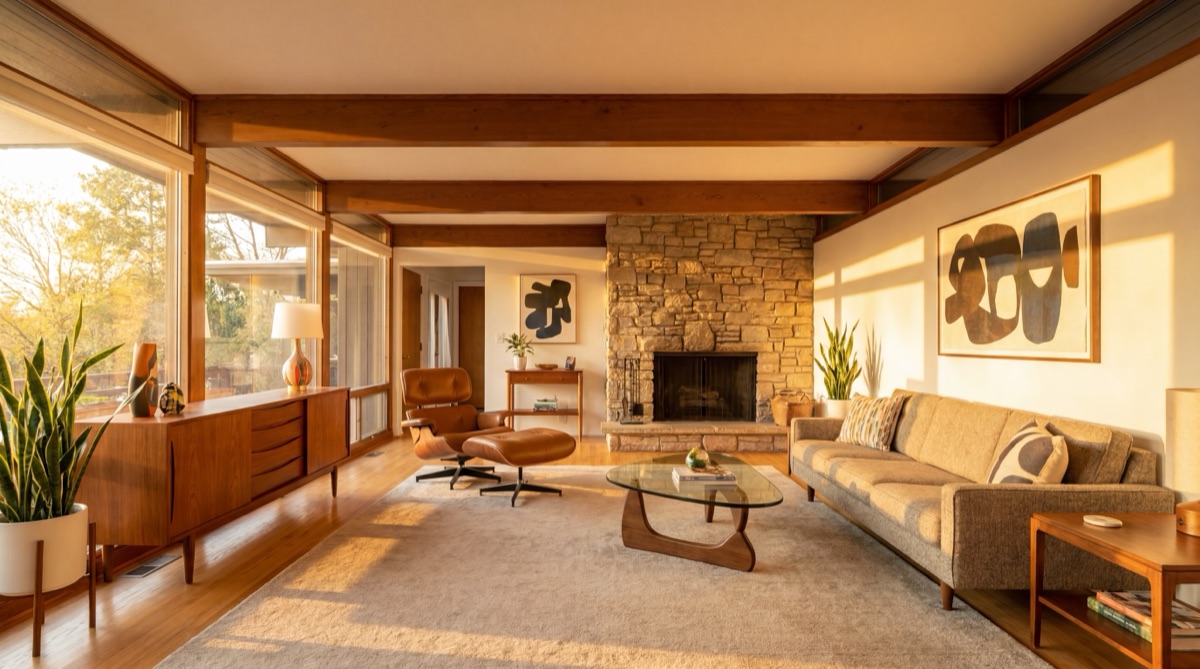
If the designers are the vocabulary, the materials are the grammar. Mid-century modern has a tight material palette, and knowing it is the second half of telling a real MCM piece from one that only borrows the label.[2] The woods are warm and shown honestly, walnut in its natural tone, teak, rosewood, warm oak, never a dark walnut stain and never painted. The grain is visible and part of the appeal. Alongside the wood sit the period's other honest materials, leather, wool, and the molded plywood and fiberglass that new post-war manufacturing made possible.
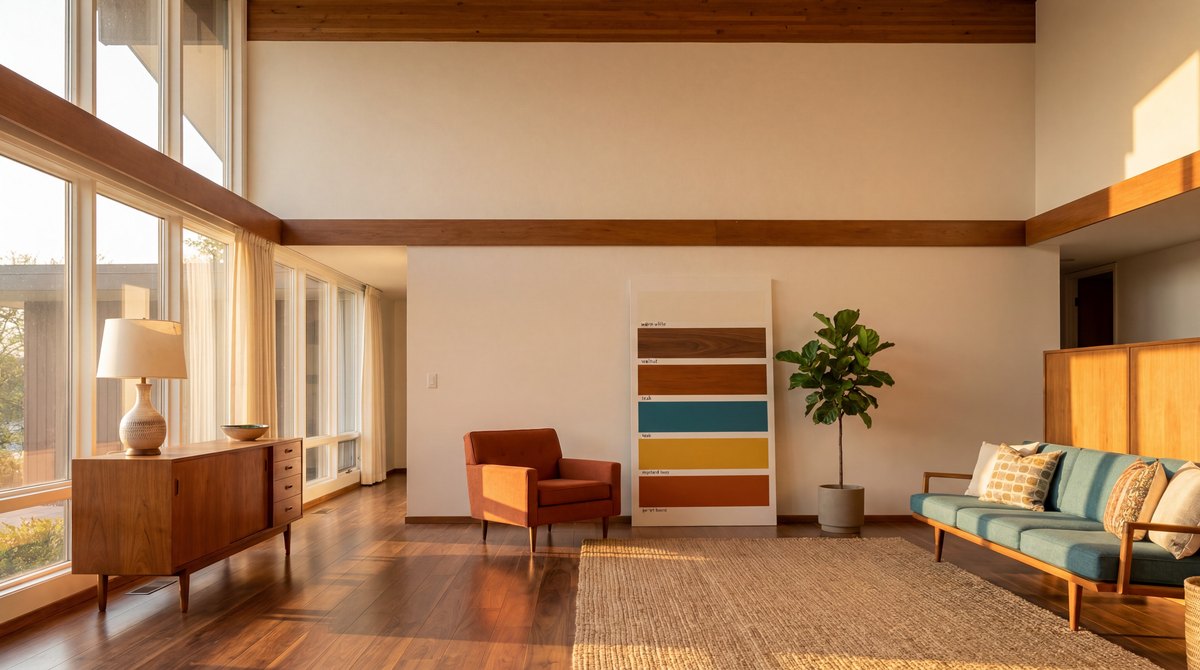
The color logic is just as specific. The foundation runs warm, warm white, warm cream, light wood floor tones, and against that warm base the period uses exactly one bold accent done genuinely boldly. The three classic MCM accents are teal, mustard yellow, and burnt orange, and the rule is one, not a mix. A room that uses warm neutrals plus a single confident accent is speaking the period's color language. A room that is cool and gray, or one that scatters several accents, is not, regardless of what the furniture looks like.
Danish Modern and the Style's Close Relatives
Mid-century modern did not develop in isolation, and r/InteriorDesign threads constantly place it next to its neighbors. Danish Modern is the Scandinavian branch of the same movement, Hans Wegner's Wishbone and Papa Bear chairs belong to it, and it shares MCM's warm wood and clean lines while leaning a little lighter and more restrained. Knowing that relationship explains why MCM blends so naturally with Scandinavian and with Japandi, the Japanese-Scandinavian hybrid, both share the warm wood and the low, honest profile.
The useful distinction for a beginner is between MCM and the broader words it gets confused with. Modern is the wide movement MCM grew out of. Contemporary just means current. Retro is a loose nostalgia term that sweeps in the 1970s and 1980s, which is why MCM enthusiasts avoid it. Mid-century modern is the narrow, dated, named thing in the middle of all that, 1945 to 1969, specific designers, specific materials. Place it correctly among its relatives and the label stops being vague.
Why the History Still Matters
Knowing the period is not trivia, it is a buying tool. Once you know MCM is 1945 to 1969, you can look at any piece and ask whether it references the period honestly or just borrows the word for marketing. Warm wood with visible grain, tapered or splayed legs, low profile, organic-meets-flat, one bold accent color, that is the period vocabulary. A high-gloss sideboard on a chrome base is selling you the label, not the style. The history is the filter.
See Also: More Mid-Century Modern Guides
- the mid-century modern color palette breakdown
- authentic vs. replica mid-century modern home decor
- The complete Mid-Century Modern guide
Where to Go Next
Nineteen forty-five to 1969, a handful of named designers, and one idea: that a functional object could also be beautiful. The Complete Mid-Century Modern Interior Design Guide covers the whole style room by room, including the palette, the furniture and the room-by-room layouts.
Sources.
- [1] architecturaldigest.com: What Is Mid-Century Modern Design?
- [2] thespruce.com: Mid-Century Modern Style: A Complete Guide
- [3] dwell.com: Mid-Century Modern Homes: Everything You Need to Know
Frequently asked
What years are considered mid-century modern?
Mid-century modern covers roughly 1945 to 1969, the two decades after the Second World War. Furniture sold today as MCM references that period rather than belonging to it.
Who started mid-century modern design?
No single person. The style was built by a group of post-war designers including Charles and Ray Eames, Eero Saarinen, Harry Bertoia, Florence Knoll, and Hans Wegner, supported by manufacturers like Herman Miller and Knoll.
Is mid-century modern the same as modern?
No. Modern is a broad movement, and contemporary means whatever is current. Mid-century modern is a fixed historical period, 1945 to 1969, with a specific vocabulary of warm wood, organic forms, and low profiles.
Why is it called mid-century modern?
Because it falls in the middle of the twentieth century and grew out of the modernist design movement. The term was popularized later, in the mid-1980s, to describe that specific window.
What is the difference between mid-century modern and retro?
Retro is a loose nostalgia term that often includes the 1970s and 1980s. Mid-century modern enthusiasts avoid retro because it blurs the period and reads as kitsch. MCM is 1945 to 1969, no later.
There are 15 more Mid-Century Modern guides.
This is one room of the set. The pillar links to all of them, and new guides go out by email first.
Read the Mid-Century Modern guide