Table of Contents
The 12 Essential Mid-Century Modern Pieces
These 12 archetypes cover almost every mid-century modern room. You do not need all 12, you need the right four or five for the space you have.
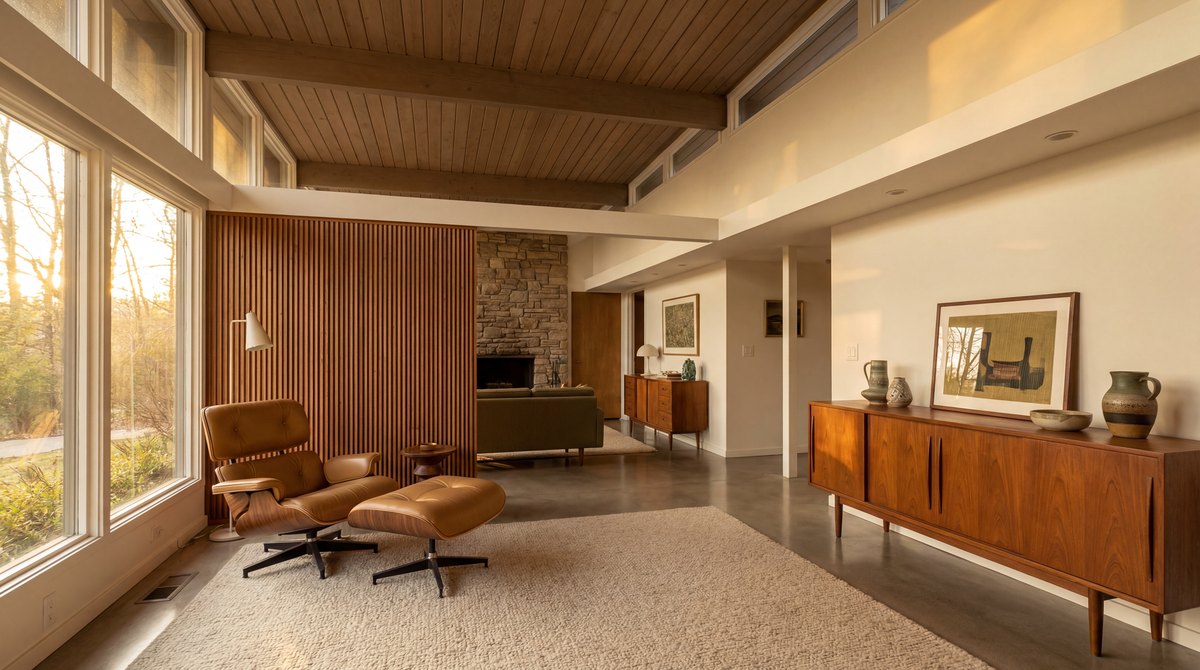
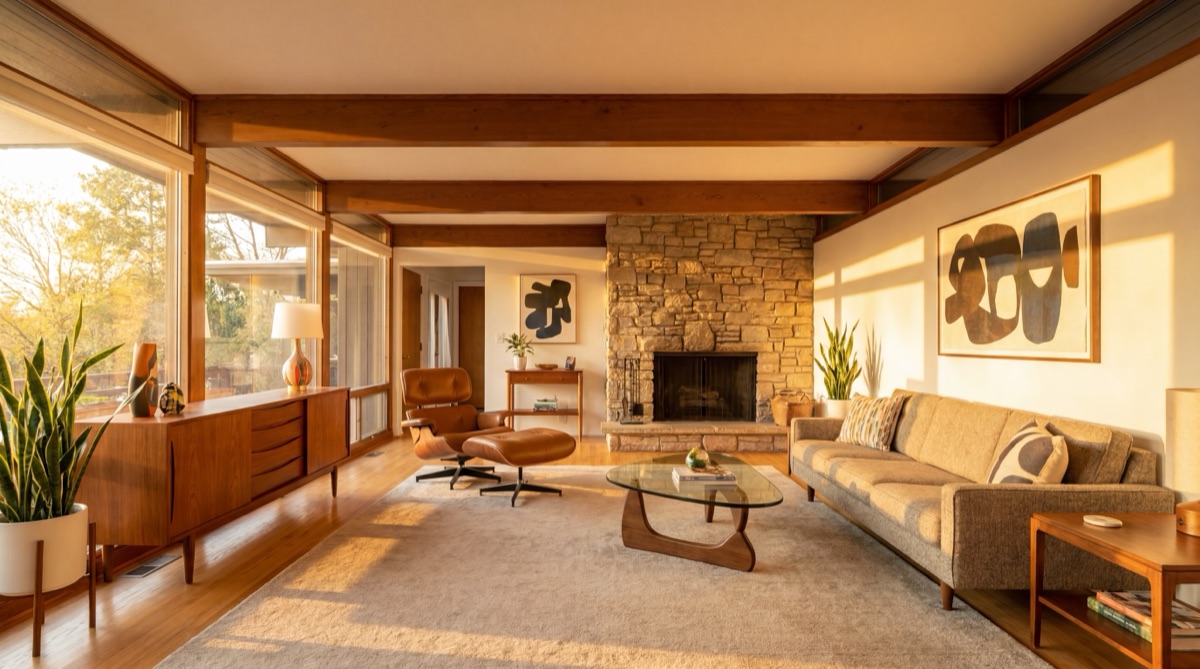
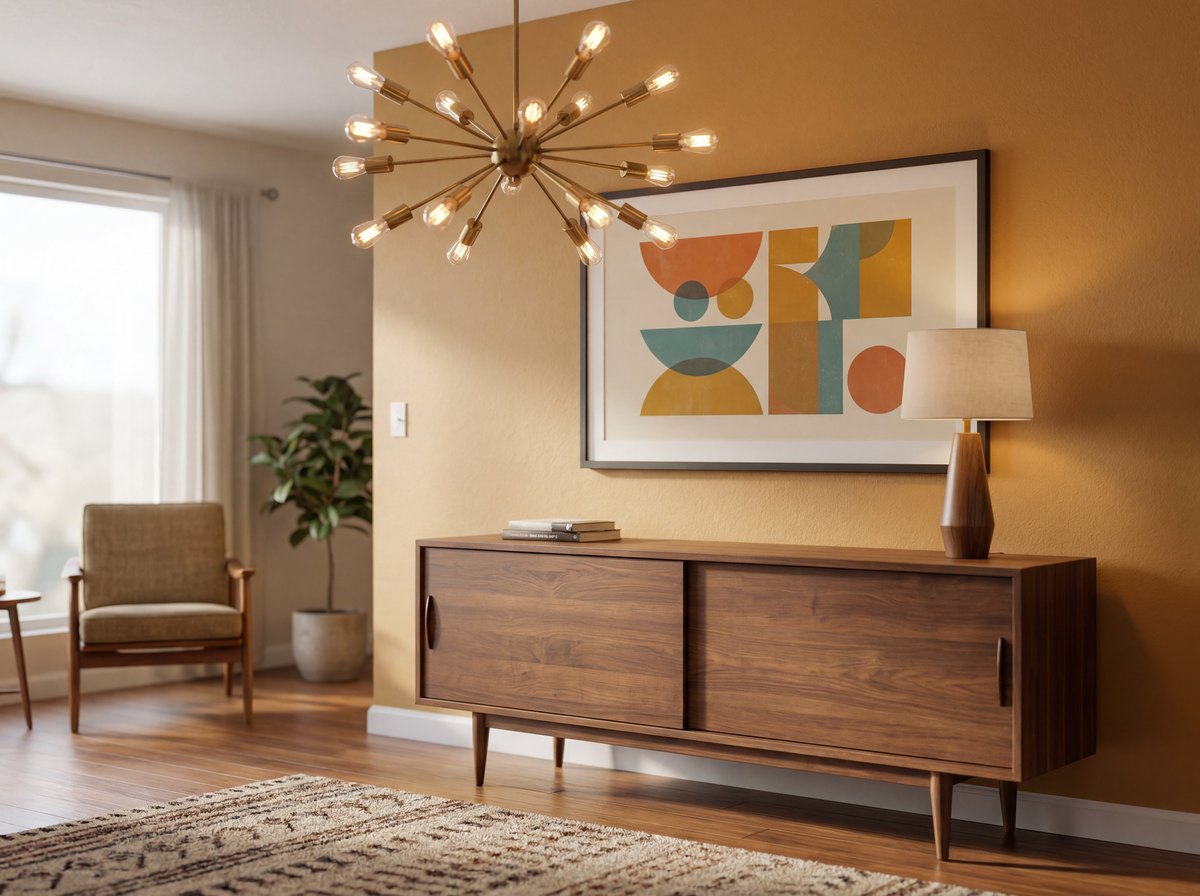
- Walnut credenza or sideboard on tapered legs. The single most important MCM piece. Low, horizontal, warm grain.
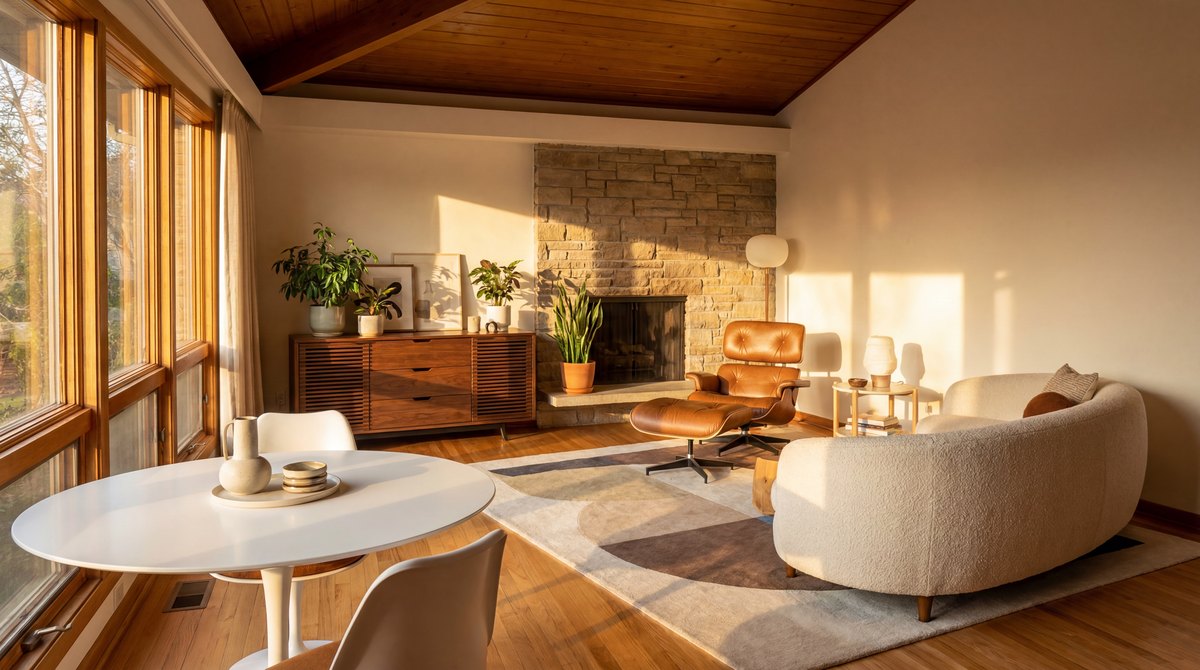
- Eames-style lounge chair and ottoman. The icon. Molded plywood shell, leather cushions, the most recognizable object in the style.[1]
- Low-profile sofa on tapered wood legs. Sits low and long. Visible wooden legs are the MCM tell.
- Tulip-base dining table. Eero Saarinen's single-pedestal table that clears the clutter of legs underneath.[1]
- Shell or molded dining chairs. Fiberglass or plywood, organic curve to the body.
- Sputnik chandelier or Nelson bubble pendant. One sculptural lighting statement per room.
- Tapered-leg dining table in light ash or walnut. The everyday alternative to the Tulip.
- Wire chair. The Bertoia Diamond, a sculptural seat made of welded steel wire.[1]
- Hairpin-leg coffee table or console. Walnut top, slim splayed metal legs.
- Arc floor lamp. The Arco-style sweeping arc, sculptural lighting that doubles as architecture.
- Low platform bed. Tapered legs or a floating frame, horizontal emphasis.
- Graphic wall art. One large-scale geometric or abstract mid-century print, not a gallery wall.
The Three Sourcing Tiers
The mid-century modern community sorts furniture into three clear tiers, and knowing them is how you build a room without overspending or buying junk.[2]
Authentic tier, roughly $2,000 to $7,000 per piece. Herman Miller for the Eames pieces, Knoll for Bertoia and Saarinen, Fritz Hansen for the Egg and Swan. These are US-licensed or Danish-licensed originals.[2]
Quality replica tier, roughly $200 to $800 per piece. Article, the Canadian direct-to-consumer brand r/InteriorDesign most often recommends. Castlery, a frequent forum recommendation. Kardiel, a dedicated MCM replica brand. This is where most people actually shop.[2]
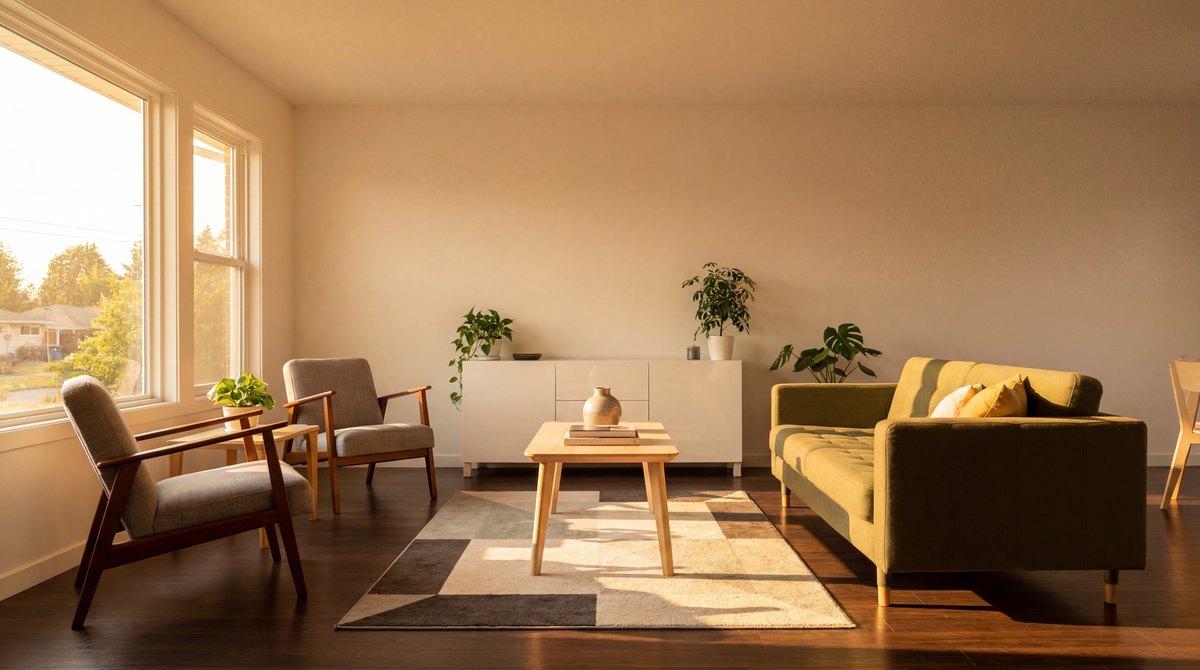
Budget tier, roughly $50 to $200 per piece. The IKEA STOCKHOLM sofa is a community-respected MCM stand-in. The IKEA LISABO table has tapered legs and lands around $180. Amazon's Rivet line sits at the top of this tier and reviews unevenly, so check the specific piece rather than trusting the label.[2]
The tiers are not a ladder you have to climb. The smart approach is to assign each piece to the tier that fits its job. A dining table takes daily abuse and has simple construction, so a budget LISABO is a genuinely good buy. An Eames-style lounge chair has a complex molded shell and a reclining mechanism, so the budget version is the one that fails, this is the piece to push up a tier or two. A credenza sits between, a budget BESTÅ fitted with solid-wood doors on tapered legs reads as quality, while a budget credenza with laminate doors and particleboard legs does not. Match the tier to the piece, not the whole room to one tier.
How to Avoid the Showroom Look
The showroom effect comes from buying too much at once from one source. Three fixes break it.
Mix the tiers. One authentic or quality-replica anchor piece, the rest budget, with a vintage find or two mixed in. A room where everything came from the same catalogue at the same time always looks staged.
Vary the wood tones. All walnut and no variation is the single most common regret in these threads. Let a teak piece, a lighter ash piece, or a vintage rosewood find break up the matched-set effect.
Introduce pieces over time. The community advice is consistent: add each element separately, with personal objects between them, rather than placing a full set on day one.[3] The room earns its layered look.
Scale: The Quiet Furniture Mistake
Mid-century modern furniture is low and has a large footprint, which is exactly why scale trips people up. Authentic MCM sofas sit low and long, and in a small apartment that footprint eats the floor. In a tall-ceilinged loft, the same low sofa looks lost and undersized.
Before buying, measure. A low-profile sofa needs floor space more than it needs wall space. A Tulip table needs clearance around the single base. If the room is small, choose fewer pieces with breathing room rather than the full 12-piece set crammed in. Scale is the difference between a room that looks designed and one that looks packed.
A Starter Set for Each Room
If the 12-piece menu feels like too much, here is the short version by room. A living room needs four core pieces: a low-profile sofa, a walnut credenza, one sculptural chair, and one statement light, usually a sputnik or a bubble pendant. A bedroom needs three: a low platform bed, two matching nightstands, and a pair of ceramic lamps. A dining area needs two: a Tulip or tapered-leg table and a set of shell chairs. A home office needs two: a tapered-leg desk and a molded shell or leather task chair.
That is a whole apartment in eleven pieces. Most come straight off the archetype list; the bedroom and office add a few pieces the list does not name, because no living-room archetype covers a bed or a task chair. The list of twelve is a menu to choose from, not a shopping cart to empty. Start with the four living room pieces, since that is the room MCM does the most work in, then add the others as the budget allows. A room built from four well-chosen archetypes reads more convincingly mid-century than a room crammed with all twelve.
Authentic or Replica: A Piece-by-Piece Decision
The authentic-versus-replica debate is the single most active discussion in the mid-century modern community, and it rarely has one answer.[2] The useful way to settle it is per piece rather than per room, because the gap between an authentic and a replica version is huge for some archetypes and almost nothing for others.
The pieces where authentic is worth the spend are the ones with complex engineering. An Eames-style lounge chair has a multi-layer molded plywood shell, a precise recline, and decades of refinement behind the originals from Herman Miller.[1] A budget lounge knockoff is the piece those threads most often report wobbling or delaminating after a year, which is why it is the classic over-bought-replica regret. The Bertoia wire chair and the Saarinen Tulip base are similar, the licensed Knoll versions hold their geometry and finish in a way cheap copies do not.
The pieces where a replica is genuinely fine are the simple ones. A tapered-leg dining table, a hairpin-leg coffee table, a low platform bed, and most credenzas are straightforward construction, a flat top, four legs, honest joinery. A quality-replica or even budget version of these does the same visual job, and the money saved is better spent pushing the lounge chair up a tier. Buying vintage is a third path that sidesteps the debate entirely, a real 1960s teak credenza found secondhand is often cheaper than a new quality replica and carries the wood-tone variation the showroom look lacks. The disciplined buyer mixes all three, one authentic anchor where engineering matters, replicas for the simple pieces, and a vintage find or two for character.
See Also: More Mid-Century Modern Guides
- authentic vs. replica mid-century modern home decor
- the IKEA and Target mid-century modern sourcing guide
- The complete Mid-Century Modern guide
Shop the Look
The pieces below cover credenza, coffee table, floor lamp, side table and table lamp for a room built from the essential archetypes, and every one is priced and linked, from $90 to $160.
Prices move, and we re-check them whenever this post is updated. These are affiliate links: if you buy through one, Amazon pays us a small commission and you pay the same price you would have anyway.
Where to Go Next
Twelve pieces, three tiers, and one rule: match the tier to the piece, not the whole room to one tier. The Complete Mid-Century Modern Interior Design Guide covers the whole style room by room, including the palette, the room layouts and the budget breakdown.
Sources.
- [1] architecturaldigest.com: What Is Mid-Century Modern Design?
- [2] curatedinterior.com: Authentic vs. Replica Mid-Century Modern Furniture
- [3] apartment therapy: How to Avoid the Mid-Century Modern Airbnb Look
Frequently asked
What furniture is considered mid-century modern?
The core pieces are the walnut credenza, the Eames-style lounge chair, a low-profile sofa on tapered legs, a Tulip or tapered-leg dining table, shell dining chairs, a sputnik or bubble light, a wire chair, a hairpin-leg coffee table, an arc floor lamp, a low platform bed, and one graphic print.
Is mid-century modern furniture expensive?
It spans a wide range. Authentic licensed pieces run roughly $2,000 to $7,000 each, quality replicas run $200 to $800, and budget pieces from IKEA and similar run $50 to $200.
What are the best quality replica mid-century modern brands?
Article, Castlery, and Kardiel are the brands the design community recommends most often for quality replicas in the $200 to $800 range.
Why does my mid-century modern furniture look like a showroom?
Usually because it was all bought at once from one source with no wood-tone variation. Mix the sourcing tiers, vary the wood tones, add a vintage find, and introduce pieces over time.
How many pieces do I need for a mid-century modern room?
Four or five well-chosen pieces are enough for most rooms. The 12 archetypes are a menu, not a checklist. In a small space, fewer pieces with breathing room beats a full set crammed in.
There are 15 more Mid-Century Modern guides.
This is one room of the set. The pillar links to all of them, and new guides go out by email first.
Read the Mid-Century Modern guide