Table of Contents
The Tree: Slim, Sculptural, or Atomic
The mid-century modern Christmas tree is not a wide traditional fir. It is one of three directions.
The slim modern tree. A narrow profile that keeps the floor space MCM rooms value, and reads clean rather than fussy.
The atomic or aluminum tree. The genuine period piece, a silver aluminum tree, sometimes paired with a color wheel light. It is the most authentically mid-century holiday object there is, and a real vintage one is a find.
The sculptural alternative tree. A wood dowel tree, a wall-mounted tree shape, or a tabletop sculptural tree for small apartments. These lean into the MCM love of sculptural form.
Whichever you choose, keep it restrained. An MCM tree is sparse on purpose: fewer ornaments, more visible branch. The kit further down uses the slim or sculptural tree rather than the aluminum one, because an authentic aluminum tree is a vintage hunt rather than something you can order this week, and the prices swing with what turns up.
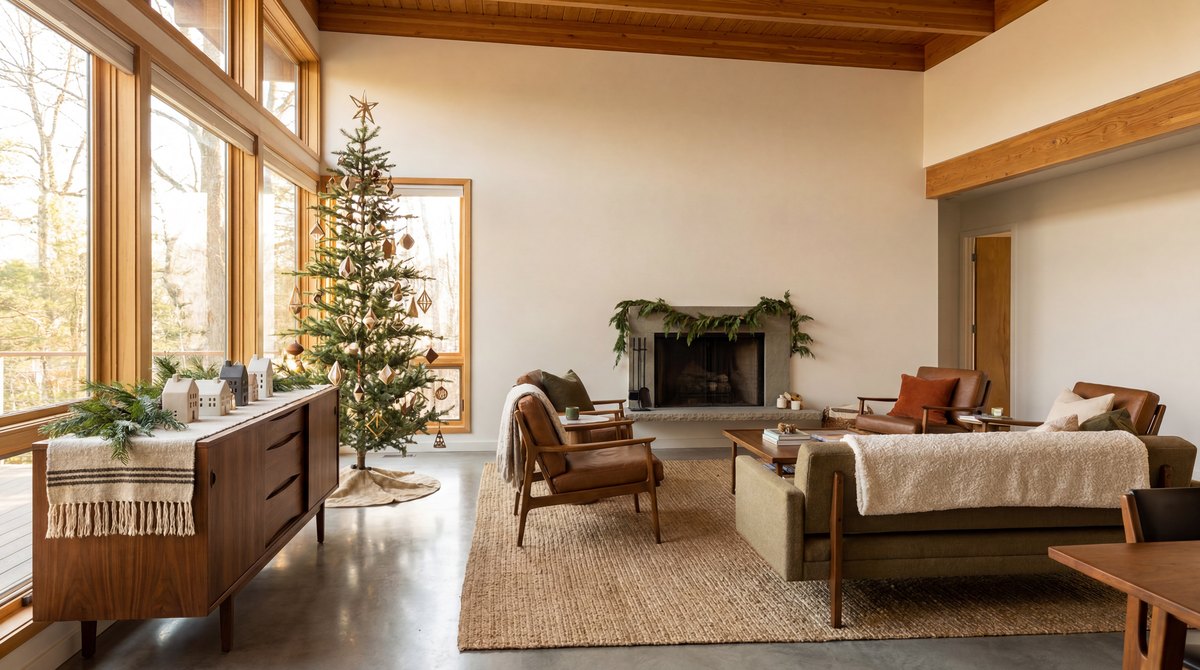
Tree placement matters as much as tree choice in an MCM room. The tree should sit where it does not break the room's low horizontal line or block the credenza, the sofa, or the statement light, ideally in a corner that was already a little empty. A slim tree on a simple wood or hairpin-leg stand reads intentional. A wide tree dropped in front of the main furniture grouping turns the whole room into a holiday set for a month, which is exactly the takeover the style wants to avoid.
The Warm Holiday Palette
The mistake with MCM Christmas decor is defaulting to standard red and green, which fights the warm MCM palette. The fix is to pull the holiday colors into the existing scheme.[1]
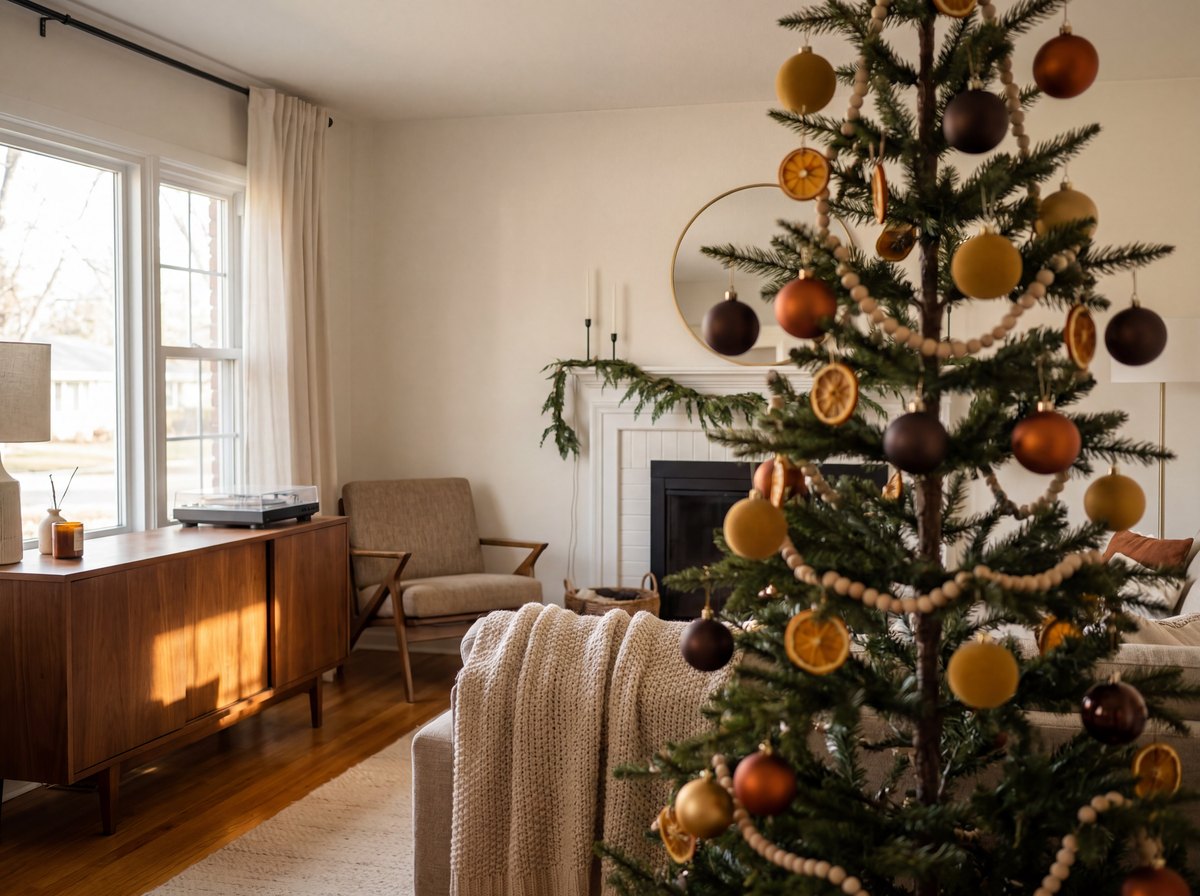
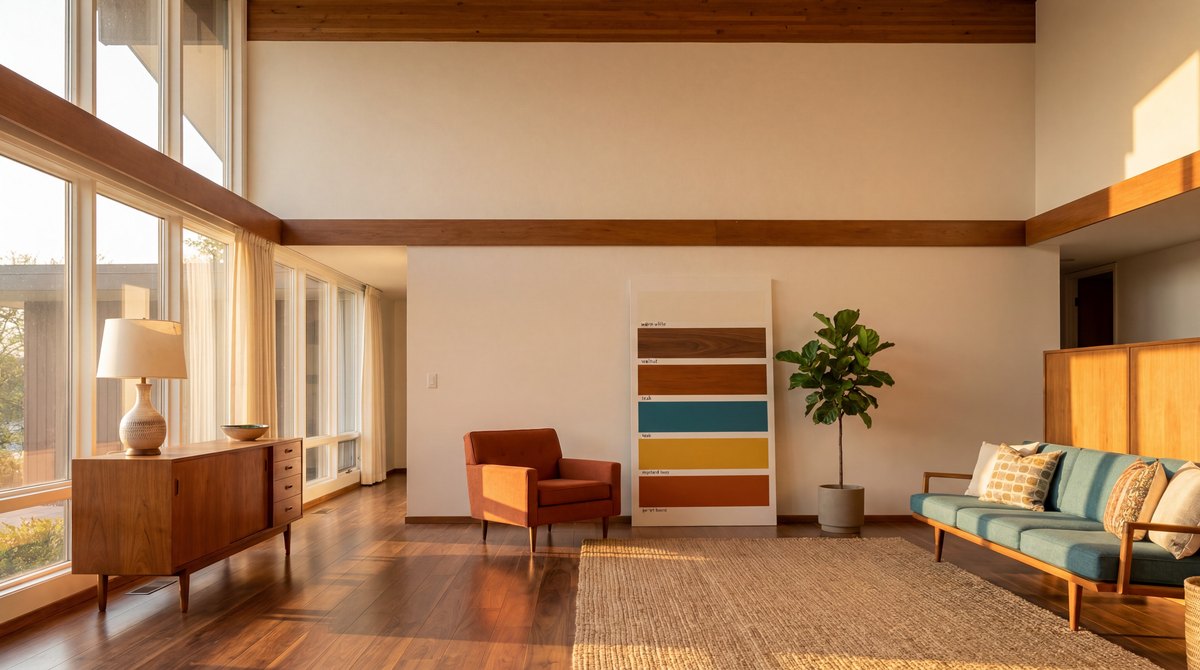
Stay with the MCM accent colors: mustard, burnt orange, teal. Mustard, burnt orange, and teal all work as holiday colors and stay on-period. Warm metallics, brass and copper rather than cool silver, carry the festive shine without going cold. A muted, warmer red is fine as the one bold accent if you want a traditional nod, but skip the bright primary red-and-green pairing. The holiday palette should look like your MCM room got dressed up, not like a different room moved in for December.
Sculptural Ornaments and Lighting
MCM ornaments are about shape, not sparkle. Look for geometric and atomic shapes, starbursts, simple spheres, wood and felt ornaments, and clean glass forms in the warm accent colors. Skip the novelty ornaments and the heavy glitter, the restraint that governs mid-century modern year-round governs the tree too.
Lighting stays warm. Warm-white string lights, never cool blue-white. A color wheel light is the one playful exception, because it is a genuine period piece. If the room has a sputnik or bubble fixture, it does not need holiday additions, it is already the sculptural lighting moment. The credenza is the best holiday surface in an MCM room. A low garland in warm greenery, a few sculptural ornaments and one warm-metal object carry the season without cluttering it.
Greenery, used carefully, is the most period-friendly holiday material. Real or faux evergreen in a clean, low arrangement reads warm and natural, which suits the style, where heavy tinsel and flocking do not. Keep the greenery to one or two placements, the credenza and maybe the dining table, rather than running it along every surface. A simple bundle of greenery in a ceramic vessel is as much as an MCM room usually needs, and it leans on the style's existing love of bringing natural material indoors.
Keeping the Holiday Layer On-Period
The principle for MCM Christmas decor is that it is a layer, not a takeover. The room underneath stays the room. The walnut credenza, the low sofa, the one statement light, the warm palette, all of it stays visible, and the holiday decor sits lightly on top.
The test is simple: if you removed every holiday item, the MCM room should still be intact and uncluttered underneath. If the holiday layer required moving furniture out, covering surfaces completely, or hiding the MCM pieces, it went too far. The best MCM holiday rooms look like the same well-edited space with a slim tree, a warm-toned garland on the credenza, and a handful of sculptural ornaments. Restraint is the through-line of the whole style, and the holidays are no exception.
Storing and Reusing the Holiday Layer
One practical advantage of doing MCM Christmas decor this way is that a small, well-chosen holiday layer is easy to store and easy to reuse. A slim tree, one set of sculptural ornaments in your accent colors, a warm garland, and a string of warm-white lights fit in a single bin and come back out every year looking intentional, because they were chosen to match the room rather than bought as a seasonal impulse.
This is also the budget argument for restraint. A loaded, maximalist holiday display costs more every year as it grows, and most of it does not coordinate. A tight MCM holiday kit is bought once, in colors that already live in the room, and it improves with reuse because you are not constantly adding mismatched pieces. Buy a few sculptural, warm-toned, genuinely mid-century holiday objects, store them together, and the MCM Christmas room becomes a fifteen-minute setup that looks designed rather than decorated-over.
A Worked MCM Holiday Kit
It helps to see the restrained holiday layer as a real, finite shopping list rather than an open-ended seasonal budget. Here is one version of an MCM Christmas kit that fits in a single storage bin and sets up in about fifteen minutes.
| Item | Choice | Approx. Cost |
|---|---|---|
| Tree | Slim modern tree or tabletop sculptural tree | $90 |
| Ornaments | One set of geometric and atomic shapes in mustard, burnt orange, and teal | $40 |
| Lights | Warm-white string lights, 2700K | $20 |
| Garland | Real or faux evergreen, low and clean, for the credenza | $25 |
| Accent object | One warm-metal sculptural piece, brass or copper | $30 |
That is a complete, on-period holiday layer for roughly $205, bought once. Because every color in the kit already lives in the room, nothing clashes and nothing has to be replaced next year. The atomic aluminum tree is the one upgrade worth saving for, a genuine vintage one runs higher and is harder to find, but it becomes the centerpiece for a decade. Everything else on this list is the kind of piece that improves with reuse rather than dating.
Three Things to Settle Before December
Three questions are worth settling before any of the shopping starts, because each one changes what you buy.
Can a real fir tree work in an MCM room? Yes, as long as it is on the slimmer side and placed where it does not block the credenza or the main furniture grouping. The tree shape is less important than the restraint of what goes on it. A narrow real tree with sculptural ornaments reads MCM. A wide, heavily flocked one does not.
Is colored tinsel ever right? Generally no. Heavy tinsel and flocking fight the clean, sculptural quality of the style. The one playful period exception is a rotating color wheel light aimed at a silver aluminum tree, which is genuinely mid-century. Everything else stays restrained.
What if the room already has a sputnik or bubble light? Leave it alone. The existing sculptural fixture is already the lighting moment, and adding holiday elements to it crowds the one piece that is doing the most work. Let it carry the room and keep the holiday layer on the credenza and the tree.
See Also: More Mid-Century Modern Guides
- mid-century modern living room ideas for real apartments
- the mid-century modern color palette breakdown
- The complete Mid-Century Modern guide
Where to Go Next
The whole holiday layer comes down to one thing: decorate the room you already have, in the colors it already uses, and put it all back in one bin in January. The Complete Mid-Century Modern Interior Design Guide covers the whole style room by room, including the living room and the palette.
Sources.
- [1] housebeautiful.com: Mid-Century Modern Room Ideas
Frequently asked
What does mid-century modern Christmas decor look like?
A slim, sculptural, or atomic aluminum tree, ornaments in geometric and atomic shapes, the warm MCM accent palette of mustard, burnt orange, and teal, warm metallics, and warm-white lights, layered lightly over the existing room.
What kind of tree is mid-century modern?
Three options: a slim modern tree, a silver atomic aluminum tree (the genuine period piece, sometimes with a color wheel light), or a sculptural alternative like a wood dowel or wall-mounted tree for small spaces.
What colors are mid-century modern Christmas decor?
The existing MCM accents, mustard, burnt orange, and teal, plus warm metallics like brass and copper. A muted warmer red works as a single accent. Skip bright primary red-and-green, which fights the warm MCM palette.
How do I decorate a mid-century modern room for the holidays?
Treat the holiday decor as a light layer, not a takeover. Keep the walnut credenza, low sofa, and warm palette visible, add a slim tree, a warm garland on the credenza, and a few sculptural ornaments.
What is an atomic Christmas tree?
A silver aluminum tree from the mid-century period, often displayed with a rotating color wheel light. It is the most authentically mid-century holiday object, and a genuine vintage one is a sought-after find.
There are 15 more Mid-Century Modern guides.
This is one room of the set. The pillar links to all of them, and new guides go out by email first.
Read the Mid-Century Modern guide