Table of Contents
The Sun-Aged Standard.
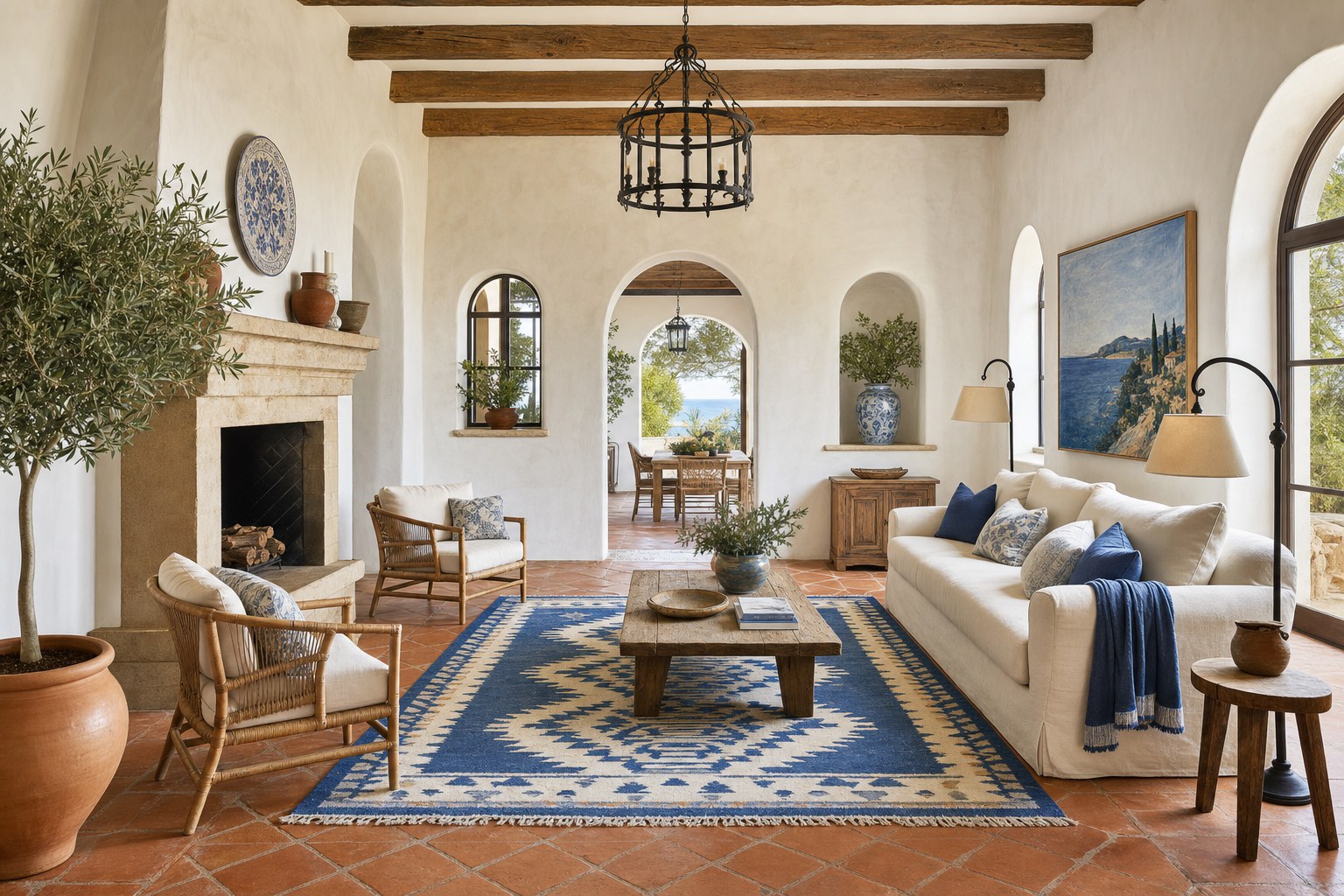
Mediterranean interior design covers more ground than any other style name in residential design. It includes: Ibiza minimalist (limewashed white walls, curved niches, minimal decor), Tuscan ornate (heavy dark wood, rich textile pattern, stone floor), Greek island (white plaster + cobalt blue tilework), Spanish Colonial (Saltillo tile, Talavera accent, mission arch), and the California/Florida builder version that goes wrong. These sub-styles share terracotta and the arch. Everything else diverges.
The most important step in a Mediterranean interior is deciding which Mediterranean you are building before buying anything. Mixing Ibiza and Tuscan in the same room is the fastest path to the "vacation rental" failure mode. The five elements below work across all sub-styles. The Sun-Aged Standard is universal: every purchase should look better - more settled, more worn, more handcrafted - in 10 years than the day it was installed. That test eliminates faux-stucco, machine-made "kilim," vinyl "terracotta," and chrome masquerading as wrought iron.
The goal is "the sunburnt charm of the Mediterranean without excessive baroque complexity." That restraint - sunburnt charm at the material level, not the souvenir level - is the operating principle. Five elements. Every item chosen for longevity. Every item linked and priced.
The Arch-Accessible Form · $129.96
The arch is the single most-requested Mediterranean element in design community threads, and it has the most restrictive access barrier: you cannot add a structural arch without wall modification. This creates the defining renter's problem for Mediterranean design. Arched mirrors solve it completely. An arched rattan, wood, or brass mirror placed on a blank wall reads as architectural. The arch registers to the eye as a form language, not a decorative object. This is the principle Oak & Olive's design team identifies when listing "arched brass mirrors" as the primary recommendation for renter-accessible Mediterranean execution. The arch vocabulary extends: arched headboard (frames the bed as an alcove), arched doorframe insert (under $80 on Amazon), arched peel-and-stick wallpaper panel (trompe l'oeil, fully reversible). For owners: the 2025/2026 direction per Courtyard Modern is simplified arched forms achieved through modern fabrication - rounded niches, barrel-vault doorways, curved plaster-finished window surrounds.
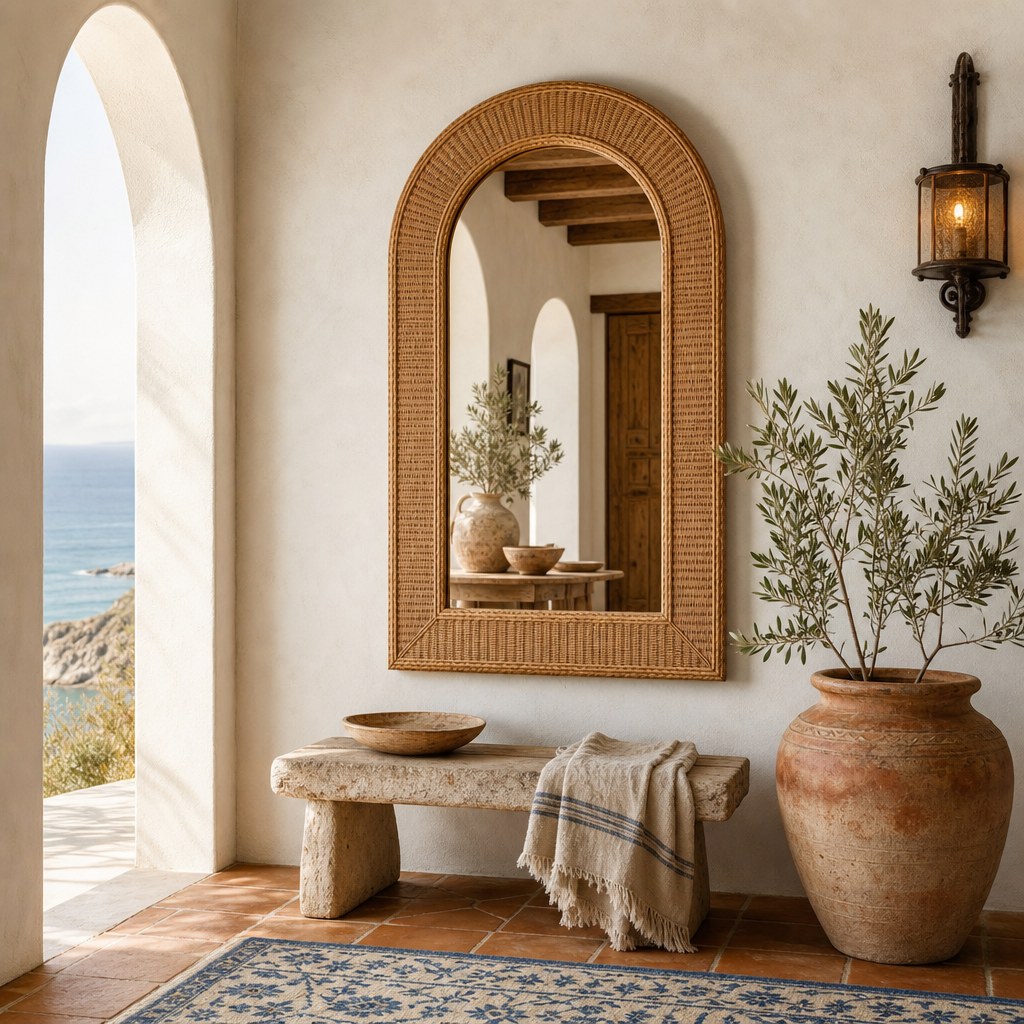
E1 Receipt - The Arch-Accessible Form
The Terracotta Surface · $89.96
Terracotta is Mediterranean's signature material. It differentiates the style from coastal (seagrass, linen, driftwood), Scandinavian (white oak, wool, matte black), and Japandi (ceramic, bamboo, natural void). Every credentialed source in this guide lists terracotta as a non-negotiable Mediterranean material - Katherine Mueller Design places it first in the material hierarchy, Little Greene dedicates a full color section to its warm rust palette, and Oak & Olive specifies "clay vases" and "terracotta pots" as the renter-accessible terracotta moment. The Sun-Aged Standard test for terracotta: real terracotta (floor tile, backsplash tile, pottery) weathers and develops a warmer surface tone over time. Ceramic tile labeled "terracotta look" does not - it looks the same in 10 years as it looks today, which is to say, faintly fake. The 2025 trend updates the terracotta standard: muted terracotta (closer to clay-brown than orange) replacing bold orange. If your terracotta reads orange, it's trending toward the failure mode. If it reads clay-brown, it's current.
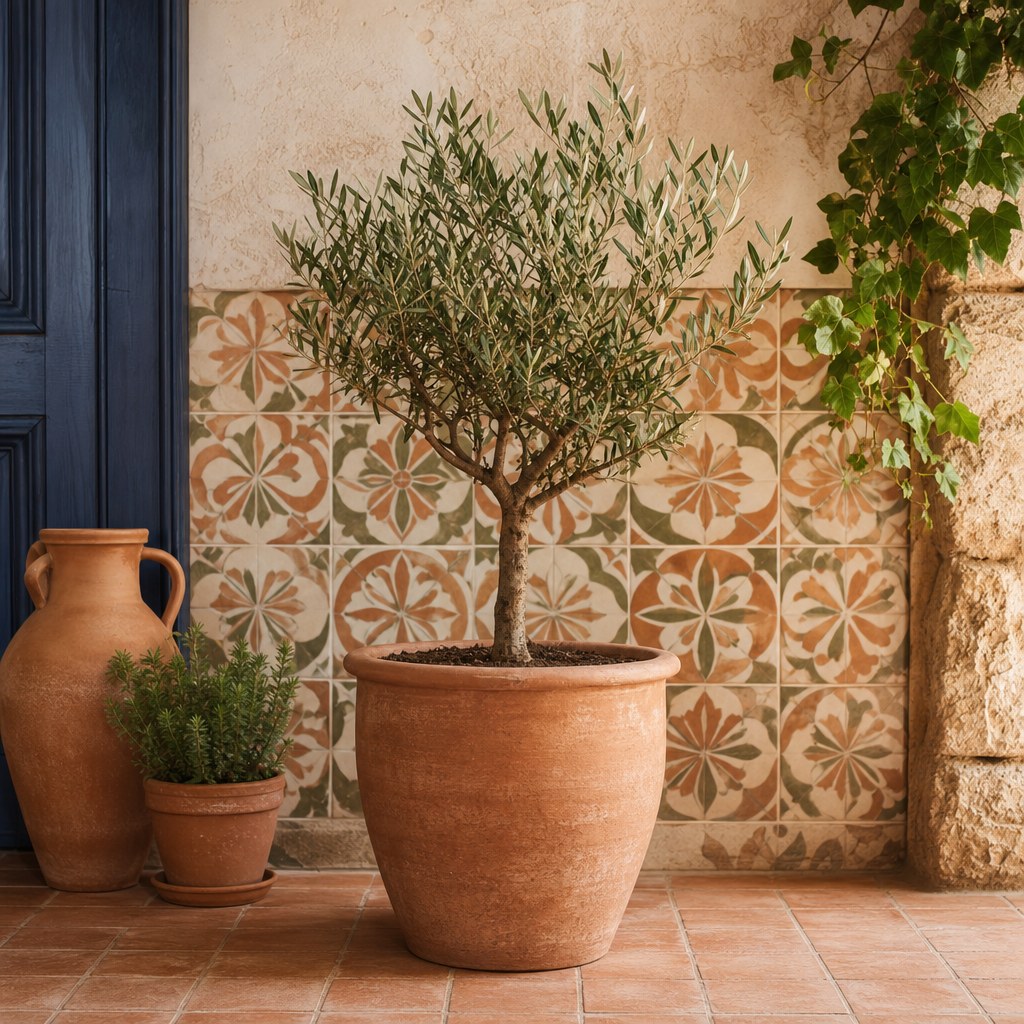
E2 Receipt - The Terracotta Surface
The Handwoven Floor Layer · $219.92
The Mediterranean floor layer is different from every adjacent style's rug. Coastal uses seagrass or jute. Scandinavian uses flat-woven wool. Bohemian uses vintage Persian. Mediterranean specifically uses the kilim (a flat-woven geometric-pattern rug from Turkey, Greece, or North Africa) or the Beni Ourain / Moroccan pile rug - both natural-fiber, hand-knotted, with pattern variation that machine-made cannot achieve. Oak & Olive specifically recommends "berber/handwoven rugs in neutral tones" for the Mediterranean floor layer. The key word is handwoven - the slight variation in pattern and color that comes from a human hand is the Sun-Aged Standard signal. A machine-made kilim-pattern rug with perfectly uniform pattern registers as a print; a handwoven kilim with slightly irregular geometry reads as the real thing. Color guidance: kilim colors for Mediterranean should stay within the warm earth range - terracotta, camel, ochre, cream, muted red - with geometric pattern, not organic.
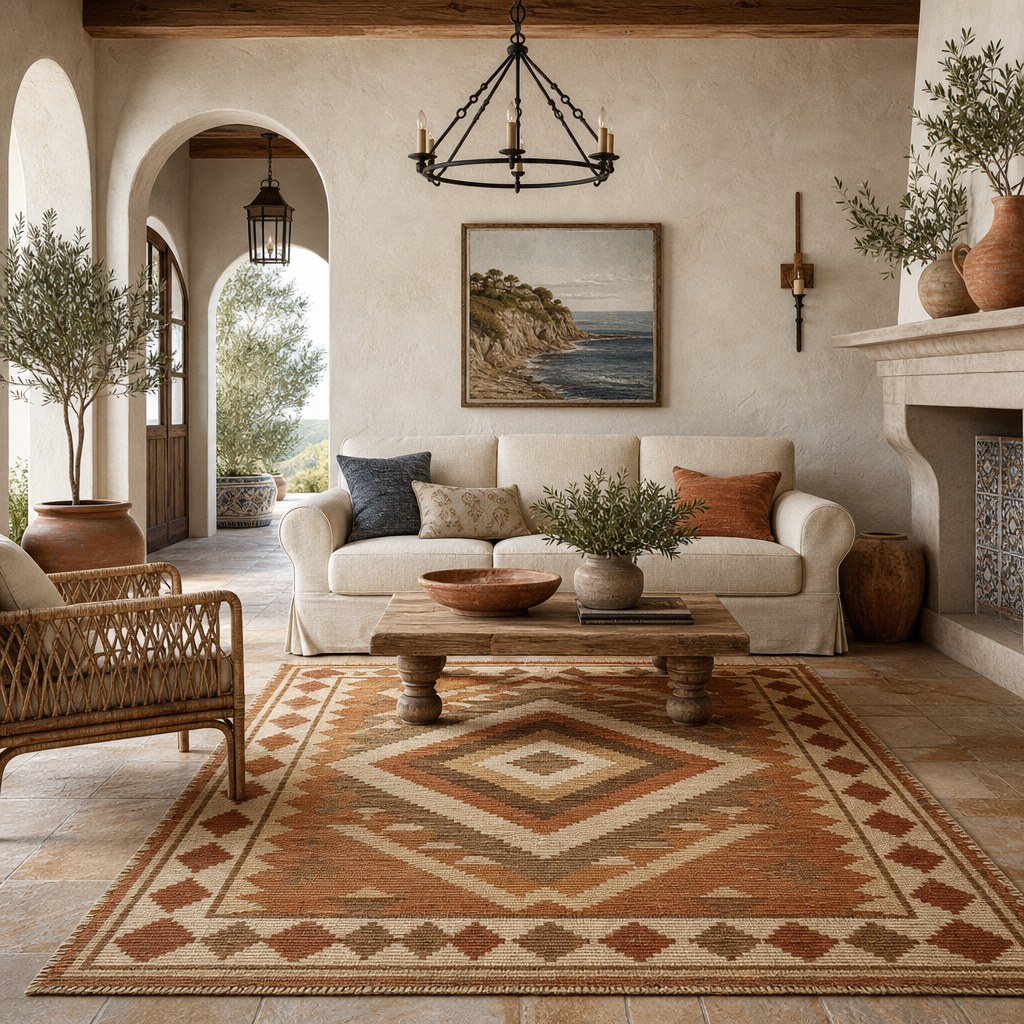
E3 Receipt - The Handwoven Floor Layer
The Forged Metal Lighting · $134.88
Mediterranean lighting is metal - wrought iron, forged steel, hammered copper, or aged brass - not chrome, not polished nickel. The material distinction matters because forged metal oxidizes over time, developing a warmer, darker surface that reads as aged. Katherine Mueller Design identifies wrought iron accents as core Mediterranean architectural hardware. Oak & Olive recommends "rattan pendant lighting" as the alternative for the Ibiza/modern Mediterranean sub-style, where the rattan-woven pendant reads as natural texture rather than ornate metalwork. For the traditional/Tuscan sub-style, a forged iron multi-arm chandelier or lantern pendant is the correct form. Bulb specification: warm white LED (2700K), Edison-style glass. The warm color temperature is the indoor-outdoor-light alignment Mediterranean design requires - cool white (4000K+) reads as office, not villa.
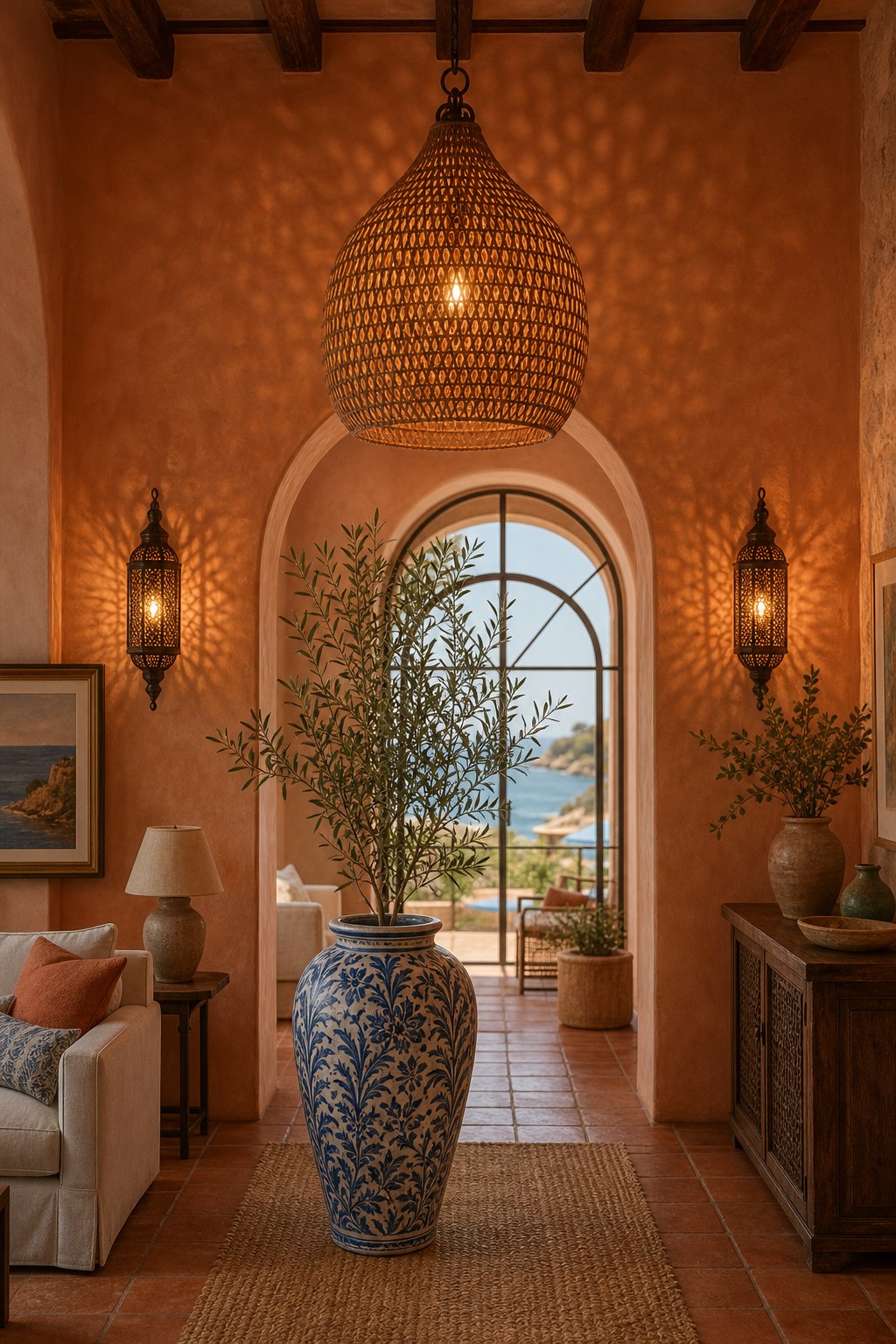
E4 Receipt - The Forged Metal Lighting
The Mediterranean Living Layer · $143.86
The indoor-outdoor connection is not optional in Mediterranean design. Every credentialed source in this guide identifies it as a core principle. For apartments and northern-climate homes without a courtyard, the indoor-outdoor connection is established through plants - specifically Mediterranean plants that reference the region's landscape by species, not just by pot material. An olive tree (Olea europaea) in a terracotta pot is the single strongest Mediterranean living element available for interior use. It is geographically specific (olive trees are a defining element of Mediterranean landscape), texturally correct (gnarled wood trunk, silver-grey leaves), and long-lived as an indoor plant in bright light. BY Design And Viz specifically recommends "Mediterranean plants in terracotta pots" as one of five implementation principles. Alternatives: rosemary (native to the Mediterranean basin, fragrant, sculptural when aged), fig tree (Ficus carica - architecturally bold), lavender (Provence lavender in terracotta), and Bay laurel. All should be planted in actual unglazed terracotta pots - the unglazed terracotta breathes and produces the characteristic white mineral salt efflorescence on the pot exterior that is a visual signature of authentic Mediterranean.
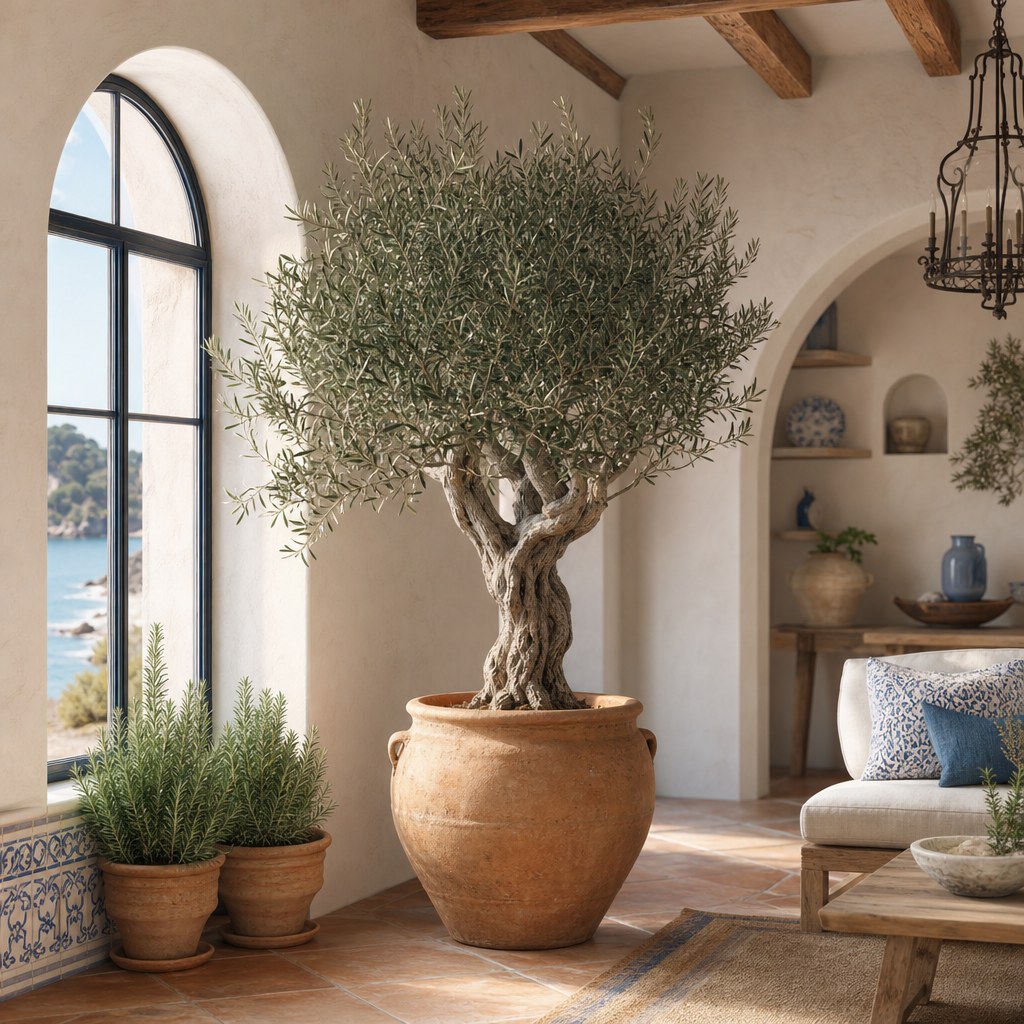
E5 Receipt - The Mediterranean Living Layer
More rooms like this
No spam. Unsubscribe anytime.
Mediterranean vs. Tuscan.
Tuscan is the most commonly confused adjacent style. Both use terracotta and arches. Everything else diverges significantly. The distinction is the reference environment and the resulting material and color decisions.
| Dimension | Mediterranean (Modern/Ibiza) | Tuscan (Traditional) |
|---|---|---|
| Wall treatment | Limewash, smooth plaster, whitewashed | Warm sienna plaster, rough stucco, fresco |
| Primary wood tone | Light or raw, olive, whitewashed oak | Dark and heavy, walnut, chestnut, aged oak |
| Textile pattern | Minimal, solid linen, simple geometric kilim | Rich, damask, brocade, embroidered linen |
| Metal hardware | Aged brass, minimal forged iron | Heavy wrought iron, ornate ironwork |
| Color palette | Cream, limewash white, muted terracotta, olive | Warm sienna, ochre, deep red, dark green |
| Furniture silhouette | Low, curved, linen-upholstered | Heavy, carved, leather or tapestry |
| Failure mode | Ibiza + Tuscan mix = vacation rental | Over-ornamented = Italian restaurant |
Frequently asked questions.
What is Mediterranean interior design?
Mediterranean interior design is a residential style rooted in the architecture, materials, and climate logic of the countries bordering the Mediterranean Sea - Spain, Italy, Greece, Morocco, and their California and Florida interpretations. Its defining character is material permanence: terracotta, plaster, handwoven textiles, and forged iron are chosen because they improve with age. Every credentialed source identifies the same core principles: maximum natural light, textured walls (plaster or limewash), terracotta surfaces, arched or curved forms, and indoor-outdoor flow. The most common failure mode is the 1990s California McMansion version: orange barrel tile, faux-stucco, builder-grade aluminum. The anti-McMansion protocol: real terracotta or none, real plaster or none, real wrought iron or none.
What colors are used in Mediterranean interior design?
Mediterranean operates on a foundation-plus-accent system. The foundation - walls, primary upholstery, large surfaces - uses white, cream, sandy beige, and warm stone. The accent tier adds terracotta, muted ochre, olive green, and selective sea blue drawn from tilework, pottery, and textile. Little Greene's specific paint matches: Giallo/Bassoon for yellows, Mid Azure/Mazarine for blues, Tuscan Red/Drummond for earthy reds. The 2025 standard per designer Beril Yilmaz: Sherwin-Williams Accessible Beige, Benjamin Moore Revere Pewter, Farrow & Ball Jitney, Behr Terracotta Clay. Key rule: terracotta and ochre appear as accents, not base coats. A room where terracotta is dominant reads as Southwestern; where cream is dominant with terracotta as accent, it reads as Mediterranean.
What is the difference between Mediterranean and Tuscan interior design?
Mediterranean is a family; Tuscan is one member. Tuscan specifically references northern Italian farmhouse architecture: heavy dark wood, richly patterned textiles (damask, brocade), ornate iron hardware, warm sienna-to-ochre palette. Greek island Mediterranean is the opposite: stark white plaster, blue-and-white tilework, minimal furniture, lighter palette. Ibiza/modern Mediterranean is more restrained than either: limewashed white walls, curved niches, clean-lined furniture in natural linen, selective terracotta. The practical test: heavy dark wood furniture with rich textile pattern = Tuscan. White or cream walls with terracotta accents and minimal pattern = modern Mediterranean or Ibiza. Mixing Tuscan and Ibiza in the same room produces the vacation rental failure mode.
How do I do Mediterranean interior design in a rental apartment?
The renter's Mediterranean challenge is the arch - the most-desired element with no standard DIY path. Renter-accessible solutions: arched rattan or wood mirror (fastest transformation - reads architecturally on a blank wall), arched headboard (frames the bed as an alcove), arched peel-and-stick wallpaper panel (fully reversible). Beyond the arch: limewash-effect paint or peel-and-stick limewash wallpaper on one wall (reversible), terracotta peel-and-stick backsplash tile (removable), a handwoven kilim or Moroccan-style rug, rattan or forged-metal pendant lighting (swapped with existing fixture, easily reversed), and an olive tree or Mediterranean herbs in terracotta pots. The entry path at approximately $165 works fully in a rental.
What materials define Mediterranean interior design?
Mediterranean is defined by materials chosen for aging properties: terracotta (ages from orange to warm rust-brown), plaster (develops micro-cracks and patina), handwoven textile (each piece individual, variation in pattern and color), forged or wrought iron (oxidizes to a warmer tone over time), natural stone (travertine, limestone, sandstone with visible grain variation), and natural wood (olive, chestnut, walnut with visible grain - never painted to uniformity). The Sun-Aged Standard test: does this material look better in 10 years than today? Faux versions of any of these - vinyl "terracotta," smooth paint pretending to be plaster, machine-made "kilim" with uniform pattern - produce the failure mode.
What is the 2025 Mediterranean interior design trend?
The 2025 trend is "New Mediterranean Design" - a variant blending rustic Mediterranean elements with modern sensibility. The triple-distinction test: "coastal without being overtly nautical, modern without feeling cold, and classic without looking dated." Key 2025 shifts: heavy ornamentation out, clean lines in; muted color palette (muted terracotta replacing bold orange); limewash and textured plaster surging; curved forms returning via modern fabrication; large-format porcelain replacing terracotta in high-traffic applications. The 2025 Mediterranean room looks sun-aged in the right ways and newly considered in the right ways.