Table of Contents
The souvenir shop test.
Coastal interior design draws its operating logic from the sensory experience of living near the sea - the palette of sand and sky and water, the texture of seagrass and rattan and linen, the quality of rooms that feel washed in natural light. But the style's most distinctive principle is not what it adds. It is what it removes. Laura Gaskill, writing for Houzz, captures the standard: "If you can't imagine kicking off your shoes and putting your feet up on something, it probably doesn't have a place in a coastal-style home." The filter is comfort and honesty. Designer Rebecca Heane, with 14 years in interior design, reduces the methodology to five words: "Keep it simple and edit ruthlessly."
The failure mode of coastal design is not bad taste. It is literal-mindedness. The room that mistakes the symbols of the beach - anchors, starfish, lighthouse prints, shell collections - for the feeling of the beach. Oksana FancyBloom, with 18,700 views on her modern coastal guide, opens her video by separating the "grandmother-style" and "anchor decor" interpretations from the modern California and Australian coastal approach. That approach eliminates symbolic references entirely and replaces them with material honesty: real linen, real seagrass, real rattan, light-toned real wood. Nothing that pretends to be something it is not. Livingetc editor Tessa Pearson echoes this from the editorial side: the guiding principle is "character over cliche," which means avoiding stereotypical nautical motifs even in explicitly coastal spaces. The aim is a room with genuine coastal soul, not a staged beach-theme installation.
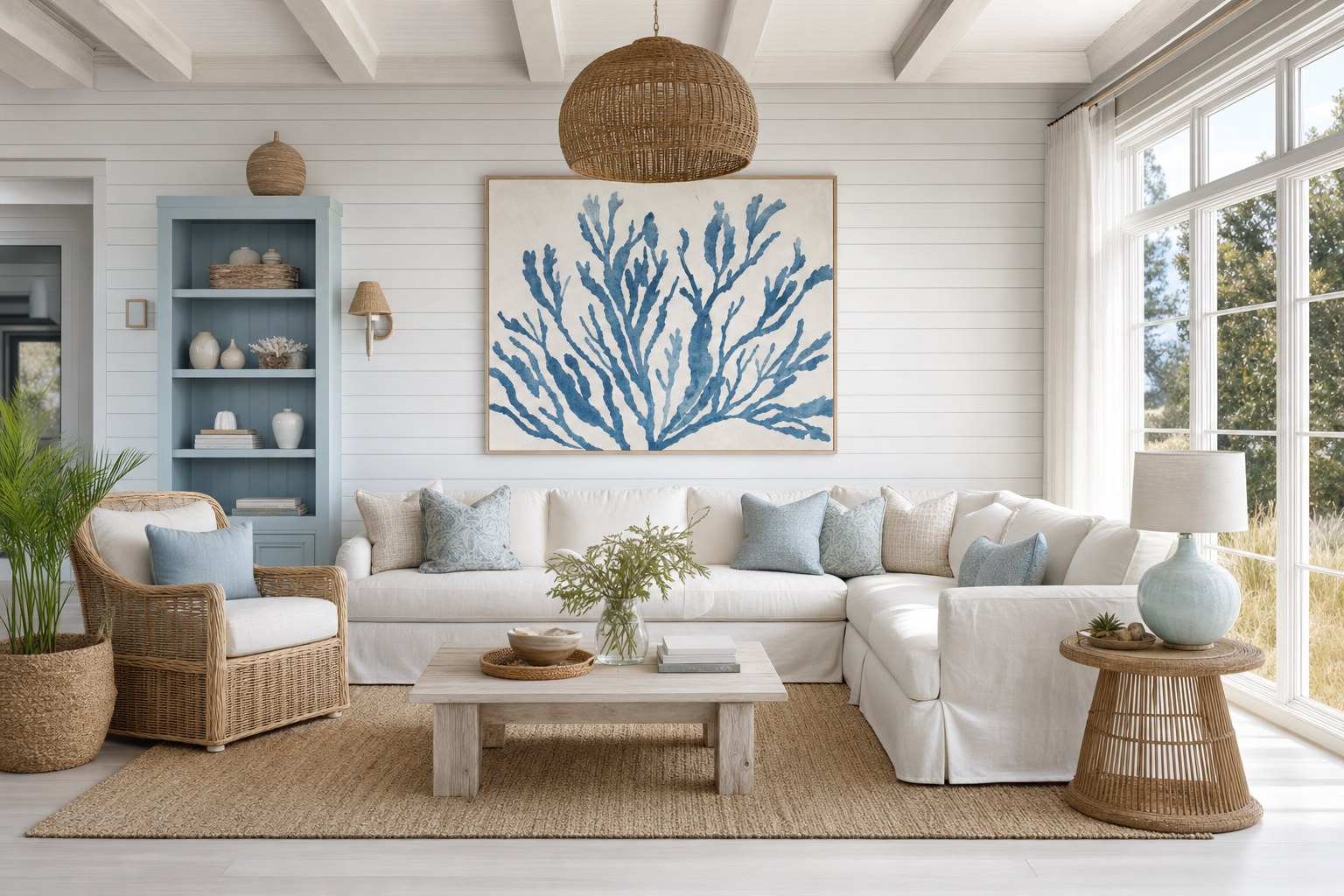
Licensed interior designer Rachel Blindauer, whose studio serves coastal markets, has the defining formulation: "I design for people who want their homes to feel like summer - without looking like a souvenir shop." That is the test. Every purchase in a coastal room should pass it. Rattan armchair: passes. Anchor-print throw pillow: does not. Seagrass area rug: passes. Framed vintage lighthouse painting: borderline. Belgian linen curtains: passes. Ship wheel wall art: fails. The five elements below are all souvenir-shop-proof. The entry path, at $339.95, transforms a standard room into a functional coastal interior without a single piece of beach merchandise.
The Slipcovered Sofa · $469.96
The slipcovered sofa is the structural anchor of a coastal living room and one of the clearest signals the style sends. Laura Gaskill identifies the sofa's coastal-specific logic: "If you can't imagine kicking off your shoes and putting your feet up on something, it probably doesn't have a place in a coastal-style home." The slipcover accomplishes this in practical terms - it is washable, replaceable, and communicates the casual, lived-in quality that every credentialed source identifies as coastal design's foundation. Rebecca Heane specifies the material: linen or cotton canvas in white, cream, or warm sand. Not faux linen, not polyester. Suzie Anderson Home's 93,000-view styling guide dedicates a full chapter to coastal furniture and arrives at the same specification: natural fiber upholstery in the lightest possible tones, with rolled arms and low, approachable seat height that keeps the room from feeling stiff. The stripe throw pillow is the only coastal pattern that crosses from nautical into coastal without souvenir-shop risk - horizontal stripes in cream and sand or soft blue and white are Heane's cited example of a pattern that reads coastal without reading kitschy. The cotton throw blanket in sand or cream closes the sofa layer with the texture dimension Tessa Pearson identifies as the defining move of refined coastal: "texture is the new pattern."
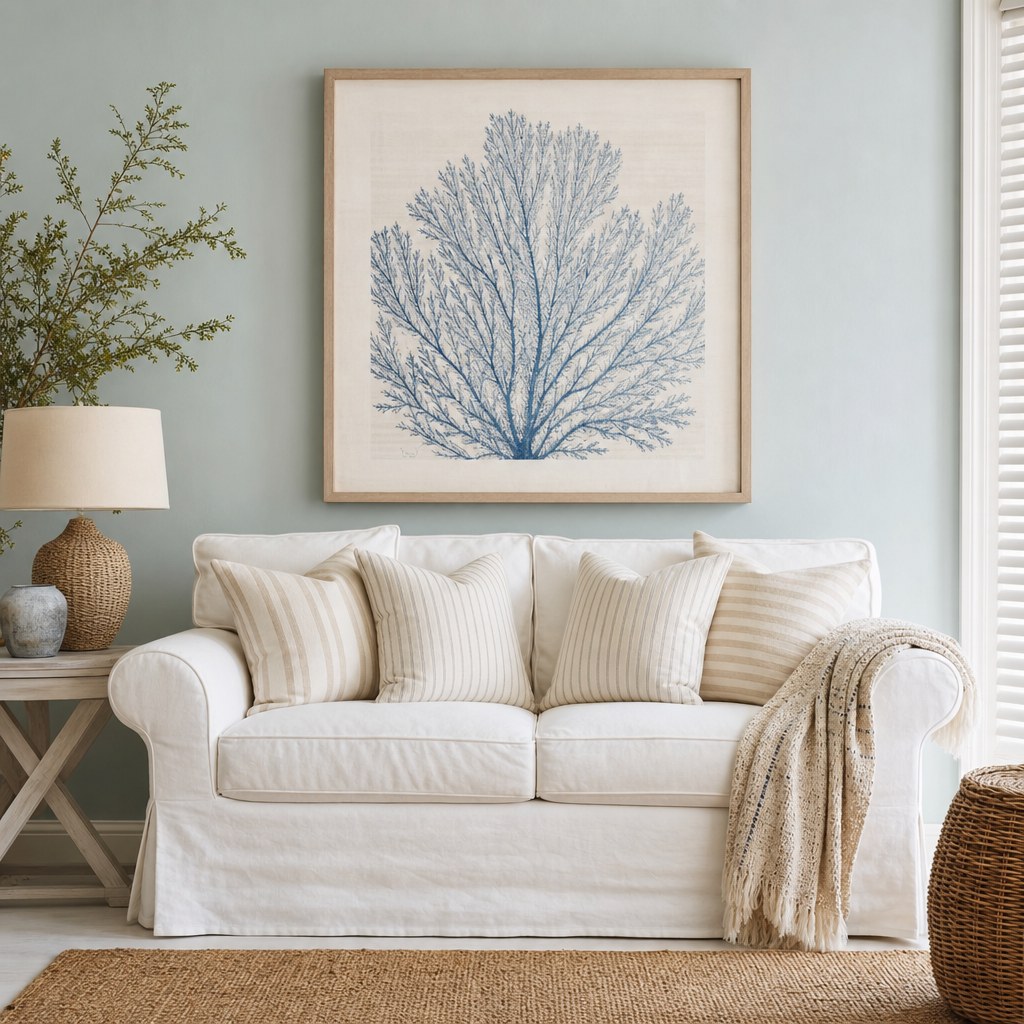
E1 Receipt - The Slipcovered Sofa
Natural Floor Grounding · $299.96
Flooring in a coastal interior begins with the rug - and the rug material is not optional. Seagrass, jute, sisal, and coir are the four correct natural fiber rug materials in coastal design; every credentialed source in this research specifies them over synthetic alternatives. Rebecca Heane lists natural flooring materials as among her top three coastal essentials, naming coir, seagrass, and sisal specifically. Oksana FancyBloom's modern coastal guide is explicit on what to avoid: dark-stained wood floors and heavy pile rugs both fight the quality of coastal light. The correct visual target is the color of dry sand - warm, undyed, with visible fiber texture that catches light differently than flat surfaces do. That texture is as important as the color: Rachel Blindauer identifies it as the foundational principle, describing texture as "the new pattern" in coastal design. The jute braided rug in 8x10 feet creates the room-scale grounding that the sofa requires without adding pattern or color competition. The seagrass baskets extend the natural fiber vocabulary vertically - they are the storage object in a coastal room that passes the souvenir shop test immediately and effortlessly. The rug pad is not decorative but is functionally required for natural fiber rugs on hardwood: without it, seagrass and jute slip and can scratch floor surfaces.
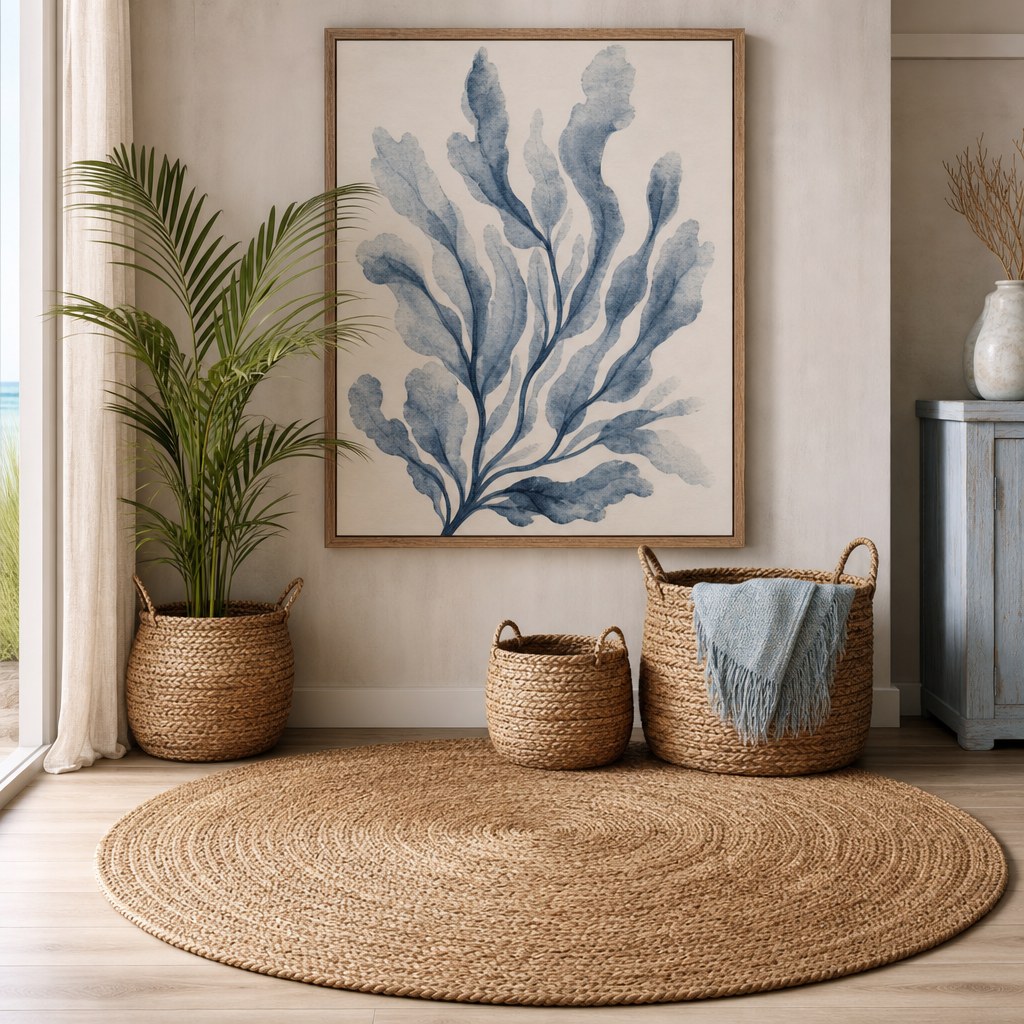
E2 Receipt - Natural Floor Grounding
Linen Window Treatment · $159.96
Window treatments in coastal design serve a specific architectural function: they control the quality of light rather than blocking it. Rachel Blindauer's licensed design practice places light before color in her design methodology - "design with light first, then color" - meaning the window treatment is not the last decision in a coastal room but one of the first. Suzie Anderson Home dedicates a full chapter to window treatments in her coastal guide, identifying the specification: lightweight linen panels or bamboo Roman shades that filter light from the outside rather than cutting it. The goal is the diffuse, ambient quality of light filtered through beach grass - warm, soft, not glaring. Linen is the correct fabric for coastal curtains because it lets light pass through it at a quality that synthetic sheers cannot replicate: the warm, slightly irregular transmission of a natural fiber. Rebecca Heane cites Roman blinds in natural linen as a coastal standard - they stack cleanly and allow the window architecture to show when open. The bamboo curtain rod positions the rod high and wide, which makes the window read larger and maximizes the amount of light the room receives even when the panels are closed. Brass cafe clips and finials are the correct hardware for coastal - chrome reads too cold, iron reads too industrial.
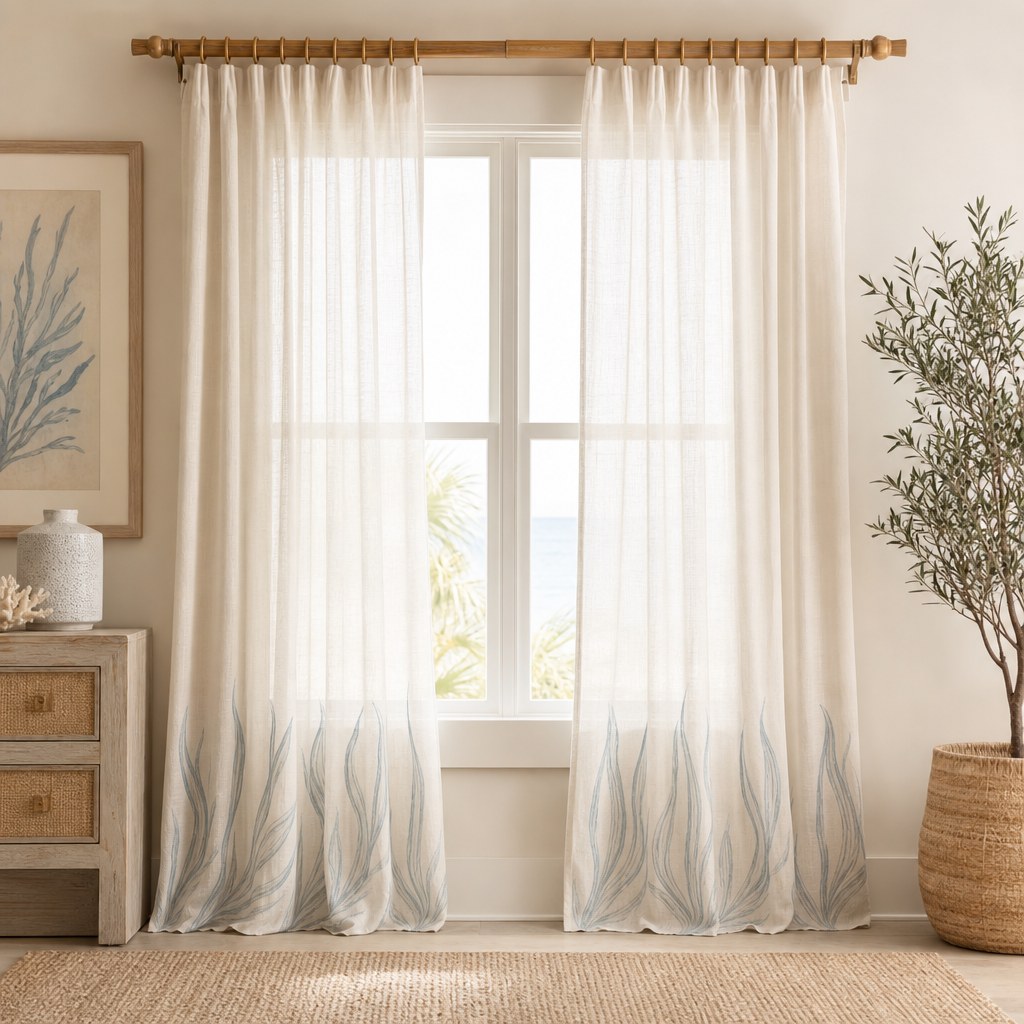
E3 Receipt - Linen Window Treatment
Natural Fiber Lighting · $224.96
Lighting in coastal design connects the material language established by the sofa, rug, and curtains to the ceiling and upper wall planes. Suzie Anderson Home dedicates a chapter to coastal lighting and arrives at a specific specification: rattan, wicker, and natural fiber pendants are the correct fixture materials; warm bulbs at 2700K are the correct temperature. Denise Jadd, the licensed Palm Beach designer, extends this to include brass and concrete as coastal-appropriate fixture materials alongside rattan, with the layering principle that Suzie Anderson also identifies - the goal is never a single overhead source but a mix of pendant, table lamp, and ambient sources that create the warm, diffuse quality of late afternoon seaside light. Megan Molten, the Mount Pleasant designer, identifies the 2025 evolution: "statement-making sculptural light fixtures" are replacing predictable rattan globe pendants. The oversized woven rattan pendant in this guide sits between tradition and evolution - it has the natural fiber material of classic coastal but the generous 20-inch scale that reads contemporary. The rattan table lamp extends the material vocabulary while providing the second layer of ambient light. Warm Edison bulbs in the 2700K range are the correct choice for coastal rooms: cool white or daylight bulbs fight the warm palette of cream, sand, and brass that the style requires.
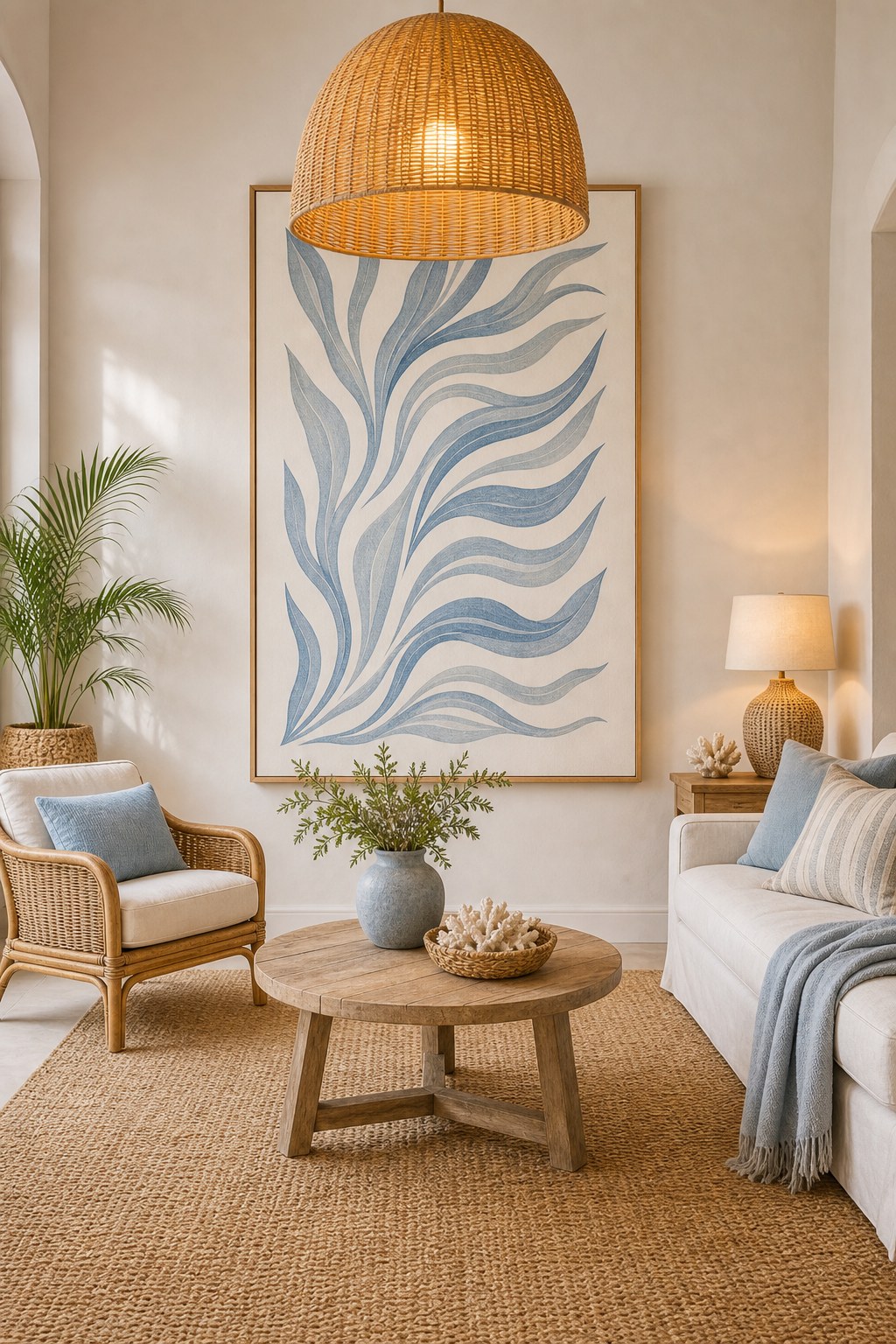
E4 Receipt - Natural Fiber Lighting
The Living Energy Layer · $169.95
The living energy layer is where coastal design either succeeds or fails as a souvenir shop test. This is the zone where most coastal rooms go wrong: the ship wheel appears, the lighthouse print arrives, the glass bottle filled with sand from the Florida panhandle lands on the coffee table. Suzie Anderson Home names the correct layer "living energy" and treats it as an organic category: plants, driftwood, ceramic objects in organic shapes, and botanical prints that reference nature rather than specific beach iconography. Her 93,000-view guide closes on this layer, presenting it as the element that distinguishes a correctly assembled coastal room from a staged one. Oksana FancyBloom's modern coastal interpretation is even more disciplined: a single meaningful organic object on a surface, not a collection. The driftwood branch is the object that passes every test - it references the sea through the geological process that creates it (salt water plus time plus wood), not through any manufactured symbol. White ceramic vases in organic, irregular shapes extend this principle to the table object layer. The coastal botanical wall print in the receipt below is the one picture-frame concession available in a coastal room: a pressed botanicals print, a seagrass field photograph, or an ocean horizon photograph passes the souvenir test; a lighthouse painting or a ship chart framed decoratively does not. The live plant is the most important purchase in this category. Denise Jadd and Megan Molten both identify biophilic integration as a defining element of 2025 coastal design: a large-leafed tropical plant (monstera, bird of paradise, snake plant) introduces genuine living energy that no object can replicate.
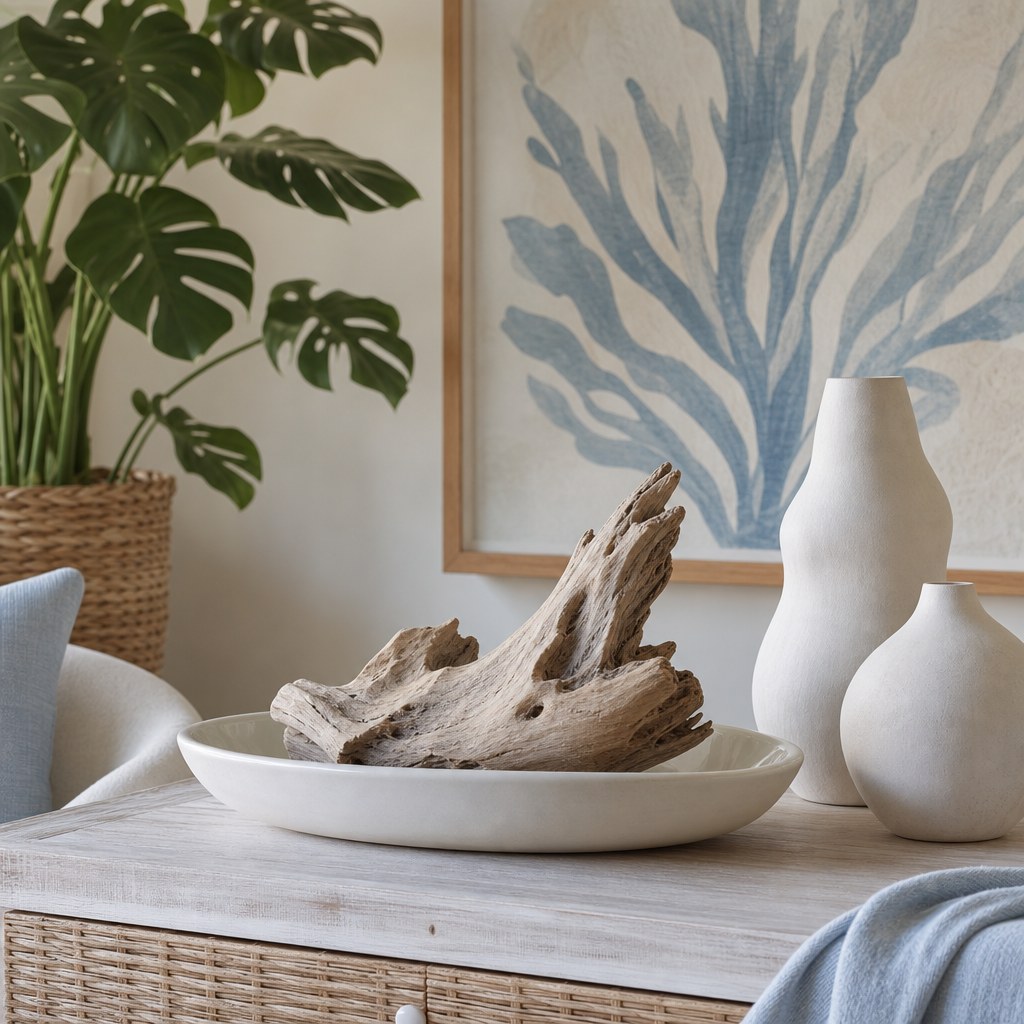
E5 Receipt - The Living Energy Layer
Coastal vs. Nautical: The material test.
Coastal and nautical design are frequently sold as the same aesthetic in retail contexts and are structurally different. Oksana FancyBloom opens her modern coastal guide by separating them explicitly. Tessa Pearson at Livingetc identifies avoiding stereotypical nautical motifs as the defining move of contemporary coastal design. The distinction is not aesthetic preference. It is a structural difference in how each style references the sea.
| Category | Coastal | Nautical |
|---|---|---|
| Design logic | Material and atmosphere. References the sea through texture, palette, and quality of light | Symbol and object. References the sea through maritime iconography and seafaring objects |
| Palette | Cream, sand, warm white (dominant) + soft blue, muted green, coral (accent) | Navy and bright white (dominant) + red accents; high contrast, bold primary palette |
| Textile language | Linen, cotton, seagrass, jute, rattan, natural fiber throughout | Horizontal stripe pattern (navy/white) as primary motif; canvas and oilcloth common |
| Decorative objects | Driftwood, organic ceramics, botanical prints, living plants, sea-glass-colored glass | Anchors, ship wheels, lighthouse imagery, rope knot art, naval flags, compass roses |
| Furniture silhouette | Slipcovered, casual, low-slung; organic shapes; rattan and light wood frames | Often heavier, structured; canvas-covered; teak or dark wood frames referencing ship construction |
| The souvenir shop test | Passes: no item explicitly references seafaring, boats, or marine objects | Fails: most decorative elements are available in any beach town gift shop |
| Failure mode | Souvenir shop drift. Adding symbols rather than maintaining material discipline | Theme park effect: so saturated with maritime symbols it reads as a costume rather than a home |
The $339.95 entry path.
A complete coastal living room transformation for under $340. All five elements, entry-tier only.
Frequently asked questions.
What is coastal interior design?
Coastal interior design is a residential style rooted in the sensory experience of living near the sea - the palette of sand, water, and sky, the texture of natural fibers, and the quality of rooms that allow air and light to move through them freely. The style's defining principle is restraint: coastal design earns its calm by removing rather than adding. Its material vocabulary is specific and consistent across every source: linen, cotton, seagrass, jute, rattan, and light-toned wood are the foundational materials. The palette operates in three tiers - neutral foundation (cream, sand, warm white), soft chromatic accent (aqua, teal, soft blue, muted sage), and warmth accent (coral, terracotta). The most persistent misread is confusing coastal with nautical. Coastal references the sea through material and palette; nautical references it through symbols and maritime objects (anchors, ship wheels, lighthouse imagery). Designer Rachel Blindauer's formulation is the best definition: coastal design should feel like summer without looking like a souvenir shop.
What colors are used in coastal interior design?
Coastal interior design operates on a three-tier palette. The foundation is neutral: white, cream, warm beige, and sand on walls, floors, and primary upholstery - these tones replicate the beach itself. The secondary tier introduces soft chromatic accents from sea and sky: aqua, turquoise, teal, soft navy, and muted sage green. Licensed Palm Beach designer Denise Jadd specifies Benjamin Moore Lacey Pearl OC-62 (creamy neutral), Providence Blue 1636 (soft blue-green), and Van Deusen Blue HC-156 (richer coastal blue) as the three recommended paint options. The accent tier adds warmth: coral, terracotta, and warm sand tones prevent the palette from reading cold. The 2025 evolution documented by Mount Pleasant designer Megan Molten introduces deep green and charcoal into the secondary tier. The structural rule: neutrals should dominate the room, chromatic accents should support, and warm accents should ground. A room where blue dominates reads as a beach house; a room where cream dominates reads as coastal.
What is the difference between coastal and nautical interior design?
Coastal and nautical design are structurally different. Nautical design is symbol-driven: anchors, ship wheels, rope details, lighthouse imagery, navy-and-white stripes, and maritime motifs are its primary vocabulary - it references the sea through objects associated with boats and seafaring. Coastal design is material- and atmosphere-driven: it references the sea through palette, texture, and a quality of light and air, not through objects. A well-executed coastal room may contain no single item that explicitly references the ocean. Oksana FancyBloom, with 18,700 views on her modern coastal guide, opens by explicitly separating the "grandmother coastal" and "anchor decor" interpretations from the modern California-Australian approach, which eliminates symbolic references entirely. The practical test: if an item references a boat, lighthouse, or piece of seafaring equipment, it is nautical. If it references a material that occurs naturally in coastal environments - seagrass, driftwood, linen, rattan - it is coastal.
Can coastal interior design work in an inland home?
Yes - and this is one of the most important and underappreciated facts about the style. Coastal design is a sensory language, not a geographic requirement. Its palette, material vocabulary, and structural approach (restraint, natural light, breathing room, indoor-outdoor flow) are available to any interior regardless of proximity to the sea. Rachel Blindauer's approach is documented precisely: design for the feeling of summer without designing a souvenir shop. That feeling is constructed through decisions about light, material, palette, and open space. The most important inland adaptation is intentionality about natural light: lightweight linen sheers or bamboo Roman shades that filter light are essential when there is no ocean view to anchor the visual experience. Large-leafed tropical plants (monstera, bird of paradise, snake plant) introduce the living energy that in a literal beachfront home is supplied by the view itself.
What materials define coastal interior design?
Coastal interior design has a specific and consistent material vocabulary. Natural fibers define the textile layer: seagrass, jute, sisal, coir, and rattan for hard surfaces (rugs, baskets, furniture frames); linen, cotton, and Belgian linen for soft surfaces (upholstery, curtains, throw covers). Light-toned wood is the furniture material of record: bleached oak, whitewashed pine, driftwood-finish wood, and natural bamboo. The 2025 evolution adds dark-stained walnut as a counterpoint, but the traditional coastal wood tone remains light and weather-worn. Hard surface accents include white ceramic, natural marble, and concrete or rattan for lighting. Metal hardware is brass or matte black - never chrome, which reads too cold for the warm coastal register. The materials to avoid are equally clear: synthetic "coastal-themed" fabrics, glossy lacquered surfaces, heavy dark woods, and anything that cannot plausibly be found through natural means in a coastal setting.
What is modern coastal interior design?
Modern coastal interior design is the contemporary evolution of the style, emerging from California and Australian design communities. It shares the traditional coastal palette and material vocabulary but applies them with greater restraint, cleaner lines, and a stronger commitment to open space. Oksana FancyBloom's guide identifies the key distinctions: walls in soft creamy whites or muted sage rather than bold blue; light-toned hardwood floors (never dark); furniture in natural linen and rattan with organic rounded shapes; decor reduced to singular meaningful objects rather than collections. Balance and Rhythm's analysis identifies how major retailers interpret modern coastal: Crate and Barrel and West Elm lean toward modern minimal; Serena and Lily spans whimsical to sophisticated modern; Pottery Barn offers a layered eclectic interpretation. Designer Megan Molten documents the 2025 evolution: dark-stained woods entering, colored marble replacing white marble, sculptural lighting replacing rattan globes, and curved architectural details softening the clean-line precedent.
More rooms like this
No spam. Unsubscribe anytime.