Table of Contents
The gold rule.
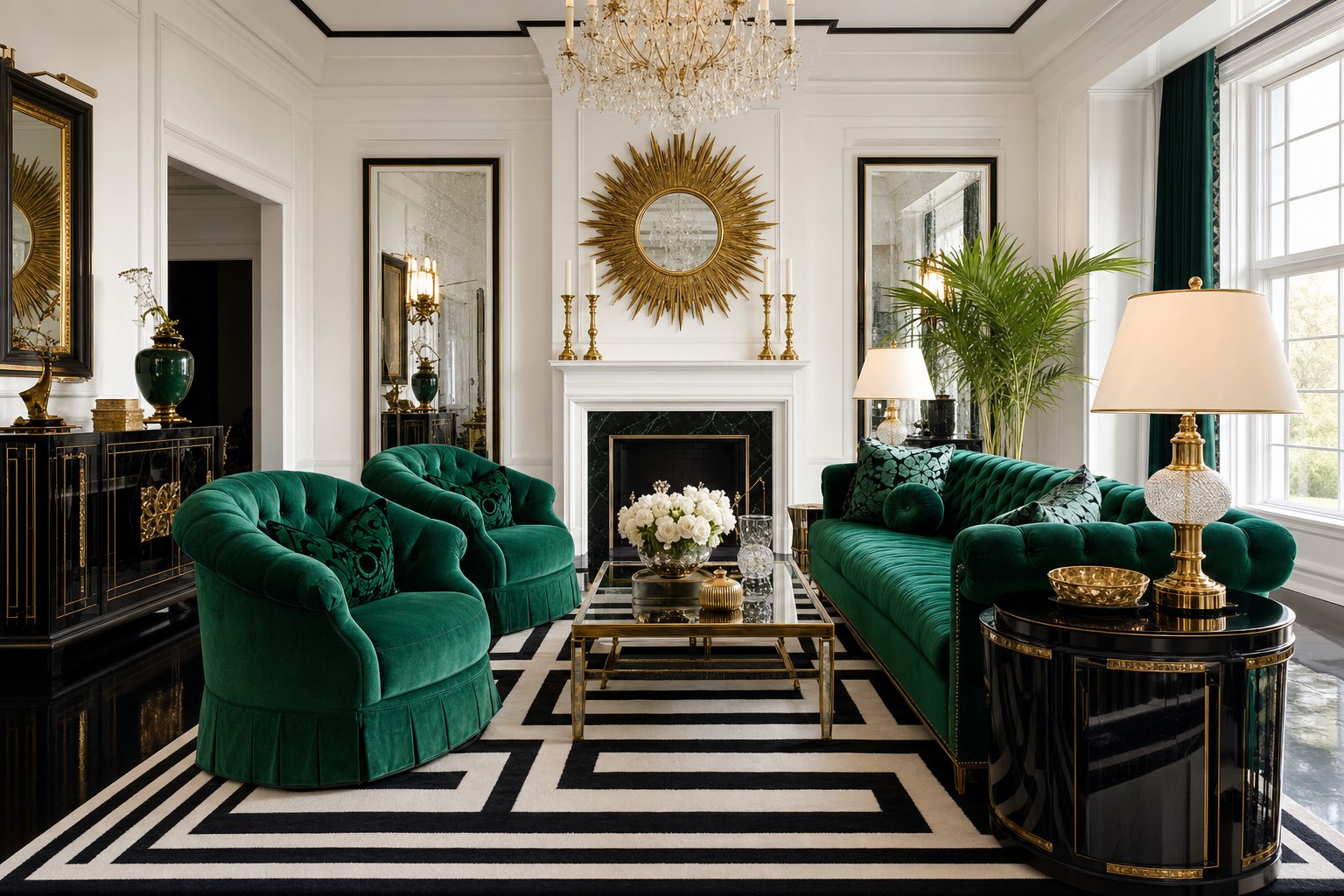
Hollywood Regency emerged in 1930s-1940s Hollywood under designer William Haines, who translated the opulence of the studio system into residential interiors for film industry elites. Dorothy Draper carried the style's principles through the postwar period, and it has been revived repeatedly as a maximalist counterweight to minimalist trends. Its material signature is unmistakable: saturated jewel tones on a white or cream ground, velvet and lacquer as the primary surfaces, oversized sunburst and starburst mirrors, brass hardware and candlestick accents, tufted low-profile seating, crystal lighting, and precisely controlled pattern in animal print or geometric form. The style's current search volume is approximately 8,100 searches per month - not a trend, a returning constant.
The pattern in Hollywood Regency rooms is consistent. The rooms that work share one property: bold color against a white or cream anchor, with the pattern ceiling respected. The rooms that fail share a different property: pattern count exceeds two, or the neutral anchor is replaced by a warm beige that muffles the jewel tones rather than amplifying them. The gold rule is not a rule about gold the metal (though gold is always present in Regency rooms). It is about the ratio: the color is bold and saturated, and the white ground is there to make it read.
The failure modes that come up consistently are three. Pattern overload: leopard print plus geometric rug plus floral wallpaper plus stripe cushion is four active patterns. The ceiling is two. Warm neutrals instead of white: beige walls absorb jewel tones rather than bouncing them. And all glam with no weight anchor: a room of only velvet, crystal, and brass with no lacquered surface or solid dark element reads as floating rather than composed. The five elements below address all three. The entry path - Elements 2 and 3, mirrors and lacquered surfaces - is $309.92.
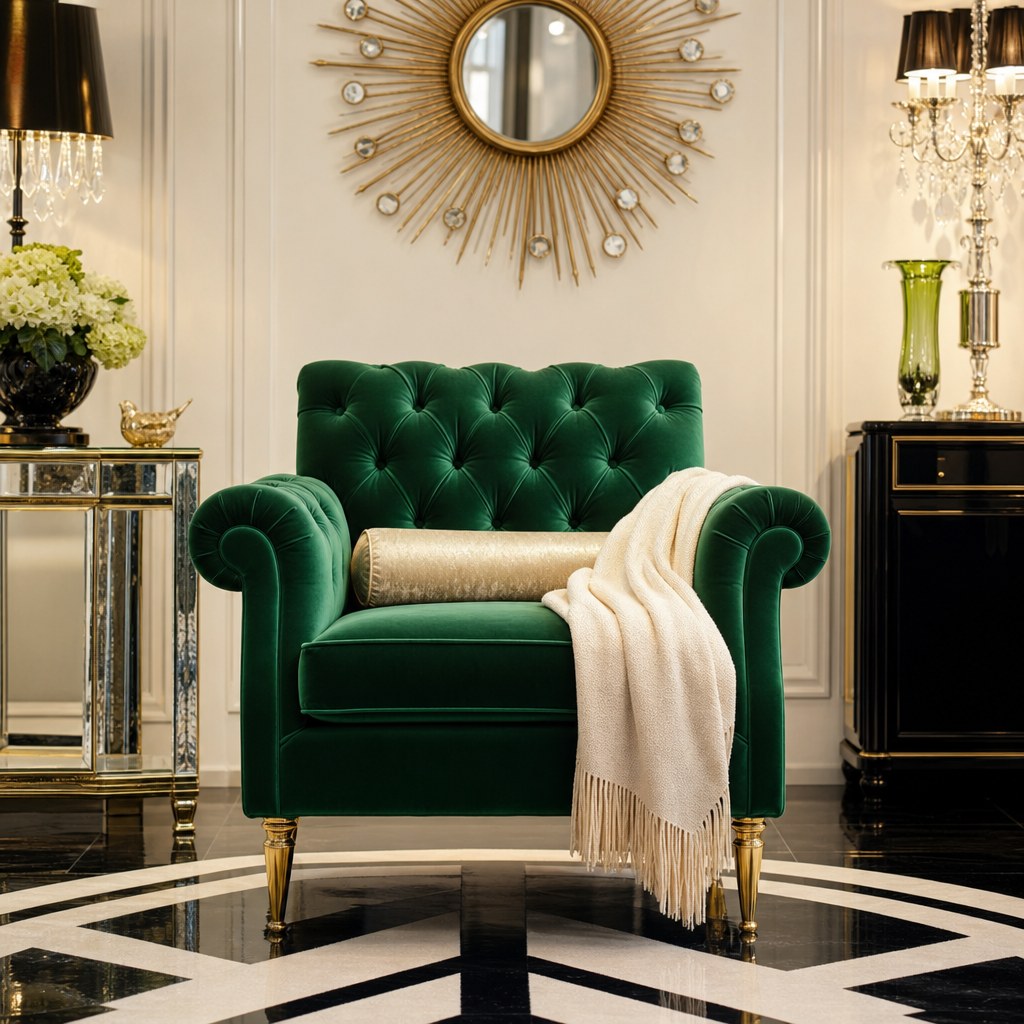
Velvet Seating Layer · $229.96
Velvet is the primary surface material of Hollywood Regency. Not velvet as texture alone but velvet in a saturated jewel tone - emerald, sapphire, ruby, or deep violet - against a white or cream ground. The tufting detail is secondary to the color: a smooth velvet armchair in the right jewel tone reads Regency immediately; an unmade beige sofa with velvet cushions does not. The seating layer requires one upholstered piece in the signature color. Every other element in the room supports it. The pillow covers, bolster, and throw in this element extend the velvet language without requiring a full sofa replacement, making this an accessible starting point for any room that already has a neutral seating anchor.
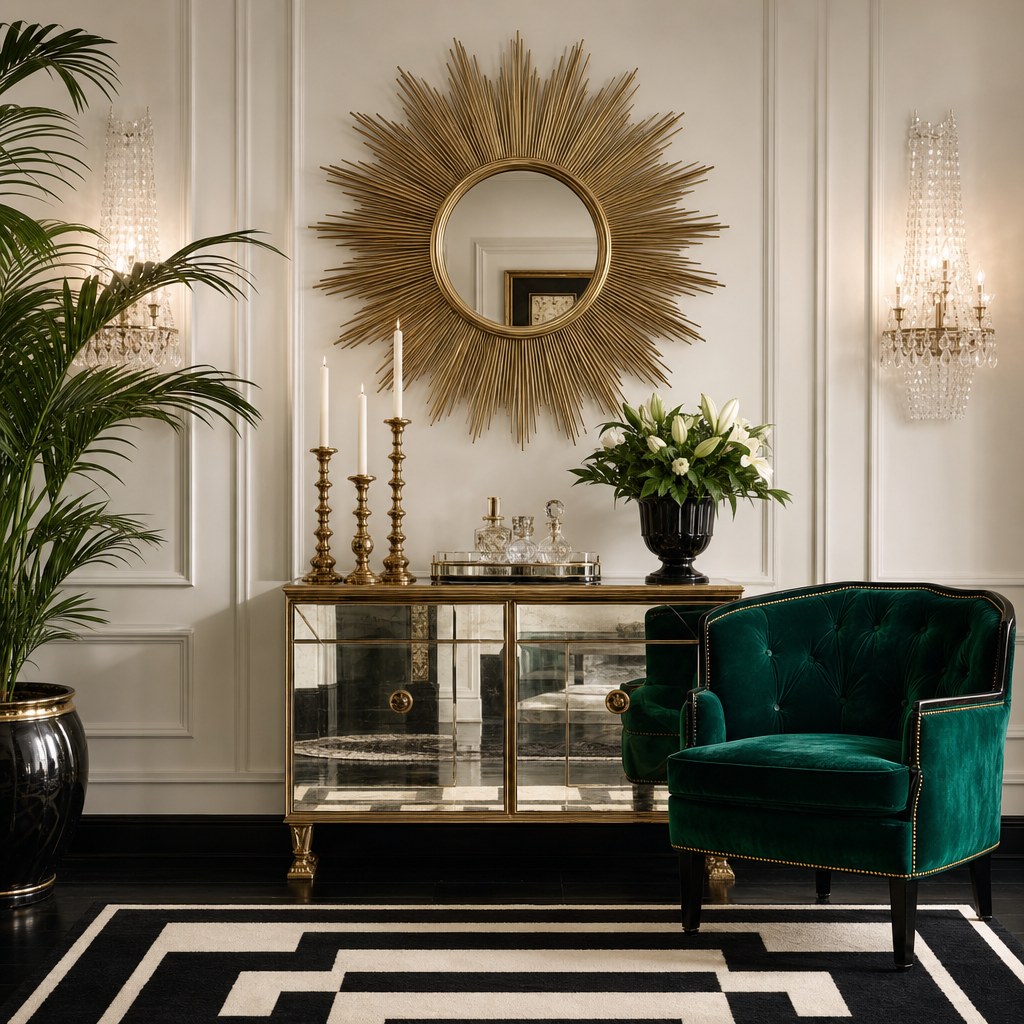
Mirrors and Brass · $169.96
The sunburst or starburst mirror is the fastest single Hollywood Regency signal in any room. It appears in virtually every reference image of the style, from the original 1940s interiors to contemporary interpretations. Its function is not primarily reflective but architectural: the radiating gilded arms create the burst form that connects directly to the style's love of solar motifs and 1930s-1940s glamour. Scale is non-negotiable. A small sunburst mirror reads as a decorative object. A large one (28-36 inches minimum) reads as a focal point. The brass candlestick grouping, tray, and side table extend the warm metallic language throughout the room without adding another dominant visual element. This is the recommended entry path combined with Element 3: mirrors and brass plus lacquered surfaces at $309.92 total is a complete starting point for any neutral room.
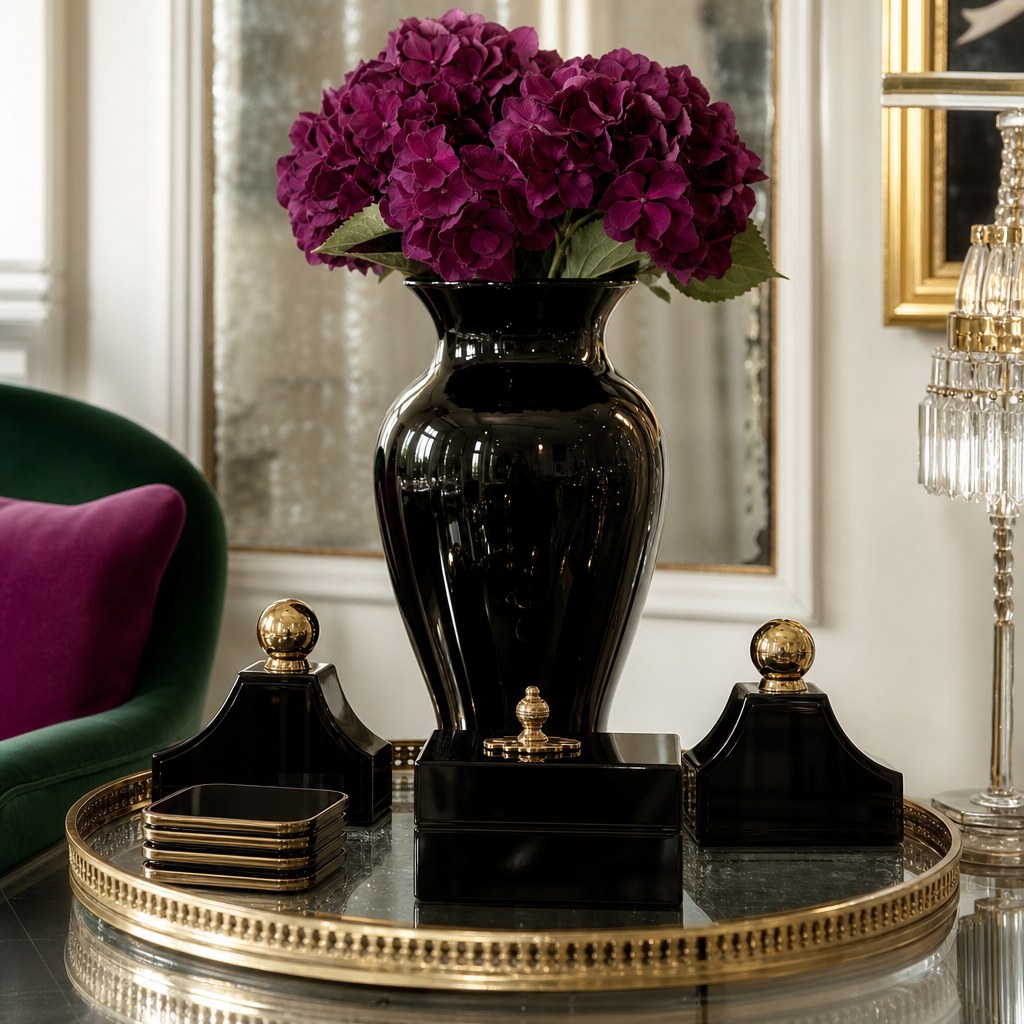
Lacquered Surfaces · $139.96
Lacquer provides the visual weight anchor that prevents a Hollywood Regency room from reading as all-velvet-and-glitter with no grounding. The lacquered surface - in black, deep jewel tone, or white high-gloss - creates a hard, reflective plane that contrasts with the softness of velvet and the organic warmth of brass. Historically, lacquer entered the style through Chinese export furniture adapted by Hollywood's set designers for residential use. In practice today, it is expressed through lacquered accessories: a high-gloss vase, a set of bookends, a lacquered box, and coasters in a matching finish. The vase in this element is the piece that reads most immediately; the lacquered box and bookends create the surface-level layering that makes the display look composed rather than placed. Black and white high-gloss are both correct for this element - the choice depends on the dominant jewel tone.
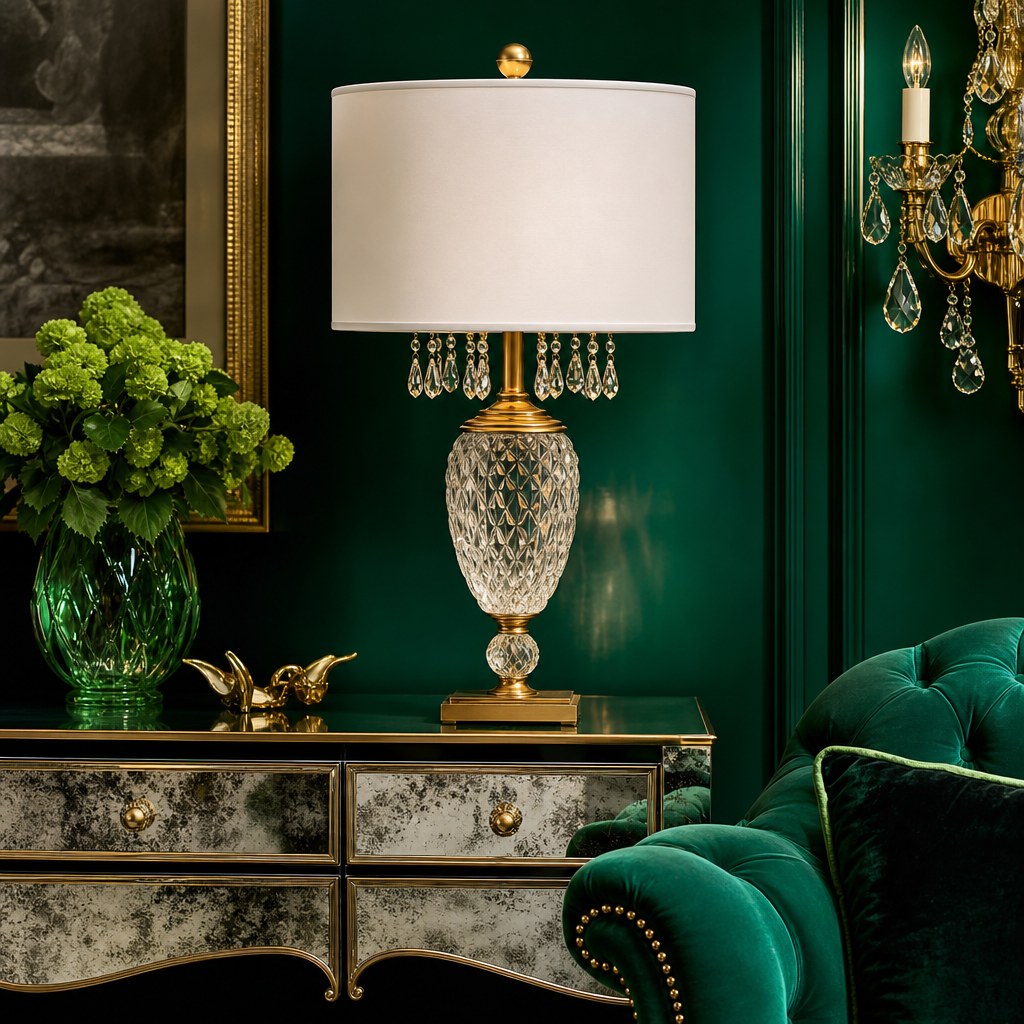
Statement Lighting · $199.96
Crystal and brass lighting is the third signature material combination in Hollywood Regency, after velvet and lacquer. The style's lighting is never recessed, track-based, or understated. It is declarative: a crystal table lamp with a brass base and a white shade, a brass wall sconce with faceted crystal drops, chandelier-style pendant fixtures with prism elements. The crystal prism is the primary decorative unit. Crystal captures and scatters light, creating the atmospheric quality that makes a Hollywood Regency interior read as theatrical rather than merely furnished. A crystal table lamp on the side table next to the velvet chair is the minimum lighting intervention. The prisms added to an existing fixture as chandelier drops are the most cost-effective way to add the crystal element to any lamp or light fitting without replacing the fixture.
Pattern and Textile · $164.96
Pattern in Hollywood Regency follows precise rules. The permitted patterns are: leopard or cheetah print (the original Hollywood animal print, used on upholstery, rugs, and drapery), geometric repeat (diamond, chevron, Greek key, starburst as textile repeat), and stripe in a jewel tone and white or gold combination. The pattern ceiling in this style is strictly enforced: 1-2 active patterns visible in the room simultaneously. The reason is that the color is already doing significant work. Saturated velvet plus patterned animal print is a full visual statement. Adding a geometric rug and a striped drapery alongside both makes the room unreadable rather than dramatic. In this element, the removable wallpaper provides the largest pattern surface, the leopard print pillow is the animal print signal, and the tufted ottoman in a geometric weave extends the jewel tone. The drapery holdbacks in brass tie back to Element 2. This is the ceiling of the pattern layer: one wallpaper plus one upholstery pattern is two sources. The installation ends there.
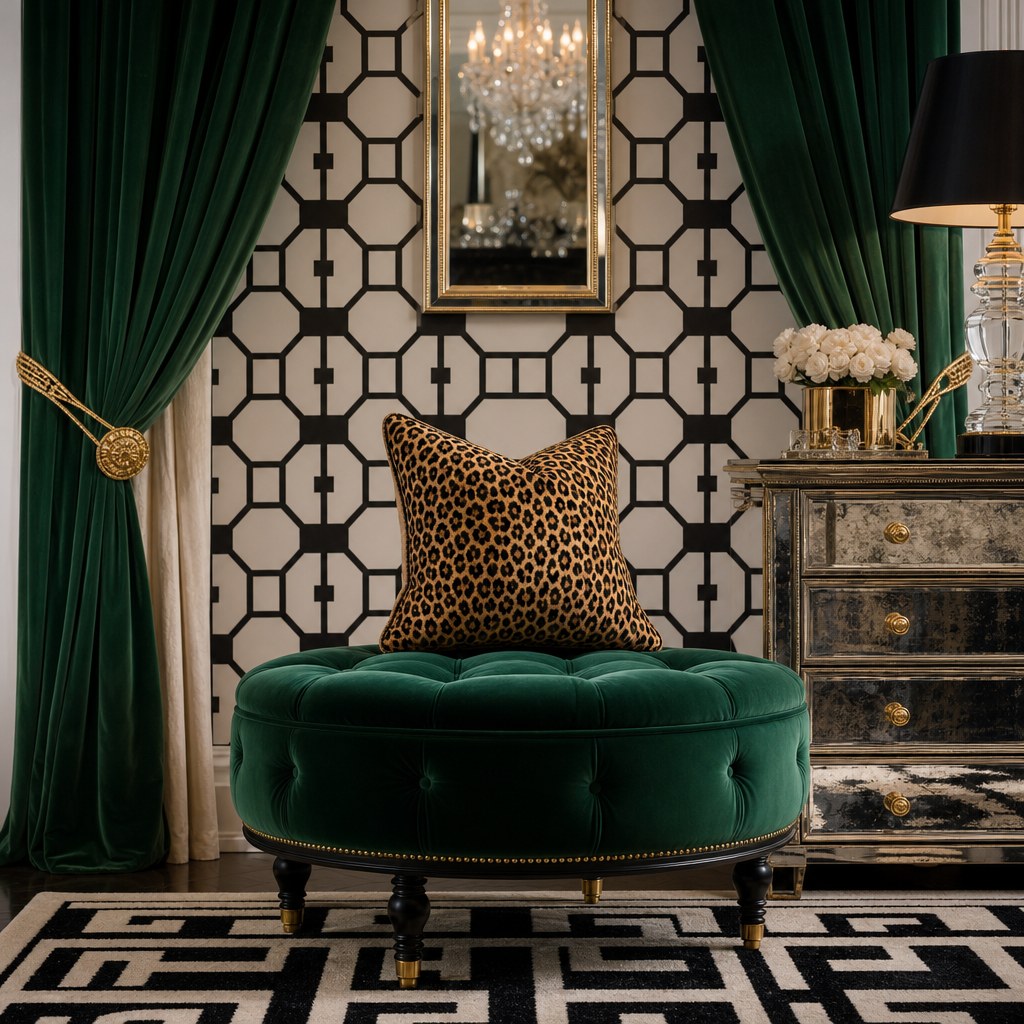
| E1 -- Velvet Seating Layer | $229.96 |
| E2 -- Mirrors and Brass | $169.96 |
| E3 -- Lacquered Surfaces | $139.96 |
| E4 -- Statement Lighting | $199.96 |
| E5 -- Pattern and Textile | $164.96 |
| Grand total | $904.80 |
Hollywood Regency vs. Glam: six differences.
The terms Hollywood Regency and Glam are used interchangeably in retail and social media. They are not the same. Glam is a general direction: any room that pursues sparkle, shine, and the appearance of luxury. Hollywood Regency is a specific style with a defined historical period (1930s-1950s), a specific furniture typology (tufted, low-slung, curved), a specific material palette (velvet, lacquer, brass, crystal), and precise rules on color and pattern. A Glam room can be any decade and any form. A Hollywood Regency room is a specific set of decisions made together.
| Dimension | Hollywood Regency | Glam |
|---|---|---|
| Historical roots | 1930s-1950s Hollywood, William Haines, Dorothy Draper | No fixed origin; borrows from any decade that pursued luxury |
| Furniture form | Low-slung, tufted, curved; chaise, settee, low-profile sofa | Any form; scale and height are not constrained by period reference |
| Pattern language | Leopard, geometric, stripe; maximum 2 active patterns | Any pattern; no ceiling enforced by the style |
| Color approach | Jewel tone on white or cream ground; warm metallics in gold and brass | Silver and chrome are as common as gold; palette is not constrained |
| Failure mode | Exceeding the pattern ceiling; warm neutrals instead of white anchor | Mixture of cold and warm metallics; sparkle without material grounding |
| Longevity | Cyclical: peaks and returns; consistent search volume across decades | Trend-dependent; peaks with maximalist cycles, retreats in minimalist ones |
Frequently asked questions.
What is Hollywood Regency interior design?
Hollywood Regency is an interior design style that emerged in 1930s-1940s Hollywood, developed by designer William Haines for the homes of film industry elites. Its material signature is specific: saturated jewel-tone color (emerald, sapphire, ruby, deep violet) on a white or mirrored ground, velvet and lacquer as the primary surfaces, oversized sunburst and starburst mirrors, brass hardware and candlestick accents, tufted low-profile seating, crystal lighting, and precisely controlled pattern in animal print or geometric form. The style disappeared with the studio system and was revived in the late 1990s and again in the 2010s as a maximalist counterweight to the all-white minimalist trend. The gold rule that separates a working Hollywood Regency room from generic glam: color is bold and saturated, but neutrals anchor the space so the jewel tones read clearly. Pattern follows a ceiling: 1-2 active patterns in the room simultaneously, never more.
What is the difference between Hollywood Regency and Art Deco?
Both styles share a love of glamour and luxury, but their historical roots, furniture forms, and operating principles are distinct. Art Deco emerged in 1920s Paris as a response to both Art Nouveau's organic forms and the stripped geometry of modernism. Its material signature is angular geometry, stepped silhouettes, sunburst motifs, exotic veneers (ebony, zebrawood, macassar), and a restrained palette of black, gold, and ivory. Hollywood Regency developed a decade later in 1930s-1940s California, adapting the opulence of Deco for a warmer, more livable residential context. Hollywood Regency furniture is lower-slung, more curved, and more upholstered than Art Deco furniture. Art Deco favors black and gold as primary - jewel tones appear as accents. Hollywood Regency inverts this, making the jewel tone the dominant field. In practice: if the room has stepped pediment moldings and angular veneer furniture, it reads Deco. If it has a tufted low chaise, a sunburst mirror, and a sapphire velvet sofa, it reads Regency.
How do I do Hollywood Regency in a small apartment?
Small apartments are well-suited to Hollywood Regency because the style's primary mechanism is surface quality rather than scale. Three entry moves work in any size space. First: one oversized sunburst or starburst mirror on the primary wall. In a small room, a large mirror does double work - it adds the Hollywood Regency visual anchor and it expands the apparent space. Do not use a small mirror; the sunburst effect requires scale. Second: one velvet accent chair in a saturated jewel tone, emerald or sapphire preferred. A single upholstered piece in the right color reads the style immediately without requiring a full sofa replacement. Third: a lacquered side table or tray in black or deep jewel tone to carry brass objects. The apartment ceiling rule applies here more strictly than in larger spaces: one pattern maximum in a small room. The entry path of mirror plus velvet chair is complete as a starting point - add layers only after living with the first two.
What colors go with Hollywood Regency style?
Hollywood Regency operates on a white or cream ground with jewel-tone saturated accents. The five primary jewel tones used in the style are emerald green, sapphire blue, ruby red, deep violet or amethyst, and champagne or old gold. The neutrals that anchor these tones are crisp white, cream, and ivory - not beige or warm greige, which dilute the jewel-tone contrast. Black is used sparingly and precisely, primarily as a lacquer surface or a furniture leg, to sharpen the jewel tones by contrast. The gold rule on color mixing: choose one dominant jewel tone per room and let it govern the upholstery and major soft furnishings. The second jewel tone, if present, belongs only in accessories. Metallics in Hollywood Regency run warm: gold and brass are standard; chrome reads too cold and too modern for the 1930s-1940s original reference.
What are the most common Hollywood Regency decorating mistakes?
Four mistakes account for most failed Hollywood Regency rooms. First: pattern overload. The style permits 1-2 active patterns simultaneously. Leopard print upholstery plus a geometric rug plus a floral wallpaper plus a stripe cushion is four patterns. The ceiling is two; applying it strictly is what separates a composed Hollywood Regency room from a costume. Second: warm neutrals instead of white. Beige and warm greige on the walls absorb the jewel tones rather than amplifying them. Hollywood Regency jewel tones read brightest against crisp white or ivory. Third: all glam with no weight anchor. A room of only velvet, crystal, and brass with no lacquered or solid anchoring surface reads as floating. The lacquered side table, the mirrored console, or the solid dark-leg chair provide the visual mass the jewel tones need. Fourth: furniture scale mismatch. Hollywood Regency furniture is low-slung and horizontal in profile. Tall, boxy upholstered furniture placed alongside tufted chaises and low settees creates a scale discontinuity that disrupts the period coherence.
Is Hollywood Regency still in style in 2026?
Hollywood Regency is a cyclical style rather than a trend. It peaked in the 1930s-1940s under William Haines, disappeared with the studio system, revived through designers like Dorothy Draper in the 1950s-1960s, retreated again, and returned in the maximalist wave of the 2010s. In 2026, it sits in the same durable position as Art Deco - a reference style that practitioners return to repeatedly because its principles are structurally distinct and visually consistent. The term continues to run approximately 8,100 monthly searches, which indicates active consumer interest rather than nostalgia research. The 2020s version of Hollywood Regency has absorbed several updates: wallpaper has partially replaced painted jewel-tone walls, animal print has expanded beyond leopard to zebra and snake, and the brass hardware trend made the style's metallic palette mainstream. The elements that remain non-negotiable are the tufted low seating, the oversized mirror, the lacquered surface, and the jewel-tone color at saturation.
Want yours next?
One issue every Sunday. We'll plan your room with your city + salary.