Table of Contents
Eclectic design is the style most people already have and don't know how to name. When someone says "it's just my stuff" about a room that mixes vintage chairs, modern art, a global rug, and a family heirloom lamp - that's eclectic. The vocabulary people use is revealing: "colorful," "layered," "mix-and-match," "collected over time," "personal" - not "eclectic."
The operating principle is simple: mix with love, match with forethought. The love part is the collecting impulse - buying what resonates, keeping what matters. The forethought part is what most people skip: choosing a unifying principle before buying. Color, scale, material, era - pick one that will run through the room like a thread. The five elements below each contribute a specific function to the room system. None are interchangeable. None are optional if you want the room to pass the Point Test.
The Neutral Anchor Chair
Eclectic rooms need a neutral foundation - this is the one rule every source agrees on. The most accomplished eclectic rooms almost always have a neutral base: walls plain-painted, not patterned; large upholstery in muted tones; flooring that doesn't compete. The neutral is not a concession to safety - it is the canvas that makes everything else legible.
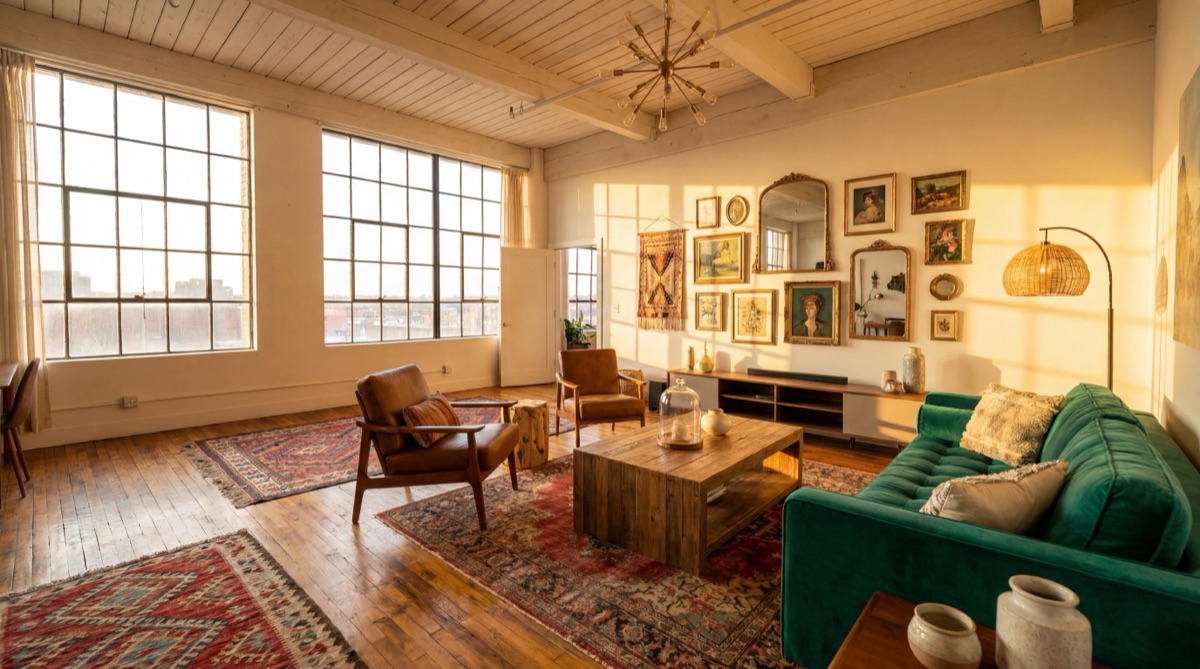
The anchor chair is a different neutral than the wall: it's a large, solid-upholstered seat in a muted but not white color - warm putty, dusty sage, soft camel, or pale blush. The anchor chair serves three functions simultaneously: it provides a large neutral mass that grounds the room, its solid fabric shows off the texture game happening around it (patterned rug, gallery wall, layered throws), and it signals "this room is not cluttered - look how clean this piece is." The chair is the eye's resting place.
Selection criteria: solid fabric (no pattern), slightly curved silhouette (reads as inviting, not institutional), wood or metal legs in a tone that will appear elsewhere in the room (establishing the material common denominator). At $250-350, a statement armchair in solid upholstery outperforms a generic sofa at the same price point for eclectic use because its smaller scale allows more pieces to exist alongside it without crowding.
E1 Receipt -- The Neutral Anchor Chair
The Gallery Wall
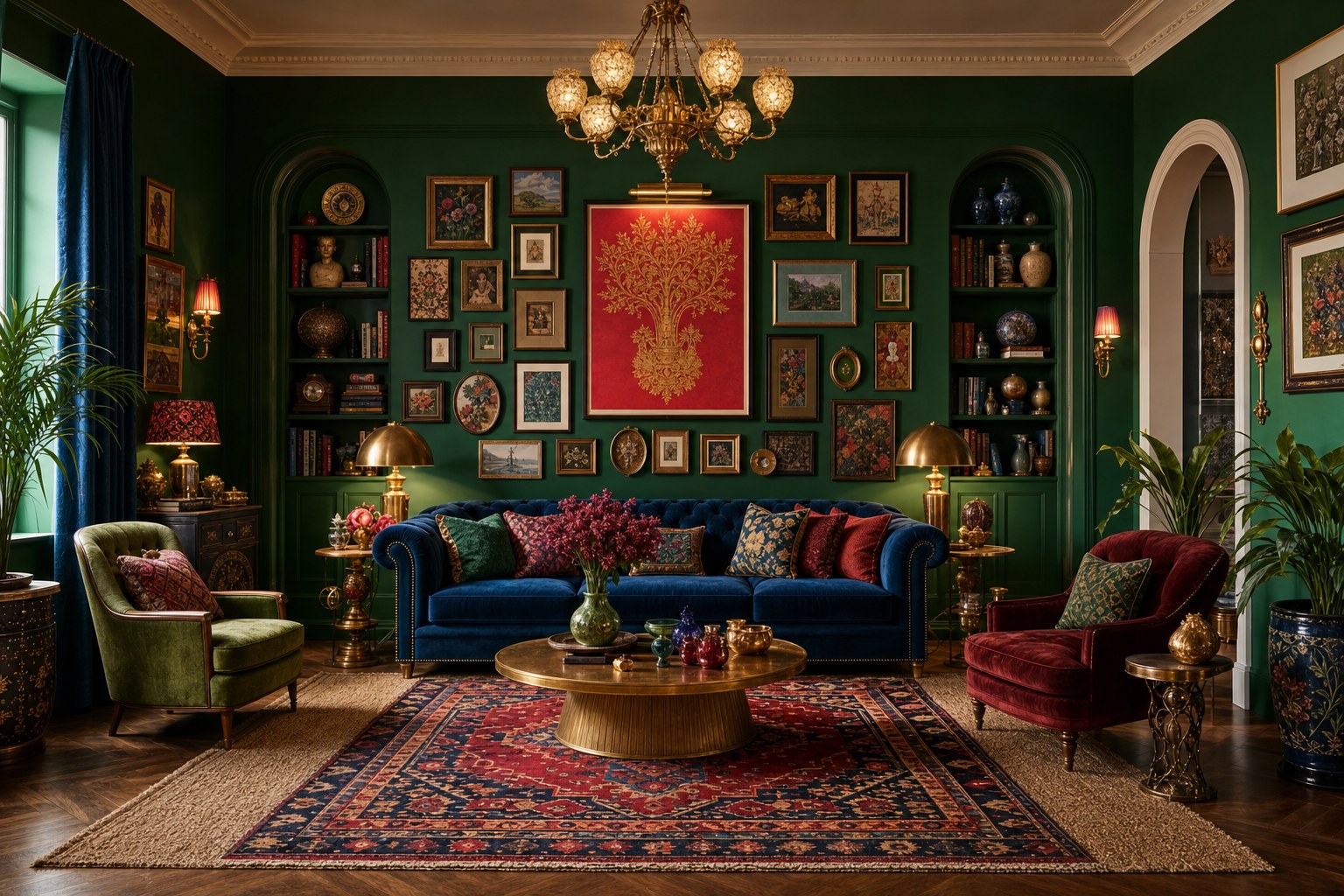
The gallery wall is the single most recognized signal of eclectic design. The rule is to mix art with objects - display artwork alongside collected items unified by color, theme, or motif. Books, plants, and unexpected object groupings as accessories bridge the styles. A gallery wall (or equivalent art moment) is not optional - a room without one reads as a room that hasn't been given a personality yet.
The key word is "unified." A gallery wall that mixes frames without a unifying element reads as random. A gallery wall where every frame shares a color (all black, all gold, all white), or every piece shares a theme (all vintage botanical prints, all black-and-white photography, all abstract expressionism), or every piece shares a tone (all warm-toned art regardless of subject) reads as well-chosen. The mix is the surface. The unification is the structure beneath.
For the Point Test: the gallery wall's point is to provide the room's personality layer in concentrated form. Each piece in the gallery wall should earn its place within the gallery's unifying principle - not just be placed on the wall because it was available. A well-chosen gallery wall of 5-7 pieces from the same color family costs $80-120 at IKEA and art print platforms and outperforms an arbitrary gallery wall at any price.
E2 Receipt -- The Gallery Wall
The Global Textile
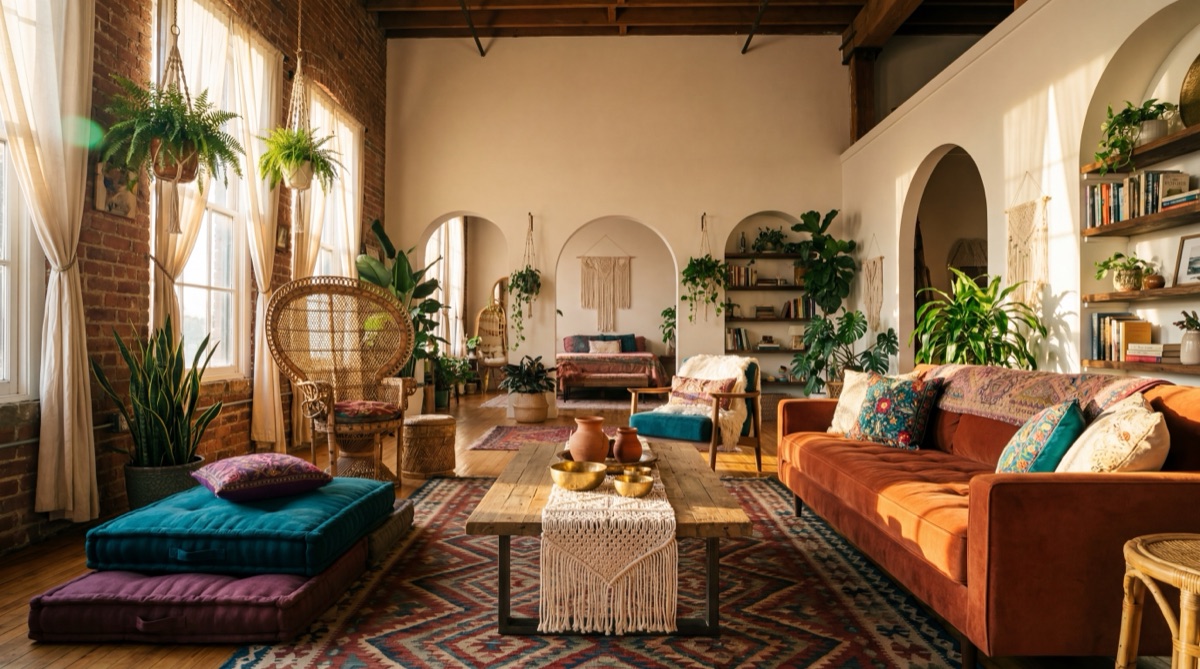
Eclectic design's relationship to global culture is a distinguishing feature. Cultural diversity is a defining eclectic principle - Moroccan textiles alongside Japanese ceramics, global travel souvenirs as core accessories, travel treasures incorporated throughout. The global textile - a kilim, a Moroccan wool rug, an Indian block-print throw, an Ikat-patterned fabric - carries two functions simultaneously: it introduces pattern to the room and it carries geographic/cultural provenance, which is the eclectic story layer that makes a room feel collected rather than purchased.
As a floor layer, the global textile (5x8 or 8x10 area rug) grounds the seating arrangement and introduces pattern that the anchor chair's solid upholstery can contrast against. The pairing of solid-upholstered seating + globally-patterned rug is the most reliable eclectic combination - it uses contrast (pattern vs. solid) and coherence (color from the rug picked up in the chair pillow or gallery wall) simultaneously.
Point Test for the global textile: it should introduce colors or patterns that appear at least one other place in the room (in the gallery wall, the accent pillows, or the artwork). A kilim that introduces warm terracotta and gold earns its place because those tones recur. A kilim that introduces colors that appear nowhere else creates visual noise rather than depth.
E3 Receipt -- The Global Textile
The Mixed-Era Lamp
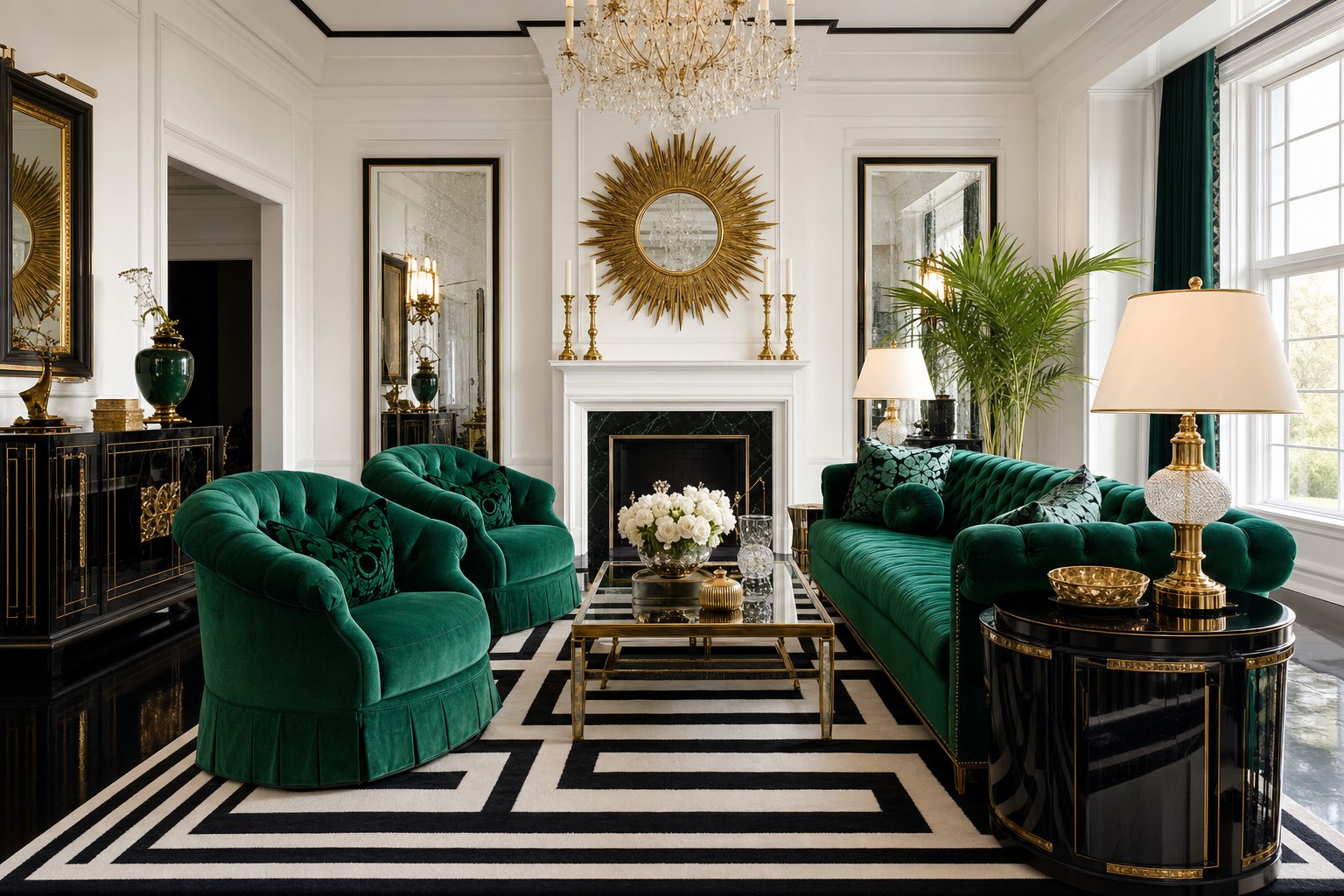
The mixed-era lamp is the piece from the "wrong" design period used deliberately. A 1950s ceramic table lamp on a contemporary side table. An art deco floor lamp in a minimalist room. A Victorian oil-lamp-style electric fixture in a mid-century modern space. The lighting principle: layer multiple sources at varying heights, combining vintage and contemporary fixtures strategically. The word "strategically" is the Point Test applied to lighting.
The lamp earns its place in an eclectic room through contrast - it should look like it belongs to a different era than the room's anchor style, which creates the "I've collected this over time" quality that distinguishes eclectic from catalog-coordinated. The contrast should resolve through material: if the lamp is brass and the room has gold-finish gallery frames and wood furniture with warm undertones, the lamp connects to the room even as its silhouette diverges.
Bulb specification: warm white (2700K), Edison-style or globe shape, visible when lit. The bulb is not invisible in an eclectic room - it contributes to the room's warm ambient tone and should be chosen for visual quality, not just function. At $25-30 for a 4-pack, this is the highest return-on-investment detail in the room.
E4 Receipt -- The Mixed-Era Lamp
The Unexpected Object
The unexpected object is the piece that generates the question "what is that?" in visitors. It is the item that doesn't obviously belong to any of the room's other design eras, cultural references, or material categories - but which clearly has a reason to be there. The rule: make it personal by adding the unexpected - trust your instincts and display meaningful souvenirs, sculptures, or objects reflecting individual personality.
The unexpected object earns its place through the Point Test in its purest form: its "point" is the personal narrative it carries, not a visual function like color contribution or textural contrast. A ceramic bowl from a ceramics workshop the owner attended. An inherited brass candlestick set that belonged to a grandparent. A carved wooden figure from a trip to West Africa. A first-edition book spine that reads as artwork. These objects resist interior design category - they cannot be found at Target or IKEA - and that resistance is their value.
For a new eclectic room without inherited objects, the best path is the thrift store: a genuinely aged ceramic, a brass object with patina, a carved wood piece with visible hand-work. These carry the time dimension that new objects cannot simulate. Budget: $15-50 at a well-chosen thrift store, antique mall, or estate sale. The Point Test still applies - pick one piece that generates a question, not five pieces that generate noise.
E5 Receipt -- The Unexpected Object
Eclectic vs. Maximalist: Key Differences
Maximalist and eclectic are the most commonly confused adjacent styles. Both allow density and visual complexity. The difference is in the governing principle: eclectic requires "breathing room for furnishings to shine" while maximalist treats density as a feature, not a failure.
| Category | Eclectic | Maximalist |
|---|---|---|
| Core principle | Every piece has a point | More is more -- density is the goal |
| Breathing room | Required -- space lets pieces read individually | Not required -- density is a feature |
| Color approach | Neutral foundation + one bold accent color | Multiple bold colors can co-exist |
| Pattern mixing | Permitted but anchored to shared color tone | Layered without restraint -- clash is the point |
| Scale of collection | Edited -- the most meaningful items remain | Additive -- the collection grows without editing |
| Risk of failure | Too much -- becomes maximalist or eccentric | Too little -- becomes eclectic or minimal |
| Provenance requirement | High -- each piece earns its place through story or function | Lower -- visual impact can substitute for provenance |
Frequently asked questions.
What is eclectic interior design?
Eclectic interior design is a residential style that deliberately mixes elements from different periods, cultures, and design movements to create a cohesive space reflecting the owner's individual personality and collected experience. The defining principle is The Point Test: everything must have a place and each piece must have a point to it. Purpose and intentionality separate eclectic from cluttered. The operating philosophy: mix with love, match with forethought. The forethought is choosing a unifying principle - color, scale, material, or era - before buying anything. Successful eclectic rooms share: a neutral foundation, a common denominator running through disparate pieces, and a limit on competing design styles within any single room.
What is the difference between eclectic and cluttered?
The difference is intentionality. Cluttered rooms contain objects because they are present; eclectic rooms contain objects because they have been chosen for a reason. The Point Test: if you cannot articulate why a piece is in the room - what it contributes to the color story, scale relationship, textural contrast, or personal narrative - it is clutter. There's a fine line between eclectic and eccentric. The line is the edit. An eclectic room has been edited; it contains fewer pieces than the owner owns. Eclectic rooms also require breathing room between objects so each piece can be registered by the eye.
What is the difference between eclectic and bohemian interior design?
Both mix styles, eras, and cultural references, but the governing logic differs. Bohemian embraces maximalism - more layers, more pattern, more texture, more color - because richness and density are the goal. Eclectic is not inherently maximalist; it can be executed in a spare room with five carefully chosen disparate objects. The unifying logic also differs: bohemian is organized around an aesthetic feeling (free-spirited, worldly, romantic); eclectic is organized around a concrete principle (color palette, material category, or scale relationship). Eclectic requires breathing room for furnishings to shine - bohemian does not necessarily. A room can be both if eclectic mix-with-intention principles are applied to bohemian source materials (global textiles, vintage furniture, layered rugs).
How do I start an eclectic interior design?
Correct sequence: (1) Neutral foundation - paint walls neutral, select large upholstered piece in solid neutral fabric. (2) One accent color - one bold hue that recurs in at least two or three places. This is the common denominator. (3) Anchor style - one era or aesthetic that dominates (mid-century modern, Victorian, global, industrial). (4) Two or three contrasting pieces - each must relate to the neutral foundation or accent color. (5) Run the Point Test: for each piece, articulate why it belongs. If you cannot, don't buy it. (6) Leave breathing room - remove one-third of what feels right. The edit is what separates thoughtful from cluttered.
What colors work in eclectic interior design?
Eclectic operates on a neutral foundation plus one or two accent colors. Foundation - walls, large upholstered pieces - stays neutral: white, cream, warm gray, warm beige. The neutral base allows bold elements to read clearly without competing. One dominant bold accent hue (mustard yellow, deep teal, terracotta rust, forest green, cobalt blue, or deep burgundy) appears in at least two places. Keep walls plain-painted, not patterned - accessories and art carry the visual interest. Pattern mixing is permitted but requires consistent color tone as anchor. The 2025 direction: 68% of homeowners choose authenticity over perfection - imperfect handmade objects and vintage pieces over catalog-coordinated schemes.
What furniture styles work together in an eclectic room?
Eclectic furniture from different eras needs a common attribute - shared color tone, shared material (all wood legs, all upholstered seats, all metal frames), or shared scale. The classic pairing: "wingback chairs paired with contemporary coffee tables." This works because both share seat-height scale and can share wood tone. The 80/20 principle: 80% of furniture from a consistent aesthetic base, 20% from contrasting eras. The 20% creates the eclectic tension; the 80% provides cohesion. Never represent more than three distinct furniture eras in a single room - beyond three reads as storage facility rather than designed space.
Want yours next?
One issue every Sunday. We'll plan your room with your city + salary.