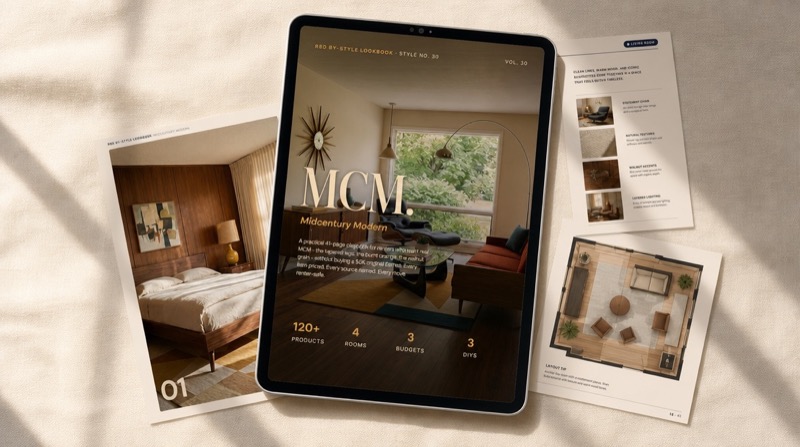
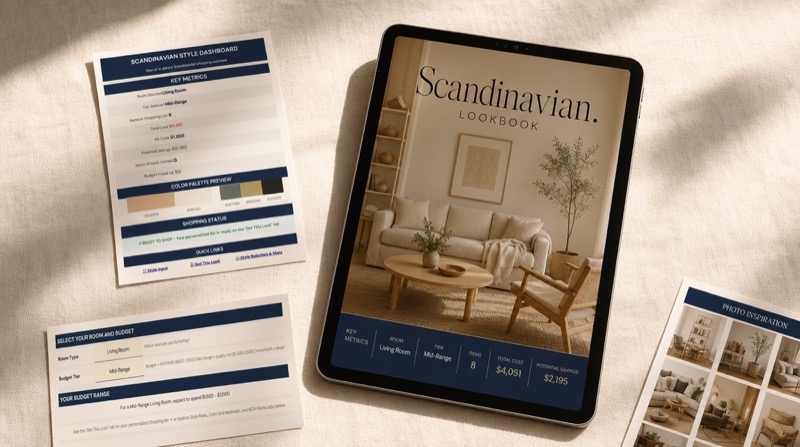
New Scandinavian guide series, pillar + 15 deep-dive cluster posts · Free Scandinavian color palette card, download below · Real apartment sourcing, real budget tiers, real renter angles · New Scandinavian guide series, pillar + 15 deep-dive cluster posts · Free Scandinavian color palette card, download below · Real apartment sourcing, real budget tiers, real renter angles ·

This post contains affiliate links. If you purchase through our links, we earn a small commission at no extra cost to you.

Scandinavian · Cluster Guide

What Is Scandinavian Design? History & Origin (1950s-Today)

A restored 1950s Scandinavian furniture showroom with a Hans Wegner CH24 Wishbone chair on pale oak floor, warm off-white walls, and a single Louis Poulsen PH pendant lamp

One Danish renter posted a picture of her kitchen to r/InteriorDesign and the top comment was "my apartment still has everything from back then and it's brown kitchen with flowery laminate counter tops, bathroom has brown tiles on the floor and on the walls", and it was upvoted 19 times because everyone recognized it. That is the paradox of Scandinavian design history. The movement the world calls beautiful, clean, and timeless is the same movement that, when frozen in place since 1975, becomes the apartment you're actively trying to update. This guide is the full story, who made it, when, why it traveled to the U.S., and why the "warmth aesthetic" reading of the style is the historically correct one. It's also the first cluster that sits under our Complete Scandinavian Interior Design Guide, which covers the rest of the style end-to-end.

Where Scandinavian Design Actually Comes From

Scandinavian design is the post-war Nordic design movement that emerged formally in the 1950s across Denmark, Sweden, Norway, Finland, and Iceland, built on five principles, functionalism, democratic design, craftsmanship, simplicity, and connection to nature. The term entered global vocabulary through a single touring exhibition. Design in Scandinavia ran from 1954 to 1957 and circulated through twenty-two U.S. and Canadian museums, backed by the Nordic design councils as a deliberate post-war cultural export. It worked. By 1958 every American design magazine had a "Scandinavian modern" section. By 1960 Herman Miller was importing Danish pieces for the U.S. market.

The philosophical roots ran deeper than the exhibition. Sweden had the Swedish Grace movement in the 1920s, which softened functionalism with warmth and care. Denmark formalized Danish Functionalism in the 1930s, the Bauhaus ethos filtered through Nordic materials. Finland kept a pure-craftsmanship tradition going through the 1940s, led by Alvar Aalto. When the war ended and the Nordic countries needed to rebuild their economies, these traditions got consolidated into a single exportable brand. Scandinavian Design, capital-S capital-D, is that consolidation.

Five principles still define any legitimate Scandinavian room. Functionalism, every piece has a job. Democratic design, good design available at every price point. Craftsmanship, visible joinery, hand-finished wood. Simplicity, one clear idea per object. Connection to nature, wood, wool, linen, daylight, palette drawn from Nordic landscapes. If you read those five principles and then walk through any current IKEA showroom, you can see the lineage directly. That's not a coincidence.

The Five Designers Who Defined the Style

The Scandinavian canon was built by five designers, mostly Danish, one Finnish, working between the 1930s and the 1960s. Every luxury Scandinavian piece sold today traces back to one of them.

Hans J. Wegner (Denmark, 1914-2007) produced over five hundred chair designs in his career. The Wishbone chair he drew in 1949 for Carl Hansen & Søn, model CH24, is the single most-referenced Scandinavian chair on Reddit and still sells today at around $1,050, made to order in Denmark. His Papa Bear chair, Peacock chair, and Shell chair are all in the same ledger. Wegner was a trained cabinetmaker before he was a designer, which is why his joinery looks the way it does.

Arne Jacobsen (Denmark, 1902-1971) was the architect-designer who gave Fritz Hansen its global identity. His 1958 Egg Chair and Swan Chair were drawn for the SAS Royal Hotel in Copenhagen, a total-design commission where Jacobsen designed the building, the furniture, the cutlery, and the ashtrays. His 1955 Series 7 chair (model 3107) is the best-selling chair in world history. If you've sat in a European office or dining room in the past forty years, you've probably sat in one.

Alvar Aalto (Finland, 1898-1976) ran the Finnish branch of Scandinavian design. He pioneered the bentwood manufacturing techniques that made plywood chairs possible, founded Artek in 1935, and drew the Stool 60 (1933) and the Savoy Vase (1936), two pieces that still sell in their original form today. Aalto's contribution is less a single icon and more a whole manufacturing lineage: the bentwood joinery in a $80 IKEA LISABO chair is downstream of Aalto's Stool 60 research.

Finn Juhl (Denmark, 1912-1989) brought a sculptor's instinct to Danish modern. His 1949 Chieftain Chair and 1940 Pelican Chair are the two pieces most often cited when American designers want to make a room look "chosen" in the legitimate sense. Juhl designed pieces you notice rather than pieces you sit in without thinking, he was the exception that proved Wegner's rule.

Poul Henningsen (Denmark, 1894-1967) defined Scandinavian lighting. The PH 5 pendant lamp he drew in 1958 and the PH Artichoke from the same year are the two most-imitated Scandi light fixtures in history. Every "tripod floor lamp with a linen shade" you've seen in an American apartment is a descendant of PH's original glare-free diffuser research. He's the reason Scandi rooms always have plural lamps instead of a single overhead fixture.

How Scandinavian Design Reached the U.S.

Three waves brought Scandinavian design to American apartments. The first was the 1954-1957 Design in Scandinavia exhibition already mentioned, twenty-two museums, millions of attendees, the birth of the U.S. appetite for Danish modern. The second was Herman Miller importing Danish and Swedish pieces through the late 1950s and 1960s, which gave the style a retail presence for middle-class Americans.

The third wave was the one that actually stuck: IKEA opened its first U.S. store in Philadelphia in 1985, and overnight Scandinavian design went from "designer import" to "default starter apartment furniture." IKEA was the direct commercial descendant of the "democratic design" principle, the idea that good design should be available at working-class prices. And Scandinavian design became the default American first-apartment style because IKEA made it one. When Reddit users ask "where can I buy Nordic design on a budget besides IKEA," the top comment is, literally, "there's a place that has what you are looking for, but it's IKEA", and that's not a joke, it's an accurate summary of the last forty years of U.S. Scandinavian retail.

There's one more cultural moment worth knowing about: the 1996 IKEA UK "chuck out your chintz" advertising campaign. The ad told British households to throw out their dated floral chintz sofas and replace them with clean Scandi neutrals, and it worked so aggressively that people still quote the slogan on r/InteriorDesign thirty years later. The campaign is the reason the UK's aesthetic baseline shifted to Scandi-adjacent over the course of a decade. Chuck out your chintz, and the rest of the look follows.

Why 1970s Scandinavian Design Still Works (When Other 70s Designs Don't)

A specific Reddit thread, hpewj4 in r/InteriorDesign, post score 196, asked whether Scandinavian design from the 1970s has aged better than every other Western design of the same era. The top answer: yes, because it was less trendy to start with. "It's more minimal without as many harsh colours, it doesn't look aged even if it is." Another comment added the cultural piece: "Their culture just values good design, believing that if you live and work in well-designed spaces you'll feel better."

The deeper reason the 1970s Scandinavian pieces still read well is that the style never depended on trend vocabulary. A 1975 teak dining table reads modern in 2026 because it was designed around proportion, joinery, and material honesty, not around a decade's color palette. The closest American equivalent, 1970s avocado-and-orange kitchens and harvest-gold appliances, aged badly because it leaned into trend colors. Scandinavian leaned into wood grain, which doesn't expire.

Get notified when the Scandinavian Lookbook launches
Plus grab the free Scandinavian palette card now

Shop the Canon

Ten pieces that trace directly to the five designers above, the budget descendants of each icon (IKEA LISABO as the Wegner wishbone dupe, POÄNG as the Aalto-lineage accent chair, FADO lamp as the PH-lineage ceramic), plus a couple of mid-tier Article pieces that bridge to the luxury end.

Product
Coming at launch
Affiliate link pending
Product
Coming at launch
Affiliate link pending
Product
Coming at launch
Affiliate link pending
Product
Coming at launch
Affiliate link pending
Product
Coming at launch
Affiliate link pending
Product
Coming at launch
Affiliate link pending
Product
Coming at launch
Affiliate link pending
Product
Coming at launch
Affiliate link pending
Product
Coming at launch
Affiliate link pending
Product
Coming at launch
Affiliate link pending

See Also

The two most useful follow-up reads from this cluster are on the visual language and the luxury canon this history points to:

Frequently Asked Questions

When did Scandinavian design start?

The movement formalized in the 1950s, launched globally by the 1954-1957 *Design in Scandinavia* touring exhibition, though the philosophical roots go back to the Swedish Grace movement of the 1920s and Danish Functionalism of the 1930s.

Who invented Scandinavian design?

Nobody invented it, it's a movement, not a single author. The five landmark designers who defined it are Hans J. Wegner, Arne Jacobsen, Alvar Aalto, Finn Juhl, and Poul Henningsen, all working between the 1930s and 1960s.

What's the difference between Scandinavian and Nordic design?

In strict usage, "Nordic" is the geographic umbrella (Denmark, Sweden, Norway, Finland, Iceland) and "Scandinavian" is the 1950s design movement specifically. In everyday U.S. usage the two terms are interchangeable.

Is IKEA considered Scandinavian design?

Yes. IKEA is the direct commercial descendant of the "democratic design" principle, Scandinavian design philosophy made available at working-class price points. The U.S. launched in Philadelphia in 1985.

Why does 1970s Scandinavian design still look modern?

Because the style was built on proportion, joinery, and natural wood, not on trend colors. A 1975 teak dining table reads well in 2026 for the same reason a 1949 Wishbone chair does: the design never leaned on a decade's color palette.

Where to Go Next

If you want to understand how the palette the 1950s designers chose still works in an American apartment today, the color cluster is the next step. And if you want to see the actual investment pieces this history points to, the Wishbone chair, the Egg chair, the PH 5 pendant, the luxury cluster walks through the full canonical set.

For the whole style end to end, loop back to the Complete Scandinavian Interior Design Guide that this cluster sits under.

Free download: Scandinavian palette card

RenderedbyDesign is a participant in affiliate programs including Amazon Associates and others. Links on this page may earn us a commission at no extra cost to you. We only recommend products we'd put in our own apartments.