Table of Contents
The botanical rule.
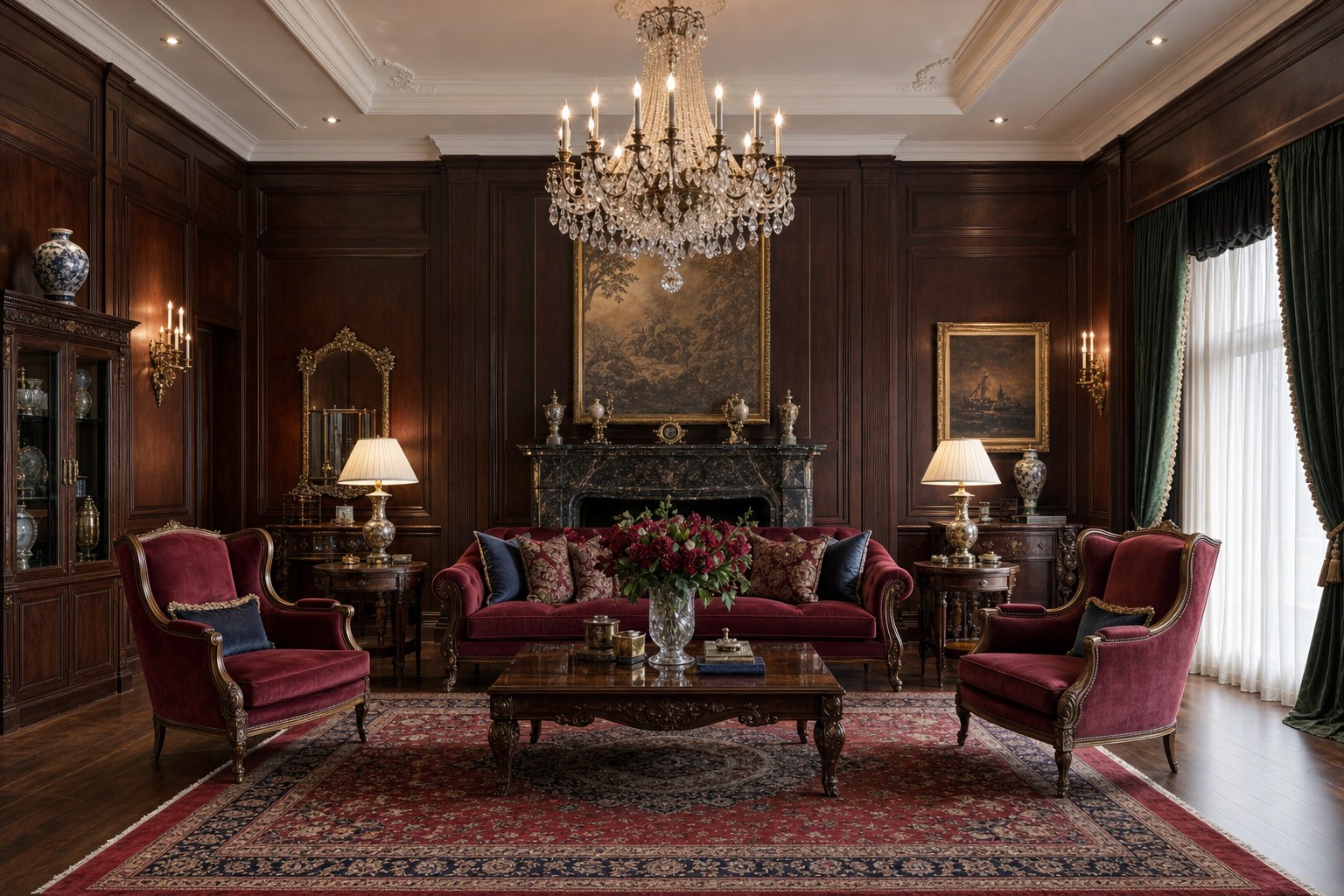
Traditional interior design draws its operating principles from 18th- and 19th-century European interiors - England and France primarily - and its goal has always been comfort, warmth, and a gracious sense of home rather than period accuracy for its own sake. Laura Gaskill, writing for Houzz, identifies the style's thesis directly: "Traditional decorating embraces a sense of history, with heirloom-quality antiques, rich woods, and plush carpets," with the ultimate aim being "comfort, warmth and a welcoming feel." The structural vocabulary is specific and consistent across every credentialed source: symmetry as the operating principle, dark hardwoods (mahogany, cherry, walnut, oak) in carved and turned-leg forms, neutral walls with jewel-tone accents, layered lighting at three levels, and architectural details - crown molding, wainscoting, coffered ceilings - that come standard in the period reference and must be added or replicated in most contemporary homes.
The failure mode of traditional design is not formality. It is overdecorating. Rosslyn Tebbutt, founder of SampleBoard with 20 years in interior design, makes the restraint argument clearly: "every piece should earn its place." Traditional design's ornate potential - the pattern options, the accessory language, the layered textiles - creates a specific temptation to add more than the room can hold. The rooms that read as successful traditional design are disciplined about accessory count and pattern. The rooms that read as cluttered are not operating from different taste - they are operating from the same taste applied without restraint.
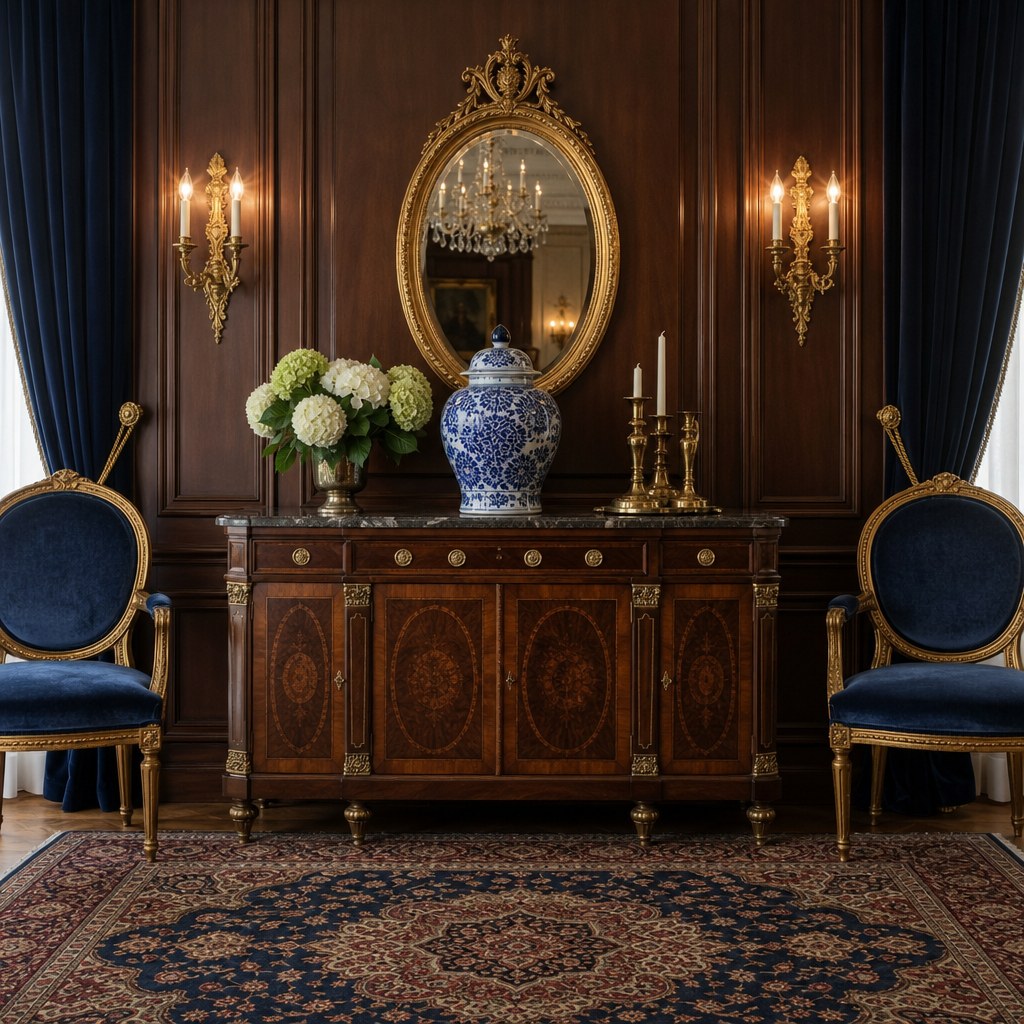
The botanical close is the most counterintuitive finding in the research and the strongest. Suzie Anderson Home (241,000 views) closes a 34-minute traditional design video not on furniture or architectural detail but on fresh flowers and houseplants - calling the section "living energy" and treating botanicals as essential signifiers rather than optional finish. Ashley Childers (120,000 views) closes identically: "There is nothing more gracious than a billowing vase of hydrangeas or a rose posy perched on a side table." Two independent sources, researched separately, closing on the same element. The botanical rule is this: fresh flowers are not decoration in a traditional room. They are the evidence that the room is inhabited. Without them, even a correctly assembled traditional room reads as staged. The entry path of $254.96 starts with crown molding and ends with a ginger jar. The botanicals cost $12-18 per week from any grocery store.
Symmetry Seating Foundation · $552.96
Symmetry is the structural operating principle of traditional design - not an aesthetic preference but a rule. Interiors by Steven G., Florida's oldest professional interior design firm, identifies it plainly: pairs of sofas, chairs, end tables, lamps, and sconces are arranged around a focal point (fireplace, mantel, or art grouping). The seating layer in a traditional room does not mix types: wingback chairs face each other, or they flank the sofa symmetrically, or they sit in matched pairs at the far side of a conversational grouping. The camelback sofa with its arched back profile and rolled arms is the traditional seating anchor of record. Ashley Childers names it specifically: "Go for timeless shapes with a rolled arm - like a Chesterfield or camelback sofa - and accent with wingback or club chairs to add a layer of timeless appeal." The velvet and cotton-velvet upholstery fabrics are correct for both. The damask pillow covers and tufted bolster extend the traditional textile language without requiring full upholstery replacement.
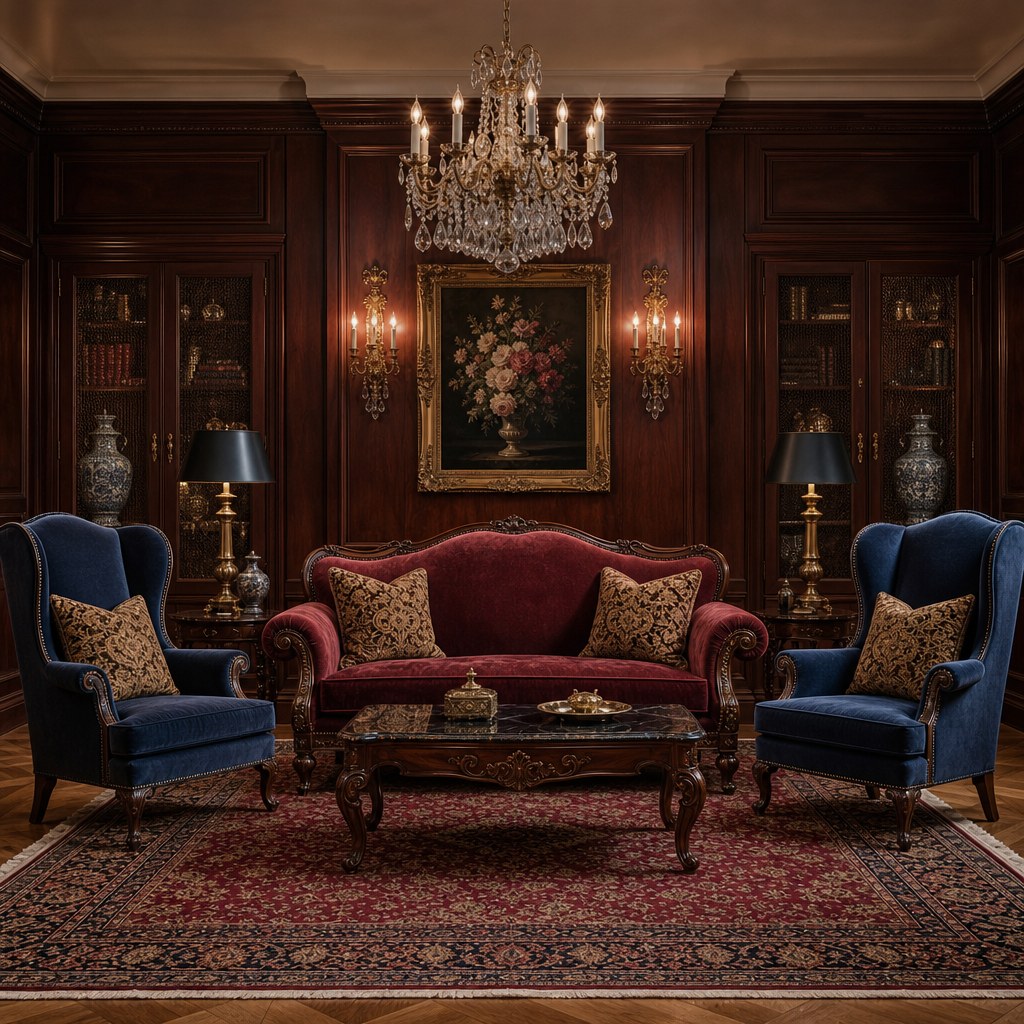
E1 Receipt - Symmetry Seating Foundation
Architectural Character Layer · $293.96
Architectural detail is not optional in traditional design - it is definitional. Crown molding, wainscoting, coffered ceilings, columns, arched doorways, and wood paneling are the period elements that separate a traditional room from a room with traditional furniture in it. The Interiors by Steven G. guide lists built-in cabinetry, crown molding, columns, wood paneling, and coffered ceilings as the six primary traditional architectural elements. Suzie Anderson Home dedicates the longest chapter of her 34-minute video to architectural features - 6 minutes on symmetry, crown molding, wainscoting, coffered ceilings, arches, columns, and a fireplace focal point. The crown molding kit produces the highest traditional signal per dollar of any single purchase in this guide: a flat-ceilinged room with crown molding reads as traditionally detailed; the same room without it reads as builder-basic regardless of how the furniture is assembled. The mantel shelf creates the focal point that the symmetry principle requires. Picture-frame wall molding - strips of flat molding applied in rectangular grid patterns on the lower wall - approximates the paneling of period interiors at a fraction of custom millwork cost.
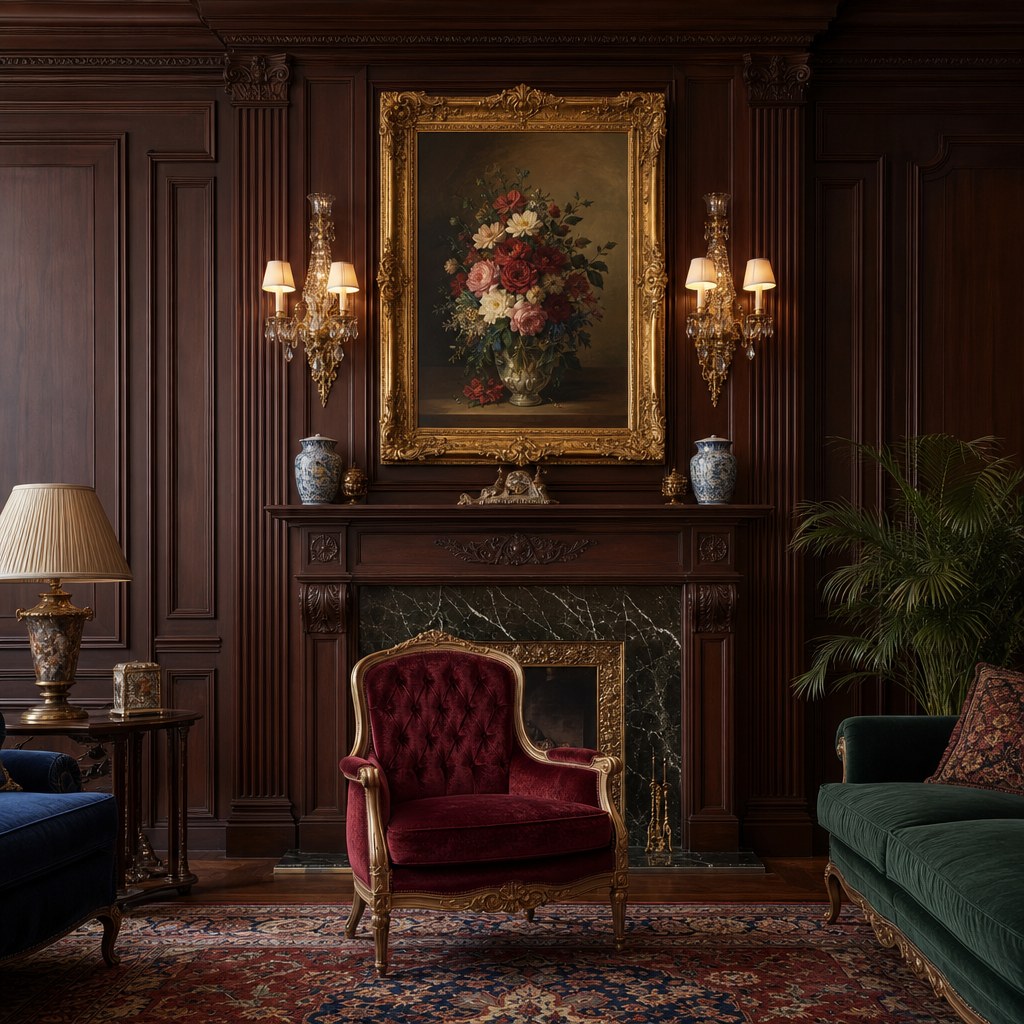
E2 Receipt - Architectural Character Layer
Three-Level Lighting · $413.96
Both YouTube sources in this research give lighting its own dedicated chapter, and both arrive at the same specification: never rely on a single light source in a traditional room. The correct layering is chandelier overhead, wall sconces at eye level, and table or floor lamps at conversational height. Suzie Anderson Home names the metal finishes precisely: polished nickel, unlacquered brass, and crystal accents are the correct traditional hardware. Ashley Childers adds gathered-fabric-shade sconces on brass as a specific combination. Crystal is not optional in traditional lighting - it is how the style signals refinement without ostentation. A chandelier without crystal reads transitional or farmhouse; a crystal chandelier in a room with dark wood and Oriental rug reads traditional immediately. The three-piece lighting set below covers all three levels. The chandelier is polished-nickel with crystal drops; the sconces are brass-finish with gathered fabric shades; the table lamps are ceramic-base with pleated drum shades that control the quality of light at the seated level.
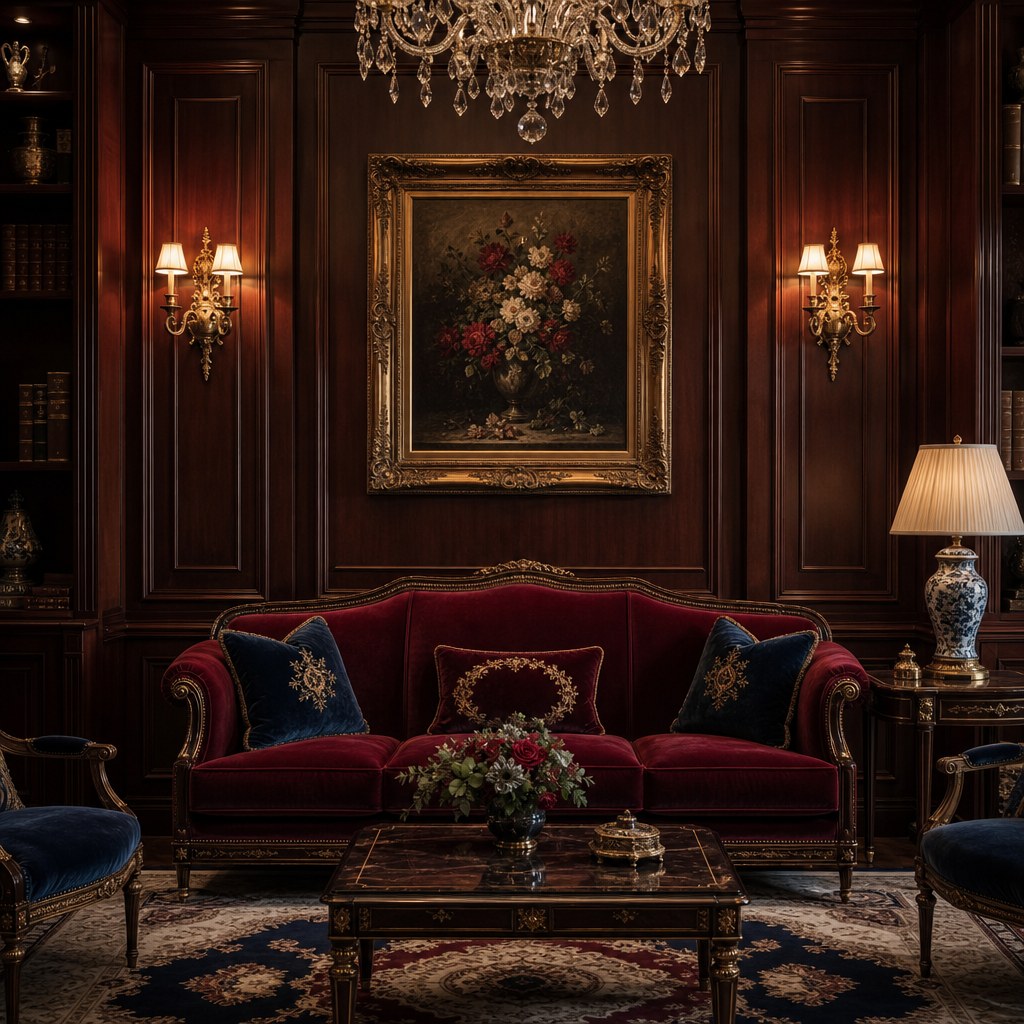
E3 Receipt - Three-Level Lighting
Dark Wood Case Goods · $614.97
Traditional furniture is dark. The Houzz editorial identifies cherry, oak, mahogany, and walnut as the primary species. Interiors by Steven G. adds maple and merbau to the list. The correct finishes are deep and warm - ebony stain, dark cherry, mahogany brown, dark walnut - never pickled, gray-washed, or whitewashed. The furniture forms carry historical silhouettes: carved legs with claw-and-ball or pad feet on the coffee table, spindle legs or barley-twist legs on side tables, glass-door fronts on case storage to display china or books while keeping them protected. Ashley Childers names the spindle leg and the barley-twist leg explicitly as traditional silhouette identifiers; they are what separates a traditional side table from a transitional or contemporary one at a glance. The glass-door bookcase is essential in traditional rooms for the same reason the ginger jar is essential: traditional spaces are meant to display the objects that signal a well-read, well-traveled, cultured household. A closed bookcase hides that signal. Glass doors display it. The carved dark wood coffee table anchors the seating arrangement and provides the visual weight that the symmetry principle requires at the center of the conversational grouping.
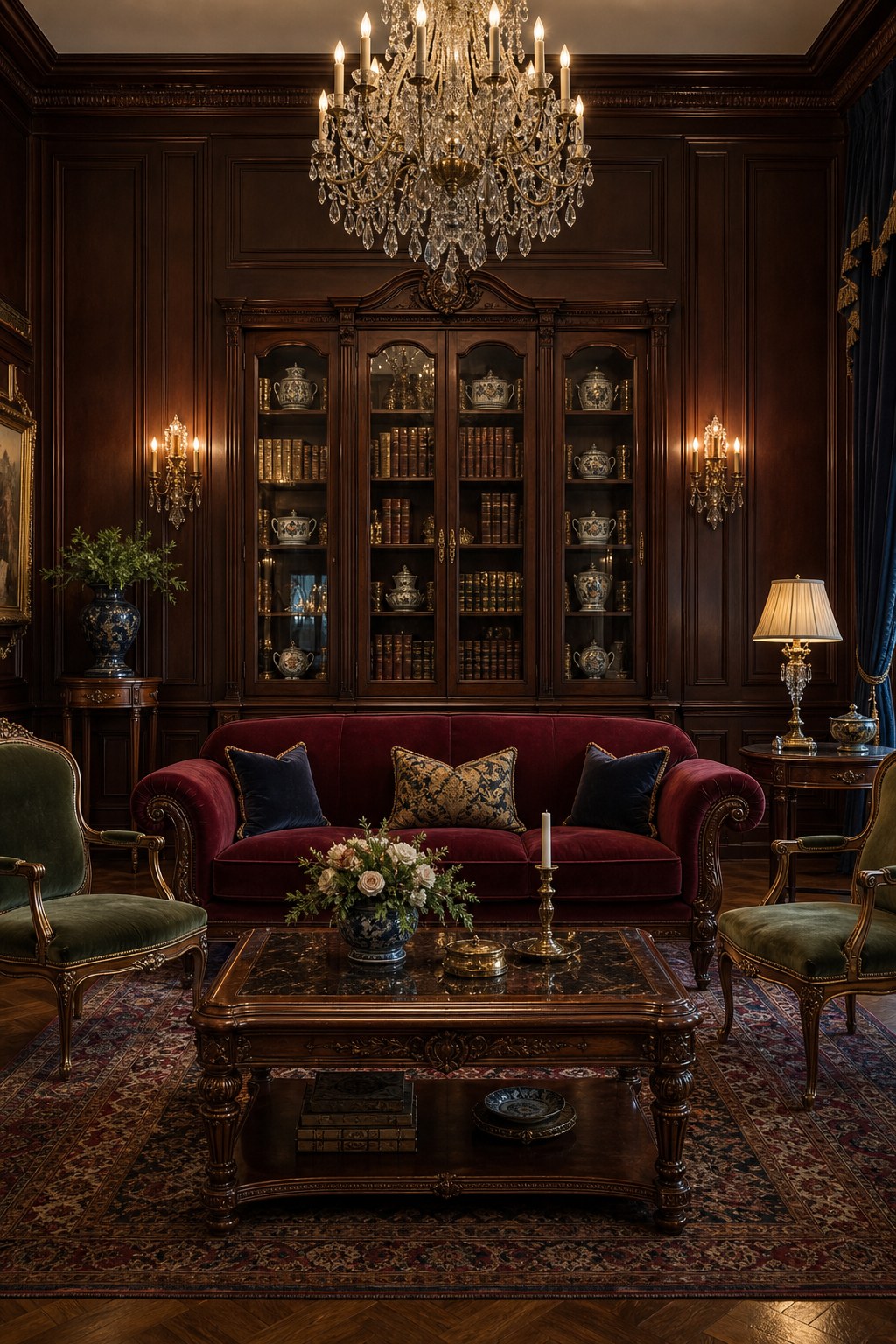
E4 Receipt - Dark Wood Case Goods
Classic Textiles and Accents · $459.95
The textile and accessory layer in a traditional room is where the style's restraint rule applies most directly. The sources agree on pattern quantity: Ashley Childers gives the clearest ceiling - one or two patterns per room in easy-to-live-with quantities. The patterns available to traditional design are extensive (damask, toile, chintz, paisley, floral, plaid, houndstooth), but applying more than two simultaneously is the overdecorating failure mode that Tebbutt warns against. The area rug is structural: an Oriental or traditional-medallion pattern rug on dark hardwood floor is the flooring signature of the style. Suzie Anderson Home dedicates an entire chapter to it, specifically citing Oriental and wool rugs over dark herringbone or parquet hardwood. The navy velvet curtain panels extend the jewel-tone accent language from the seating to the window, adding the textural weight and formality that sheers alone cannot provide. The blue-and-white ginger jar is cited by Houzz's Laura Gaskill as a defining traditional accessory - along with crystal objects, book collections, and brass candlesticks - and it is the single most efficient signal item in the accessory layer. The oval gold mirror above the mantel anchors the focal point the architectural layer creates.
E5 Receipt - Classic Textiles and Accents
| E1 - Symmetry Seating Foundation | $552.96 |
| E2 - Architectural Character Layer | $293.96 |
| E3 - Three-Level Lighting | $413.96 |
| E4 - Dark Wood Case Goods | $614.97 |
| E5 - Classic Textiles and Accents | $459.95 |
| Grand total | $2,335.80 |
Crown molding kit ($64.99) + blue-and-white ginger jar ($49.99) + oval gold mirror ($119.99) + damask pillow covers ($19.99) = $254.96. Start with the crown molding first -- it produces the highest traditional signal per dollar of any single item in this guide.
Traditional vs. Transitional.
The most common confusion in the style category. Transitional design was created specifically to mediate between traditional and contemporary -- it keeps traditional comfort and scale while stripping the period-specific silhouettes and architectural detail. The differences are structural, not aesthetic.
| Dimension | Traditional | Transitional |
|---|---|---|
| Historical roots | 18th-19th century Europe (England, France) -- Queen Anne, Chippendale, Sheraton | No period reference; blends traditional comfort with contemporary line work |
| Furniture silhouettes | Carved legs, claw-and-ball feet, cabriole forms, barley-twist details, button tufting | Cleaner lines, minimal carving, tapered legs, streamlined arms -- no period-specific detail |
| Wood tone | Dark -- mahogany, cherry, walnut, oak in deep stains; never light or gray-washed | Medium to light -- natural oak, light walnut, blonde finishes are acceptable |
| Pattern language | Damask, toile, chintz, paisley, floral, plaid; 1-2 patterns per room | Subtle texture, geometric, or solid -- period patterns are typically avoided |
| Architectural detail | Crown molding, wainscoting, coffered ceilings, columns -- required, not optional | Clean walls and ceilings are acceptable; architectural detail is not expected |
| Failure mode | Overdecorating -- too many accessories or patterns; room reads as cluttered, not curated | Blandness -- stripping so much period detail that the room has no reference point at all |
Frequently asked questions.
What is traditional interior design?
Traditional interior design is a style rooted in 18th- and 19th-century European interiors - particularly English and French influences. It is celebrated for elegance, refinement, and a timeless quality that never reads as dated. The structural principles are symmetry (pairs of everything arranged around a focal point), dark hardwood furnishings in mahogany, cherry, walnut, or oak, neutral walls with jewel-tone accents, layered lighting at three levels, and architectural details including crown molding, wainscoting, and coffered ceilings. Crystal chandeliers, brass or polished-nickel hardware, and Oriental rugs on dark hardwood floors are the material signature. The most persistent misread is that traditional design is stiff or museum-like. Every credentialed source in this research agrees: the goal is warmth, comfort, and a room designed for daily use of fine things - not a period installation. Fresh botanicals close every traditional room; two independent YouTube creators, researched separately, both end their traditional design videos on fresh flowers as the final essential element.
What colors are used in traditional interior design?
Traditional design operates on a warm neutral foundation - cream, off-white, warm beige, ivory, and tan on walls - with jewel-tone accents layered through upholstery, drapery, and accessories. The primary accents are deep red and burgundy, navy and Wedgwood blue, hunter and sage green, mustard and old gold, and emerald. These are rich, warm colors; cool cobalt or bright lime read out-of-period. Metal finishes are warm: polished nickel, unlacquered brass, oil-rubbed bronze, and antique brass are the four correct options. Chrome reads too modern for the 18th-century reference. Classic patterns - damask, toile, chintz, paisley, plaid, houndstooth, and floral - appear in one or two per room at most. The neutral wall is not optional: a room where the walls are also a jewel tone will compete with the upholstery rather than amplifying it.
What is the difference between traditional and transitional interior design?
Traditional and transitional are the two most commonly confused residential styles. Transitional was designed specifically to bridge traditional and contemporary. Traditional design commits to a historical reference - 18th- and 19th-century European interiors - and its furniture, patterns, and architectural details reflect that period directly: Queen Anne legs, Chippendale carved backs, Sheraton inlay, coffered ceilings, crown molding, Oriental rugs. Transitional strips the period-specific details and keeps only the scale and comfort of traditional furniture, pairing it with cleaner lines and lighter wood tones. In a traditional room, the furniture has historical silhouettes; in a transitional room, it does not. Traditional commits to dark wood on Oriental rugs; transitional accepts lighter floors and geometric or solid rugs. The failure mode of traditional is overdecorating. The failure mode of transitional is blandness.
What furniture pieces define traditional style?
Traditional furniture is defined by historical silhouettes from four primary periods. Queen Anne (early 18th century): curved cabriole legs with pad or claw-and-ball feet, fiddle-shaped chair backs. Chippendale (mid-18th century): elaborately carved backs, ball-and-claw feet, ribbon-and-splat details in solid mahogany. Sheraton (late 18th century): lighter, more rectilinear forms with tapered legs and inlay work. For seating, the camelback sofa with its arched back profile and rolled arms is the anchor. The wingback chair - high back with projecting ear wings, upholstered in leather or velvet - is the traditional accent chair of record. All traditional furniture is dark: mahogany, cherry, walnut, oak, and maple in deep stains are correct. Light or pickled finishes read transitional or French country, not traditional.
How do I add traditional style on a budget?
Rosslyn Tebbutt of SampleBoard identifies four high-impact, low-cost entry moves: refinish vintage furniture, frame classic artwork, install crown molding, and create tablescape arrangements with thrifted fine china. The entry path for this guide is $254.96 - crown molding kit ($64.99), blue-and-white ginger jar ($49.99), oval gold-leaf mirror ($119.99), and damask pillow covers ($19.99). The crown molding produces the highest traditional signal per dollar: a flat-ceilinged room with crown molding reads as traditionally detailed; without it, even correctly chosen furniture reads as builder-basic. For furniture, estate sales and thrift stores are the correct source for traditional style on a budget - Queen Anne and Chippendale chairs are common and refinish well. Buy fresh flowers weekly once the structural elements are in place; the botanical close is the cheapest and most effective finishing element in any traditional room.
Are fresh flowers really necessary in a traditional interior?
Yes - and the evidence for this is unusually strong. Two independent YouTube design channels - Suzie Anderson Home (241,000 views) and Ashley Childers (120,000 views) - both close their traditional design videos on fresh flowers and houseplants. Suzie Anderson dedicates a section she calls "living energy" to botanicals, presenting them as essential traditional signifiers rather than optional decor. Ashley Childers closes with: "There is nothing more gracious than a billowing vase of hydrangeas or a rose posy perched on a side table." Traditional rooms are not supposed to look staged; they are supposed to look inhabited by people who care for their home. Fresh flowers accomplish this in a way that artificial flowers, candles, and books cannot. Hydrangeas, roses, and peonies in a ceramic or crystal vase are the botanicals most cited. A weekly grocery-store bouquet at $12-18 is the correct maintenance cost for this element.