Table of Contents
What is Southwestern interior design?
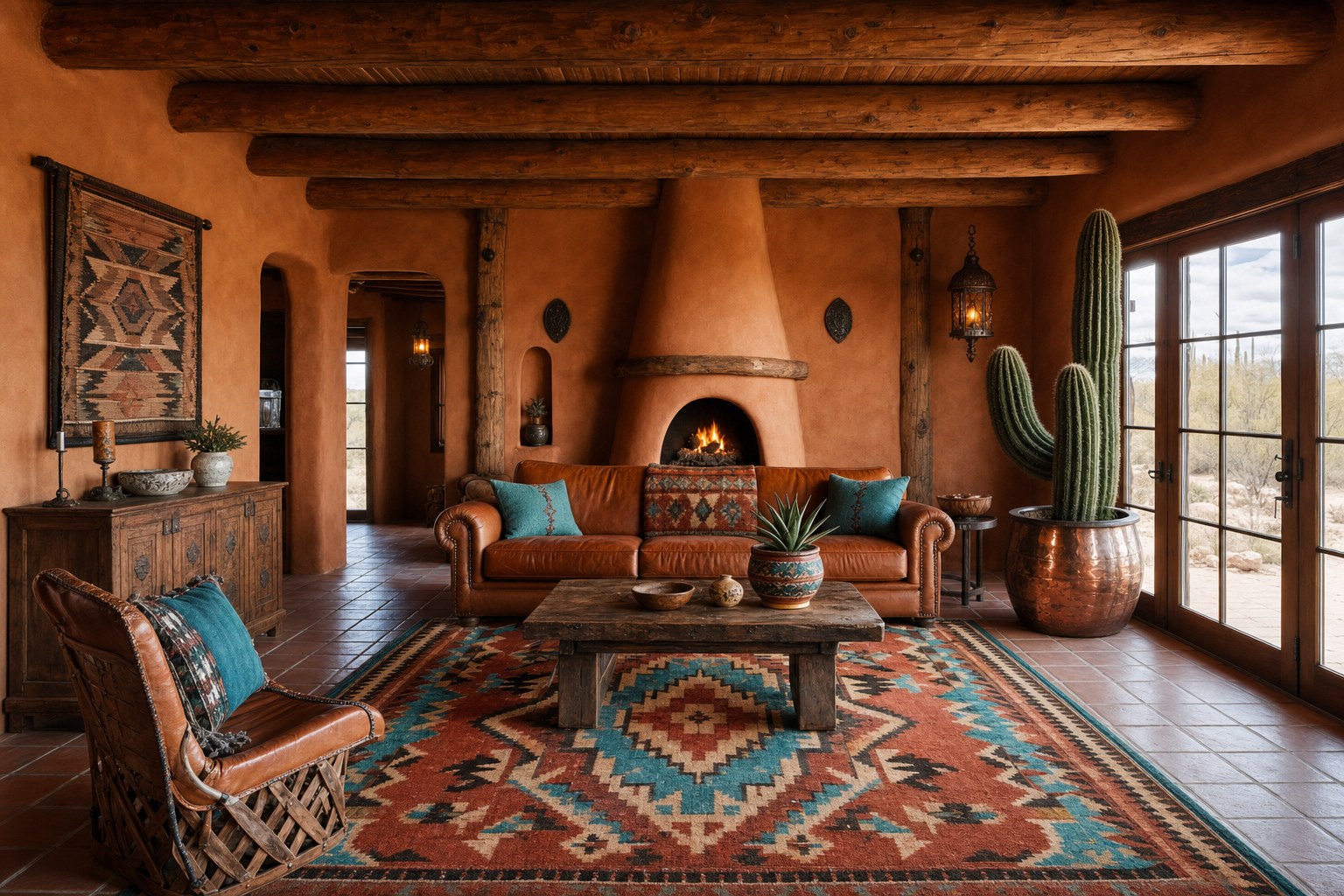
Southwestern interior design - most commonly called Santa Fe style by people who actually live with it - is the built environment of the American Southwest rendered as a residential design language. It synthesizes three traditions: the thick-walled adobe architecture of Pueblo peoples (the structural vocabulary of vigas, earthen plaster, and kiva fireplaces), the textile traditions of Navajo and Zapotec weavers (geometric wool textiles that function as both floor coverings and visual anchors), and the Spanish Colonial craft heritage that brought Talavera pottery and wrought iron to the Southwest via Mexico. The result is a style that is warm without being soft, geometric without being cold, and handcrafted without being rustic. Furniture components are commonly made of pine with natural stain finishes and rustic wrought iron hardware, with textures emphasizing suede, leather, serapes, and woven textiles.
The style's consumer vocabulary reflects its complexity. People who want Southwestern interiors rarely call them that - they say "Santa Fe style," "desert modern," "boho desert," or describe the specific materials: terracotta floors and wood ceiling beams. The brand anchor that gives Mid-Century Modern (Eames) or Modern Farmhouse (Joanna Gaines) their cultural shorthand simply does not exist for Southwestern, which makes the style both harder to search and richer in authentic regional specificity. The keyword "southwestern decor" commands 1,900 monthly searches; the more formal "southwestern interior design" is less commonly searched. Both point to the same underlying aspiration: the deep desert authenticity of terracotta plaster, handwoven wool, and handmade pottery, without the howling-coyote caricature.
The five elements below build the Southwestern room in the order that prevents the kitsch failure mode: palette layer first, textile anchor second, ceramic moment third, leather core fourth, desert plants last. Each element introduces one material or cultural reference. The cumulative effect is a room that reads as desert-authentic and architecturally coherent rather than thematically assembled. Budget sourcing logic mirrors the general principle of material-forward styles: source the authentic handcrafted pieces (genuine Navajo-inspired wool rugs, hand-thrown pottery) from specialty vendors or artisan markets, and source the ceramic and plant accessories new from accessible retailers.
Desert Palette Layer · $167.96
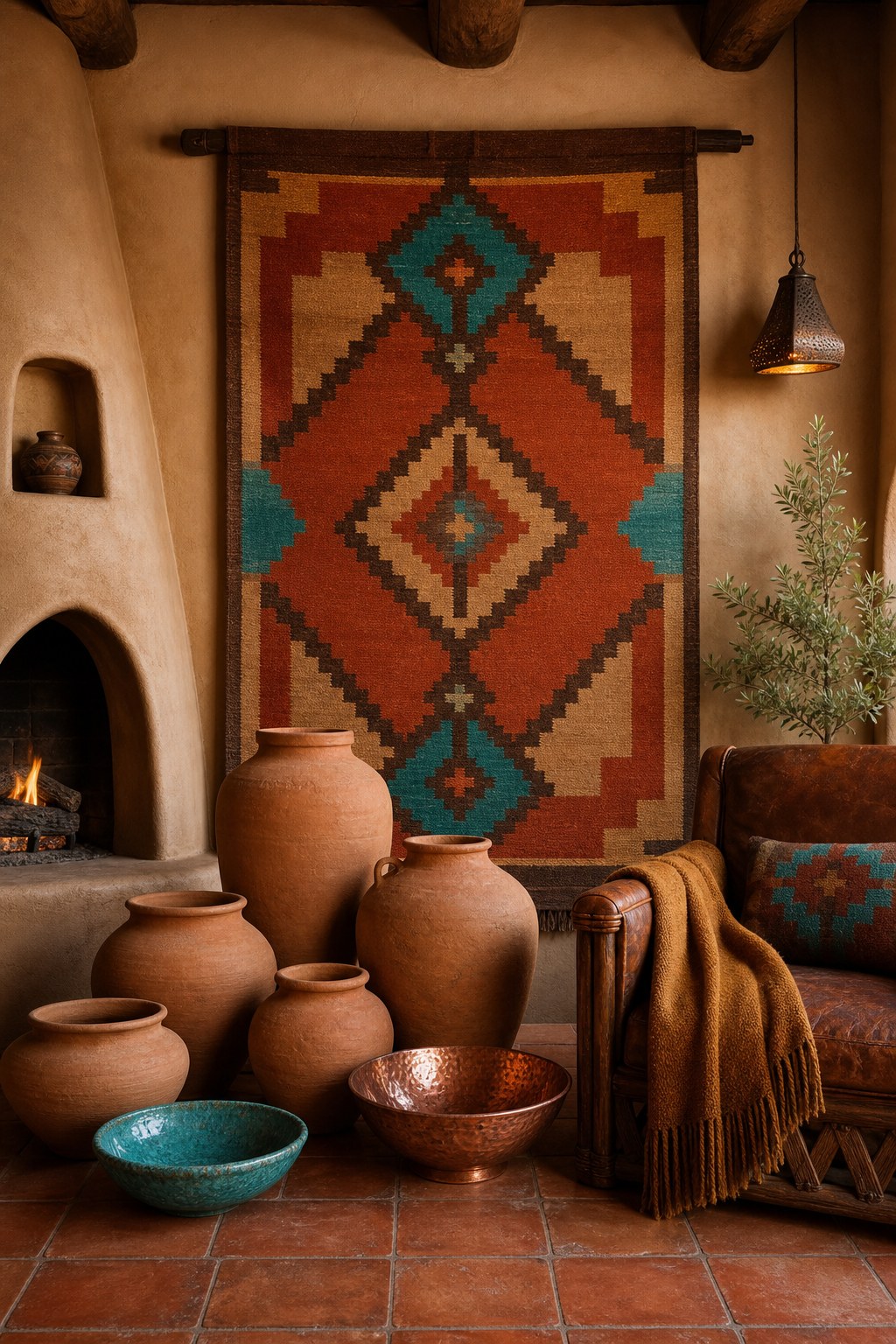
The desert palette is established in objects before it is committed to walls. Terracotta pots, turquoise-glazed ceramic accents, an ochre throw, and hammered copper bowls: because the color story of Southwestern decor has two failure modes at opposite ends of the spectrum: the bone-dry all-beige room that forgets the turquoise and terra entirely, and the oversaturated room where every surface fights for attention at full saturation. The Southwestern palette operates on two registers: a warm neutral foundation of adobe white, warm sand, and unbleached linen, and an accent tier of terracotta, turquoise, ochre, and adobe red. The desert sunset palette runs from brick red to burnt orange to muted yellow, combined with earth neutral bases and pops of crisp white, turquoise, indigo blue, and silver. Terracotta is the structural color: it appears in floor tile, wall paint, and pottery simultaneously. Turquoise is the accent that defines the style but destroys it in overuse: one or two turquoise objects read as authentically Southwestern; a turquoise-upholstered sofa reads as costume. Build the palette in the four objects below before making any irreversible paint or tile decisions.
E1 Receipt - Desert Palette Layer
Navajo Wool Rug Anchor · $249.00
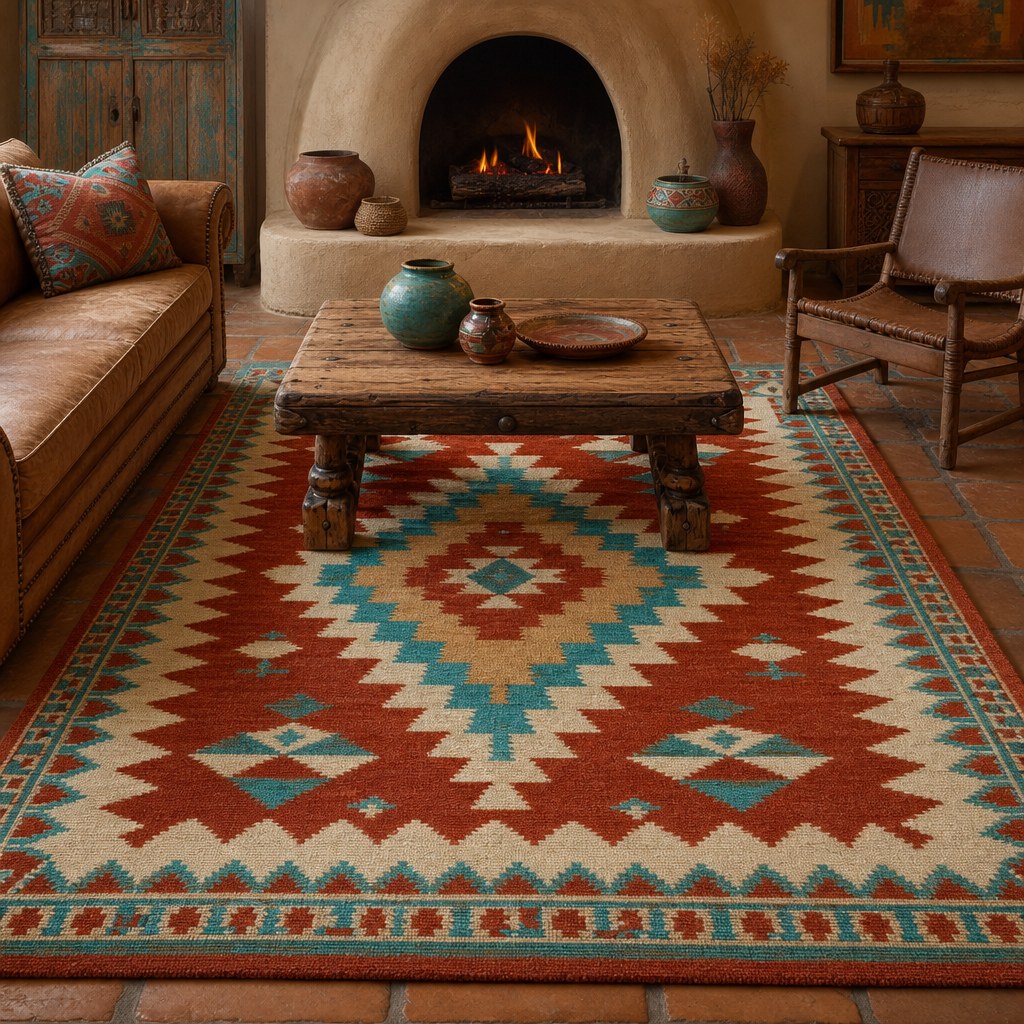
The Navajo or Zapotec-inspired wool rug is the single most important investment in a Southwestern room. And the element most likely to carry the room if every other piece is stripped away. Navajo weavings can function as floor rugs, wall hangings, or draped across the back of a sofa or leather chair, and they look especially strong when used in multiples. Different rug designs placed near each other rather than matched. The geometric language of Navajo textiles, diamonds, zigzags, stepped triangles, and striped fields, carries a design logic that Ralph Lauren and Frank Lloyd Wright both incorporated into residential work, recognizing the rugs' capacity to balance masculine geometry with feminine intricacy, producing an overall effect that is lively yet dignified; warm yet serene. Navajo rugs look most authentic when paired with the materials they belong to: leather couches in chocolate, tobacco, or cognac tones, exposed wood surfaces, and stone or terracotta floors. A Navajo-inspired wool rug in terracotta, turquoise, and natural undyed wool, sized 5x8 feet for a living room seating area, establishes the textile grammar that the rest of the Southwestern room responds to. Source from artisan weavers or specialty Southwestern rug dealers for the genuine article; Zapotec-woven rugs from Oaxaca, Mexico offer comparable quality and geometric richness at accessible price points.
E2 Receipt - Navajo Wool Rug Anchor
Talavera Ceramic Moment · $134.97
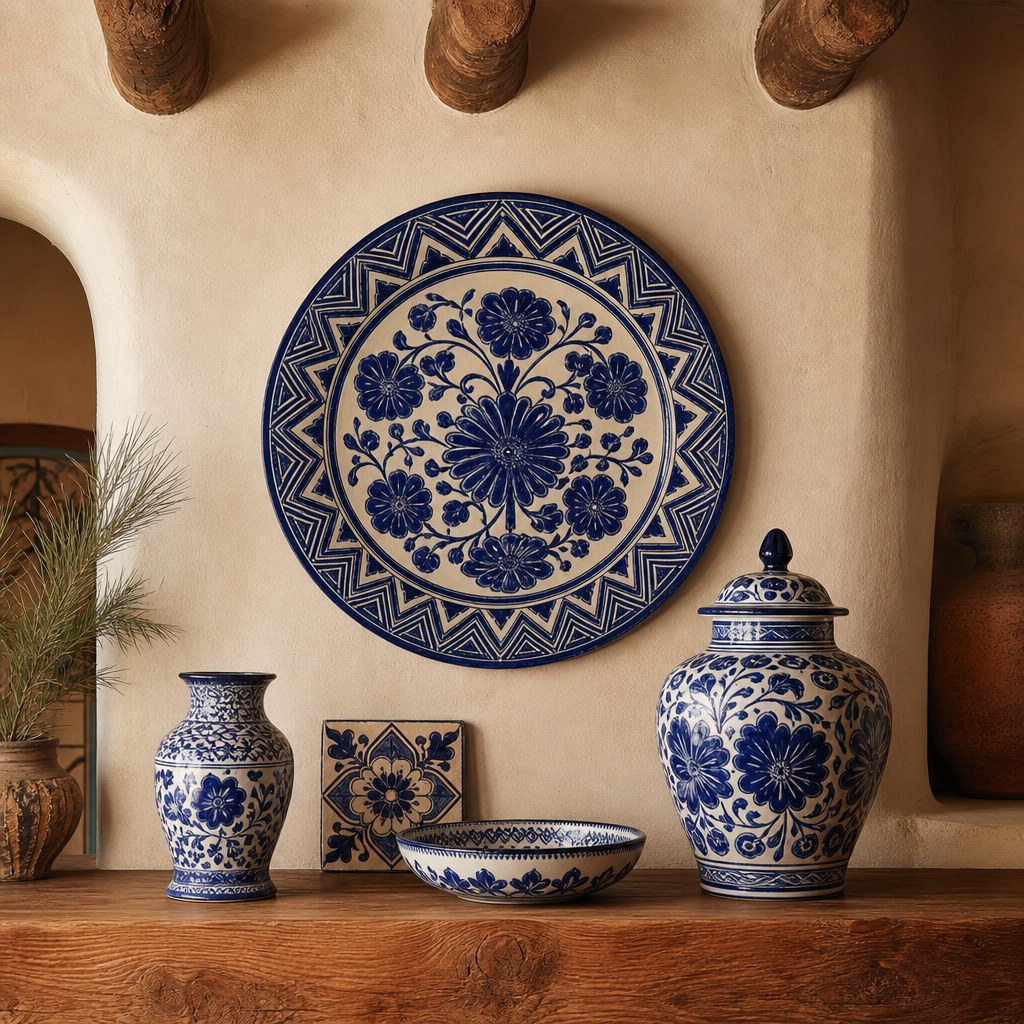
Talavera pottery is the ceramics tradition that anchors the Spanish Colonial half of Southwestern design. Hand-painted earthenware produced in Puebla, Mexico, featuring cobalt blue, yellow, and terracotta floral or geometric motifs on a white glaze ground. In interior applications, Talavera appears as decorative plates and platters mounted on adobe walls, as large vessel vases on shelving or console tables, and as tile insets in kitchen backsplashes or stair risers. Integrating a Talavera tile backsplash brings an explosion of pattern and cultural history. The Talavera ceramic moment in this blueprint is built from three objects at increasing scale: a small hand-painted Talavera accent tile for display or framing (the entry-point piece, approximately 6 inches square), a Talavera-style ceramic vase in cobalt blue and white (the vertical accent for shelving or mantle), and a large decorative Talavera platter for wall mounting above a console table or fireplace mantle. The three together introduce the style's signature ceramic vocabulary without requiring tile work or permanent installation. A specification that matters for renters. The contrast between the hand-painted Talavera pieces and the unglazed terracotta pots from Element 1 is intentional: the glazed and the unglazed coexist in authentic Southwestern rooms because they reference two different regional ceramic traditions that happen to share the same desert palette.
E3 Receipt - Talavera Ceramic Moment
Cowhide and Leather Core · $389.99
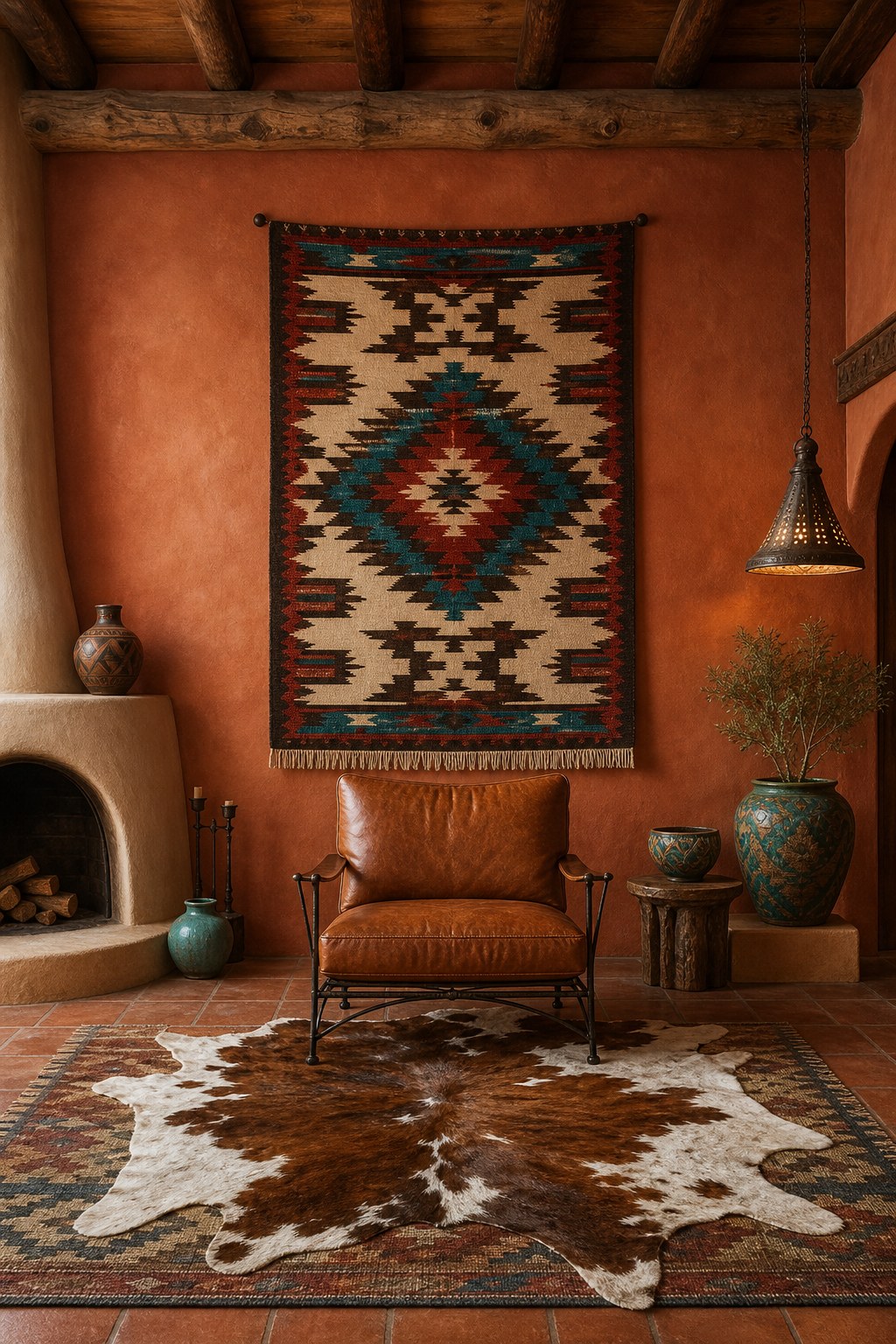
Cowhide and leather are the seating and floor materials that ground Southwestern interiors in the ranching and working-land tradition that runs alongside the Pueblo and Spanish Colonial design lineages. Cowhide was one of the main materials used when this hybrid interior decor was born, so leather furnishings are a centerpiece of this design. Navajo rugs look especially beautiful when paired with leather couches in shades of chocolate, tobacco, or cognac. The warm brown leather tones sit in the same temperature register as the terracotta and ochre accents while providing visual weight and textural contrast against the soft wool pile of the rug. The cowhide and leather core in this blueprint is built from two pieces. The cowhide accent rug, a genuine or high-quality synthetic cowhide in natural brown and white, placed on top of the Navajo wool rug from Element 2 introduces the layered-rug technique that is a signature of authentic Southwestern interior styling: two textiles of different pattern scales and material textures overlapping in the same floor zone. The leather accent chair in cognac or tobacco tone provides the seating anchor that completes the material story, pairing the Navajo textile geometry with the warm leather that the tradition has always stood beside. Wrought iron legs or hardware on the chair reinforce the Spanish Colonial craft reference that Talavera pottery introduced in Element 3.
E4 Receipt - Cowhide and Leather Core
Desert Plant Installation · $104.97
Desert plants are the living decor element that distinguishes Southwestern interiors from other warm-neutral palettes that share the terracotta color story. Cacti, succulents, and agave are peanut butter and jelly with New Mexico decor. The pairing is so natural it functions as a litmus test for whether a room has committed to the desert aesthetic or merely borrowed its surface colors. The architectural quality of desert plants is what makes them design objects rather than styling accessories: a saguaro arm reaches upward with the same structural confidence as a viga beam; a prickly pear's paddle silhouette introduces geometry as legible as the stepped triangles in the Navajo rug; a barrel cactus on a shelf holds its own against a Talavera vase without competing with it. Display desert plants in terracotta pots, ceramic planters with Aztec-inspired patterns, or wooden stands to vary the heights. The height variation is what creates an intentional installation rather than a matched collection. The three-piece desert plant installation in this blueprint builds from floor to shelf to tabletop: a large floor-level saguaro or columnar cactus in a hammered copper or terracotta pot, a mid-height prickly pear or agave on a carved wood stand, and a cluster of small succulents on a shelf in Talavera-style ceramic planters.
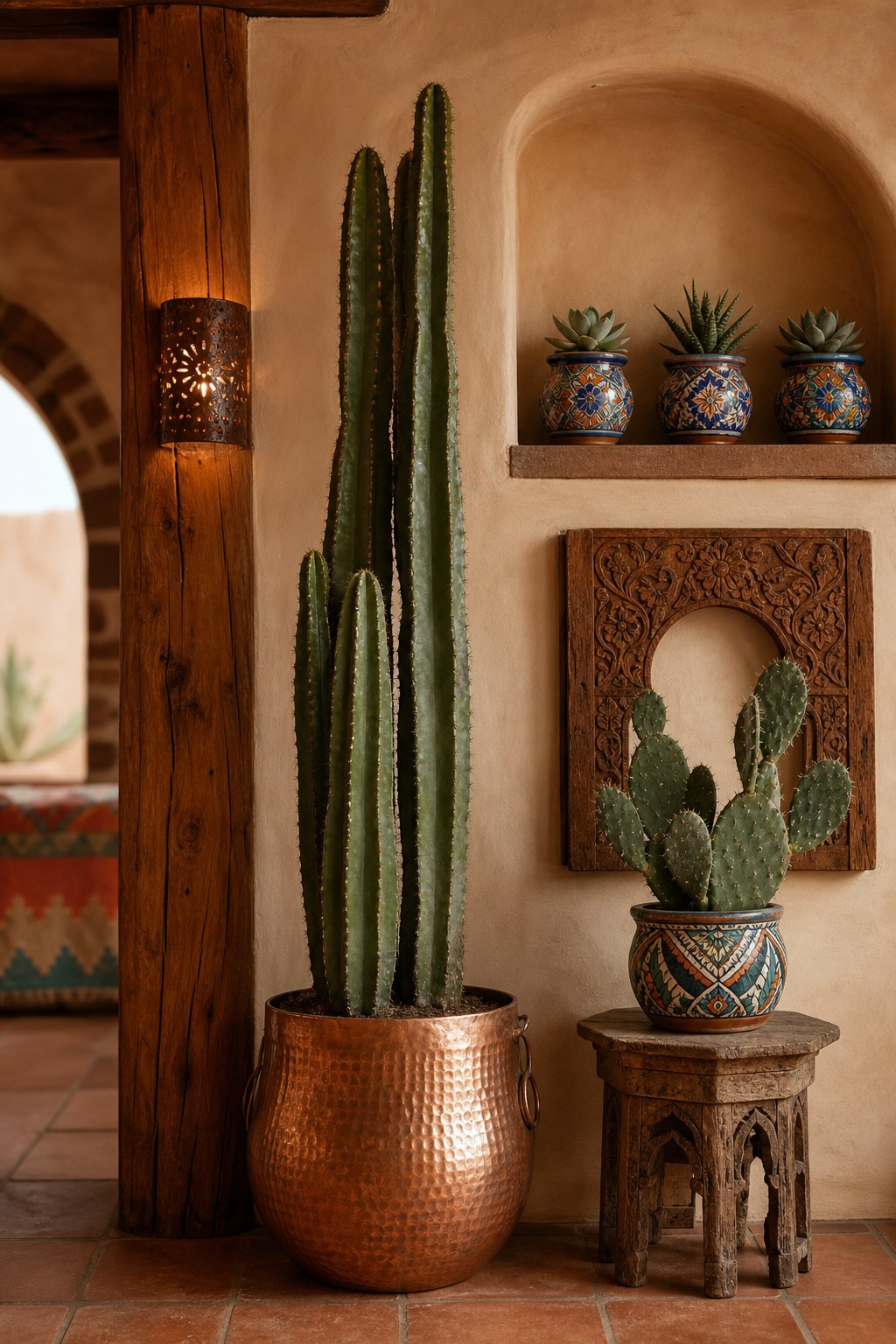
E5 Receipt - Desert Plant Installation
Southwestern vs. Desert Modern.
Both styles draw from the same geographic palette, terracotta, warm sand, desert plants, natural materials, which is why they are frequently conflated. The distinction is cultural referencing versus material restraint. Southwestern design carries explicit cultural signals: Navajo geometric textiles, Talavera pottery, vigas and adobe plaster, and the full visual vocabulary of Pueblo and Spanish Colonial craft traditions. Desert Modern strips the cultural references and keeps only the material palette, warm neutrals, organic materials, minimal ornamentation, resulting in a style that reads as contemporary California or Arizona architecture rather than Santa Fe. The simplest test: if there is a hand-woven geometric rug and hand-painted pottery in the room, it is Southwestern. If there is a concrete floor, a linen sofa, and three potted succulents, it is Desert Modern.
| Dimension | Southwestern / Santa Fe Style | Desert Modern |
|---|---|---|
| Cultural anchors | Strong. Navajo and Zapotec textile geometry, Talavera ceramics, Pueblo adobe and viga architecture | Absent. Material palette without cultural referencing; landscape as the only inspiration |
| Color use | Warm and layered. Terracotta, turquoise, ochre, adobe red, all in active use across surfaces | Restrained. Warm sand and concrete neutrals dominate; color limited to single accent objects |
| Textile approach | Prominent and geometric. Navajo-inspired wool rugs, woven wall hangings, serapes, layered floor textiles | Minimal and solid. Linen upholstery, simple cotton throws; pattern avoided entirely |
| Ceramics | Hand-painted Talavera pottery, hand-thrown Pueblo-style vessels; ceramics as cultural objects | Minimal ceramics in warm neutrals; no hand-painting; form over cultural reference |
| Architecture | Adobe plaster walls, exposed viga ceiling beams, kiva fireplaces, Saltillo tile floors, architecture carries the style | Clean-lined contemporary architecture in stucco or concrete; no historical reference required |
| The confusion test | Feels like a Santa Fe or Taos living room, warm, hand-crafted, culturally layered | Feels like a Scottsdale or Palm Springs home. Cool, minimal, the desert as abstraction |
The $167 entry path.
Four items that establish the Southwestern desert palette in any room. No rug replacement, no paint, no tile work required. The complete E1 serves as the entry path.
Frequently asked questions.
What is Southwestern interior design?
Southwestern interior design - also called Santa Fe style - is a warm, material-forward residential aesthetic rooted in the architectural traditions of the American Southwest, synthesizing Pueblo, Navajo, and Spanish Colonial craft into one design language. Its defining structural elements are adobe or clay-plaster walls, exposed wooden ceiling beams called vigas, and Saltillo terracotta tile floors. The material palette runs on Navajo and Zapotec wool textiles, hand-painted Talavera pottery from Mexico, cowhide and leather seating, and desert plants used as living decor. Natural materials such as wood, stone, and clay are used as essential accents to stucco or concrete. Exposed wooden beams, rough-hewn furniture, and handcrafted pottery bring an authentic touch that celebrates the beauty of imperfection. The color story draws from the desert terrain: terracotta, ochre, turquoise, adobe red, and sage green. The contemporary version - sometimes called desert modernism - applies this material palette with restraint, favoring authentic handcrafted pieces over the mass-produced gift-shop version of the style.
What is the Southwestern color palette?
The Southwestern color palette operates on two registers. The warm neutral foundation - adobe white, warm sand, unbleached linen - establishes the base that makes the accent colors readable without overwhelming the room. The signature accent tier draws directly from the desert landscape: terracotta (the structural color, appearing in floor tile, wall paint, and pottery simultaneously), turquoise (the style's most iconic accent), ochre and mustard yellow, adobe red (a deeper brick tone distinct from terracotta), and sage green. The desert sunset palette runs from brick red to burnt orange to muted yellow, with earth neutral bases and pops of crisp white, turquoise, indigo blue, and silver. Turquoise is the style's defining accent color and its most dangerous: one or two turquoise objects in a terracotta-and-sand room read as authentically Southwestern; a turquoise-upholstered sofa reads as costume. Use it at accent scale, one or two objects, and let the terracotta and warm wood carry the room's warmth.
What is a viga in Southwestern interior design?
Vigas are the heavy exposed wooden ceiling beams that are the single most recognizable architectural element of Southwestern and Pueblo Revival design. In traditional adobe construction, "flat, rounded rooflines are supported by long wooden support beams called vigas," which are typically cedar or pine and "protrude through the exterior adobe walls" on both sides. Between the vigas, smaller poles called latillas - often peeled aspen or cedar branches - are laid in a herringbone or parallel pattern to create the ceiling surface. In contemporary Southwestern interiors, vigas appear as decorative elements that reference the architectural tradition even in non-adobe structures: heavy timber beams in pine, cedar, or reclaimed wood applied to the ceiling carry the architectural signal even where the adobe walls are absent. The viga is the structural element that makes every other Southwestern material choice read as intentional rather than decorative - without it, the Navajo rug and Talavera pottery exist in a context that could belong to any warm-neutral style.
How do you do Southwestern decor without it looking like a gift shop?
The gift-shop failure mode has a specific inventory: mass-produced coyote howling-at-the-moon wall art, turquoise deployed at every surface, plastic Kokopelli figurines, and the color combination of bright orange plus bright turquoise at equal saturation with no neutral grounding. The elevated version follows three rules. First, anchor the room in warm neutrals: adobe white or warm sand walls - the terracotta and turquoise accents read as sophisticated against a neutral base and as chaotic against each other. Second, source at least one authentic handcrafted piece: a genuine Navajo-inspired wool rug, hand-thrown pottery, or handmade Talavera tile carries the cultural authenticity signal that the entire room benefits from, because the made-by-hand quality reads at a distance in ways that mass production cannot replicate. Third, limit turquoise to accent-tier objects - pottery, a single throw pillow, one framed piece of art - rather than deploying it as a wall or upholstery color. The standard to aim for: deep desert authenticity - terracotta plaster, vigas, and natural textiles without the gift-shop kitsch.
What plants work in a Southwestern interior design?
Desert plants are the living decor element that distinguishes Southwestern interiors from other warm-neutral palettes that share the terracotta color story - peanut butter and jelly with New Mexico decor style. Saguaro cactus (large specimen plants for floor-level focal points), prickly pear cactus (mid-height branching architecture), barrel cactus (compact, sculptural, suitable for tabletop and shelf display), agave (dramatic rosette form that reads as architectural), and succulents for small-scale shelf repetition are the canonical choices. These plants work visually because their silhouettes are architectural rather than soft, reinforcing the room's structural quality. Display them in terracotta pots, ceramic planters with Aztec-inspired patterns, or wooden stands to vary the heights - the height variation creates an intentional installation rather than a matched collection, which is the difference between a living decor moment and a garden center impulse purchase. Low-water requirements make desert plants particularly practical: the plants that define the visual language of the style are also the easiest to keep alive in it.
More rooms like this
No spam. Unsubscribe anytime.