Table of Contents
The Earth Tone Revival.
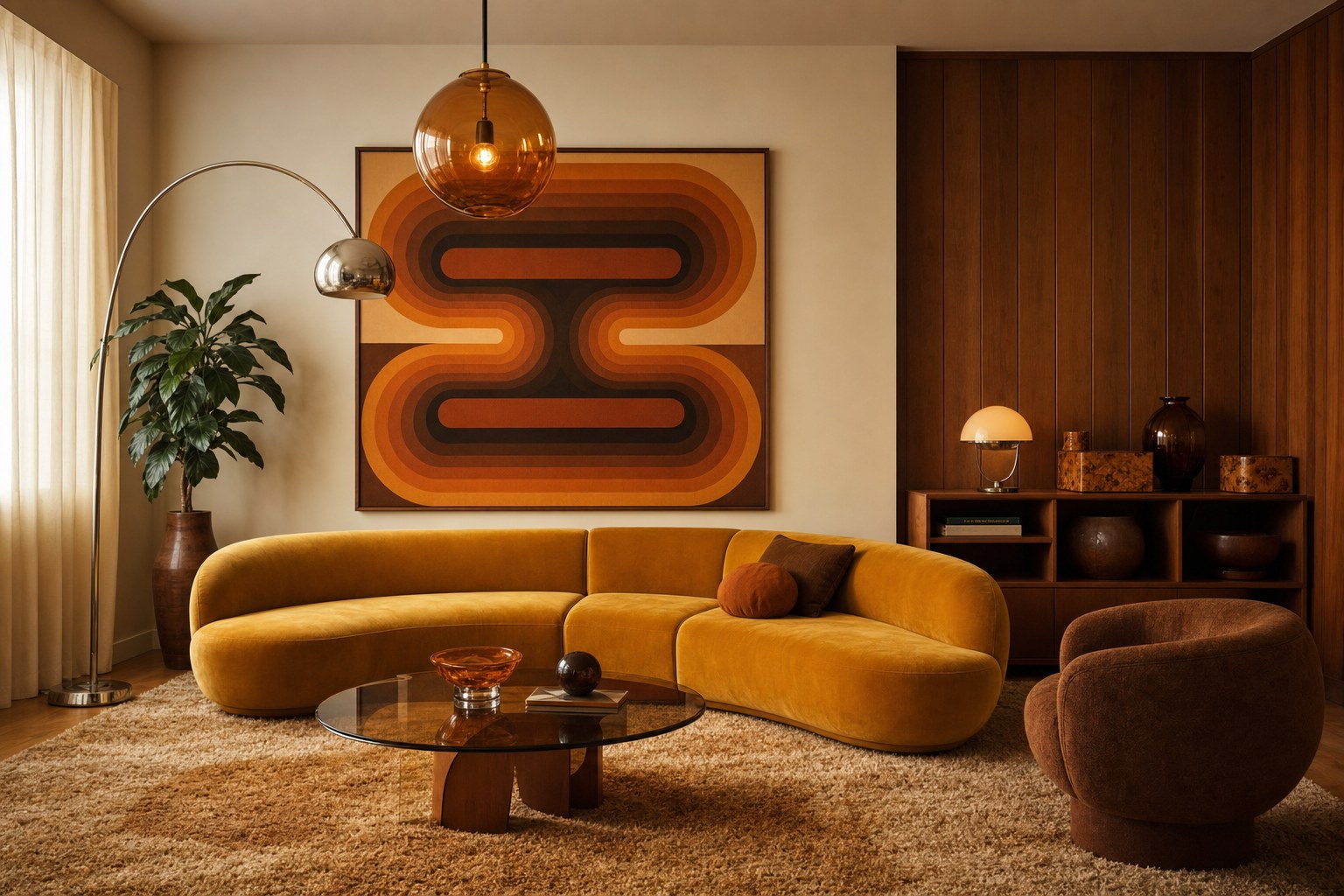
The 1970s design revival is not nostalgia for shag carpet and lava lamps. It is a response to design fatigue. A decade of optic white walls, gray laminate floors, and matte black fixtures left a generation of renters and homeowners craving warmth and what designers in the Alice Lane Home Collection identified as rooms that feel "grounded." The 70s was, from a design standpoint, the decade most committed to making warmth structural - not decorative. Mustard yellow was a wall color, not a pillow accent. Walnut was a surface material, not a veneer. Shag was a floor treatment, not a throw. The revival is applying that same commitment to warmth through contemporary materials and contemporary restraint.
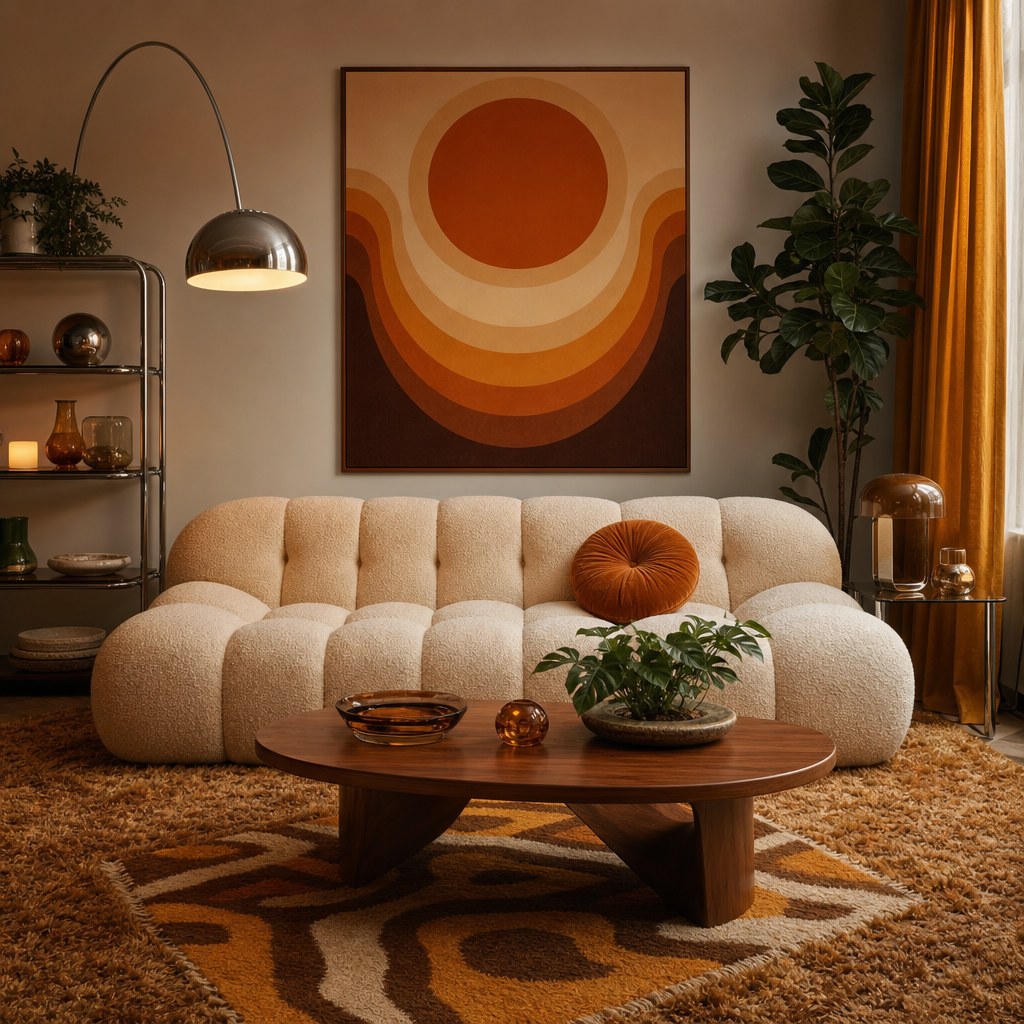
The specific visual language the design world has settled on: what journalist Cara Greenberg called the "curated, earth-toned Laurel Canyon look" - organic, relaxed, low-to-the-ground, and made of real materials. Twenty-seven percent of U.S. designers and twenty-nine percent of UK designers cited the 1970s as their primary era of inspiration for 2024, outranking the 1960s (cited by only 14%) and every other historical decade in a 1stDibs survey of professional designers. The 70s won because it is the decade where warmth and sophistication were the same thing. The five elements below build the 70s revival room in the order that prevents the look from tipping into kitsch: palette established first, seating core second, wood layer third, lighting fourth, textiles last.
Budget logic for the 70s revival follows the same sourcing hierarchy as every material-forward style. Source the curve-silhouette accent chair and mushroom stool vintage (First Dibs, Chairish, local estate sales) - age and patina reinforce the authenticity of the organic shapes. Source the velvet pillow covers, amber glass vases, and shag rug new (Amazon, Target, CB2) - these categories have reliable quality at accessible price points. Source the burl wood accessories wherever you find them - burl is having a genuine commercial moment, and both Wayfair and HomeGoods carry legitimate burl-finish pieces for under $60.
Earth Tone Palette Layer · $154.96
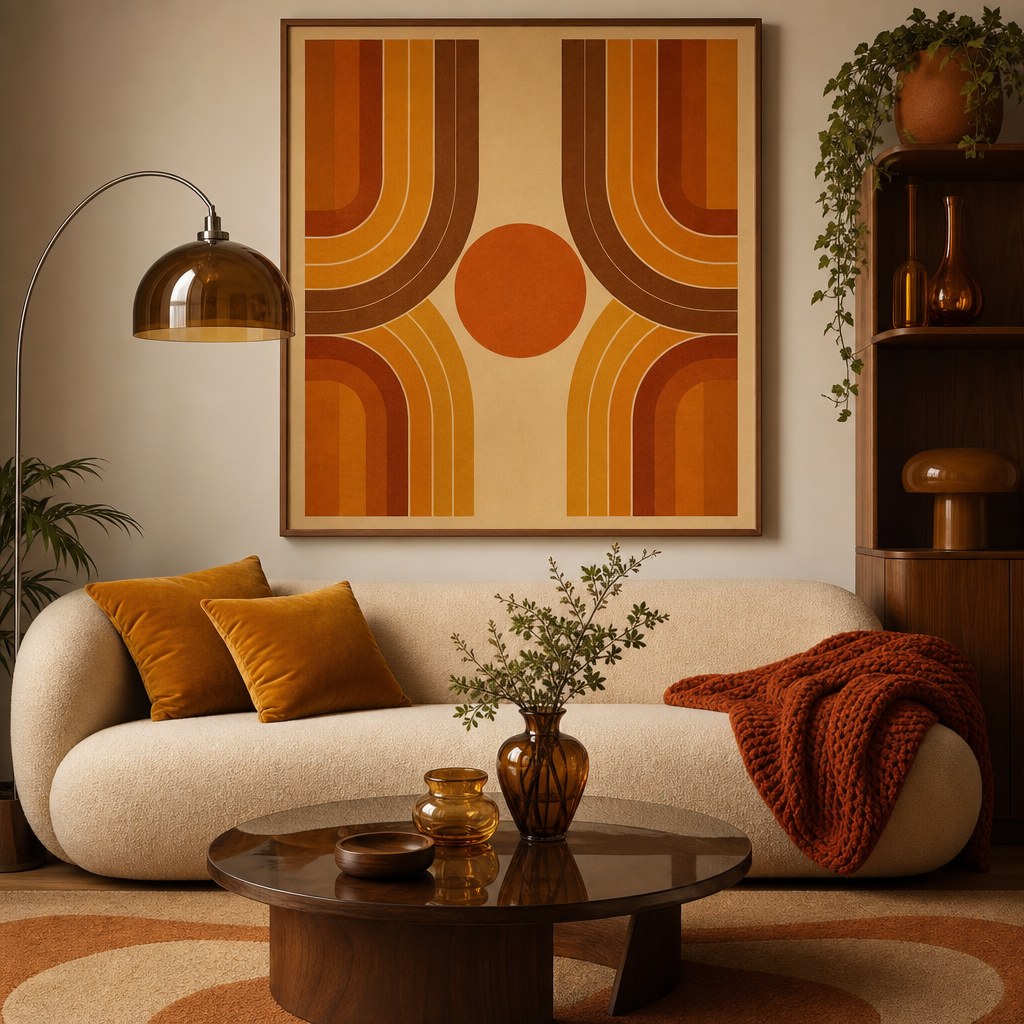
The earth tone palette is the first decision in the 70s revival blueprint, and it is the element that makes or breaks the rest. Build the palette in objects before you paint: four palette layer items. Mustard velvet pillow covers, amber glass vases, a burnt orange throw, and terracotta pots. Establish the color story across every surface at a price point that is fully reversible if the direction shifts. The 70s palette runs on three tiers. The warm neutral base (cream walls, warm white oak floors) is the canvas. The signature mid-tones, mustard yellow, avocado green, burnt orange, terracotta, are the room's color story, introduced through upholstery and large accents. The accent tier (oxblood, olive green, warm amber) comes in through glass, ceramics, and small objects. A useful self-test before committing to wall color: "What is your shade? Are you an avocado? Are you mustard? Are you lemon?" The right answer is singular. Not all three at once. Pick the dominant mid-tone and build the other two as supporting characters. The amber glass vase set is the palette's transparent indicator light: hold it up against the proposed wall color, and the resulting glow tells you whether the color story is warm enough.
E1 Receipt - Earth Tone Palette Layer
The Curved Seating Core · $358.97
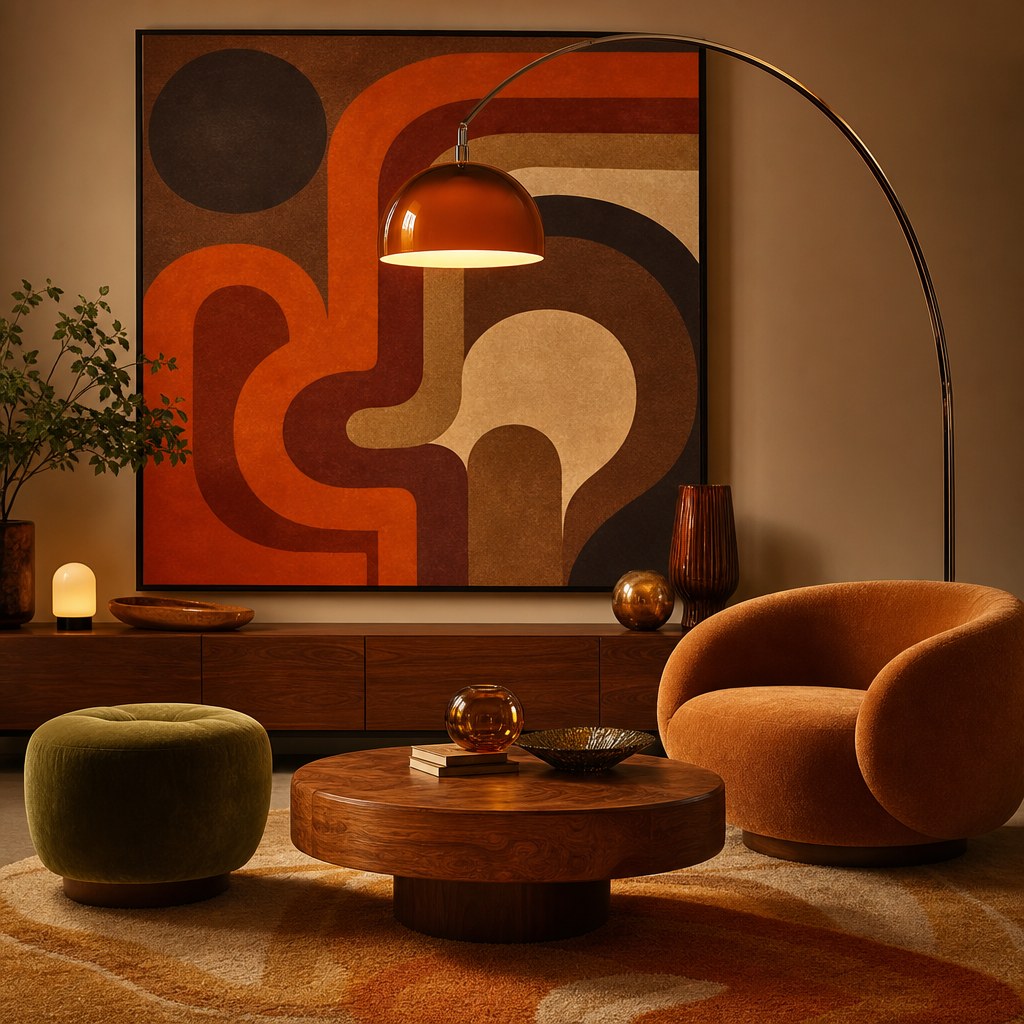
Curves are the primary furniture signal of the 70s revival. Every major designer in this research agrees on that. The decade rejected the rectilinear geometry that defined mid-century modernism and replaced it with what the Alice Lane designers called "organic shapes and non-directionals": forms that are neither horizontal nor vertical, neither traditional nor modern, just softly and radically curved. The curved seating core is built from three pieces in ascending scale: the velvet mushroom accent stool (the smallest and most versatile 70s seating signal, at 18 inches and suitable for any room corner, stairwell landing, or console moment), the round organic coffee table (the room's geometric anchor, which establishes that the soft-edged material logic is intentional and not accidental), and the curved velvet accent chair (the sculptural statement seating that carries the most visual weight of the three). The mushroom stool deserves particular attention. Working interior designers at Alice Lane identified the velvet mushroom stool as the "quintessential 70s accent piece for small spaces". Not just for its era reference but because its circular silhouette and plush velvet upholstery are two of the style's most identifiable signals packed into a $79 piece. Avocado or mustard colorways are both period-accurate; choose based on which sits in the room's dominant mid-tone family.
E2 Receipt - The Curved Seating Core
The Warm Wood Layer · $219.96
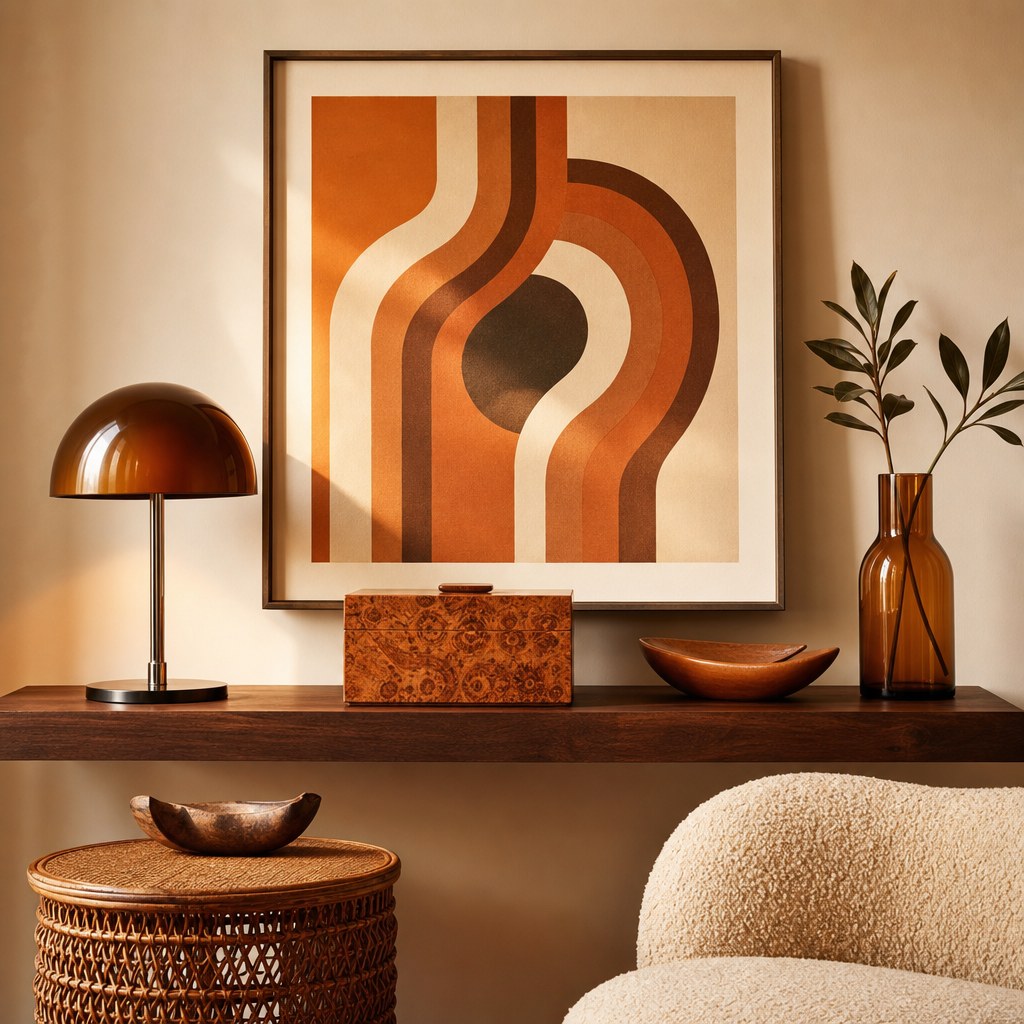
The warm wood layer is where the 70s revival diverges most sharply from mid-century modern. Both styles use wood prominently, but the 70s went darker and warmer: walnut-stained finishes, teak, and the singular material called burl wood. Burl wood is what happens when a tree's grain grows in a wildly irregular swirling pattern around an injury or burl growth. The resulting sliced surface is a one-of-a-kind organic map of dark and light figure that no two pieces share. It became a signature 70s interior material precisely because it is impossible to mass-produce. The current burl revival. Appearing on boxes, trays, nightstands, dressers, and full bathroom vanities, is confirmed by working interior designers as one of the clearest signals of a 70s-informed room. The concept of "wood drenching". Applying warm-stained wood to walls, ceiling, and built-ins in a single holistic wrap, is distinct from the 70s-era wood-paneled accent wall. "If you want to feel history and you want to feel something, take a wood drench," as the Alice Lane designers put it. The four warm wood layer items build this material foundation at the accessory level: the burl wood box is the gateway piece, the walnut floating shelves establish the wood-on-walls vertical logic, the rattan side table contributes woven organic texture alongside the warm wood grain, and the carved teak bowl grounds the vignette.
E3 Receipt - The Warm Wood Layer
Retro Lighting Moment · $179.98
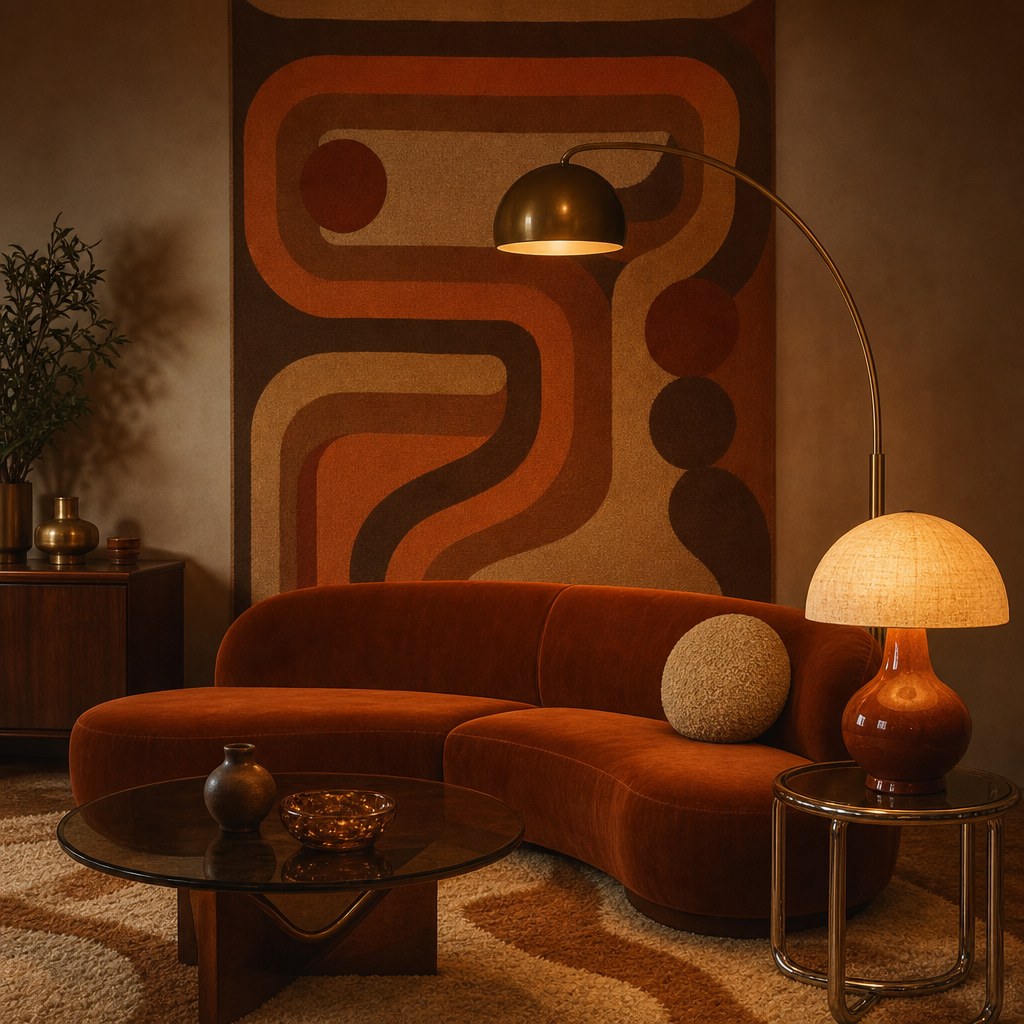
The 70s revival runs on warm, low, and ambient light. The opposite of the recessed-downlight flush-lit rooms that preceded the trend. Two pieces establish the retro lighting moment with precision. The mushroom table lamp. Named for the wide, domed shade that hovers above a cylindrical or sculptural base, is currently averaging over 12,000 monthly Google searches, and the search interest precisely reflects its role as the single most recognizable 70s-era lamp form. A ceramic base in terracotta or camel with a cream linen shade is the period-accurate version; an amber glass base is the more contemporary interpretation. The arc floor lamp. A tall single pole, curving over a seating area to deliver a pool of downward light, is the 70s-era alternative to a pendant when ceiling work is not an option. In a 70s revival room, both lamps should be on warm-toned bulbs at 2700K or lower; the harsh blue cast of daylight LEDs at 5000K is the fastest way to undo the warmth the palette layer established. The two lamps together create an ambient lighting scheme that is layered and directional without any ceiling work. An important specification for renters who cannot modify overhead fixtures.
E4 Receipt - Retro Lighting Moment
Textile Foundation · $249.97
The textile foundation is added last because it responds to the palette and material story already in the room rather than setting it. Shag pile carpet, the most stereotypically 70s floor covering, is best deployed as a contained area rug rather than wall-to-wall in the modern interpretation: it provides the tactile depth and era signal without the commitment of carpet installation. A 5x8 shag rug in camel or terracotta tones placed under the seating core's curved coffee table is the period-accurate version. The velvet curtain pair is the room's vertical textile statement: mustard yellow velvet at 84 inches gives the room the saturated column of color that the era favored while softening the window boundary without blocking light entirely. "Velvet sofas, fringed cushions, or faux fur rugs are a great way to layer texture while adding a modern feel to the space," as one textile designer put it in Goodhomes Magazine. And the same principle applies to velvet curtains, where the pile catches light differently throughout the day and creates the warm, moody atmosphere that is the 70s revival's defining ambient quality. The geometric throw rug, a smaller 2x3 accent rug in mustard, brown, and cream, is placed at an angle over the shag rug to introduce the era's signature layered-rug technique without committing to full geometric pattern at sofa scale.
E5 Receipt - Textile Foundation
70s Revival vs. Mid-Century Modern.
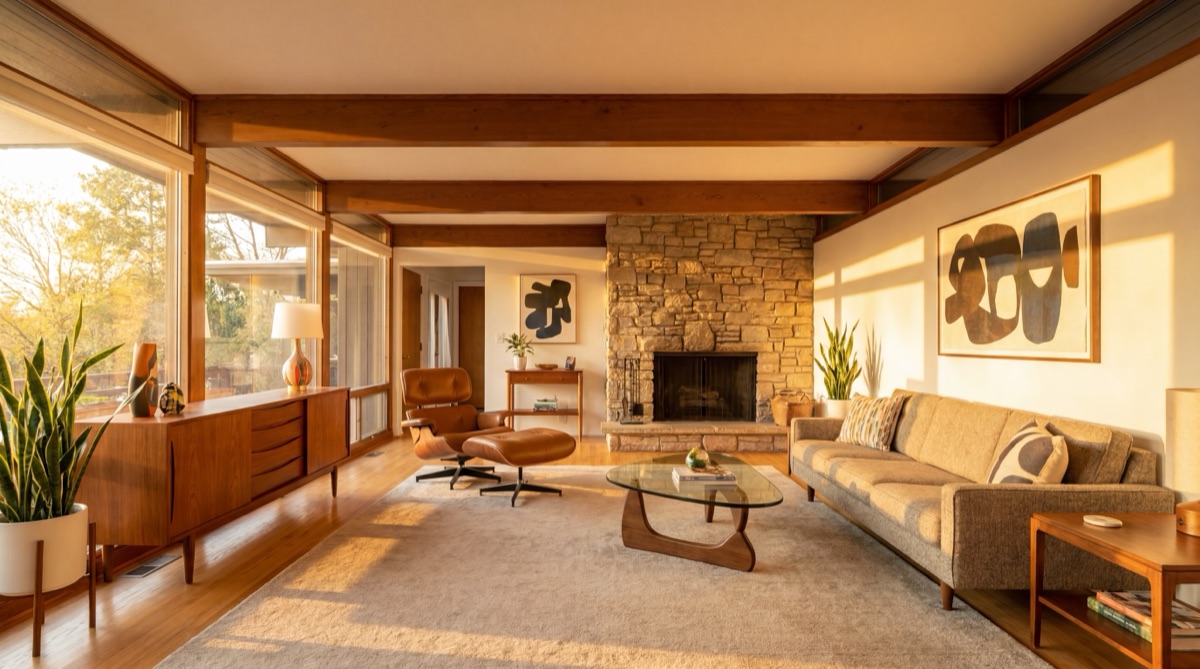
Both styles claim warm wood, organic shapes, and period-authentic materials. Which is why they are consistently confused. The distinction is temperature and commitment. Mid-century modern runs cooler: teak furniture against white walls, clean lines, controlled use of color. The 70s revival runs warmer: darker woods, earth-saturated upholstery, layered textiles, and a willingness to let the room feel cocooning rather than airy. The easiest test: if the room feels like a 1960s corporate lobby with good taste, it is mid-century modern. If it feels like a Laurel Canyon living room owned by someone who has traveled and collects things, it is 70s revival.
| Dimension | 70s Revival Interior Design | Mid-Century Modern Interior Design |
|---|---|---|
| Color temperature | Warm and saturated. Mustard, avocado, burnt orange, terracotta against cream walls | Cooler and more restrained. White or off-white walls, with pops of burnt orange or olive as accent only |
| Wood use | Darker walnut stains; burl wood accessories; wood-drenched surfaces (walls, ceiling, millwork as one material) | Teak and rosewood in furniture, but walls stay white; wood is furniture, not surface |
| Curve logic | Curves everywhere. Sofas, stools, coffee tables, lamps, ceramics; "non-directional" organic shapes | Clean lines dominate; curves appear in specific pieces (the tulip chair, the Egg chair) not as a system |
| Textile approach | Layered. Shag rug, velvet curtains, geometric throw, velvet upholstery; textiles as texture builders | Restrained. One quality rug, quality upholstery fabric; textiles subordinate to furniture lines |
| Ambient quality | Warm and cocooning. Low lighting, globe pendants, mushroom lamps, warm bulbs | Open and airy. Natural light favored; lighting as art objects (Arco lamp, Nelson bubble) |
| The confusion test | Feels like a Laurel Canyon home. Grounded, personal, warm, slightly eclectic in its material mix | Feels like a design museum piece. Intentional, clean, every object selected for line rather than feeling |
The $154 entry path.
Four items that establish the earth tone palette in any room. No furniture replacement, no paint, no structural work required. The complete E1 serves as the entry path.
Frequently asked questions.
What is 70s interior design?
70s interior design is a warm, personality-driven residential style defined by earth tone palettes - mustard yellow, avocado green, burnt orange, terracotta - curved organic furniture silhouettes, warm wood surfaces, velvet upholstery, and retro lighting in the form of mushroom lamps and globe pendants. The current revival is a direct response to a decade of cold minimalist interiors. Twenty-seven percent of U.S. designers and twenty-nine percent of UK designers named the 1970s their primary historical reference for 2024 - more than any other decade - because the era's warmth-first material logic translates directly into the rooms people are craving now. The modern version retains the material palette while using color in solid blocks rather than bold patterns, which is what keeps the revival elevated rather than costumed.
What colors define the 70s interior design revival?
The 70s revival palette runs on three levels. The warm neutral foundation - cream, oat, warm white, camel - is the base that makes the earth tones readable and prevents the room from tipping into darkness. The signature mid-tones are mustard yellow, avocado green, burnt orange, terracotta, and deep brown: "Think avocado green, mustard yellow, burnt orange, and deep brown shades that instantly make a home feel cozy," as one RISD-trained design writer put it. The accent tier adds oxblood (cherry cola), olive green, and warm amber through glass, ceramics, and small objects. The palette-use rule that separates the revival from the time capsule: use the earth tones in solid blocks across velvet and ceramic, not in bold geometric patterns at wall scale. Color blocking reads as elevated; saturated geometric wallpaper reads as dated.
What furniture defines 70s interior design?
Three silhouettes define the 70s furniture story: the curved velvet sofa (low, long, sinuous arm - available in vintage markets from First Dibs and Chairish, or new from West Elm and Article in the $800-$1,400 range), the mushroom accent stool (round, velvet-upholstered, 16-18 inches - the most affordable 70s seating signal at $79-$120), and the organic accent chair (sculptural, no sharp angles, in leather or boucle). The unifying principle across all three is what the Alice Lane designers called "non-directional" form: shapes that are neither horizontal nor vertical, neither traditional nor modern, just softly and radically curved. Burl wood surfaces, rattan weave, and walnut-stained finishes are the material complement to the curved silhouettes. Lucite and acrylic pieces - transparent, glamorous without visual weight - are the period-accurate alternative for rooms that need the 70s signal with lighter, more contemporary bones.
What is "wood drenching" in 70s interior design?
Wood drenching is the practice of applying warm-stained wood - walnut-stained white oak, teak, or dark walnut - to walls, ceiling, and built-ins as a single enveloping material gesture rather than as a single accent wall. The concept was named and popularized by the working interior designers at Alice Lane Home Collection: "We've heard of color drenching, but wood drenching was such a thing in the 70s." In a fully wood-drenched room, the ceiling joins the walls, the millwork matches, and the room feels wrapped in one continuous warm material. Jonathan Adler Hotel Palm Springs is the most frequently cited example of full wood drenching at commercial scale. The accessible version - for renters or those without major renovation budgets - applies the logic at the accessory level: walnut floating shelves, burl wood boxes, rattan tables, and carved wood bowls create the warm wood material story without touching the walls.
How do I add 70s style to a modern home without it looking dated?
Three rules for a sophisticated 70s revival that reads as intentional rather than costumed. First, start with walls: "It's a fun way to pull in something that's trending - you do it on the wall because that's the least expensive thing to change." Mustard yellow or avocado green on one wall is reversible; starting with cabinetry color locks you in. Second, use color in solid blocks: velvet in earth tones reads as elevated; bold geometric wallpaper at full saturation reads as dated. The era's groovy prints work in small doses (one geometric throw rug, one patterned accent pillow) but not as the primary surface. Third, mix one committed retro piece - a curved velvet sofa, a mushroom lamp, a burl wood tray - with otherwise contemporary pieces. The contrast between the 70s signal and the contemporary surround is what makes the revival feel curated rather than costumed.
More rooms like this
No spam. Unsubscribe anytime.