Table of Contents
The organic modern style explained.
Organic modern is not a new style. It is the answer to a specific design problem: what do rooms look like when minimalism loses its warmth? For several years, the dominant aesthetic in interior design was flat, cool, and smooth - cream walls shading into gray, black-framed windows, surfaces with no texture, nothing in the room that was not perfectly machine-made. Design communities named this accumulation "greige minimalism," and the pushback took a recognizable shape. The pushback was not a request for maximalism or bohemian maximalism - it was a request for warmth and tactility and something alive.
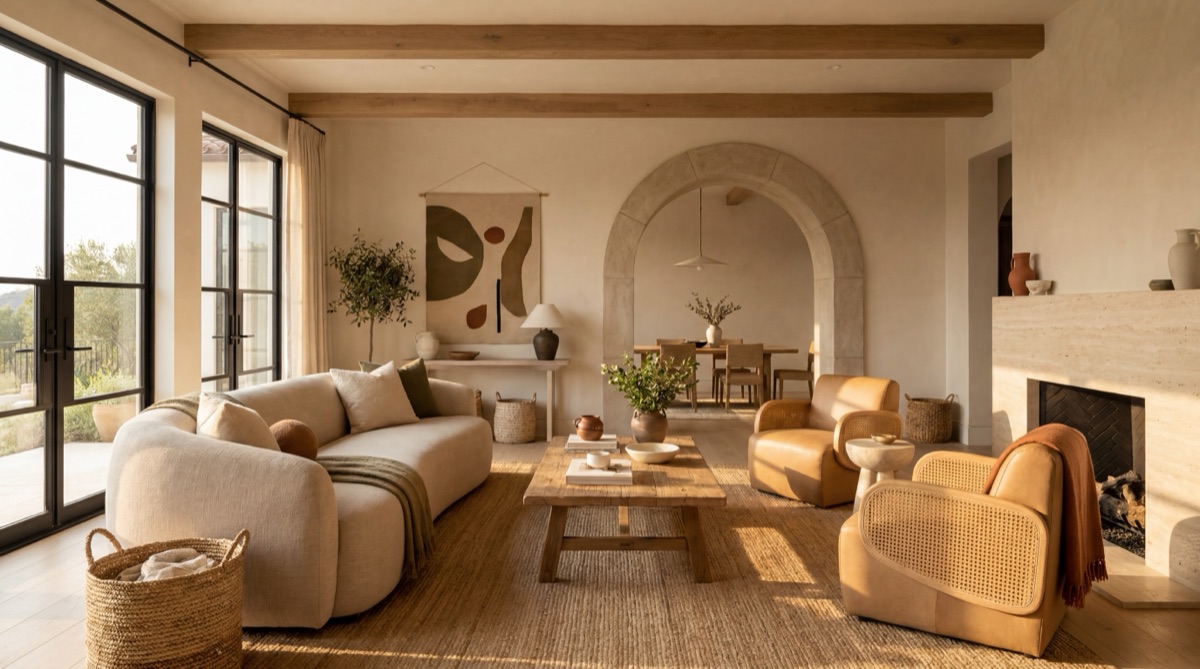
Organic modern is the design language that answered that request. It takes the structural discipline of modernism - clean lines, minimal accumulation, considered negative space - and introduces nature's material logic: curves instead of corners, handmade ceramics instead of machine-smooth objects, raw linen and handwoven jute instead of synthetic upholstery, live-edge wood instead of particle-board veneers, and actual plants large enough to read as architectural elements. Organic modernism is about creating spaces that feel intentional, welcoming, and genuinely human - exactly what greige minimalism was accused of lacking.
The five elements below build the organic modern room in the order that protects against the style's two most common failure modes: the boucle-and-arch-mirror starter pack (acquiring the signals without understanding the system), and the greige relapse (applying organic modern at such low intensity that the room still reads as nothing). Biomorphic curves first. Live-edge wood second. Linen and boucle third. Sculptural ceramics fourth. Structural plants last. Five decisions. Every item priced.
Sourcing hierarchy for organic modern follows the style's material logic. Source curved accent chairs and sculptural ceramic vases vintage (Chairish, First Dibs, local estate sales and pottery markets) - age and handmade irregularity deepen the authenticity of every organic shape. Source linen pillow covers, jute rugs, and boucle throws new (Amazon, CB2, Anthropologie Home) - these categories have reliable quality at accessible price points. Source live-edge wood wherever it appears: both Wayfair and local salvage yards carry live-edge slabs, and the uniqueness of grain and edge contour is what justifies the price premium.
Biomorphic Curves · $169.97
The defining formal move of organic modern is the elimination of right angles from the furniture layer. Where mid-century modern used curves selectively -- a tulip chair, an egg chair, each as a sculptural exception -- organic modern applies curves as a system: the sofa has a rounded back, the coffee table is kidney-shaped or oval, the accent stool is a soft cloud form, the arch mirror echoes the arched doorways. "Curves soften clean lines and bring a sense of warmth and flow," as Castlery's design team describes it -- the curve is not decorative but structural, changing the felt experience of the room at the level of geometry rather than at the level of object selection. The three items in this element establish the biomorphic curve signal at the accessory scale before any furniture commitment. The blob-shaped throw pillow inserts the biomorphic logic at the smallest possible scale; the arched decorative mirror is the vertical curve that signals organic modern to any viewer who recognizes the aesthetic; the oval rattan tray is the coffee table surface statement that introduces organic shape at the horizontal plane without replacing the existing table. These three pieces together cost $169.97 and establish the curve system in any room, whether or not the sofa is yet curved.
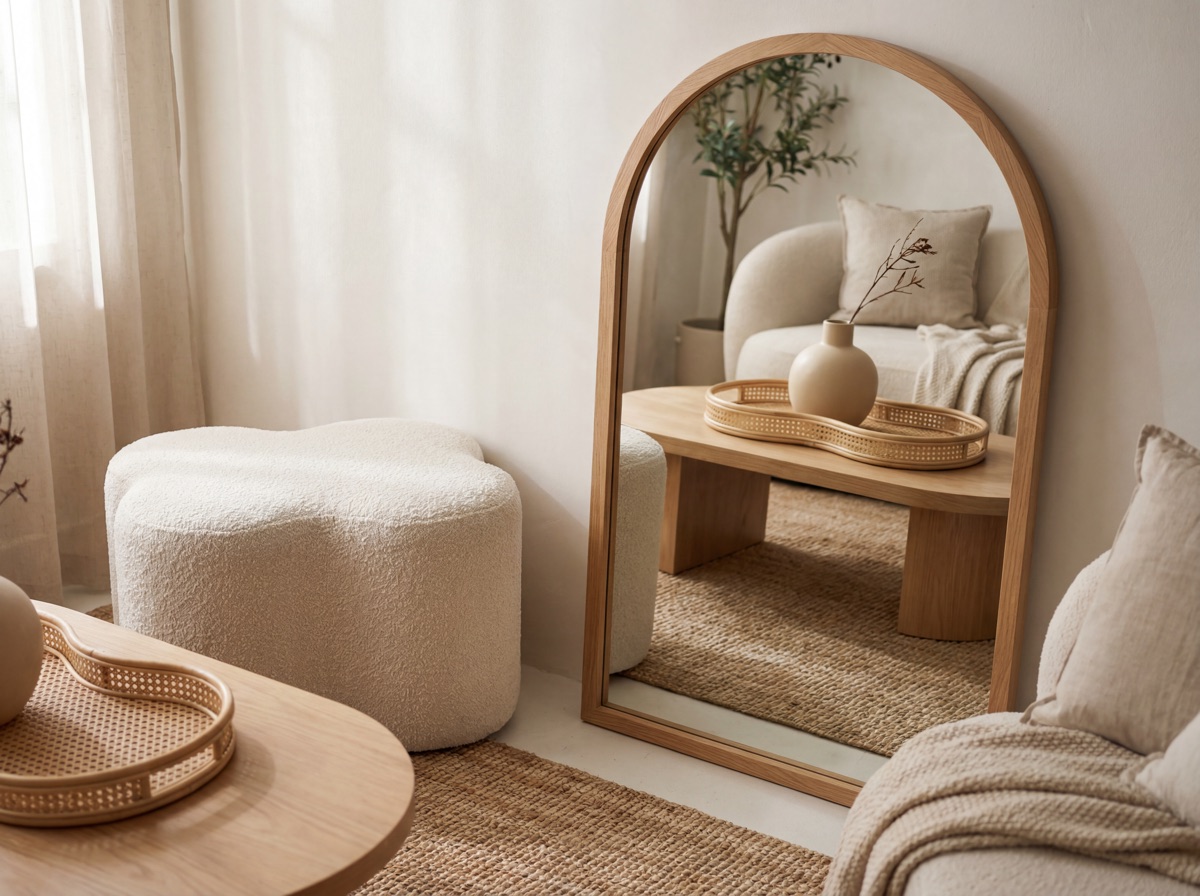
E1 Receipt -- Biomorphic Curves
Live-Edge and Textured Wood · $229.97
Wood in organic modern is not the polished, grain-smoothed furniture wood of mid-century modern or the pale veneer of Japandi. It is wood that shows what it is: live edges that preserve the original contour of the tree trunk, visible grain patterns that read as individual rather than standardized, warm honey-to-walnut tones that anchor the room in earth rather than air. "Organic modernism celebrates materials like wood, stone, clay, and concrete" -- these are materials valued precisely because they showcase natural textures and imperfections rather than concealing them. Live-edge tables are the most visible expression of this: the raw edge contrasts with sleek metal legs or minimalist trestle bases, and each piece is inherently unique because no two tree trunks have the same contour. Beyond the live-edge statement piece, the textured wood layer is built through three categories of item: floating walnut shelves that establish warm wood tone on the walls without structural work, a rattan or wicker accent table that contributes woven organic texture alongside smooth grain, and a carved wood bowl or tray that grounds coffee table and shelf vignettes in the handmade material logic the style requires. The three items in this element build the wood material story at accessible price points -- none of them require furniture replacement, and any one of the three changes the room's material temperature on its own.
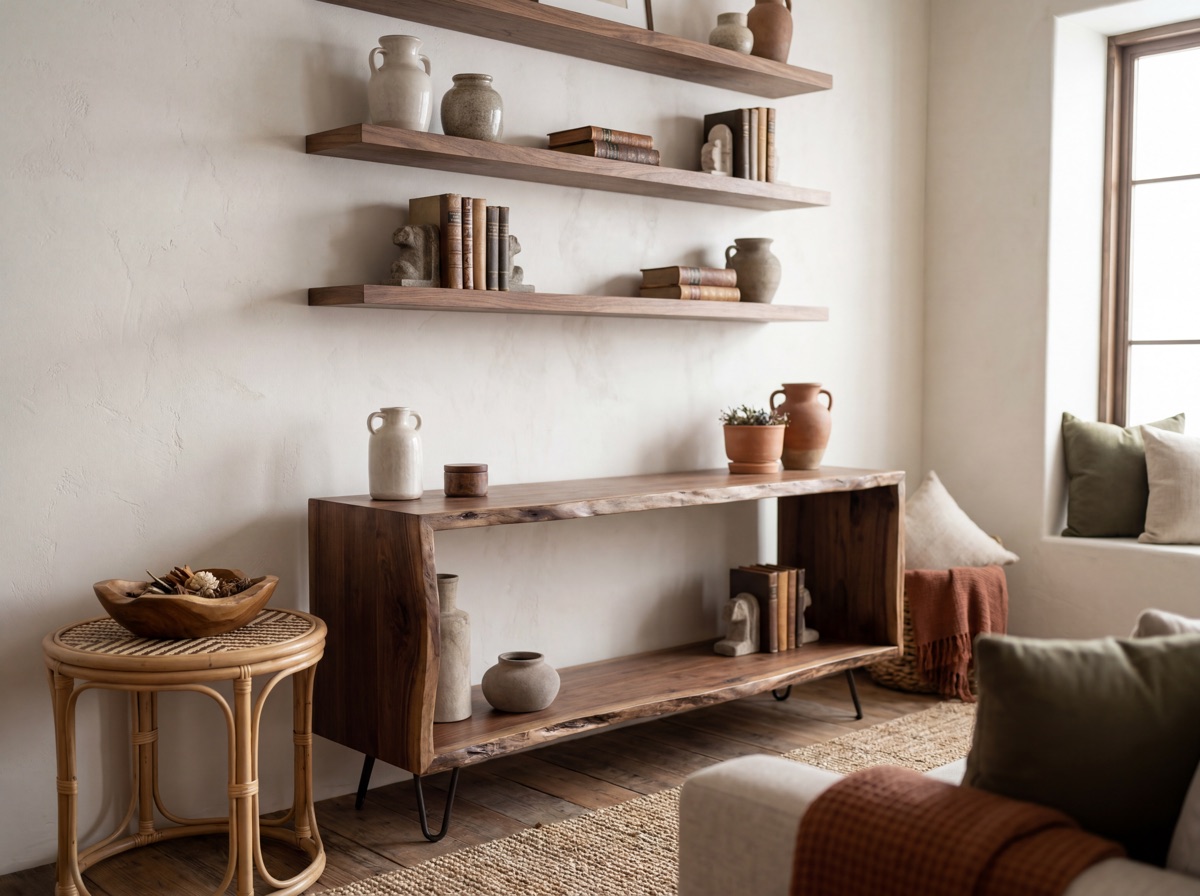
E2 Receipt -- Live-Edge and Textured Wood
Linen and Boucle Layer · $214.97
The textile layer is the single most effective and reversible move in the organic modern playbook. Two fabrics carry the style's upholstery identity: linen, for its natural fiber origin, visible weave, and warm cream-to-flax tonal range; and boucle, for its looped, nubby pile that reads as handmade and warmly imperfect even when machine-manufactured. Both fabrics work because they add color through texture rather than through saturation -- a cream boucle sofa reads as a color decision even without departing from the neutral palette. The r/femalelivingspace community's pattern of regret is instructive here: "Every surface is now boucle and it's getting tacky" is the over-application failure; the correct application is boucle on one or two dominant surfaces (sofa, accent chair), linen on the layering pieces (pillow covers, throw), and jute or wool on the floor. The four-item linen and boucle layer below covers all three of these surface categories. The boucle pillow cover set updates any existing sofa without replacing it. The linen window panel pair introduces the natural fiber logic at the window plane and softens architectural lines. The chunky knit linen throw provides the secondary drape and the tactile invitation that organic modern requires at sofa scale. The jute area rug is the floor layer -- woven, warm, natural, and sufficiently textured to read as a material decision rather than a carpet-filling exercise.
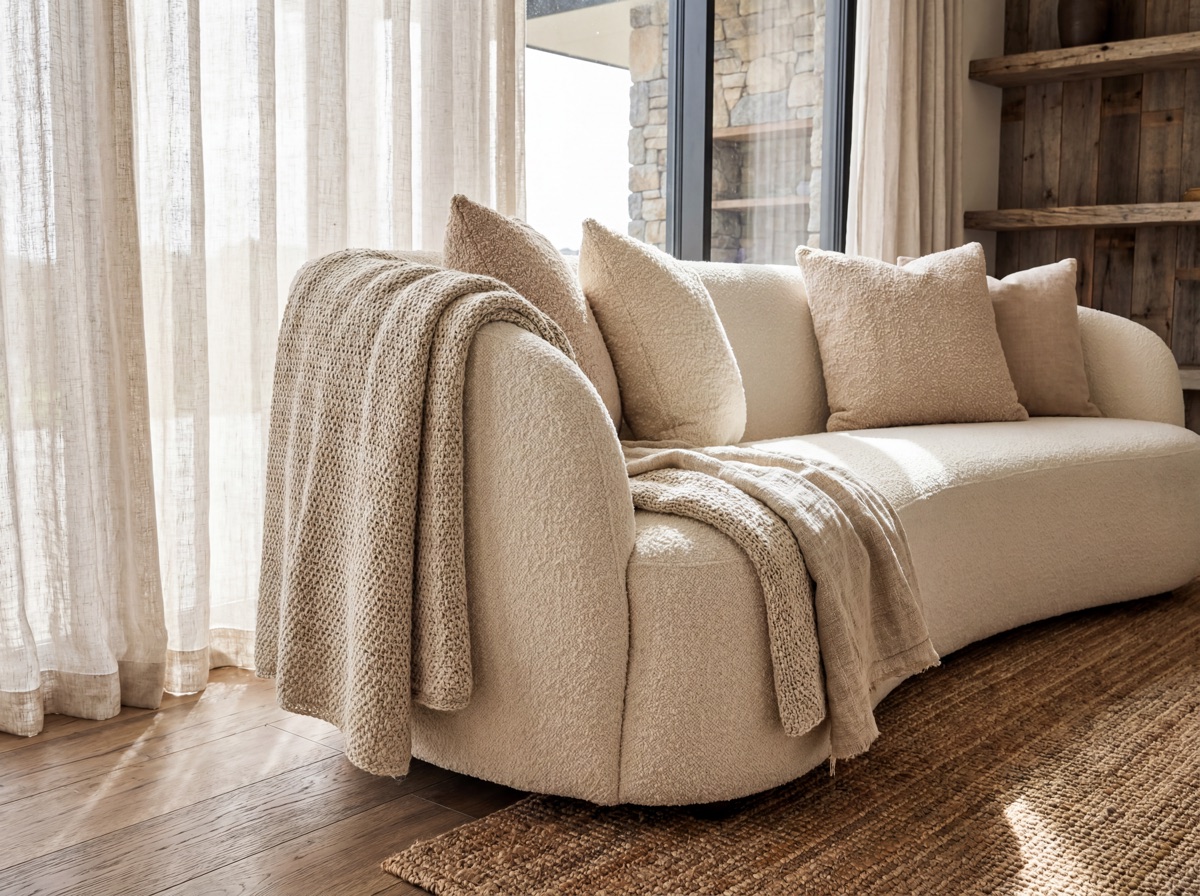
E3 Receipt -- Linen and Boucle Layer
Sculptural Ceramics and Stone · $174.97
In organic modern, the decorative object is not an afterthought applied to a finished room. The sculptural ceramic or stone object is a structural element -- present in the same way a piece of furniture is present, carrying visual weight, establishing material logic, and doing the work of making the room feel grounded in craft rather than retail. The distinction from generic decorating: organic modern ceramics are visibly handmade, showing the marks of the potter's hand -- irregular lips, slight asymmetry, visible clay body at the base. Stone objects (honed travertine bookends, rough-hewn marble spheres, soapstone candle holders) bring the geological timescale into the room, which is both philosophically consistent with the style and materially distinct from anything that can be mass-produced at scale. "Keep it minimal. Select a few key pieces like a stone vase or a wooden sculpture" -- the operative word is few, not many. Organic modern fails when every surface hosts a ceramic object; it succeeds when two or three objects are placed with enough negative space around them that each reads as a decision rather than an accumulation. The four items in this element are calibrated to occupy four distinct surface categories: shelf, coffee table, entry console, and bathroom counter -- so that the ceramic and stone logic runs through the whole space at low density rather than clustering in one room.
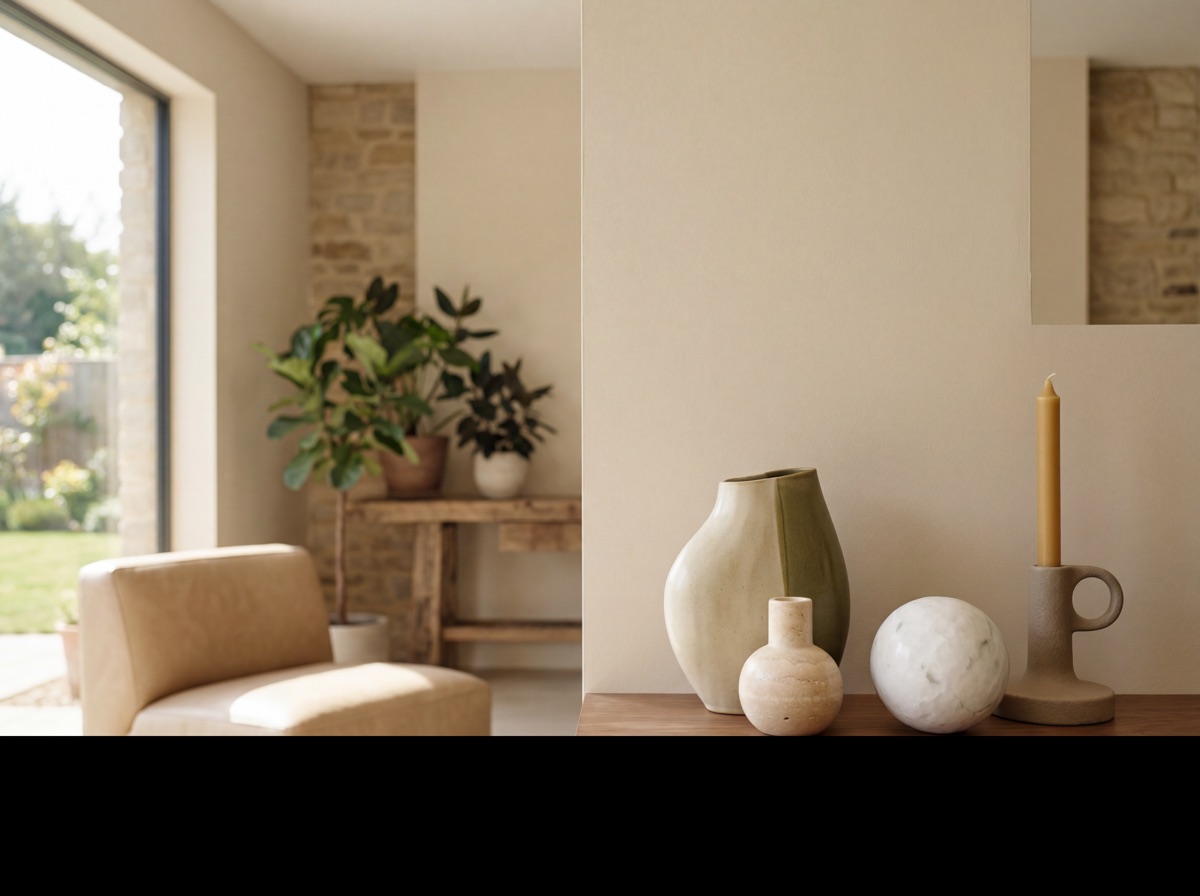
E4 Receipt -- Sculptural Ceramics and Stone
Structural Indoor Plants · $184.97
Plants in organic modern are not accessories. A fiddle-leaf fig at six feet occupies the same compositional space as a floor lamp or an accent chair; it is placed in a corner to fill vertical space, to add movement, and to create a color moment -- deep green against warm white walls -- that no ceramic or textile can replicate. The scale logic matters: the r/HomeDecorating community has a consistent prescription for rooms that feel flat or incomplete -- "It's always the same thing missing: plants and color" -- and the missing plant is always a large-format specimen, not a small succulent on a windowsill. The three plant categories in organic modern are distinct in function. The large-format floor plant (fiddle-leaf fig, monstera, bird of paradise, olive tree) anchors the corner and fills vertical space. The medium shelf plant (trailing pothos, heartleaf philodendron, small dracaena) softens the transition between the wood shelf and the wall. The small ceramic planter grouping (propagations, small succulents, air plants) completes the coffee table and bedside vignette with living material at the smallest scale. Research confirms that natural elements embedded in built environments reduce stress and improve cognitive function through the mechanisms of biophilic design. The fake botanical exception: the r/femalelivingspace community consistently and loudly calls out silk and fake plants; only dried botanicals (pampas grass, dried palms, eucalyptus bundles) are accepted as substitutes for live material -- and only when placed with the same compositional intentionality as live specimens.
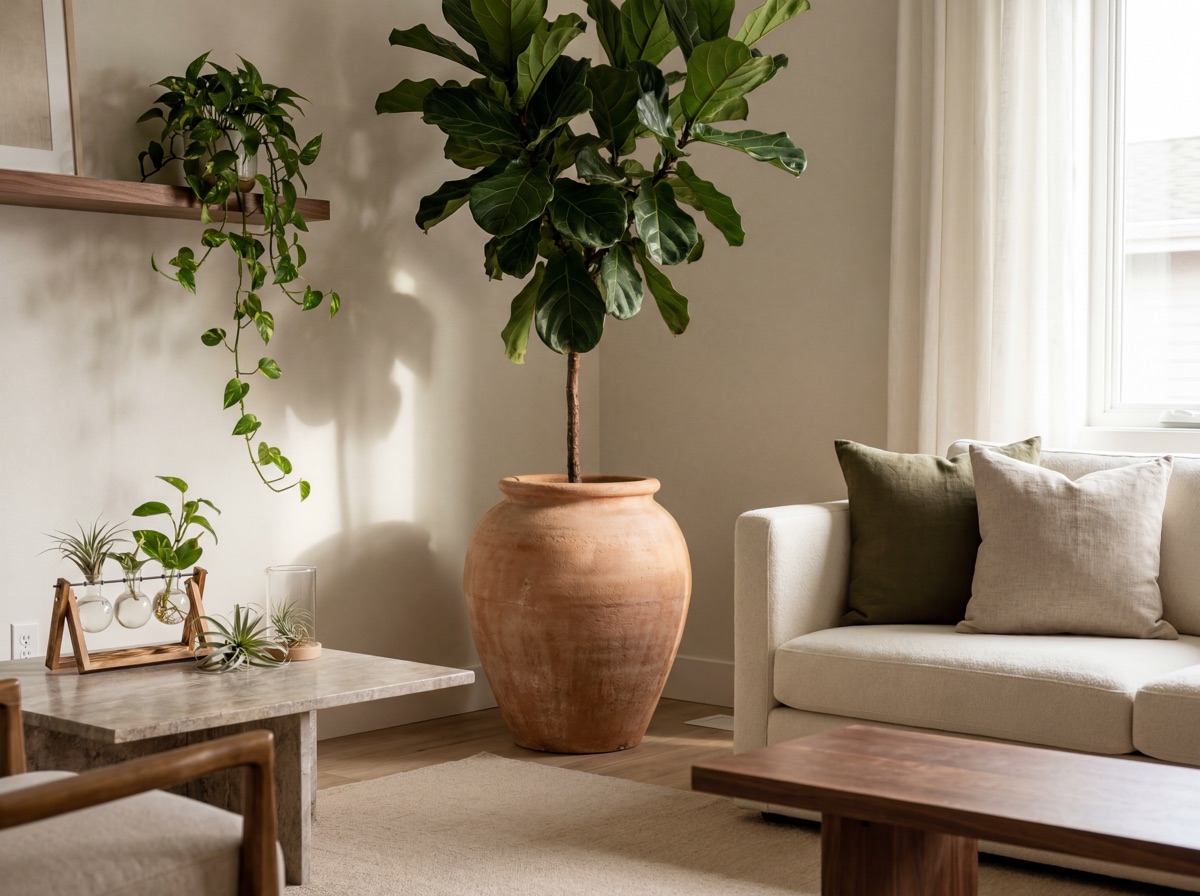
E5 Receipt -- Structural Indoor Plants
Organic Modern vs. Japandi vs. Biophilic.
Three styles share the language of natural materials, warm neutrals, and indoor plants -- which is why they are persistently confused. The distinction is not in the vocabulary but in the degrees of warmth, restraint, and literal nature immersion each style commits to. Organic modern is soft and layered -- boucle curves, linen throws, handmade ceramics, large plants. Japandi is even more pared down, focusing on simplicity, craftsmanship, and the beauty of imperfection -- empty space is intentional design, not an absence of objects. Biophilic design goes further than either: it is a philosophy that focuses on creating spaces that enhance the human connection to nature at the environmental level, not just through material choices. The practical test: if the room has a curved boucle sofa and a six-foot fiddle-leaf fig, it is organic modern. If the room has one branch in a tall vessel and otherwise nothing that does not serve a function, it is Japandi.
| Dimension | Organic Modern | Japandi | Biophilic Design |
|---|---|---|---|
| Color palette | Warm neutrals -- cream, taupe, camel, warm white -- with sage green and terracotta as accents through ceramics and plants | More muted -- charcoal, clay, ash -- with deeper contrast between light and dark; cooler overall | Full spectrum of nature -- greens, blues, stone tones -- whatever the local natural environment provides |
| Furniture curves | Systematic -- curved sofa, biomorphic coffee table, rounded accent chair, arch mirrors applied as a design system | Selective -- low-profile rectilinear furniture; curves appear in specific functional objects, not as a system | Organic shapes mimicking nature -- arched doorways, undulating walls, but not necessarily in furniture |
| Plant use | Large-format floor specimens as structural furniture equivalents; one or two species at scale | One branch, one small sculptural plant; plants are intentional and singular | Maximalist -- living walls, plant-filled rooms, green roofs, water features alongside plants |
| Textile approach | Layered -- jute rug, linen curtains, boucle upholstery, chunky knit throw; textiles as warmth builders | Restrained -- one quality rug, quality upholstery; textiles subordinate to the silence of the space | Natural fiber emphasis (wool, cotton, linen) but textiles are not the primary design move; nature is |
| Design philosophy | Modern, but lived-in and warm; nature inspires material and form choices without being literal | Empty space is part of the design; every object earns its presence through function or craft significance | Nature connection is the health goal; design serves the objective of reducing stress and improving wellbeing |
| The confusion test | Feels warm, soft, and tactile -- inviting touch across every surface | Feels calm, structured, and philosophical -- the room breathes | Feels like the outdoors has moved inside -- overwhelmingly alive and green |
The $169 entry path.
Four items that establish the organic modern signal in any room -- no furniture replacement, no paint, no structural work. One piece from each of the four accessible elements covers all five style dimensions at accessory scale.
Add a large-format plant in an oversized ceramic pot ($80-120 at a local nursery) to complete all five elements. Total with plant: $354-394.
Frequently asked questions.
What is organic modern interior design?
Organic modern interior design is the intentional fusion of contemporary minimalism with nature-inspired warmth. It takes the clean lines and minimal clutter of modern design and softens them through natural textures, curved furniture silhouettes, earthy neutral palettes - cream, taupe, camel, warm white - and living plants. The style is distinct from full biophilic design, which pursues literal nature immersion at the environmental level, and distinct from Japandi, which runs cooler and more restrained. Organic modern is defined by five repeating moves: biomorphic curves in the furniture layer, live-edge or textured wood as the primary material, linen and boucle as the upholstery and textile system, sculptural handmade ceramics or stone as the object layer, and large-format indoor plants as structural furniture equivalents. "Organic modernism is about creating spaces that feel intentional, welcoming, and genuinely human" - the operative word being human, which is what greige minimalism conspicuously failed to achieve.
What is the organic modern color palette?
The organic modern palette is built on warm neutrals: creamy off-whites with warm undertones, soft taupes, warm grays, and earthy browns. Specific paint colors that designers consistently recommend include Benjamin Moore White Dove and Sherwin-Williams Accessible Beige - both have enough warmth to read as cream rather than clinical white under natural light. Accent colors - sage green, terracotta, rust, camel, and stone - enter through upholstery, ceramics, and plants rather than through wall paint. The palette rule that separates organic modern from generic neutral decorating: add color through texture, not through saturation. A linen sofa in warm flax reads as a color decision. A jute rug reads as a color decision. A sage-green fiddle-leaf fig reads as a color decision. None of these require departing from the warm neutral base that makes the room feel settled and cohesive rather than decorated.
What is the difference between organic modern and Japandi?
Both styles share natural materials and restrained palettes, but they diverge on warmth, texture, and the role of empty space. Organic modern is softer and more layered - boucle curves, linen throws, oversized plants, handmade ceramics, live-edge wood. It feels warm, tactile, and lived-in. Japandi "blends Japanese minimalism with Scandinavian warmth" and is "even more pared down, focusing on simplicity, craftsmanship, and the beauty of imperfection." Japandi embraces empty space as part of the design - the room itself breathes. The practical test: if the room has an oversized fiddle-leaf fig, a curved boucle sofa, and a grouping of handmade ceramic vases on a live-edge shelf, it is organic modern. If the room has low-profile furniture, a single branch in a tall vessel, and nothing that does not serve a function or demonstrate exceptional craft, it is Japandi. Designer Joshua Jones recommends blending elements of both rather than choosing exclusively - "combining the texture and warmth of Organic Modern with the balance and discipline of Japandi."
What furniture defines organic modern interior design?
Four furniture forms define organic modern: the curved or blob-shaped sofa with no sharp corners in boucle or linen upholstery in cream or warm white; the kidney-shaped or biomorphic coffee table in travertine, live-edge wood, or concrete top; the sculptural accent chair with a rounded cloud-like silhouette in bouclé or textured weave; and the live-edge dining or console table with the raw edge preserved to show natural grain and contour. The unifying rule across all four: no right angles. Every piece references an organic shape found in nature rather than a rectilinear grid. "Curves soften clean lines and bring a sense of warmth and flow" - this is the design principle that separates organic modern furniture from generic modern furniture that happens to use natural materials. The 3-5-7 styling rule that works within this furniture framework: group 3 objects at varying heights on surfaces, combine 5 natural textures (linen, wool, wood, stone, rattan), and add 7 decorative accents for rhythm across the whole space.
How do I start organic modern design on a budget?
A room transformation is achievable at four price points. At $169: one arched wood-frame mirror (curve signal), one set of boucle pillow covers (textile signal), one carved wood bowl (material signal), and one handmade stoneware vase (ceramic signal). These four items deliver the organic modern argument across all five style dimensions without a single furniture purchase. At $350: add a jute area rug (floor textile), linen curtain panels (window textile), and one large-format plant in a textured ceramic pot - the three additions that most reliably convert a room from neutrally decorated to organically modern. At $700: add the live-edge wood shelves, the rattan side table, and the propagation station; the room now has the wood material logic across multiple surfaces. At $1,100: add a curved accent chair in boucle - the furniture commitment that makes the biomorphic curve system complete. The sequence matters: begin with textiles and ceramics (reversible, low-risk), add the wood and plant layer second, commit to curved furniture last once the style logic is proven in the room.
Want yours next?
One issue every Sunday. Room planned with city and salary on file.