Table of Contents
What Is Modern Farmhouse Interior Design?
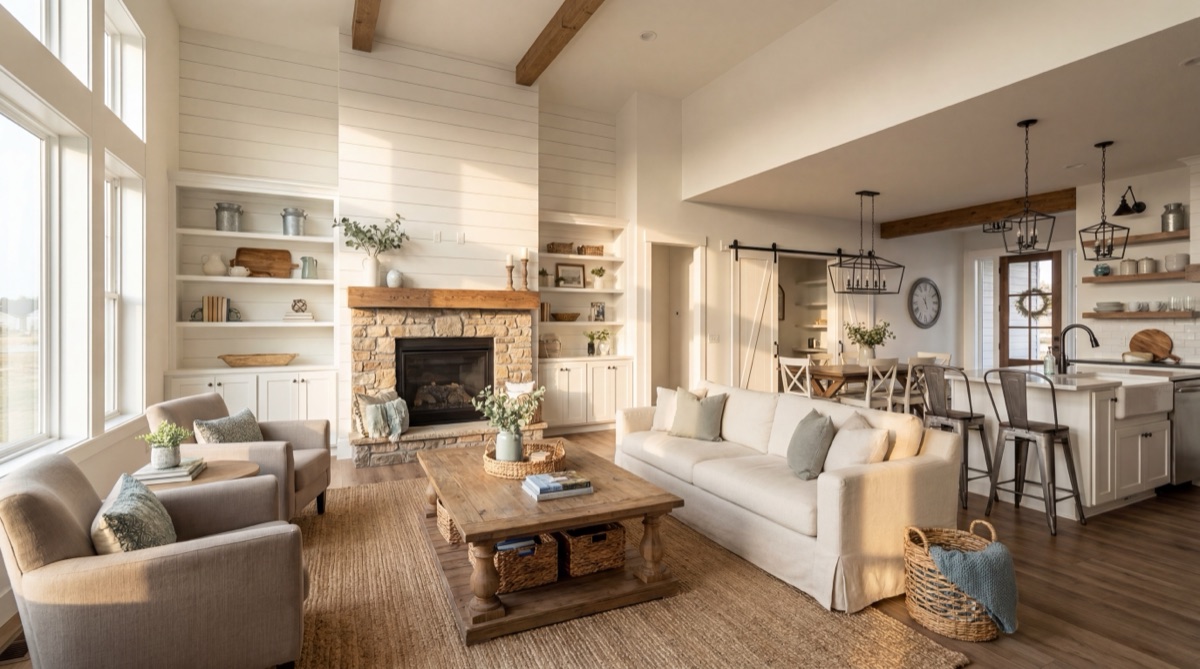
Modern farmhouse is the intersection of agrarian warmth and contemporary restraint. It takes the bones of traditional farmhouse design, exposed beams, wide plank floors, natural materials, and strips away the rustic excess. What replaces it: cleaner lines, higher contrast, and intentional editing.
The result reads warm without reading country, functional without feeling sterile. It is the aesthetic that made shiplap a household word and turned matte black hardware into the default finish for an entire generation of kitchen renovations. At its core, the style "achieves a balanced blend of rustic and refined."
Simplicity and functionality were at the heart of original farmhouses. Modern farmhouse honors that while raising the visual stakes. Expansive windows and open floor plans blur the indoor-outdoor boundary; natural light does the work that a dozen decorative accessories cannot.
Where It Came From
The style crystallized nationally in 2013 with the premiere of Fixer Upper on HGTV. Joanna Gaines and Magnolia Home popularized a formula that was already developing in the Pacific Northwest and Mountain West: open floor plans, white walls with texture, black-framed windows, salvaged materials alongside clean-lined furniture. By 2018, modern farmhouse was the most purchased architectural style on The Plan Collection.
That popularity created a problem. The formula became so replicable that homes began looking identical: shiplap in every room, galvanized buckets on every shelf, a sliding barn door in every hallway. The phrase that stuck was "the Fixer Upper hangover." Designers responded by evolving the style toward cleaner interiors: white Shaker cabinets, quartz countertops, wood floors, and fewer statement elements that read as trend rather than character.
By 2023, the same source still ranked modern farmhouse first. A decade of sustained demand is not a flash trend. The community's question shifted from "how do I get this look?" to "how do I update it without starting over?"
The Core Palette · 4 Colors
The palette is narrow by design. The palette is narrow by rule: "very limited but high contrast neutrals." The drama comes from layering textures within that range, not from adding more colors.
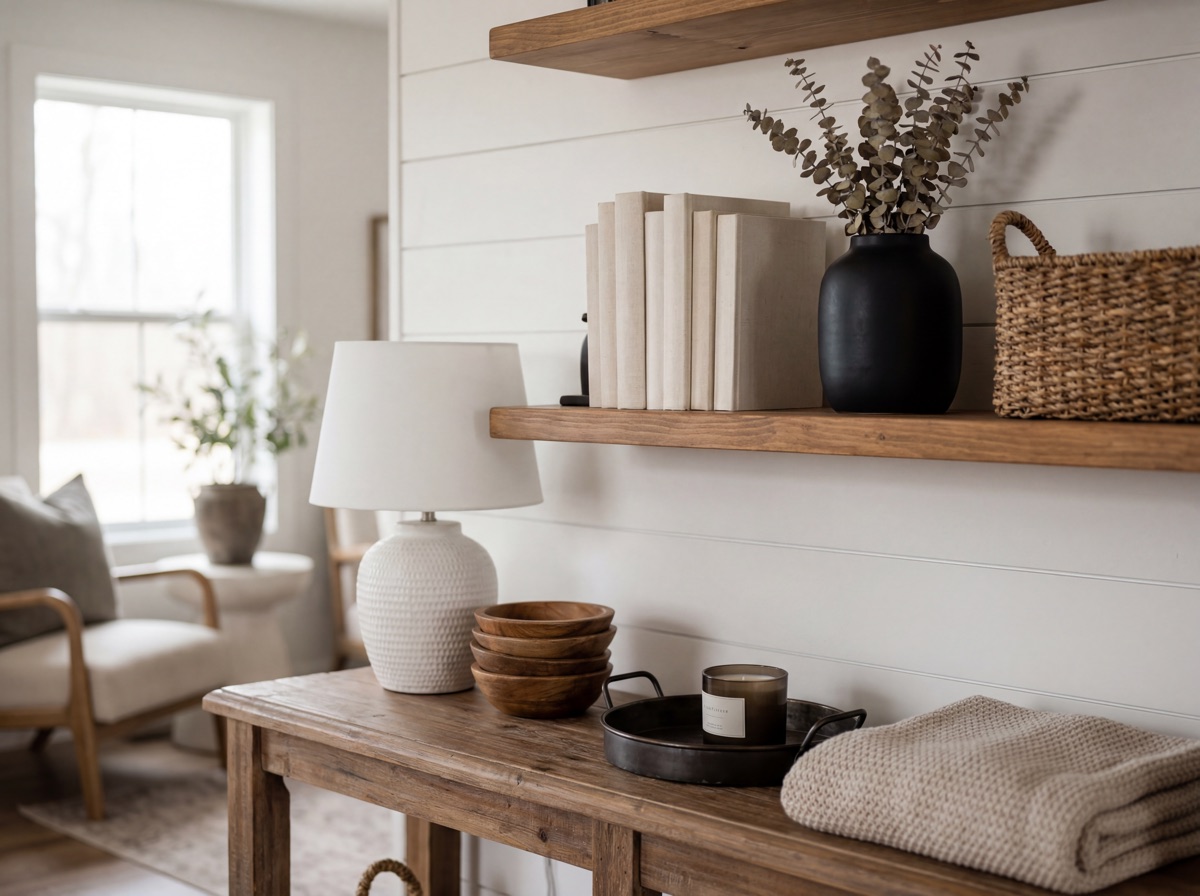
For walls, Sherwin-Williams Alabaster SW 7008 is the other go-to option alongside White Dove. Both read warm without reading yellow. Avoid pure white (too cold, too contemporary) and avoid gray-based whites (they read as builder-grade, not curated). The warmth is the whole point.
Textile layering does the heavy lifting within the neutral palette. Linen, cotton, wool, and chunky weaves in cream and oatmeal add depth without introducing color. The approach: natural fabrics with varied textures (nubbly, shaggy, velvet) where contrast comes from material, not hue.
Signature Architectural Elements · 6 to Know
Ten architectural elements define the style. These six appear consistently across every version of it, from IKEA-budget builds to Architectural Digest features.
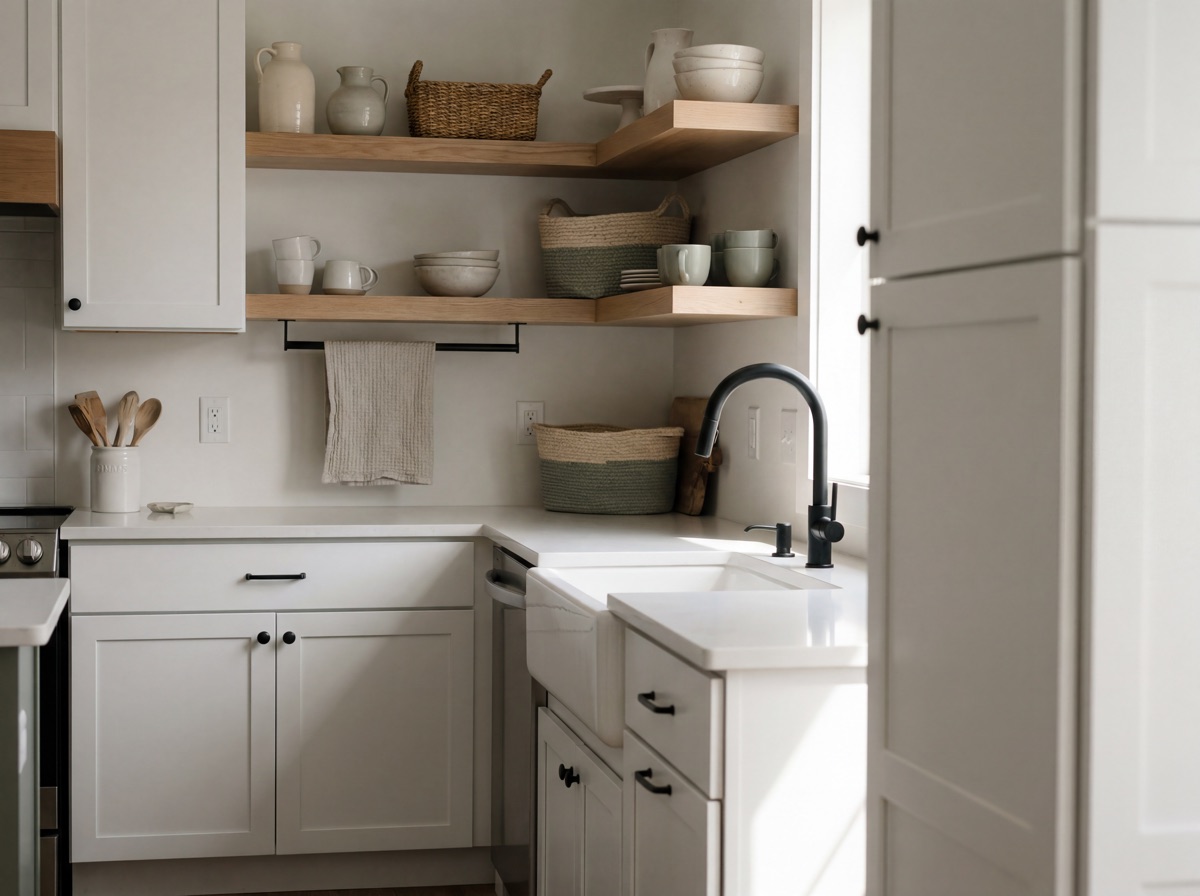
The industrial touches complete the modern half of the equation. Steel and concrete accents, iron fixtures, and metal hardware bridge the rustic bones with contemporary edge. A Colorado modern farmhouse studied by Dwell used "customized steel trusses, T&G painted wood ceilings, and European oak floors" to achieve this balance: the historic agrarian character executed through modern materials and methods.
Renter-friendly alternatives for the permanent architectural elements: peel-and-stick shiplap panels (Home Depot, Amazon) for one accent wall; lightweight faux wood beams with construction adhesive; vinyl plank flooring that mimics wide plank oak in warm tones. None of these require permits and all are reversible.
The Kitchen · 6,600/mo searches
The kitchen is the highest-demand room in the style at 6,600 monthly searches. It is also where the style has evolved most clearly: the 2025 execution looks cleaner than the 2016 version, with quartz countertops and Shaker cabinets replacing the more rustic vintage-heavy approach.
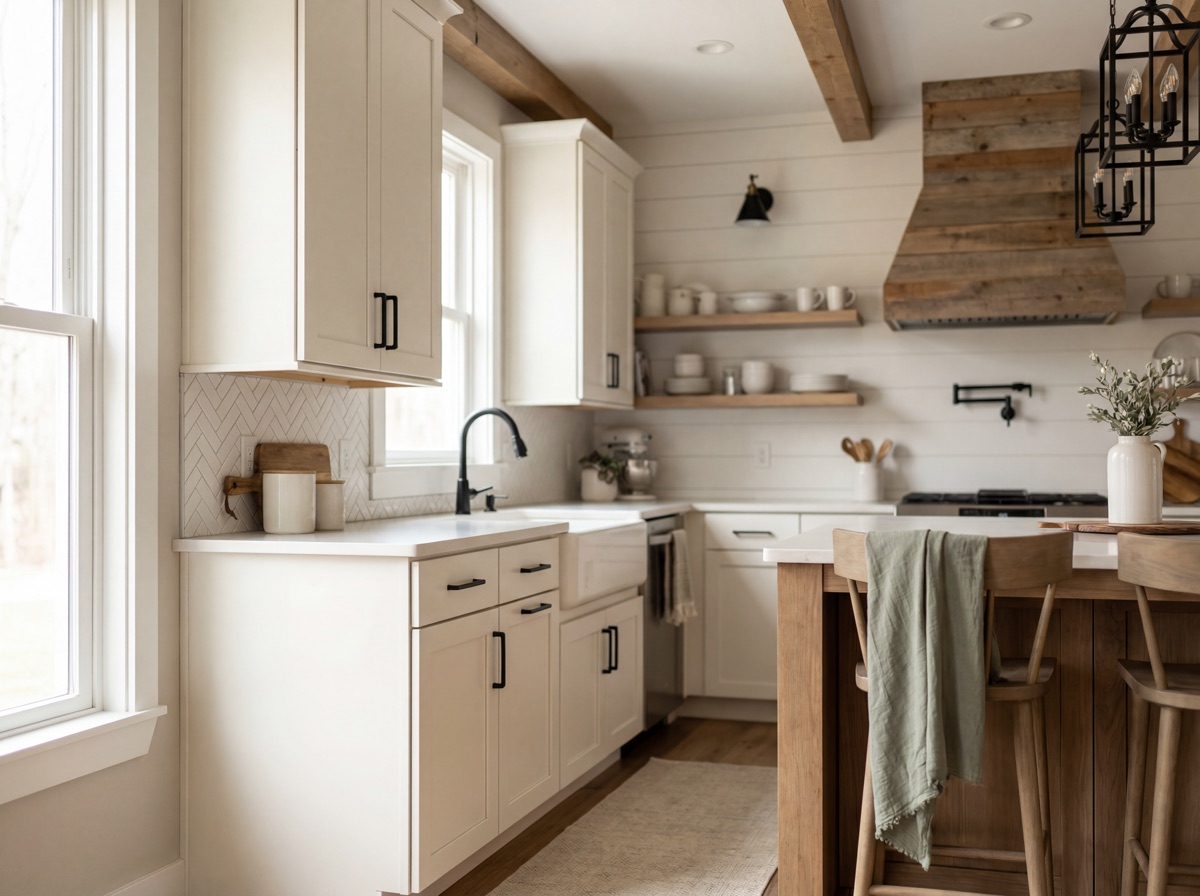
The apron-front sink is the single most recognizable element in a modern farmhouse kitchen. A white ceramic farmhouse sink from Kohler or Kraus runs $400 to $900 depending on size and mounting type; a drop-in version with an apron front facade is an option if a full cabinet replacement is not in budget. The matte black faucet and cabinet hardware do the work of the "modern" contrast at much lower cost ($30 to $150 for hardware, $200 to $400 for a quality faucet).
Living Room + Bedroom · The Furniture Guide
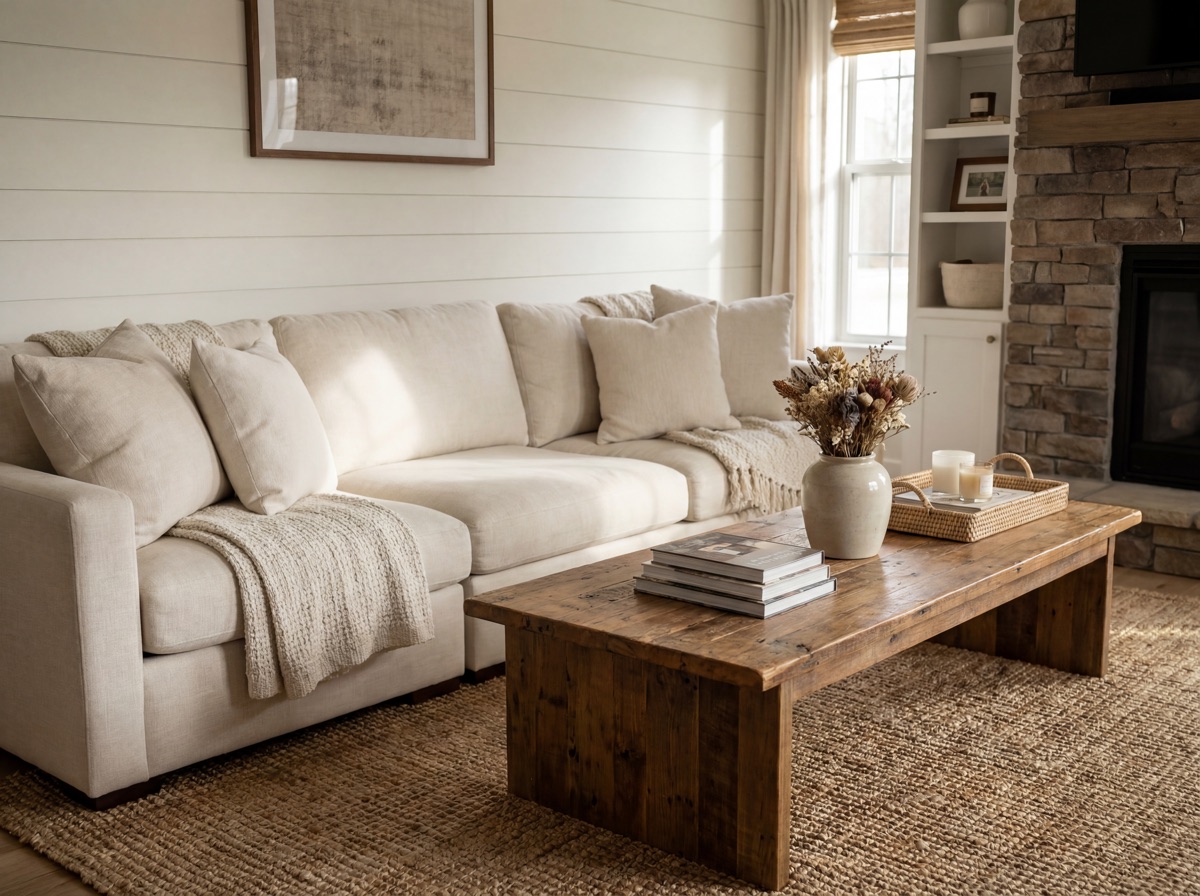
Modern farmhouse furniture is oversized and functional. It favors gathering over display: sectionals, extendable dining tables, upholstery in linen and cotton rather than minimal showroom pieces. The sofa is the anchor. Budget accordingly.
The Bedroom (1,900/mo searches)
The bedroom formula is simpler than the living room or kitchen. One shiplap or board-and-batten accent wall behind the bed anchors the space. The rest is linen and natural wood.
Common Mistakes to Avoid
Modern farmhouse is unusually well-documented on what goes wrong. These six mistakes appear consistently, often with regret attached.
Taking the style too literally is the top mistake. Signs that say "farm-fresh eggs," galvanized buckets stuffed with cotton stems, every surface a statement. The community's phrase for this: "living in a Magnolia Market display." Authentic vintage objects replace novelty farmhouse signage; one or two antique pieces with restraint replace the full catalog approach.
One accent wall reads architectural. Every wall reads renovation-house-flip - and full-room shiplap cannot be removed without a full renovation. Use it as a point of emphasis, not wallpaper.
The barn door is now shorthand for "staged for resale." They do not seal well, they are noisy, and the design has become oversaturated. For 2025, consider a solid-core door with black casing, or a pivot-style modern door if the architectural move is needed. Keep the hardware dark; lose the X-brace.
Open shelving polls as aspirational and performs as stressful. Community sentiment reports "30 minutes making shelves look photogenic before any guests come." One wall of open shelves is the maximum. Style one-third of each shelf; leave two-thirds clear. The rest stays behind cabinet doors.
Adding farmhouse elements (shiplap, barn door, apron sink) to a space without the modern restraint produces a hybrid that reads neither clean nor rustic. The "modern" in modern farmhouse means editing, not just adding. The critical point: it must not become formulaic.
The palette requires muted tones. Earthy accent colors are acceptable (dusty blue, sage, muted terracotta) but never vivid or bright shades. Vivid hues work in maximalist styles; this is not one of them.
Modern Farmhouse vs Farmhouse Classic.
The 2025 Edit: What to Keep, What to Drop.
Modern farmhouse is viable in 2025 if it is continuously evolved rather than applied formulaically. That is the consistent consensus. The curated, collected look that mixes vintage and contemporary pieces reads durable. The wholesale catalog application does not.
- Neutral palette: warm white walls, cream upholstery, wood tones
- Natural materials: reclaimed wood, stone, linen, jute
- Matte black fixtures and window frames
- Open-concept floor plans with strategic lighting
- Apron-front sink in the kitchen
- One accent wall in shiplap or board-and-batten
- Oversized, functional furniture in linen or cotton
- Sliding barn doors as a primary entry point
- Galvanized buckets, cotton-stem displays, novelty signs
- Full-room shiplap (more than one accent wall)
- All-open shelving in the kitchen
- Buffalo plaid as a primary textile (now reads costume)
- Edison bulbs as the only light source
- Rustic rope or mason jar pendant clusters
The style's appeal is specific: it appeals to young families who seek a sense of serenity in their busy lives. That aspiration is timeless. The formula that delivered it in 2016 is not. The style that survives is the one that keeps the warmth and drops the kitsch.
The clearest prescription: bring in modern elements to mix up the style and keep things unpredictable. That applies directly to the 2025 edit: a concrete or steel kitchen island alongside white Shaker cabinets, a single bold artwork against shiplap, statement pendant lighting instead of barn-style fixtures. The bones stay. The formula gets replaced with judgment.
Frequently Asked
Is modern farmhouse interior design still popular in 2025?
Yes. The Plan Collection ranked modern farmhouse as the most purchased architectural style in 2023, and search data puts "modern farmhouse interior design" at 2,900 monthly searches with related furniture terms near 90,500/month. The style has matured past the Fixer Upper era trend peak into something more durable: homeowners are now editing it rather than abandoning it.
What is the difference between modern farmhouse and traditional farmhouse?
Traditional farmhouse leans rustic: distressed wood, country plaids, antique finishes, warm amber tones. Modern farmhouse layers those same natural materials over a cleaner, more contemporary shell: white walls, black-framed windows, open floor plans, and restrained editing. The modern version keeps the warmth but removes the clutter.
What are the best paint colors for modern farmhouse?
For walls: Benjamin Moore White Dove OC-17 (warm white) or Sherwin-Williams Alabaster SW 7008. For trim and cabinetry: Benjamin Moore Chantilly Lace OC-17 or SW Extra White. The contrast comes from matte black fixtures and hardware, not from adding more wall colors. Avoid pure whites (too cold) and gray-based whites (too builder-grade).
What furniture brands work best for modern farmhouse?
At the accessible tier: IKEA (Hemnes line, linen upholstery), Target Threshold, and HomeGoods. Mid-range: Article, Pottery Barn, and Magnolia Home (the Joanna Gaines line at Target). Investment tier: Arhaus, Restoration Hardware's natural linen range, and Serena and Lily for upholstery.
How do I get the modern farmhouse look without installing shiplap?
Several renter-friendly alternatives work. Peel-and-stick shiplap panels (available at Home Depot and Amazon) install without tools and remove cleanly. Board-and-batten using removable adhesive strips works on one accent wall. Lightweight faux wood beams attach to ceilings with construction adhesive and screws, both removable at move-out.
Do you earn from the affiliate links in this post?
Yes. This post contains affiliate links. A small commission is earned when purchases are made through them. It does not change the price paid. Only items that belong in an actual room are linked.
Get the style guide PDF
Palette chips, furniture checklist, and the 2025 edit list in one printable PDF. One issue every Sunday.