Table of Contents
The earned-clutter philosophy.
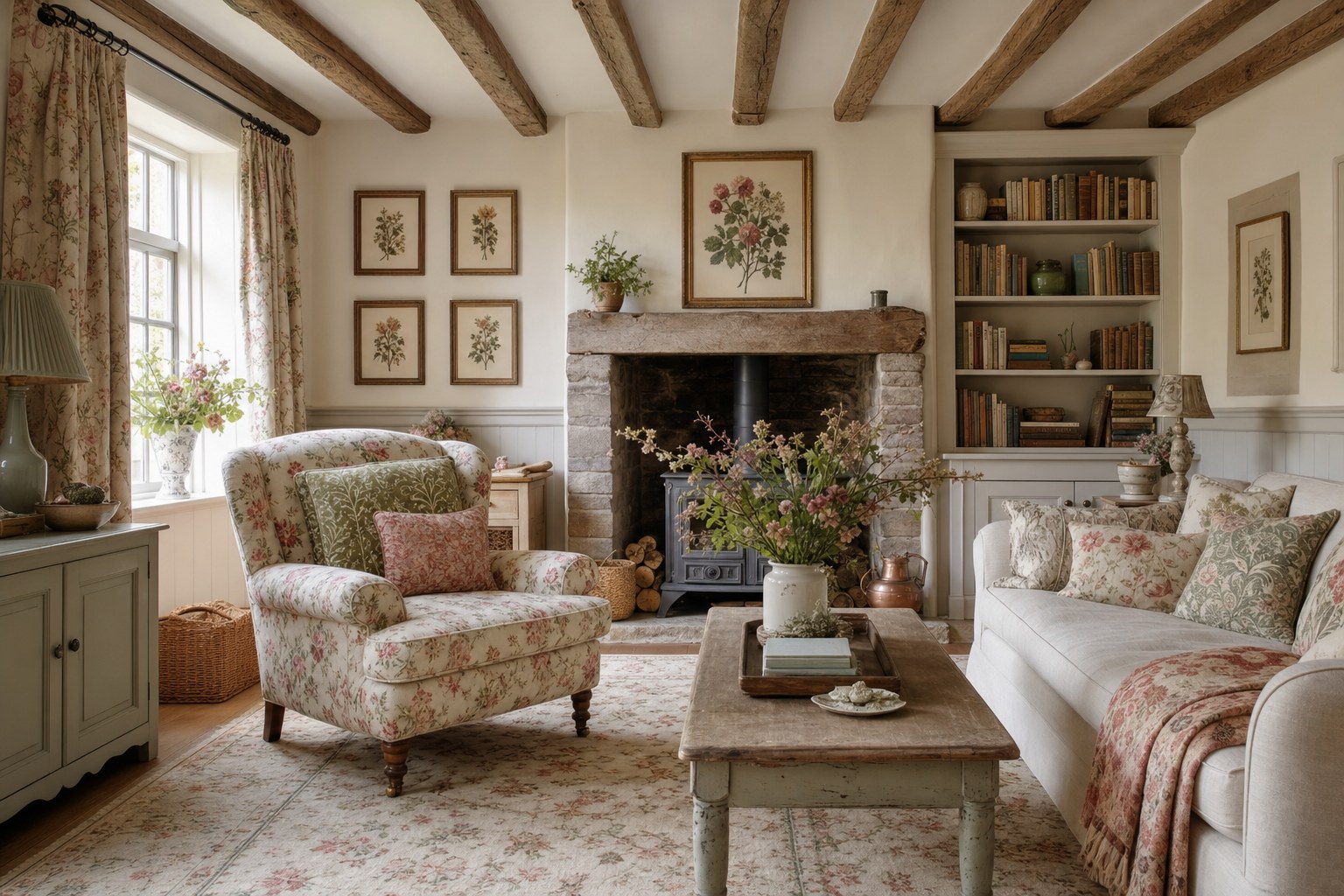
English cottage interior design is not a style for people who find decluttering satisfying. It is a style for people who find a room with a single vase on an otherwise empty shelf slightly sad. The philosophical foundation is earned clutter: the idea that a room should carry the visible evidence of a life fully lived. Books stacked in every available horizontal space. Botanical prints in mismatched frames. A shelf of hand-thrown pottery that grew one piece at a time over twenty years. Chintz curtains that have been washed enough times to soften at the folds. The goal is not messiness - it is accumulated richness. Intentional accumulation is the goal. Every item should look chosen.
The style's historical coordinates are precise. William Morris, the Victorian designer and Arts and Crafts movement founder, established the governing aesthetic in the 1860s with a philosophy that translates directly to the earned-clutter doctrine: "Have nothing in your houses that you do not know to be useful or believe to be beautiful." Nancy Lancaster and John Fowler at Colefax and Fowler codified the English country house version in the 1940s, adding Lancaster's rule that every room should include one deliberately imperfect element - a resistance to the polished perfection that would make a room feel unoccupied. Both principles converge on the same instruction: fill the room with things you love, mix pattern on pattern, and let time do the editing.
The sourcing hierarchy for English cottage follows the style's philosophy. Source Chesterfield sofas, chintz armchairs, and framed botanical prints from auction houses, estate sales, and charity shops - age and patina reinforce the earned-clutter authenticity. Source William Morris print cushions, sage green throws, and ceramic mugs new from Etsy, Rifle Paper Co., and Liberty London - these categories have reliable quality at accessible price points. Source exposed-beam faux treatments, stone-effect fireplace surrounds, and botanical wallpaper wherever the price allows - these architectural gestures do the heaviest lifting for the lowest per-square-foot cost in the style.
Floral Chintz Upholstery Layer · $89.97
Floral chintz is the first and most irreplaceable signal of English cottage interior design. The pattern that makes every other element cohere around it. Chintz originated in 17th-century India as printed cotton with a characteristic glazed finish, but it was absorbed so thoroughly into English interiors that it became the defining textile of the country house tradition: curtains, sofa upholstery, cushion covers, and armchair seat pads, all carrying the same overscale floral pattern in faded, garden-inspired tones. The governing principle of chintz deployment in an English cottage is pattern scale hierarchy: the largest floral print belongs on the biggest soft surface in the room, a sofa or a pair of curtains, while smaller-scale chintz carries to cushions and seat pads. Floral chintz brings nature indoors through curtains, cushions, and upholstered chairs: paired with soft pastels, it defines the feminine and romantic core of cottage home style. At entry-level pricing, the three-piece chintz layer. Floral throw pillow covers in a large-scale garden print, a floral chintz table runner to test the pattern in the room, and a single chintz seat cushion for an existing dining chair. Establishes the pattern signature without requiring new upholstered furniture. The test for whether chintz is reading correctly: it should look as though it was chosen for love of the pattern, not for coordination with anything else in the room.
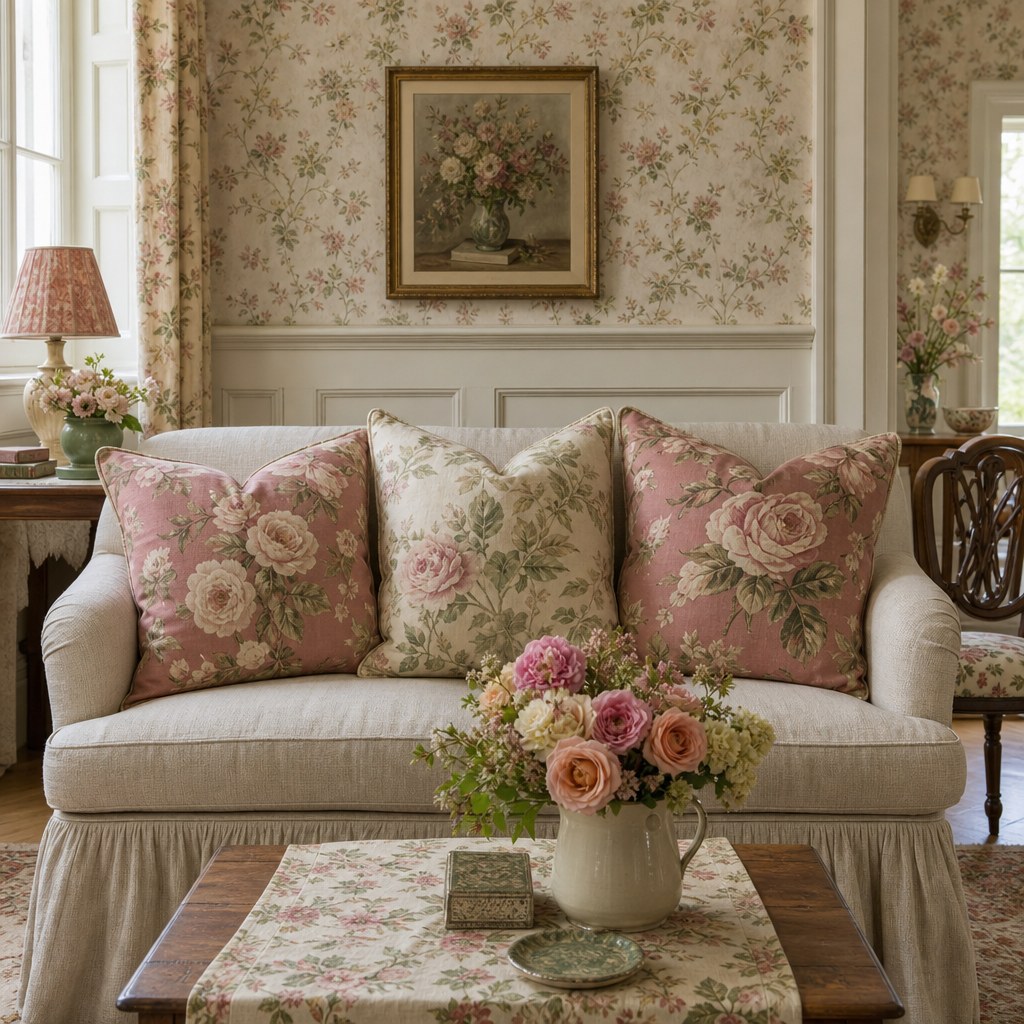
E1 Receipt - Floral Chintz Upholstery Layer
William Morris Textile Layer · $194.97
William Morris is not a trend in English cottage design. He is the founding document. Morris drew from native British wildflowers rather than exotic or invented blooms, celebrating the familiar plants of English meadows and cottage gardens: roses, honeysuckle, daisies, strawberry plants, and pomegranates rendered in the flat, richly colored surface pattern of medieval textile work. His most recognizable designs, Strawberry Thief (1883), Willow Bough (1887), and Snakeshead (1876), have never left production, which means a Morris-print cushion or curtain panel purchased today is identical in design intent to the textile that would have hung in an Arts and Crafts house in 1890. That continuity is not coincidence; it is the argument for the style. The William Morris textile layer is the room's historical anchor: it signals that the layered, nature-derived aesthetic is not decorative whimsy but the product of a coherent philosophical tradition. The complete vision is Morris prints inside and actual roses outside. The print on the cushion should feel continuous with the garden visible through the window. Three pieces build the layer at accessible price points: a Strawberry Thief or Willow Bough print cushion cover, a Morris-print tea towel (the gateway piece that tests the print in the kitchen before committing to curtain fabric), and a Morris-inspired botanical print curtain panel for the window most visible from the seating area.
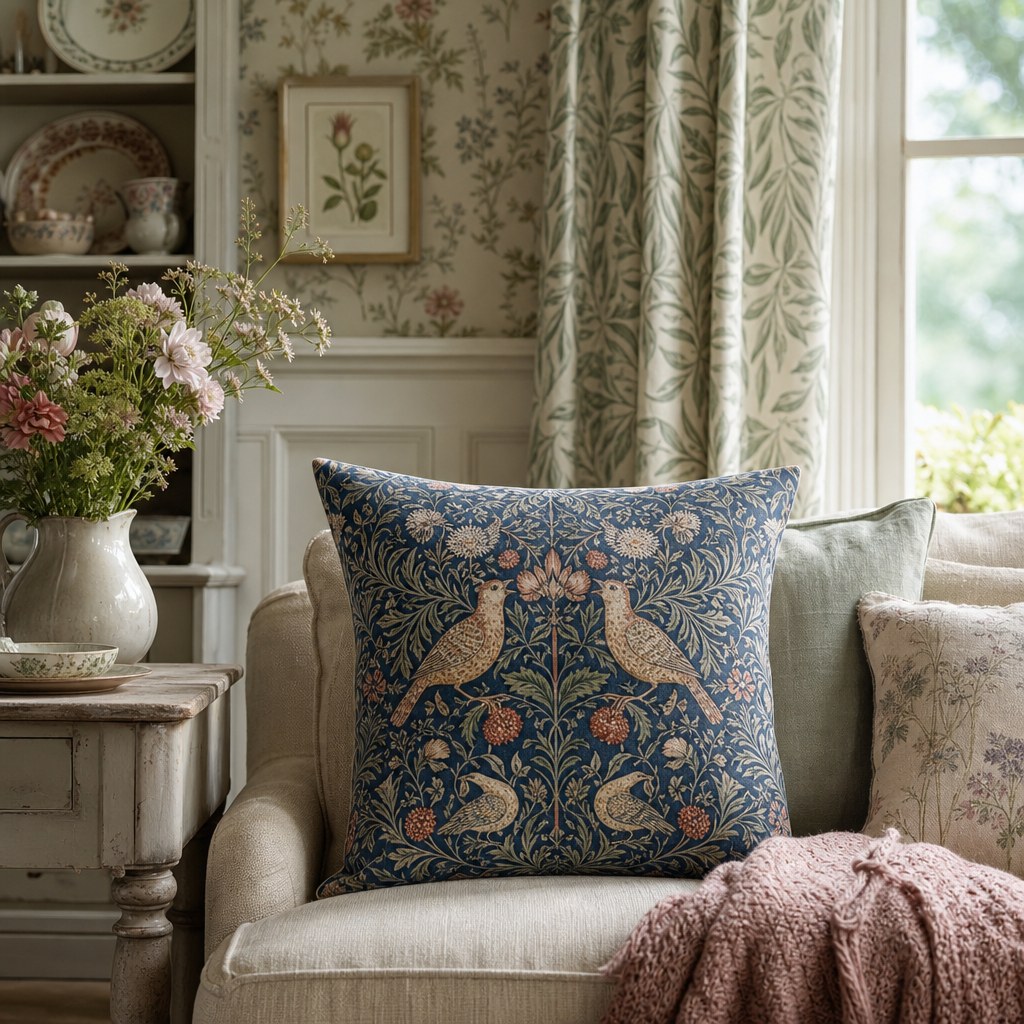
E2 Receipt - William Morris Textile Layer
Cottage Garden Color Palette · $164.97
The English cottage color palette derives entirely from the cottage garden, which means it is never sharp, primary, or fresh. Faded florals, sage green, dusty rose. The palette should look like it was once brighter. The palette runs on four tones in descending saturation. Aged cream or warm linen is the room's base. The wall color that makes every floral print readable without competing with it. Sage green is the dominant mid-tone, appearing in throws, velvet cushions, and ceramic glaze as the garden's most reproduced color. Dusty rose is the accent mid-tone, carrying the faded-climbing-rose quality that the chintz and Morris prints already establish in pattern form. Soft lavender or muted cornflower blue serves as the palette's coolest note, the equivalent of the delphiniums and forget-me-nots at the back of an English border. The palette's governing rule. The one that separates English cottage from cottagecore and from French country, is that no color in the room should look freshly applied. Sage green should look as though it has been in the room for thirty years. Dusty rose should have the quality of sunlight through thin linen. The four palette pieces in this element test the color story in soft goods before any paint commitment: a sage green velvet throw, a dusty rose ceramic bud vase, a cream-and-floral botanical print cushion cover, and a lavender linen cushion cover to complete the garden's color sequence.
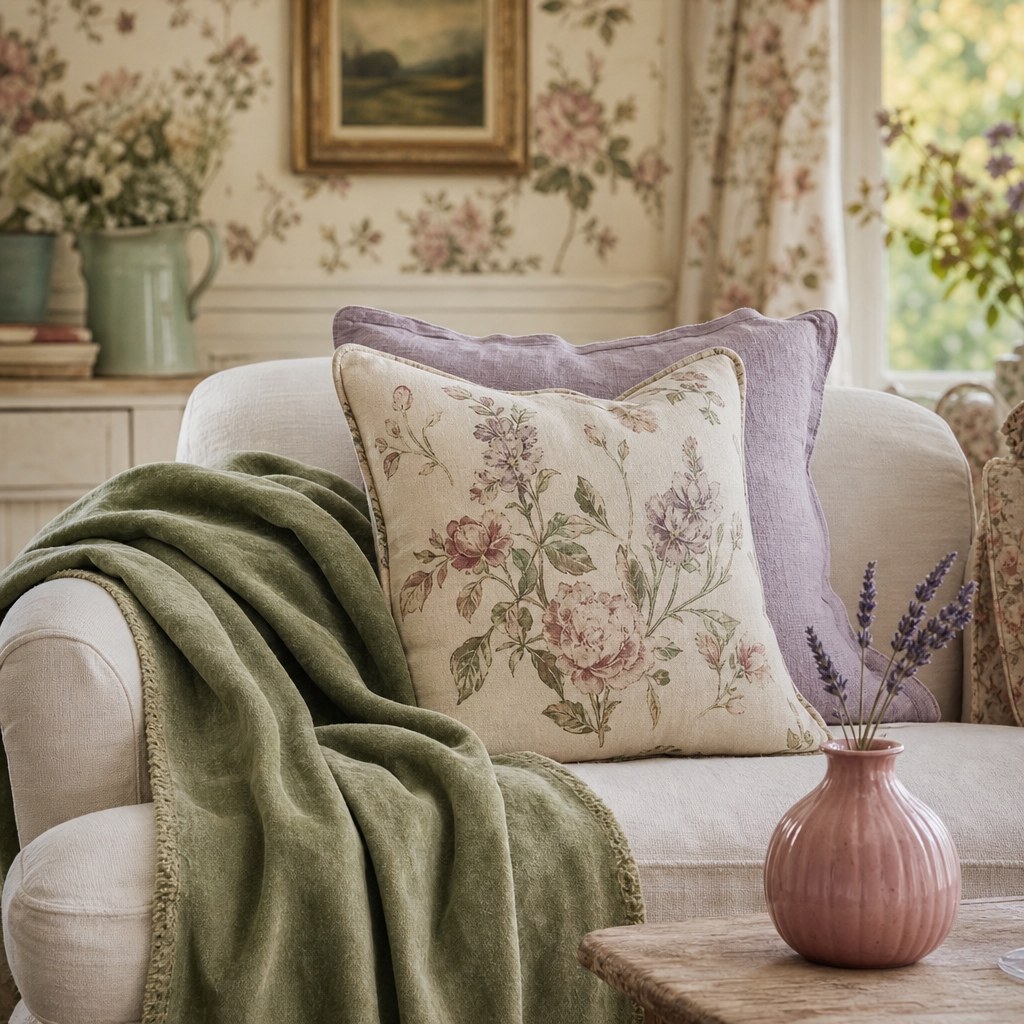
E3 Receipt - Cottage Garden Color Palette
Curated Collection Anchor · $219.96
The collection anchor is the element that most clearly distinguishes English cottage from every other layered maximalist style. Where Bohemian decorates with globally sourced objects and Art Deco decorates with decorative objects, the English cottage style decorates with collections. Deliberate, thematic, and apparently accumulated over time rather than purchased as a set. The most common cottage collections: hand-thrown pottery in varied glazes arranged on open kitchen shelving, books stacked both vertically and horizontally with the occasional horizontal stack serving as a shelf for a single ceramic piece, framed botanical and bird prints in mismatched gilt and painted frames, and vintage transferware plates displayed on a plate rail or dresser. The goal is always biography: a room that contains a collection suggests a person, and a room that suggests a person is a room that feels inhabited rather than designed. The four pieces in this element seed the collection: a set of mismatched hand-thrown mugs that begin the pottery collection, a set of vintage-style botanical framed prints for the wall, a secondhand book bundle for the stacking-as-decor technique, and a single piece of vintage transferware for the dresser-top anchor.
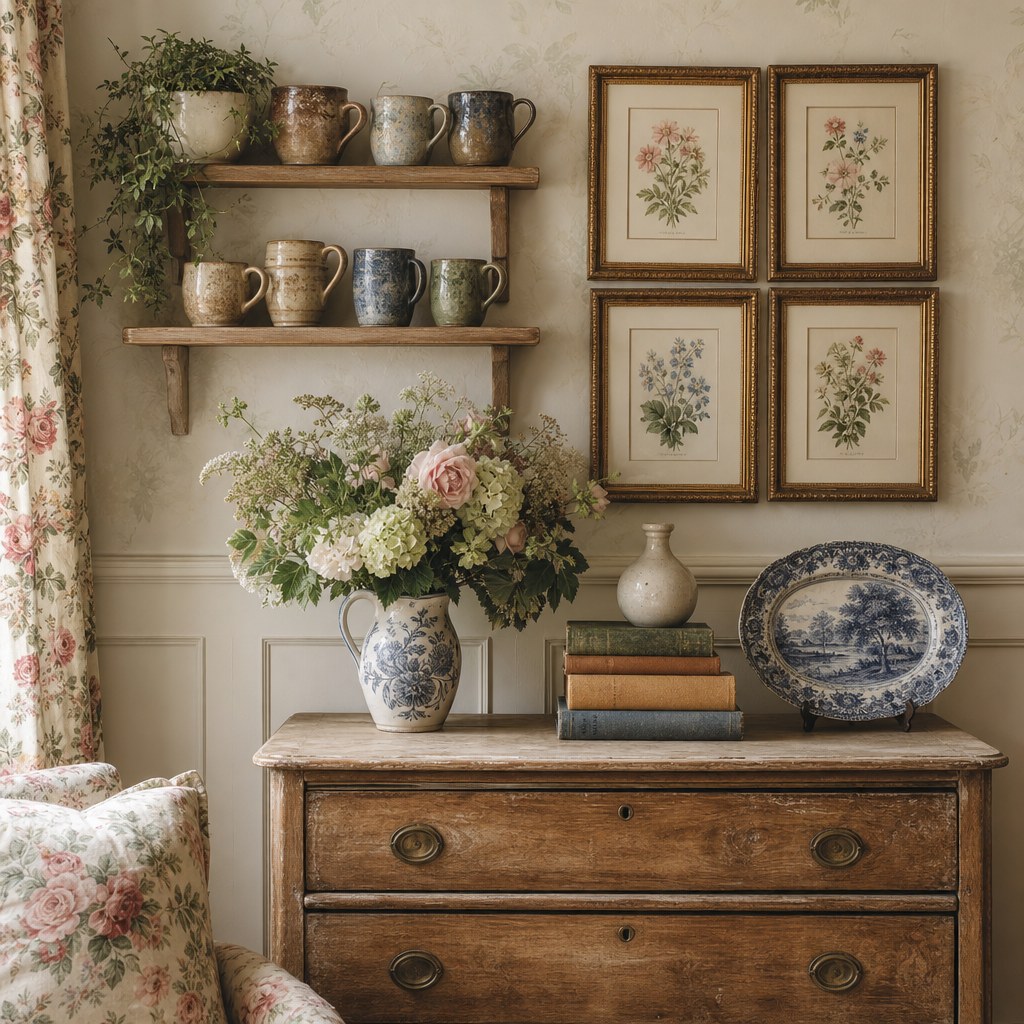
E4 Receipt - Curated Collection Anchor
Exposed Natural Surfaces · $577.96
Exposed natural surfaces are the architectural vocabulary of the English cottage: oak ceiling beams, stone fireplaces, flagstone or slate floors, and wainscoting that divides rooms horizontally in a tradition dating to the 16th century. For renters and apartment dwellers who cannot touch the architecture, this element is the most challenging and the most transformative. It is also the one that makes every other element cohere, because the textiles and collections the previous four elements introduced will feel like decoration on top of a blank box until the room has an architectural surface they can react to. The solutions at non-renovation price points run from faux beam treatments (lightweight polyurethane beams that bolt to ceilings and read as reclaimed oak from any standing distance) to stone-effect fireplace surrounds that install over an existing mantel, to flagstone-pattern vinyl tile that replaces a kitchen floor without a landlord conversation. The most accessible natural-surface gesture in a rented room: an exposed-wood floating shelf in reclaimed oak or pine, styled with the pottery collection from Element 4, makes both the wood grain visible and the collection displayable in a single move. The AGA changes the whole kitchen temperature, metaphorically and literally, and stands as the room's architectural anchor piece. For rooms where an AGA is not an option, the cast iron or enameled wood stove insert achieves the same weight and warmth at a fraction of the cost and without permanent modification.
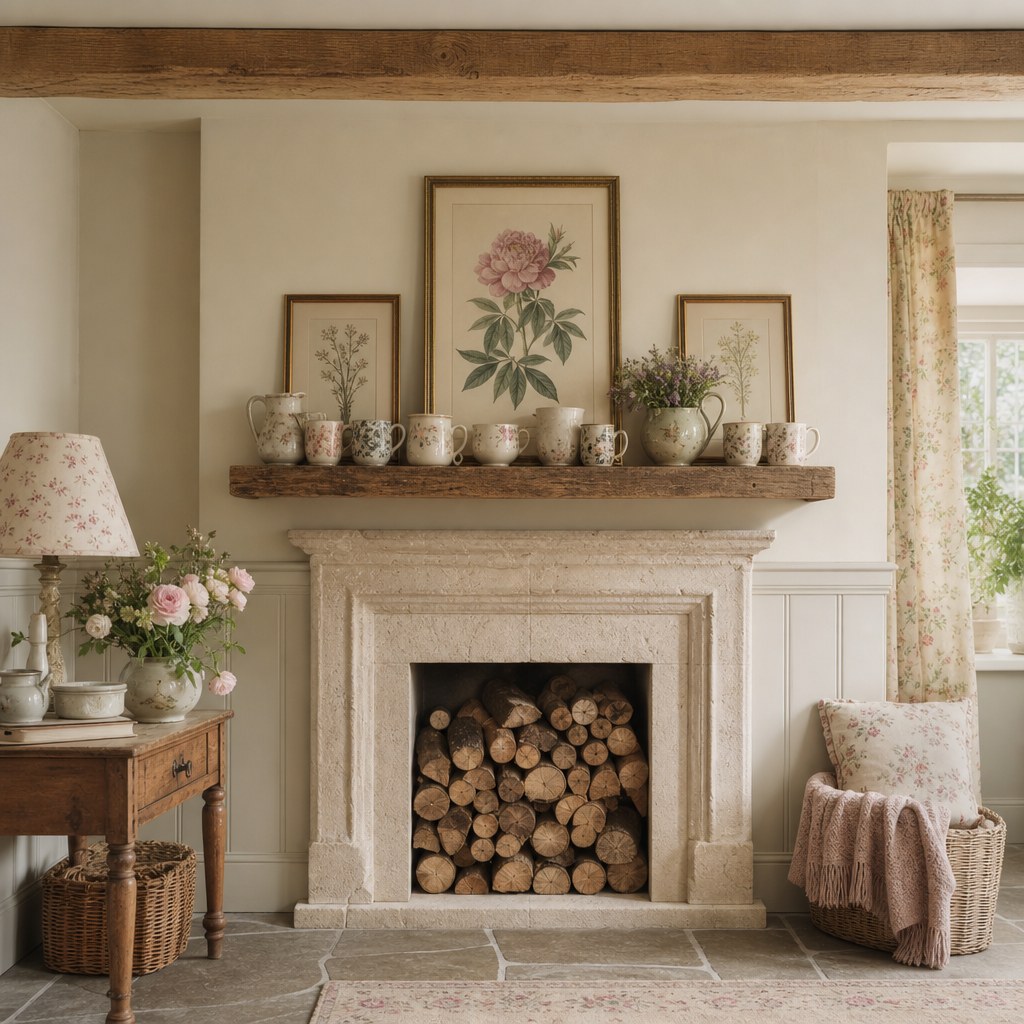
E5 Receipt - Exposed Natural Surfaces
English Cottage vs. Cottagecore.
Both styles invoke the romance of a country cottage. Which is why they are consistently conflated on Pinterest and confused at the point of purchase. The distinction is specificity and saturation. English cottage is a historically grounded style with a specific material language: chintz upholstery, William Morris prints, Chesterfield sofas, exposed oak beams, and a colorful maximalist layering that looks as though it accumulated over decades in a specific house in a specific place in England. Cottagecore is a contemporary social media aesthetic that softens and universalizes the cottage idea into something more minimal, more sustainable, and more Instagram-friendly. Linen, crochet, pressed flowers, and a palette of sage and cream that reads as quiet rather than layered. English cottage is more colorful, more eclectic, and more committed to the specific material language of the British Isles. Cottagecore is softer, more universal, and more focused on the idea of rustic simplicity than on the actual history of English domestic architecture. The easiest test: if the room has a Chesterfield sofa and a William Morris print, it is English cottage. If the room has a linen sofa and dried flowers in a mason jar, it is cottagecore.
| Dimension | English Cottage Interior Design | Cottagecore Interior Design |
|---|---|---|
| Color palette | Colorful and layered. Sage green, dusty rose, soft lavender, aged cream; tones that look faded and sunlit rather than fresh | Muted and minimal. Sage, cream, white linen; a quieter, more serene palette optimized for calm rather than richness |
| Primary textile | Floral chintz upholstery, William Morris prints, patchwork quilts, tartan throws, pattern on pattern deliberately mixed | Natural linen, crochet, simple florals; textiles chosen for texture and naturalness, not pattern complexity |
| Furniture anchor | Chesterfield sofa, roll-arm armchair, Chippendale chair, overstuffed ottoman; furniture with history and specific British lineage | Simple linen sofa, wooden chairs, vintage-inspired pieces; furniture with natural materials but no specific period commitment |
| Decorative logic | Earned clutter. Pottery collections, books, botanical prints, mismatched frames; every object should look acquired over 40 years | Curated simplicity. A few handmade objects, dried flowers, a pottery mug; less accumulation, more intentional placement |
| Architectural signal | Exposed oak beams, stone fireplace, flagstone or slate floors, wainscoting; the room should feel like a building with history | Natural wood tones, shiplap, simple plank floors; architectural naturalness without period-specific detail |
| The distinction test | Feels like a specific house. A lived-in, colorful, maximalist English farmhouse with personality and biography | Feels like a mood board. A serene, beautiful, intentional aesthetic that could belong in any country |
The $89 entry path.
Three chintz pieces that establish the floral pattern language in any room. No new furniture, no paint, no architectural work required. The complete E1 serves as the entry path.
Frequently asked questions.
What is English cottage interior design?
English cottage interior design is a warm, maximalist residential style defined by layered floral textiles, William Morris prints, an earth-anchored color palette of soft greens, dusty rose, and aged cream, and a philosophy of intentional clutter - every object chosen to look as though it has been collected over decades rather than ordered at once. The style draws on the Arts and Crafts movement, Georgian farmhouse traditions, and the cottage garden aesthetic, creating rooms that feel lived-in, personal, and richly layered. The defining aspiration: for a room to feel like it has been there for generations, not like it was just bought at once. The modern interpretation of English cottage is not a period recreation - it is the application of the style's earned-clutter philosophy to any room, at any budget, using the five material signals that make the style legible: chintz, William Morris, cottage garden palette, a collection anchor, and at least one natural surface.
What colors define English cottage interior design?
The English cottage palette runs on faded, garden-inspired tones rather than saturated primaries. The foundation layer is aged cream, warm linen, and off-white - tones that make every floral print readable without competing with it. The signature mid-tones are sage green, dusty rose, and soft lavender: colors derived from the cottage garden's most recognizable flowers - the herbs, climbing roses, and delphiniums of an English border in late summer. Faded florals, sage green, dusty rose - the palette should look like it was once brighter. The accent tier adds deep forest green, burgundy, and warm mustard through cushions, ceramics, and book spines. The governing rule: no color in the room should look fresh from the paint store. Every tone should carry the quality of having aged gracefully - sunlight through thin linen, watercolor washed over paper. That quality of fading is what separates English cottage from French country (which runs cooler and bluer) and from cottagecore (which runs quieter and greener).
What is the "earned clutter" philosophy in English cottage design?
Earned clutter is the organizing principle of English cottage interior design: the idea that a room should look as though every object has been acquired over 40 years of living, traveling, and inheriting - not selected in a single shopping session. The clutter is intentional. Every item should look chosen. Collections of pottery, stacked books, framed botanical prints, and overflowing bookshelves are not accidents but the deliberate accumulation of a life well-lived. The philosophical foundation comes from William Morris himself: "Have nothing in your houses that you do not know to be useful or believe to be beautiful." Applied at room scale, this means every object passes a dual test - it must serve a function or carry genuine aesthetic value. The practical instruction for building earned clutter without it tipping into actual clutter: start with one collection (a set of mismatched pottery mugs on an open shelf, or a group of botanical prints in varied frames), layer it against a consistent color background, and add one piece at a time rather than grouping by theme in a single purchase. English cottage is what maximalism looks like when it has good taste - the edit is continuous even when the accumulation is abundant.
What is the difference between English cottage and cottagecore?
English cottage is a traditional interior design style rooted in actual British architectural and material history - chintz upholstery, William Morris prints, Chesterfield sofas, exposed oak beams, and a colorful maximalist layering of textiles that looks as though it accumulated in a specific house over generations. Cottagecore is a contemporary social media aesthetic that borrows the romantic surface of cottage life - linen, crochet, hand-thrown pottery, pressed flowers, dried botanicals - but softens and simplifies it into a more minimal, more universally accessible palette of cream and sage. English cottage is more colorful, more eclectic, and more committed to the specific material language of the British Isles. Cottagecore is softer, more universal, and more focused on the idea of rustic simplicity than on the actual history of English domestic architecture. The practical test: English cottage rooms contain Chesterfield sofas, William Morris prints, and collections of pottery and books arranged with the comfortable density of a room that is actually used. Cottagecore rooms contain linen sofas, a single dried flower arrangement, and a carefully edited set of handmade objects arranged for a photograph.
How do you start an English cottage interior without it feeling like a period-drama set?
Three rules for a sophisticated English cottage interior that reads as inhabited rather than costumed. First, establish the palette in textiles before committing to wallpaper or paint: a William Morris cushion, a floral chintz pillow cover, a sage green throw - these are fully reversible and establish the color story without locking the room into a specific historical period. Second, mix pattern scales deliberately: a large overscale floral on the sofa cushions, a smaller gingham on the seat pad, a stripe on the curtains - the English cottage is a maximalist style but the pattern hierarchy is intentional, not random. Pattern mixing is the shortcut to cheerful British cottage energy: keep the rose and sage tones unified even as the scales and motifs shift. Third, introduce one anchor piece with genuine age - a Chesterfield sofa from an estate sale, an antique armchair from a charity shop, a framed botanical print from a flea market. The aged piece grounds all the new elements and prevents the layered textiles from reading as theme decoration. Include something a little bit imperfect, and the room will feel lived-in rather than assembled.
More rooms like this
No spam. Unsubscribe anytime.