Table of Contents
Art Deco explained.
Art Deco is not just a style. It is a statement. The movement emerged in the 1920s in the afterglow of World War I - a deliberate pivot away from the organic curves of Art Nouveau toward geometry, speed, and machine-age glamour. The 1925 Exposition Internationale des Arts Decoratifs et Industriels Modernes in Paris gave the style its name and its global blueprint. Within a decade, Art Deco had traveled from Paris to the Chrysler Building's eagle gargoyles, to Radio City Music Hall's sunburst ceiling, to South Beach Miami's pastel terracotta facades. One of the most passionate design forum threads on the style opened with five words: "We need to start the Art Deco movement back up again." The energy is genuine, and it is exactly right.
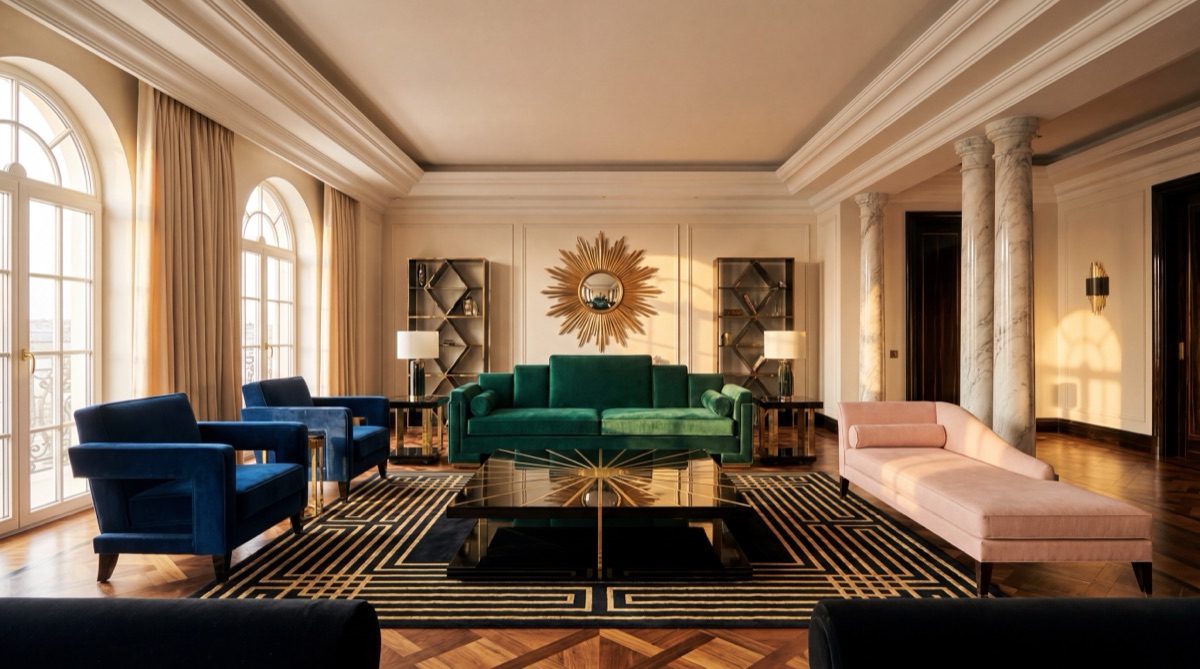
What makes Art Deco distinct from every other style in the 50-style design bundle is that it originates from architecture, not from furniture. The sunburst, the chevron, the stepped crown, the fan, the zigzag, the volute - these are architectural elements first, translated into furniture, textiles, hardware, and wallpaper second. That is why renters who try to execute Art Deco by buying one geometric print pillow end up disappointed: the style is a system, not an accent. The five elements below build the system in the order that makes the intention legible: jewel tone palette establishes the chromatic register, geometric pattern layer installs the style's visual language, metallic accents add the era's signature glamour hardware, statement lighting delivers the drama, and luxurious textiles complete the material hierarchy. Build all five and the room has an authority that individual Art Deco pieces alone cannot deliver.
The budget logic for Art Deco follows a clear sourcing hierarchy. Source geometric wallpaper panels and sunburst mirrors at mid-tier (Wayfair, Amazon, Target) - the pattern vocabulary is reproducible and quality is reliable at the $60 to $200 price point. Source velvet upholstery and lacquered furniture vintage when possible (Chairish, Facebook Marketplace, estate sales) - age and patina reinforce the style's Jazz Age authority. Source chandeliers and statement pendants at whatever investment level the room budget allows - lighting is the single highest-impact Art Deco element and the one where quality is most visible. The contemporary approach: deploy Art Deco elements selectively - the five pieces below, in the right order, establish the style without a full period-accurate overhaul.
Jewel Tone Palette · $129.97
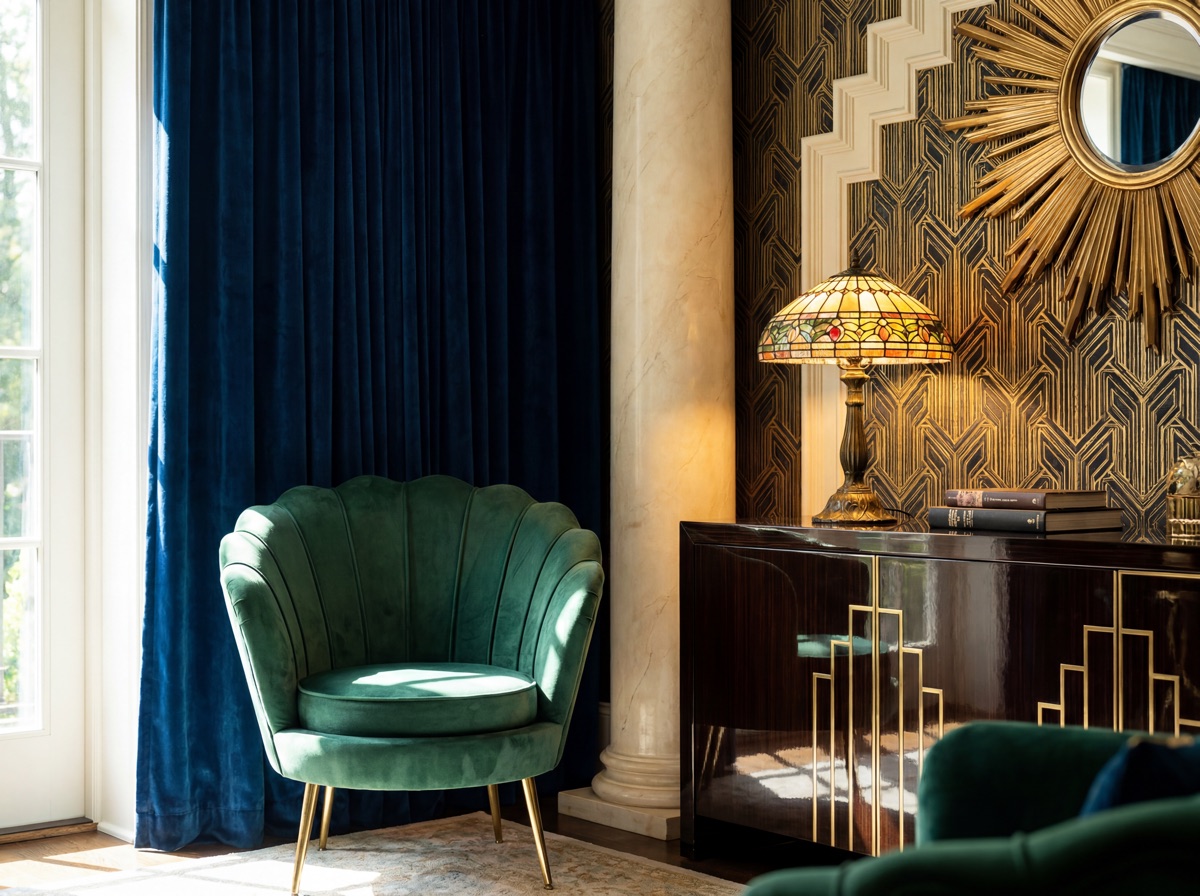
The jewel tone palette is the first decision in the Art Deco room, and it is the element that separates authentic Art Deco from the Halloween-costume version. Traditional Art Deco used very rich, jewel tone color palettes: sapphire blue, emerald green, ruby red, and deep gold, balanced against black, ivory, or cream. The palette logic runs on two tiers. The foundation is high contrast: cream or ivory walls meet deep-colored upholstery and dark lacquered surfaces -- the Art Deco room never hedges into the warm beige neutrality of Scandinavian design. The accent tier is metallic: gold, bronze, and chrome against the jewel tones create the shimmer the era favored. A practical test before committing to wall paint: introduce the jewel tone in objects first. Three items -- emerald green velvet pillow covers, a sapphire blue ceramic vase, and a deep navy throw -- establish the palette's register across multiple surfaces without a single irreversible decision. If the jewel tones feel right in the room's light at morning, afternoon, and evening, the wall color follows. Build the palette in objects before you paint.
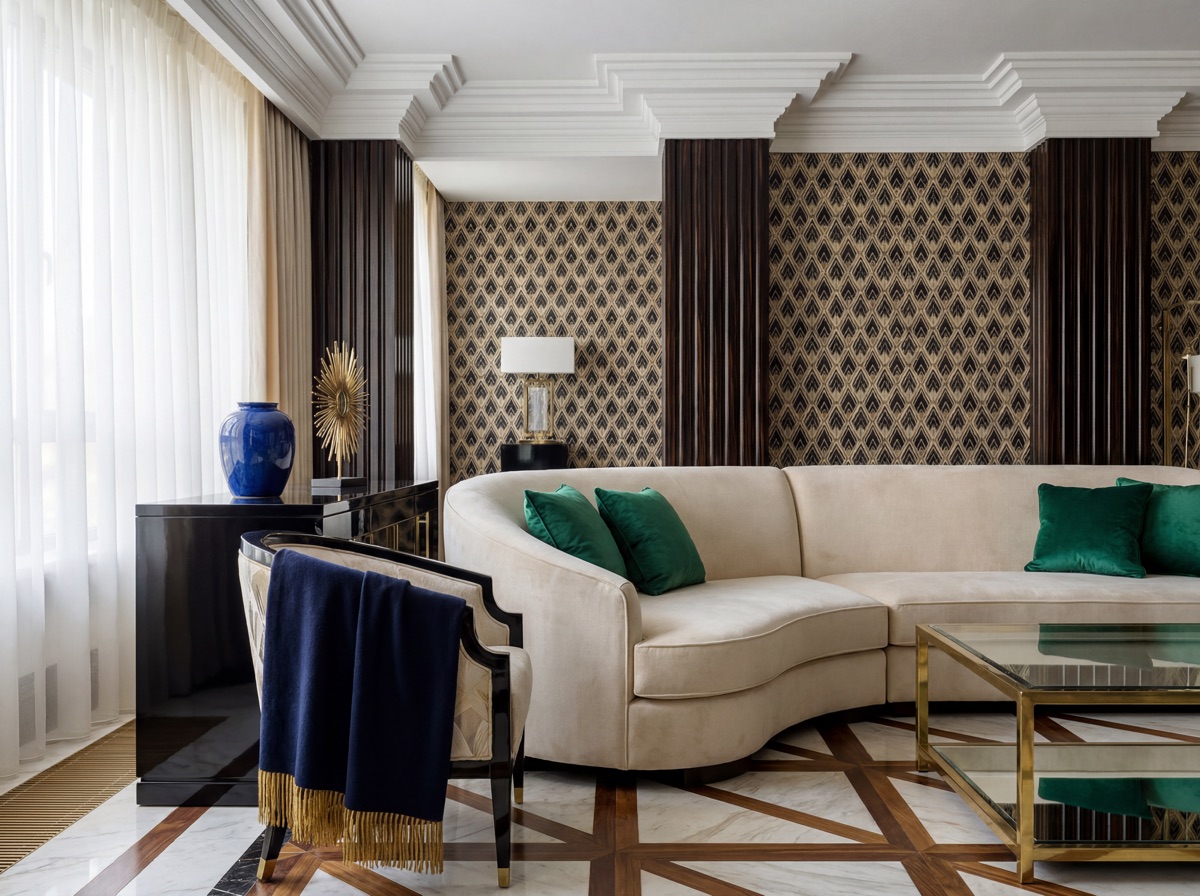
E1 Receipt - Jewel Tone Palette
Geometric Pattern Layer · $219.98
The geometric pattern layer is where Art Deco earns its identity -- and where renters can deploy the most affordable and most reversible version of the style. Zigzags, chevrons, and sunbursts are the Art Deco pattern vocabulary, applied across walls, floors, ceilings, textiles, and hardware as a system rather than an individual accent. Design communities have named sunburst, chevron, stepped crown, volute, zigzag, caryatid, fan, and torch as the eight canonical Art Deco element vocabulary. The geometric pattern layer translates three of those eight elements into apartment-scale objects: a sunburst wall clock (the sunburst motif in its most accessible form), a chevron-patterned area rug (the floor-level geometry anchor), and a geometric Art Deco wallpaper panel (the single most impactful budget transformation in the style). The wallpaper panel -- applied to one accent wall or as a single statement panel behind the sofa -- is the Art Deco transformation moment: one design forum post featured a geometric wallpaper as its central design decision, and dozens of commenters immediately asked where to find it. Chevron, fan, or stepped-arch patterns in gold on navy or black on cream are the two most period-accurate colorway combinations.
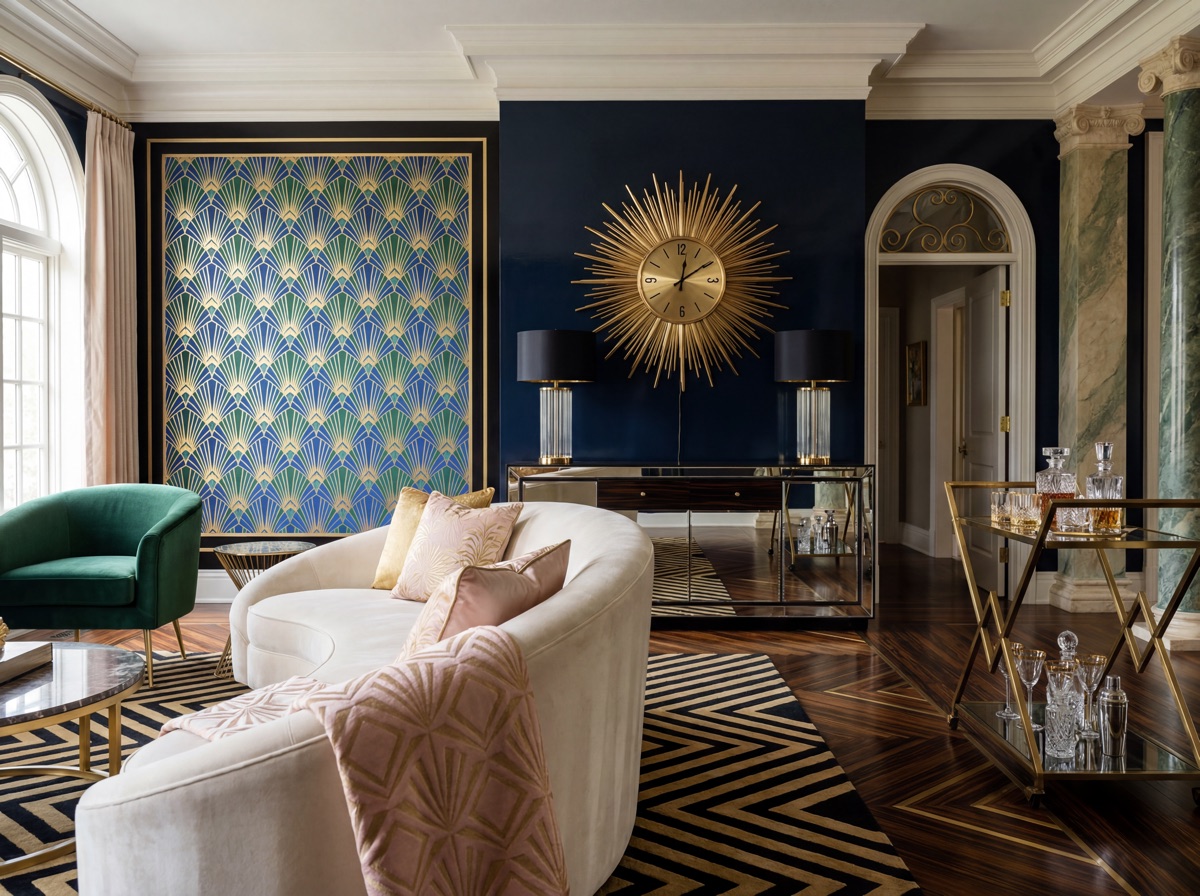
E2 Receipt - Geometric Pattern Layer
Metallic Accent System · $184.97
The metallic accent system is Art Deco's glamour hardware layer -- the element that takes the jewel tones and geometric patterns from bold to decadent. Chrome, brass, and gold were the metals the 1920s used to signal modernity and wealth simultaneously; in contemporary Art Deco rooms they carry the same dual role, adding shimmer to the jewel tones and reinforcing the geometry of the pattern layer. The Art Deco material hierarchy placed metals alongside lacquer, ebony, ivory, and exotic woods as premier materials -- chosen not just for beauty but for their association with industrial-age progress and global luxury. The metallic accent system is built from three pieces that operate at three scales. The sunburst mirror -- the most-referenced Art Deco object in the design community -- brings the style's radiating motif to the wall at mirror scale, reflecting both light and the jewel tones from across the room. The sunburst geometry in polished brass pulls the eye from every corner of the room. The geometric brass tray grounds the coffee table vignette in the same metallic vocabulary at a fraction of the investment. The lacquered black side table with brass hardware is the furniture-scale metallic moment: the lacquer-plus-metal combination is one of Art Deco's most legible material signatures, readable even in a room that has not yet received its wallpaper or chandelier.
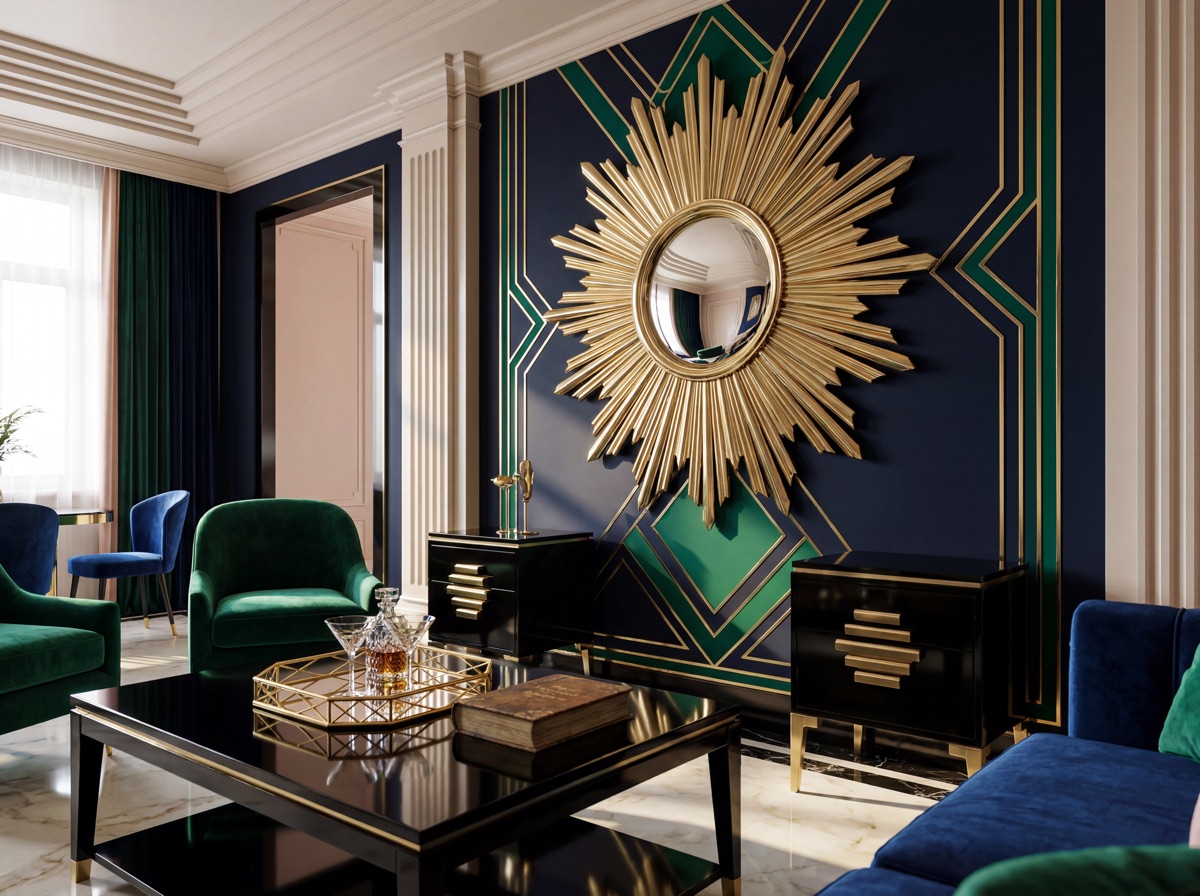
E3 Receipt - Metallic Accent System
Statement Lighting · $299.99
Lighting is the single highest-impact Art Deco element and the one where quality is most immediately visible -- which is why it lands fourth in the build sequence, after the palette and pattern have confirmed the room's direction. Art Deco lighting drew from the era's twin obsessions: geometric form and the glamour of new industrial materials like chrome, frosted glass, and polished bronze. The keyword `art deco chandelier` earns 2,900 searches per month -- the second-highest Art Deco product keyword after furniture -- precisely because the chandelier is the element buyers identify as the room's authority signal. American Art Deco design favored what historians call the "skyscraper style" floor lamp: stepped geometric base, often in chrome or brushed brass, rising to a frosted glass shade that diffuses light upward with industrial elegance. The chandelier and floor lamp together create the Art Deco lighting scheme: overhead drama from the chandelier, ambient warmth from the floor lamp. Both should use warm-toned bulbs at 2700K or lower -- the cold white of daylight LEDs strips the jewel tones of their richness and makes the metallic accents look clinical rather than glamorous. For renters who cannot replace overhead fixtures, a renter-safe plug-in chandelier (chain-hung from a ceiling hook) is the period-accurate alternative and requires no electrical work.
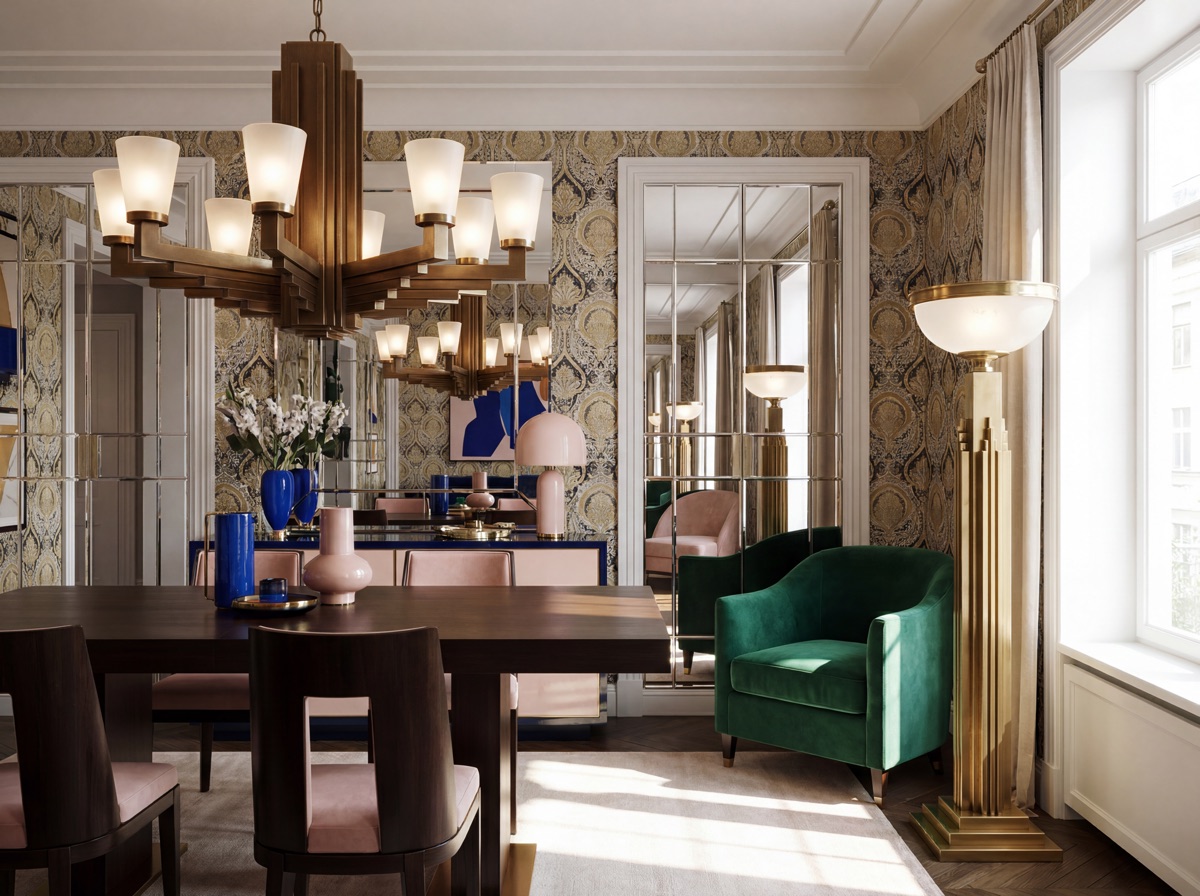
E4 Receipt - Statement Lighting
Luxurious Textile Core · $412.97
The luxurious textile core is added last because it responds to the room's established palette and material story rather than setting it -- and because Art Deco's textile hierarchy is specific enough to require the other four elements as context. Velvet, silk, and leather are the dominant upholstery and drapery materials in Art Deco interiors -- chosen for the same reason as the metallic materials: they were premier in the 1920s, associated with wealth and sophistication rather than with natural simplicity. The luxurious textile core is built from four pieces in descending scale. The velvet sofa -- the single largest investment in the Art Deco room -- is the upholstery anchor: in emerald green, sapphire blue, or ruby red, it plants the jewel tone palette in the room's largest surface and establishes that the style is systemic rather than accessorial. The velvet curtain pair extends the jewel tone vertically, creating the room's saturated color column at window height. The Tiffany-style accent lamp -- the one Art Deco decorative object with genuine mass-consumer market reach, referenced consistently across the design community -- brings the era's stained-glass tradition into a table-scale object with instantly recognizable period authority. The faux-silk cushion covers with geometric embroidery complete the material hierarchy: silk's surface sheen responds to light the same way the metallic accents do, creating a room that looks different at every hour of the day.
E5 Receipt - Luxurious Textile Core
Art Deco vs. Art Nouveau.
Both Art Deco and Art Nouveau are early 20th-century European design movements built from the same era's cultural energy -- which is why they are the most searched style comparison in the 50-style design bundle, at 5,400 searches per month with LOW competition. The distinction comes down to a single question: natural or geometric? Art Nouveau (1890-1914) draws from nature -- flowing organic curves, botanical motifs, the "whiplash curve" that dramatically turns back on itself, and a warm natural palette. Art Deco (1920s-1930s) draws from the machine age -- precise angles, straight lines, and sleek curves emphasizing symmetry and streamlined shapes, and a bold metallic palette evoking skyscrapers and industrial progress. World War I forms the dividing line between the two styles: the catastrophe of industrial warfare ended Art Nouveau's nature-worship and opened the door for Art Deco's embrace of the machine. The fastest identification test: if the pattern is built from flowing vines, lily pads, and sinuous feminine silhouettes, it is Art Nouveau. If it is built from sunbursts, chevrons, and stepped triangular forms, it is Art Deco.
| Dimension | Art Deco Interior Design | Art Nouveau Interior Design |
|---|---|---|
| Line and form | Precise angles, straight lines, geometric symmetry -- sunburst, chevron, stepped crown, fan, zigzag | Free-flowing organic curves -- the whiplash curve, botanical tendrils, sinuous feminine silhouettes |
| Inspiration source | The machine age -- industrial progress, skyscrapers, speed, and modernity; ancient Egyptian motifs (post-Tutankhamun 1922) | Nature -- botanical imagery, Japanese aesthetics, the Arts and Crafts movement, handcrafted organic forms |
| Color palette | Metallics and moody jewel tones -- sapphire, emerald, ruby with gold and chrome; high contrast black and ivory | Warm natural tones -- terracotta, beige, sage green, muted rose; evoking seasonal landscapes and botanical settings |
| Materials | Chrome, brass, lacquer, ebony, ivory, velvet, silk -- glossy, dramatic, and associated with industrial-age luxury | Carved wood, stained glass, ornate ironwork, ceramic tile -- handcrafted, delicate, celebrating fine artisan detail |
| Historical period | 1920s-1930s -- post-World War I, Jazz Age, the Chrysler Building, Radio City Music Hall, South Beach Miami | 1890-1914 -- pre-World War I, fin de siecle Europe, the Paris Metro entrances, Tiffany Studios early work |
| The fastest test | Pattern built from sunbursts, chevrons, stepped triangles -- geometric, symmetrical, and machine-precise | Pattern built from flowing vines, lily pads, and sinuous silhouettes -- organic, asymmetrical, and nature-accurate |
The $129 entry path.
Three items that establish the Art Deco jewel tone palette in any room -- no furniture replacement, no paint, no structural work required. The complete E1 serves as the entry path.
Frequently asked questions.
What is Art Deco interior design?
Art Deco interior design is a bold, glamorous style originating at the 1925 Paris International Exhibition and defined by geometric patterns (sunburst, chevron, zigzag, stepped crown, fan), jewel-tone color palettes (sapphire, emerald, ruby with gold and chrome accents), luxurious materials (velvet, lacquer, brass, exotic woods), and symmetrical compositions. The style peaked during the Jazz Age of the 1920s and 1930s and left its mark on the Chrysler Building, Radio City Music Hall, and South Beach Miami. Art Deco is architecture-born, not furniture-born: its vocabulary - the sunburst, the chevron, the stepped crown - originates in building facades and translates into interior objects second. In a modern apartment, Art Deco translates through a geometric wallpaper panel, a sunburst mirror, a velvet sofa in a jewel tone, and a statement chandelier in bronze or chrome. The pillar keyword `art deco interior design` earns 6,600 monthly searches, confirming this is one of the most sought-after design styles in the residential market.
What are the four key features of Art Deco design?
The four key features of Art Deco design are: (1) Geometric patterns - sunburst, chevron, zigzag, fan, and stepped forms applied across floors, walls, textiles, and hardware as a system rather than an accent; (2) Bold jewel-tone color palette - sapphire blue, emerald green, ruby red, and deep gold balanced against black, ivory, or cream for high-contrast drama; (3) Luxurious materials - velvet, lacquer, brass, chrome, ebony, and exotic wood veneers that hold historic and aesthetic significance as the premier materials of the 1920s; and (4) Symmetry and streamlined form - compositions that feel balanced, ordered, and monumental even at apartment scale. These four features form the identification checklist that separates authentic Art Deco from Hollywood Regency, Arts and Crafts, or Mission-style mislabeling - all three of which share decorative elements but differ fundamentally in geometry, palette, and material hierarchy.
What is the difference between Art Deco and Art Nouveau?
Art Nouveau (1890-1914) and Art Deco (1920s-1930s) are both early 20th-century European design movements, but they are visual opposites. Art Nouveau draws from nature - flowing organic curves, botanical motifs, the "whiplash curve," and a warm natural palette. Art Deco draws from the machine age - precise angles, straight lines, and sleek curves emphasizing symmetry and streamlined shapes, and bold metallic contrasts. World War I forms the dividing line between the two styles: Art Nouveau is a pre-war style rooted in organic beauty; Art Deco is a post-war style embracing industrial modernity. The fastest test: if a pattern is built from flowing vines and lily pads, it is Art Nouveau. If it is built from sunbursts, chevrons, and stepped triangles, it is Art Deco. The confusion is most common on Pinterest boards where both styles appear under the label "vintage glamour," but the geometric vocabulary makes Art Deco immediately identifiable once the element names are known. This comparison earns 5,400 monthly searches - the highest vs-cluster search volume in the 50-style design bundle.
Is Art Deco or Hollywood Regency right for my apartment?
Art Deco and Hollywood Regency are the two most commonly confused residential styles, as confirmed by frequent design forum debates where commenters split evenly between the two identifications for the same room. Art Deco is architecture-born - the geometry, symmetry, and material hierarchy originate from the 1925 Paris Exposition and 1920s American skyscraper design. Hollywood Regency is glamour-born - it takes the theatrical surface of Art Deco and adds more mixed-period antiques, more ironic maximalism, and more theatrical excess than the original style ever used. The room-level distinction: Art Deco feels like a lobbby in miniature - ordered, geometric, with a clear material hierarchy. Hollywood Regency feels like a film star's bedroom - glamorous but deliberately theatrical, mixing period pieces with deliberate irreverence. If the sunburst and chevron are structural to the room, it is Art Deco. If the room is primarily about glamour-as-mood and the period references are decorative rather than systematic, it is Hollywood Regency. Both are legitimate styles - they answer different questions about how a room should feel.
How do I get the Art Deco look on a budget?
The wallpaper-first strategy is the Art Deco budget entry point - confirmed by the r/ArtDeco post that earned for a geometric wallpaper as its central design decision. A single panel of peel-and-stick geometric Art Deco wallpaper in chevron, sunburst fan, or stepped arch costs $55 to $200 and establishes the style's vocabulary in a rental without permanent changes. Add a sunburst mirror in brass at $60 to $150, a sunburst wall clock at $40 to $90, and gold-tone cabinet hardware at $20 to $40 per set, and the room has three of the five Art Deco signals with no furniture replacement. The community's response - "it's calling me poor" ( on a r/femalelivingspace identification post) - reflects Art Deco's luxury perception, not its actual entry cost. The style's minimum viable transformation is pattern vocabulary, not price point. Three items at $129 - emerald velvet pillow covers, a sapphire vase, a navy throw with gold fringe - change the palette register of any existing room into Art Deco territory. Add geometry next. The rest follows.
Want yours next?
One issue every Sunday. We'll plan your room with your city + salary.