Table of Contents
What transitional design actually is.
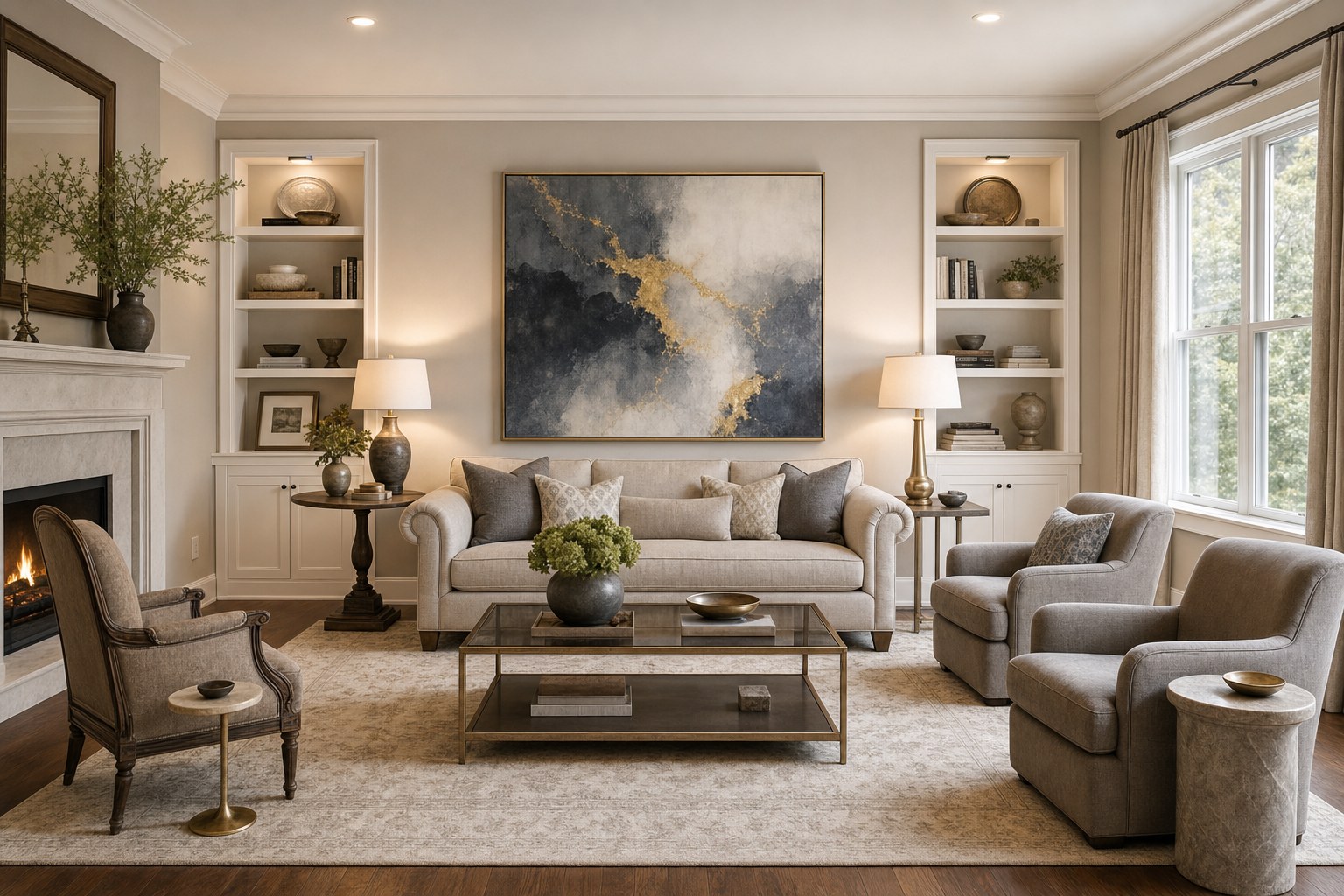
Transitional interior design is not a compromise. It is a position. It occupies the precise territory between traditional design - ornate millwork, carved furniture, heavy window treatments, period-accurate symmetry - and contemporary design, which pursues clean geometry, cool neutrals, and the current moment's dominant trend. Transitional design refuses both extremes: nothing jars the eye, and colors, patterns, and textures play in harmony. The design press calls it timeless. Most homes already are it.
The transitional origin story is always the same: two people with different aesthetic instincts - one who leans traditional, one who leans contemporary - who resolve the tension by finding the middle ground that neither abandons. The result is the most popular residential style in the US, with transitional leading every other style category including modern, contemporary, farmhouse, and mid-century in homeowner survey data.
The five elements of transitional design are sequenced here in the order that prevents misidentification: sofa silhouette and fabric first (the room's primary style signal), flooring second (the warm wood or LVP baseline that anchors the palette), millwork third (the shaker-door vocabulary in kitchens and built-ins), mixed metals fourth (the hardware and lighting language that bridges old and new), and layered neutral rug last (the textile foundation that grounds the seating core). This is the order interior designers use to build a transitional room, and it is the order that makes the style most readable at each stage.
Upholstered Rolled-Arm Sofa · $549.00
The sofa is where transitional happens in practice. The formula: the sofa has to be clean-lined but not cold. That is the whole tension. The rolled arm is the detail that holds it. It is traditional enough to read as substantial and comfortable, contemporary enough in its restraint to sit against a flat-panel wall without looking period. Transitional sofas have clean profiles and gentle curves, upholstered in rich velvet, nubby linen, or a touch of nailhead trim. The nailhead being the optional traditional signal that some buyers add and others omit depending on how far toward the traditional pole they sit. The fabric color is the second decision: warm greige, warm taupe, and oatmeal boucle are the three neutral families that read transitional. Pure white and dove gray read contemporary. Ivory with a warm undertone and beige read transitional. A linen sofa with a slightly curved back and rolled arms is the canonical form. Source new from Amazon, Target, or Wayfair in the $400-$900 range, or vintage from Facebook Marketplace in the $150-$350 range where the classic silhouette is always available.
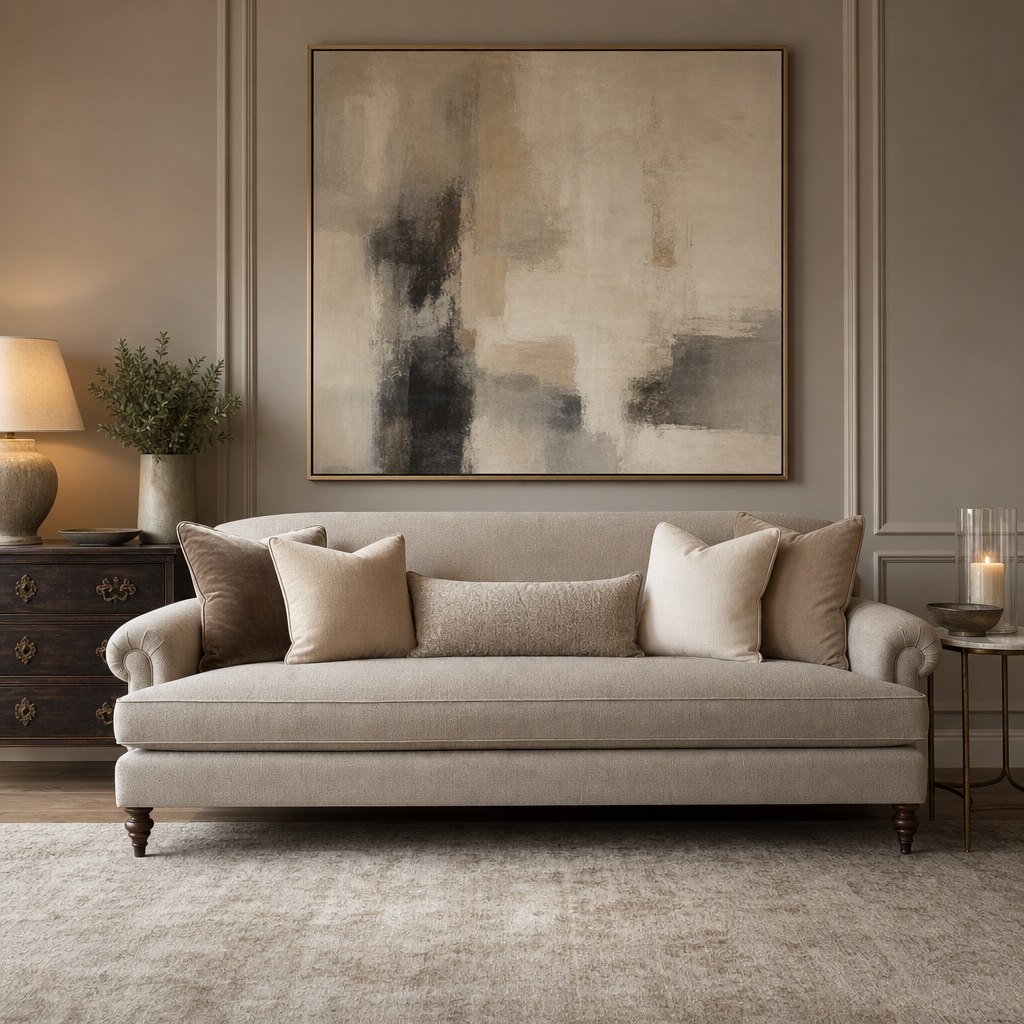
E1 Receipt - Upholstered Rolled-Arm Sofa
Warm Hardwood or LVP Flooring · $179.97
Warm wood floors are one half of the transitional formula. The warm wood floors plus the clean-lined sofa is the transitional baseline. People often spend days trying to name the style they have already built before arriving at this description. The key word is warm. Cold gray laminate reads contemporary or Scandinavian. Dark espresso wood reads traditional. Warm honey oak, warm medium walnut, and warm blonde maple in the medium-brown range read transitional. Neither too rustic nor too sleek, which is exactly the palette logic that defines the style. For renters and homeowners without budget for flooring replacement, LVP (luxury vinyl plank) in warm wood tones at 6-9mm thickness is the surface that professional stagers and design influencers use most consistently to update the floor read of an existing space. The receipt below covers the styling layer on top of existing floors: a warm wood coffee table (the floor's material echo at furniture height), a wood-finish console table for entryway or media, and a set of bamboo or acacia coasters that bring the warm wood grain to tabletop scale without a single nail in the floor.
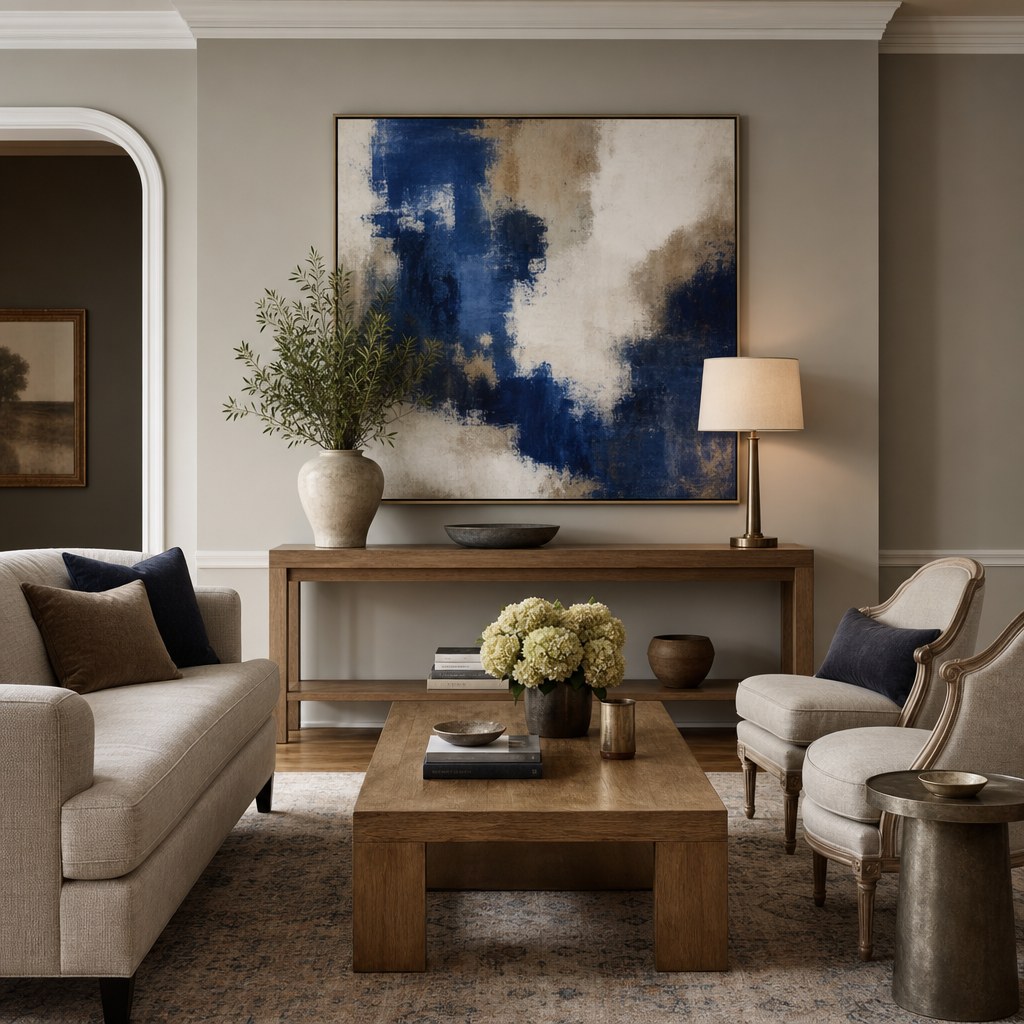
E2 Receipt - Warm Wood Flooring Layer
Shaker-Style Millwork Layer · $159.97
The shaker cabinet door is the most precise physical definition of transitional design. It is the door profile that sits exactly between the ornate raised-panel traditional door. With its layered molding profiles, its carved corner blocks, its insistence on historical accuracy. And the flat-panel contemporary door, which has no frame at all and reads as furniture, not cabinetry. Shaker has a simple recessed-panel frame, nothing more. The transitional millwork formula: marble counters paired with simple shaker-style cabinets. The updated-classic configuration that neither tips traditional nor tips contemporary. Beyond kitchens, the shaker vocabulary appears in transitional living rooms as simple crown molding (a single-profile cornice, not the three-piece built-up crown of colonial traditional), subway tile in bathrooms (the four-by-eight-inch white ceramic tile that is neither rustic nor high-gloss contemporary), and picture-frame wall molding used sparingly as an architectural detail on one accent wall. The receipt covers the paintable shaker-style cabinet door replacement set (the fastest millwork upgrade for a renter or buyer in an existing kitchen), a set of simple white subway tile peel-and-stick panels for backsplash (the transitional kitchen's secondary material), and a single package of paintable picture-frame molding for one accent wall panel moment.
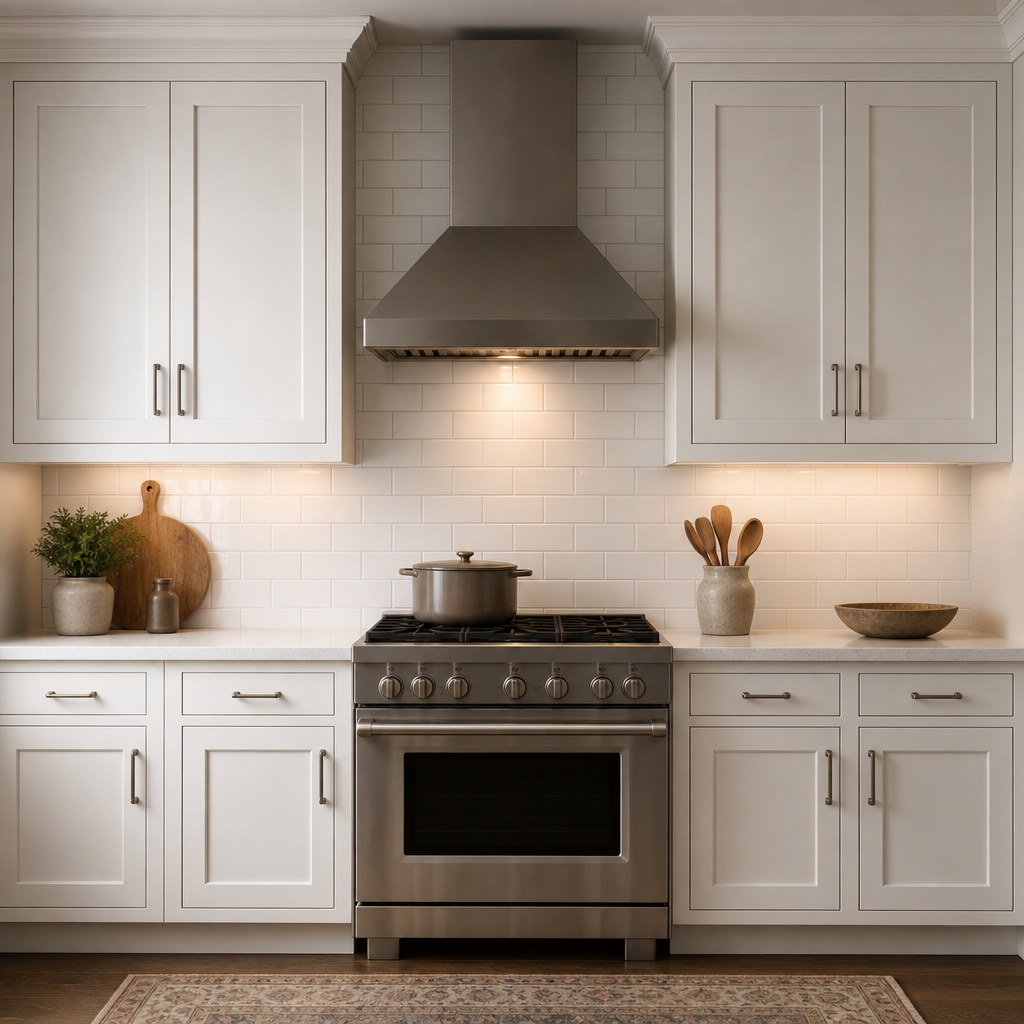
E3 Receipt - Shaker Millwork Layer
Mixed Metal Accents · $129.97
Mixed metals are how transitional design signals that it belongs to the present without belonging to any single trend cycle. Traditional interiors use one metal, typically polished brass or oil-rubbed bronze, applied consistently to every hardware and lighting fixture in the room. Contemporary interiors use one metal too, typically matte black or satin nickel, but deployed with the precision of a monochromatic palette. Transitional design mixes two: brushed nickel and warm brass are the canonical transitional pair. Brushed nickel reads clean and contemporary. Warm brass reads traditional and warm. Together they hold the style's operative tension: classic without being dated, fresh without being cold. The rule that prevents mixed metals from reading as indecision rather than intention: one metal dominates (brushed nickel on fixed hardware. Cabinet pulls, faucets, light fixtures), and the second appears as a warm accent (brass on table lamps, candleholders, decorative trays, and vase necks). No single finish dominates; combining materials like wood, leather, glass, and metal adds depth and visual interest rather than confusion. The receipt covers the brushed nickel cabinet hardware pull pack, a warm brass table lamp, a mixed-metal decorative tray (nickel frame, brass handles), and a set of brass bud vases for the coffee table vignette.
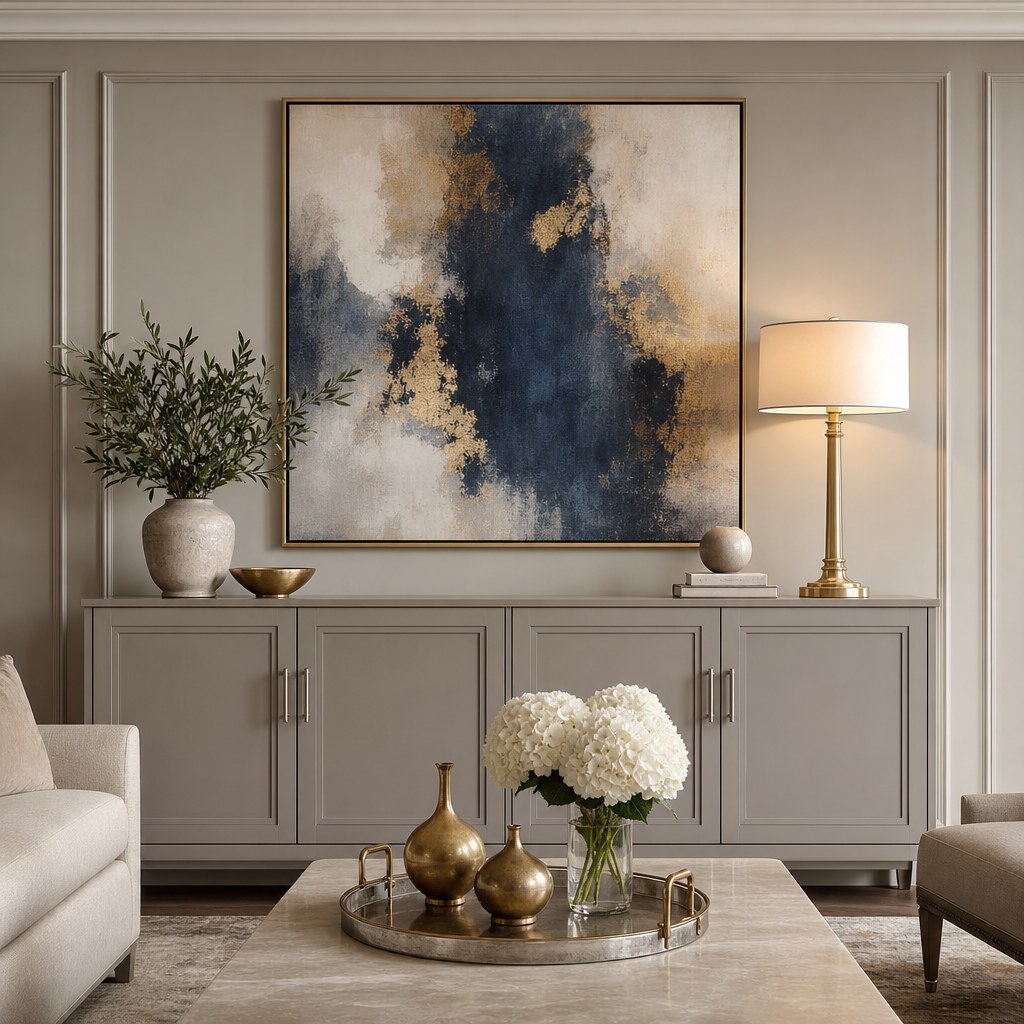
E4 Receipt - Mixed Metal Accents
Layered Neutral Area Rug · $228.97
The layered neutral rug is the transitional room's textile foundation and its most achievable upgrade. A single 8x10 or 9x12 area rug in warm ivory, greige, or warm taupe placed under the entire seating area, front legs of the sofa on the rug, coffee table fully on the rug, grounds the space and establishes the warm neutral palette on the largest horizontal surface in the room. The pattern rule for transitional rugs: low-contrast geometry (a tone-on-tone diamond or subtle stripe) is preferred over bold contrasting patterns (which read bohemian or eclectic) and over no pattern at all (which can read too contemporary). A second, smaller rug layered over the primary rug, typically a 2x3 or 3x5 flat-weave kilim in a warm palette, is the styling technique that transitions the room from neutrals to layered neutrals, which is the textural depth that distinguishes a transitional room from a merely beige one. The linen throw pillow pair (warm greige or soft taupe, 22x22) is placed on the sofa at each end and functions as the palette's soft punctuation. Neither a color statement nor a pattern statement, just the fabric and scale that read transitional at a glance.
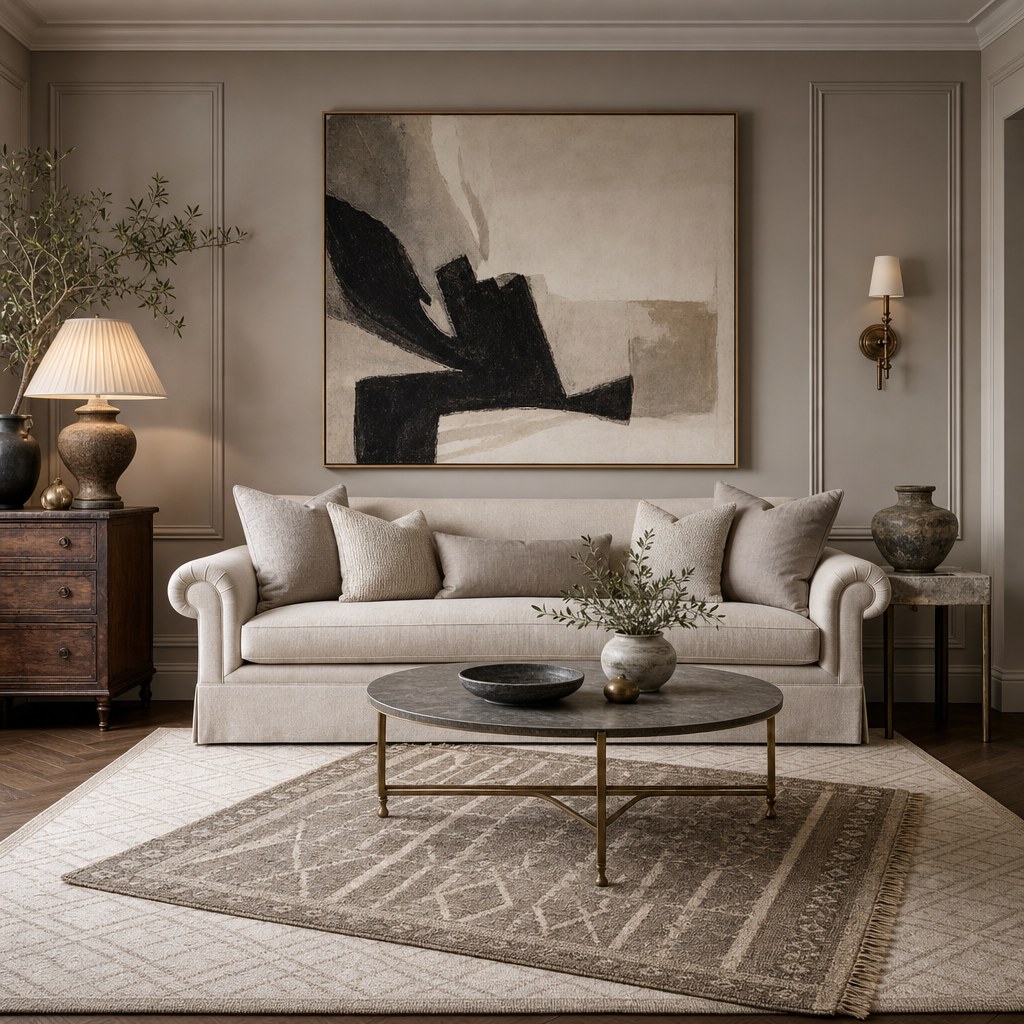
E5 Receipt - Layered Neutral Area Rug
Transitional vs. Traditional vs. Contemporary.
All three styles share certain materials and a commitment to quality. Which is why misidentification is so common. The distinction is temperature, ornamentation level, and trend relationship. Traditional design anchors to historical period accuracy: carved furniture, raised-panel millwork, ornate window treatments, symmetrical arrangements, and one metal applied consistently throughout. Contemporary design pursues the present moment: flat-panel surfaces, cool neutrals, strong geometric contrast, and a willingness to refresh every three to five years as the current moment evolves. Transitional sits between both, borrowing the timelessness of traditional and the restraint of contemporary without committing to either's excess. It avoids the extremes of overly ornate traditional interior design spaces and the cold simplicity of contemporary interior design.
| Dimension | Transitional | Traditional | Contemporary |
|---|---|---|---|
| Color palette | Warm whites, greiges, soft taupes. Warm neutral baseline with low-saturation accents | Richer, deeper tones, navy, forest green, burgundy, cream, often with pattern at scale | Cool whites, cool grays, stark contrasts, or current seasonal accent color |
| Millwork | Shaker doors, simple crown molding, subway tile. The bridge forms with minimal profiles | Raised-panel doors, built-up crown molding, elaborate architectural detail throughout | Flat-panel doors, no crown, hidden hardware, cabinetry reads as furniture |
| Sofa silhouette | Rolled arm, clean lines, neutral fabric. Traditional enough to feel substantial, contemporary enough to feel restrained | Camelback sofa, tufted back, nailhead trim throughout, ornate carved legs | Low profile, track arm or flat arm, no ornamentation, solid or bold geometric fabric |
| Metal finish | Mixed. Brushed nickel dominates on fixtures; warm brass appears on lamps, trays, vases | One finish throughout. Polished brass or oil-rubbed bronze, consistent on all hardware | One finish throughout. Matte black or polished chrome, applied with precise uniformity |
| Trend relationship | Timeless. Designed to age well and resist obsolescence; no seasonal refresh required | Period-stable. Anchored to a historical moment, not current trend cycles | Trend-adjacent. Reads current now, may require updates as the design moment shifts |
| The test | The room feels "warm and pulled-together" with no particular era commitment | The room could appear in a period drama and feel accurate | The room looks like it was designed this year, specifically |
The $199 entry path.
Three items that establish the transitional style read in any room. No furniture replacement, no paint, no structural work required.
Frequently asked questions.
What is transitional interior design?
Transitional interior design pairs the classic, time-tested appeal of traditional decor with the clean silhouettes and understated color palette of contemporary style - refined ease, embracing comfort without sacrificing elegance. It consistently ranks as the leading residential style in the US, ahead of modern, farmhouse, traditional, and mid-century in homeowner survey data. The operative principle is harmony: colors, patterns, and textures work together without any single element jarring the eye. Nothing in a transitional room is overly ornate or overly minimal - pieces feature subtle curves, neither heavily carved nor purely geometric. The style is designed to age well and require no periodic trend refresh, which is what makes it the default choice for homeowners who want quality over stylistic statement.
What colors are used in transitional interior design?
The transitional palette runs on warm neutrals: warm whites, creams, greiges, and soft taupes are the dominant palette, applied to walls, large upholstery, and rugs. Greige walls and warm-toned wood - that is the transitional baseline. Cold grays and pure whites read as contemporary, not transitional. Accent colors enter the room at low saturation through textiles and accessories: soft navy, dusty sage, warm charcoal, and muted blush all work within the transitional framework without disrupting the overall calm. Three workable color families: warm neutrals (cream, beige, taupe), cool neutrals (dove gray, snow white) used as a secondary option, and serene colors (misty blue, soft sage, dusty rose) used at accessory scale. The palette self-test: if the room feels warm without belonging to any particular decade, it is transitional.
What is the difference between transitional and contemporary interior design?
Contemporary design pursues the current moment - sharper lines, cooler neutrals, stronger contrast, and a willingness to update every few years as the design setting shifts. Transitional design pursues timelessness: it borrows the clean lines of contemporary but warms them with traditional detailing (rolled arms, shaker doors, nailhead trim) and natural materials (linen, wood, stone). Where contemporary favors cool grays and pure whites, transitional favors warm whites and greiges. Where contemporary uses flat-panel cabinetry, transitional uses shaker - the profile that is neither ornate nor cold. Where contemporary uses one metal finish applied precisely throughout, transitional mixes brushed nickel and warm brass. The result is a room that ages beautifully and remains relevant year after year, rather than requiring periodic trend refreshes. The simplest test: a contemporary room looks like it was designed this year; a transitional room looks like it was designed well.
What furniture defines transitional style?
Transitional furniture has clean profiles and gentle curves, upholstered in rich velvet, nubby linen, or a touch of nailhead trim. The defining piece is the rolled-arm sofa in a neutral fabric - clean enough to read contemporary, detailed enough (the rolled arm, the turned leg) to read traditional. Shaker-style cabinetry is the kitchen equivalent: the door profile that sits between ornate raised-panel traditional and flat-panel contemporary. A linen sofa with a slightly curved back - that is perfectly transitional. Pieces are neither overly ornate nor overly minimalist, featuring subtle curves - the practical definition that rules out both the heavily carved traditional silhouette and the purely geometric contemporary one. Quality and comfort are prioritized over stylistic statement: a transitional sofa should look as good in fifteen years as it does today.
How do you achieve transitional style on a budget?
Three items shift a room into the transitional style read without furniture replacement: a layered neutral area rug (warm ivory or greige, 8x10, placed under the entire seating area), a warm brass table lamp with a cream linen shade, and brushed nickel bar pulls to replace existing cabinet hardware. These three elements establish the warm neutral palette on the floor plane, introduce the warm brass accent metal, and deliver the transitional dominant metal (brushed nickel) on the fixed hardware - the three signals that a designer would read as transitional first. The sofa is the largest investment in the full build at $400-$900 new or $150-$400 sourced vintage. The shaker millwork upgrade requires cabinet door replacement at roughly $25-$45 per door, or can be approximated with peel-and-stick shaker overlays for renters. The mixed metal accent set (tray, vases, hardware) can be assembled for under $75.
More rooms like this
No spam. Unsubscribe anytime.