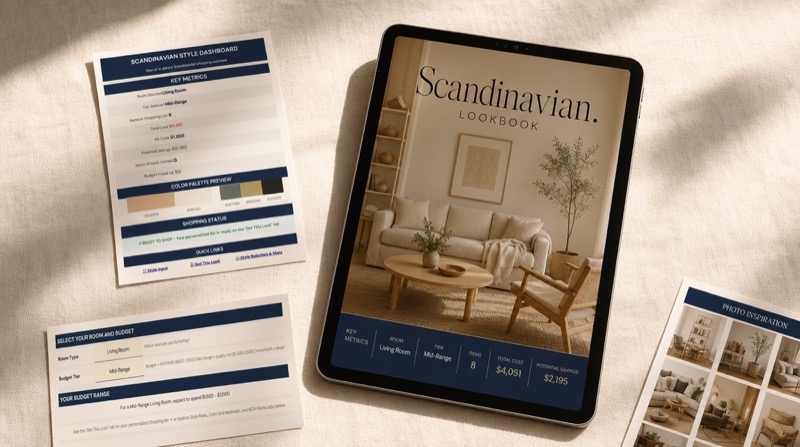
There's a quiet Reddit line from a comment that got twenty upvotes on the 1970s-Scandi aging thread: "Their culture just values good design, believing that if you live and work in well-designed spaces you'll feel better." That's the whole rationale for a Scandinavian home office in one sentence. If you work from home, and if you're reading this, you probably do, the office is the room where the five-principle framework of Scandinavian design converts most directly into a productivity outcome. This cluster is the five-piece setup for a small apartment nook, with the budget, mid, and luxury picks for each. For the full style context, our Complete Scandinavian Interior Design Guide is the parent.
The 5-Piece Setup
A legitimate Scandinavian home office needs exactly five things. Anything more is decoration; anything less is a gap.
1. The desk. Pale oak surface, tapered legs, 48-60 inches wide. IKEA LISABO Desk ($149, ash veneer) or IKEA ALEX with a pale oak top at the budget end; Article Madera Oak desk at mid; HAY Copenhague CPH30 at luxury.
2. The chair. This is the single most-important office purchase. Black plywood shell, pale wood legs, molded seat. The canonical luxury pick is the Fritz Hansen Series 7 3107 ($650), the best-selling chair in world history. Budget dupes: IKEA ÖSTANÖ or Article Ecole in black. Target Threshold has a Series 7-adjacent plywood chair at $179 that works as a bridge.
3. The desk lamp. One, not two. Adjustable arm, pale shade, warm-white bulb. IKEA ARÖD at $45 at the budget end; HAY PC Portable ($225) at mid; Louis Poulsen PH 2/1 Table ($895) at luxury. The PH-lineage lamp is the piece Reddit calls out as "the one that makes the room feel right."
4. A floating oak shelf above the desk. Single 36-48 inch floating shelf, pale oak or ash, with three objects on it, no more. A ceramic pot, one linen-bound book, one small plant. That's the whole shelf. Four objects starts to read cluttered; five breaks the room.
5. A small potted plant. Snake plant, ZZ plant, or small monstera. On the floor next to the desk or on the shelf above. Real plants, not fake. One, not three.
The setup total at the budget tier is about $450 (desk $149 + chair $130 + lamp $45 + shelf $30 + plant $25 + tax). At the mid tier it runs closer to $1,800 with the Article desk and a Hay lamp. At the luxury tier, the Series 7 chair alone ($650) puts the full setup over $2,500.
What NOT to Put on a Scandinavian Desk
The Scandinavian desk rule is subtraction. Five things that routinely ruin the setup:
- Desktop organizers with compartments. Pen holders, tape dispensers, stacking file trays. Use one small ceramic pen holder, max. Everything else goes in a drawer.
- Monitor arms and cable clutter. A Scandi desk with three monitors on boom arms and visible cables reads "tech workstation," not "Scandinavian office." If you need multiple monitors, cable-manage them under the desk and use matte black arms.
- Stickers on the laptop. The laptop is a visual object in a Scandinavian room. A laptop covered in stickers breaks the palette instantly. Plain silver, space grey, or natural metal only.
- Decorative paperweights, tchotchkes, fidget spinners. One or two deliberate objects per surface. The Reddit villain list applies here as much as anywhere else, no wicker balls, no Rae Dunn, no word art.
- Multiple plants on the desk. One plant, not three. Plants compete with the laptop for visual weight; two plants + a laptop is crowded.
The "CEO of Minimalism" Self-Check
One of the sharpest Scandi-room critiques on Reddit is the "CEO of minimalism" tag, the sarcastic label for a desk setup that's so over-edited it reads as performance rather than work. A Scandi home office isn't supposed to look like you don't do anything; it's supposed to look like you do one thing and do it well. One deliberate object on the shelf is fine; zero objects anywhere reads as stunt minimalism. The Scandi bedroom rule applies here, layering matters. A wool throw over the back of the chair, a ceramic mug of actual tea on the desk, a notebook open to a current page. The room should look used.
Small-Nook Setups (Under 30 Sqft)
A Scandinavian home office doesn't need a dedicated room, the most common real-apartment setup is a 3-foot-wide nook in the corner of a living room or bedroom. The rules:
- Use a wall-mounted desk if the floor space can't accommodate a standalone, IKEA LILLÅSEN or SKARSTA wall-mount configurations.
- Skip the floating shelf above; the vertical space is better used for a single framed print.
- Replace the task lamp with a plug-in swing-arm sconce if desk real estate is tight.
- Put the chair on wheels so it can roll under the desk entirely when not in use.
The 32,971-upvote Chicago apartment post (1ppyr71) has a corner-nook Scandi desk setup as part of the larger living room layout, visible in the photo carousel, and it's exactly this pattern.
The Remote-Worker Reality Check (Ergonomics vs Aesthetics)
The honest tension in every Scandinavian home office is aesthetics versus ergonomics. A Fritz Hansen Series 7 plywood chair looks perfect but is brutal to sit in for eight hours, it was designed for dining, not for 40-hour weeks at a screen. A Herman Miller Aeron or Humanscale Freedom is the correct ergonomic answer but reads "tech startup" more than Scandinavian. The real-world compromise most remote workers land on: keep the Series 7 or its dupe as the photo-shoot chair but own an ergonomic task chair stored under the desk for actual working hours. The Series 7 is fine for 30-minute bursts and video calls; the task chair comes out for deep-work sessions. This isn't a cop-out, it's the same pattern Nordic offices use, where designer chairs live alongside Aeron-class task seating. If you're setting up a legitimate full-time home office and can only afford one chair, pick the ergonomic one and pick it in black plywood aesthetics (the Humanscale Freedom in black reads almost Scandinavian enough). The Scandi purists will complain, but your spine will thank you in year three.
Shop the Setup
The ten pieces that build the five-piece Scandinavian desk setup described above, with budget and mid-tier picks across IKEA, Target, Amazon, and Wayfair.
See Also
- Scandinavian living room ideas (where most home-office nooks live)
- the 12 essential Scandinavian furniture pieces
Frequently Asked Questions
What does a Scandinavian home office look like?
Pale oak desk against a warm off-white wall, a black plywood or birch chair, a single desk lamp with a pale shade, a floating oak shelf above with three or fewer objects, and a small potted plant. Uncluttered, functional, warm-lit.
What's the best chair for a Scandinavian home office?
The Fritz Hansen Series 7 3107 at ~$650 is the canonical pick, the best-selling chair in world history. Budget dupes from IKEA and Target Threshold work at $130-$200. For ergonomic task chairs, the Herman Miller Aeron isn't Scandinavian but doesn't clash with the room; a Humanscale Freedom in black is the closer compromise.
Can a Scandinavian desk setup work in a small apartment nook?
Yes, and that's the most common real-world setup. Use a 3-foot wall-mounted desk (IKEA LILLÅSEN), skip the floating shelf, use a plug-in swing-arm sconce instead of a task lamp, and roll the chair under the desk when not in use.
Is the Scandinavian home office minimalist?
It's edited, not stunt-minimalist. The goal is one deliberate object per surface, not zero objects everywhere. Reddit calls the stunt-minimalist version "CEO of minimalism" sarcastically for a reason, a Scandi office should look used, with a wool throw on the chair and a ceramic mug on the desk.
How much does a Scandinavian desk setup cost?
At the budget tier, about $450 (IKEA LISABO desk + dupe chair + ARÖD lamp + floating shelf + plant). At the mid tier, about $1,800 with an Article desk and Hay lamp. At the luxury tier, over $2,500 with the Series 7 chair alone.
Back to the Pillar
The home office is one of five rooms the pillar walks through. For the rest, living room, bedroom, kitchen, bathroom, loop back to the Complete Scandinavian Interior Design Guide.