Table of Contents
The Symmetry Blueprint.
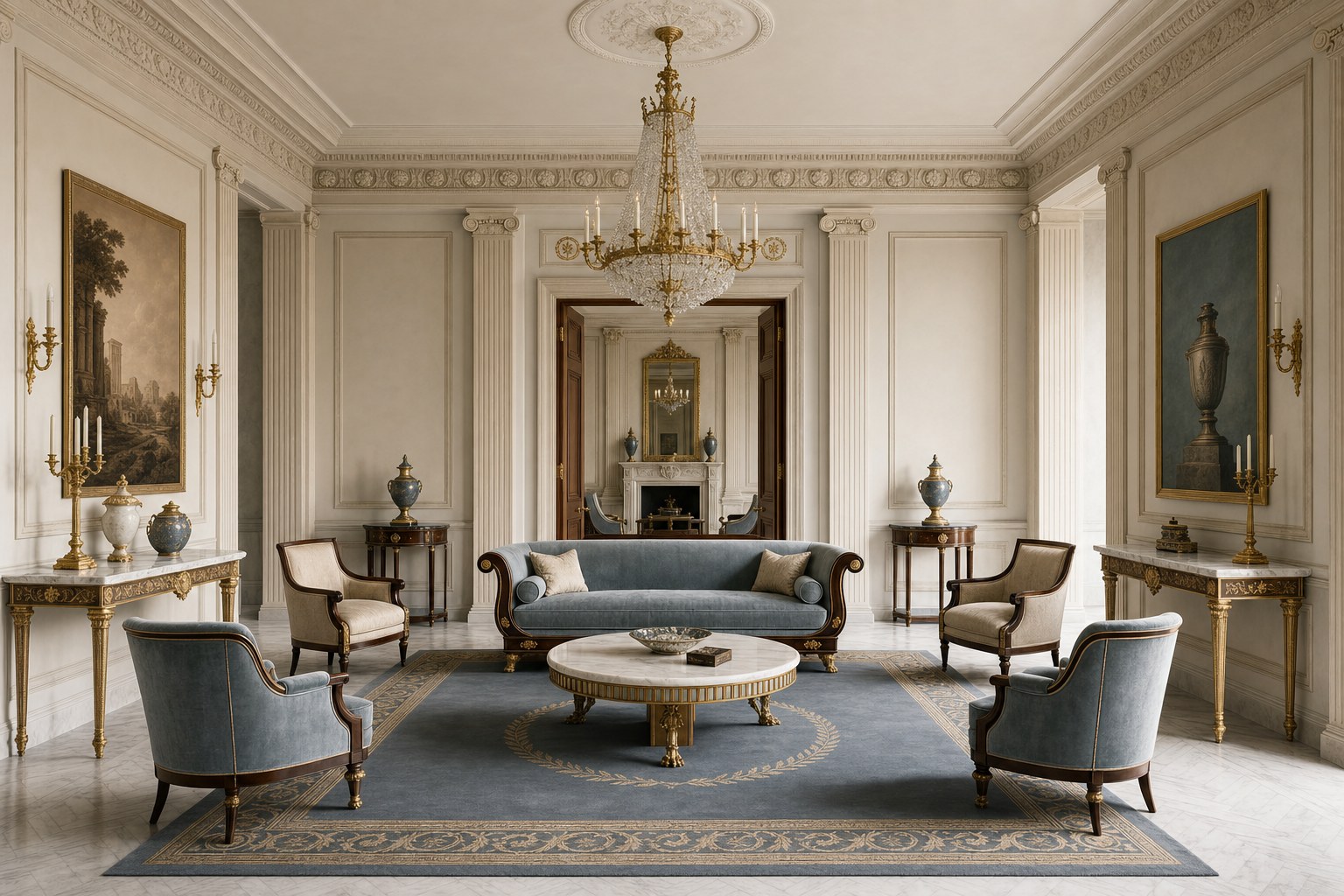
Neoclassical interior design is not about recreating a palace. It is about understanding that the architects of ancient Greece and Rome discovered proportional laws that make rooms feel authoritative and calm, and then applying those same laws inside a contemporary home. The movement was born in the 18th century when European designers, energized by the archaeological discoveries at Herculaneum and Pompeii, turned against the theatrical curves of Baroque and Rococo. The result was a design language built on five principles: symmetry around a central axis, architectural features borrowed from classical column orders, marble and stone as permanent surface materials, crystal light sources positioned at the axis center, and silk or velvet textiles that establish a material hierarchy running from stone at the base to fiber at eye level.
The style occupies a specific position in the market. "Neoclassical furniture" generates 1,000 searches per month - more than the pillar keyword "neoclassical interior design" itself at 880 monthly searches. Buyers know what they want from neoclassical at the product level before they can name the style, and the fluted leg sideboard is doing most of the work. The fluted leg is correct. Architectural millwork - the column detail, the pilaster relief, the fluted surface - is what actually converts a room from formal-adjacent to formally neoclassical. Symmetry is the law; millwork is the proof. The five elements below build the room in the correct order.
Sourcing logic for neoclassical follows a clear hierarchy. Architectural millwork and genuine marble are permanent investments - budget here first, source from stone yards and architectural salvage when possible. Crystal chandeliers have a wide quality spread; the $149 to $299 range on Amazon delivers genuine crystal drops and brass-finish frames that photograph indistinguishably from $800 retail versions. Velvet upholstery is where accent budget should concentrate: a single velvet armchair in sage, dusty blue, or ivory moves the room farther than five smaller soft goods combined. For the full furniture layer - a neoclassical sofa with carved frame and camelback silhouette - Restoration Hardware and Pottery Barn carry the accessible reproduction tier; First Dibs and Chairish carry the genuine antique tier at 2x to 5x price for corresponding provenance.
Architectural Millwork · $189.94
Architectural millwork. Columns, pilasters, fluted panels, deep cornice moldings, and pediment-top door surrounds, is the signal that separates neoclassical from merely formal. "Columns and pilasters frame entryways and create grandeur," and symmetry in placement around a central axis is the defining spatial law of the style. The column orders matter here: Doric pilasters (plain capital, strong shaft) read as the most masculine and architectural; Ionic (scroll capital, fluted shaft) is the residential standard; Corinthian (acanthus leaf capital) is the most ornate and reserved for living room and entry foyer feature applications. For renters and non-structural applications, peel-and-stick fluted wall panels and paintable foam pilaster strips achieve the same visual register at a fraction of the cost and zero permanent modification. The Greek key border at baseboard height, a continuous interlocking right-angle pattern, is the horizontal complement to vertical pilaster work and appears in both wallpaper borders and floor inlay. Install the millwork first, in symmetrical pairs flanking doorways or centered on the dominant wall axis, before introducing any other element. Everything else orients to it.
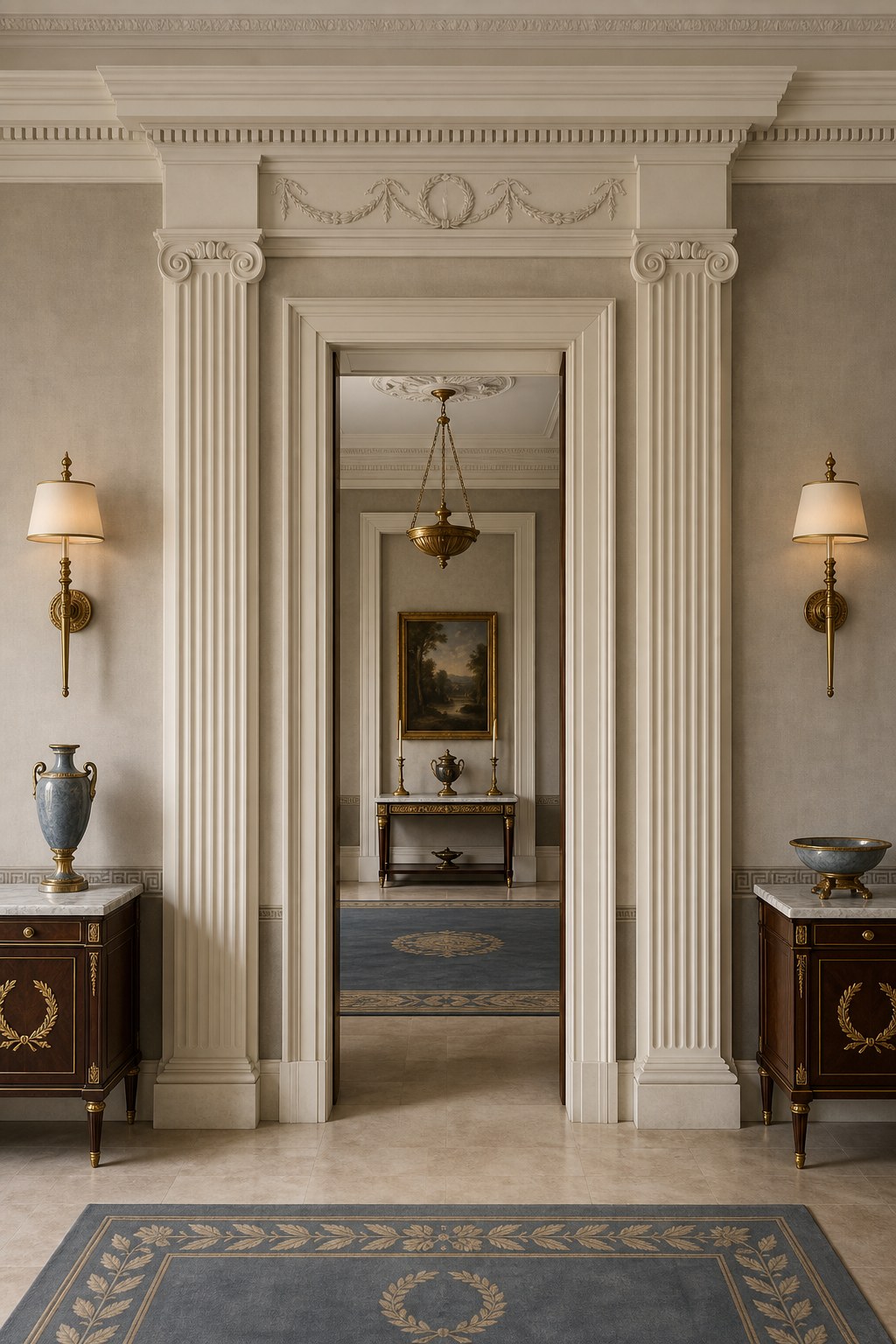
E1 Receipt - Architectural Millwork
Marble Surfaces · $298.96
Marble is the material signature of neoclassical design. Present at every scale from floor slab to decorative tray, in every room from kitchen to bath. Marble accents and black-and-white marble floors are definitional to the style, and the pattern preference runs classical: Calacatta white with grey veining for primary surfaces, nero marquina black for accent inlays and border work, and crema marfil beige for warmer applications. The symmetry and the marble counters. That is what makes it feel neoclassical. For the full neoclassical hierarchy, marble appears at three levels: structural slab (floors and counters. Genuine stone, the permanent investment), mid-scale furniture tops (coffee table, console, side table. Genuine or engineered stone), and decorative surface (tray, bookend, lamp base. Genuine or look-alike in resin). The decorative scale is where the accessible entry lives. A genuine white Carrara marble tray, a pair of marble bookends, and a marble-top side table establish the material story at accessible price points before any slab investment. The key self-test: marble in a neoclassical room should appear on at least two surfaces of different scales. One large marble surface reads as renovation; two surfaces at different scales reads as a deliberate material hierarchy, which is the neoclassical point.
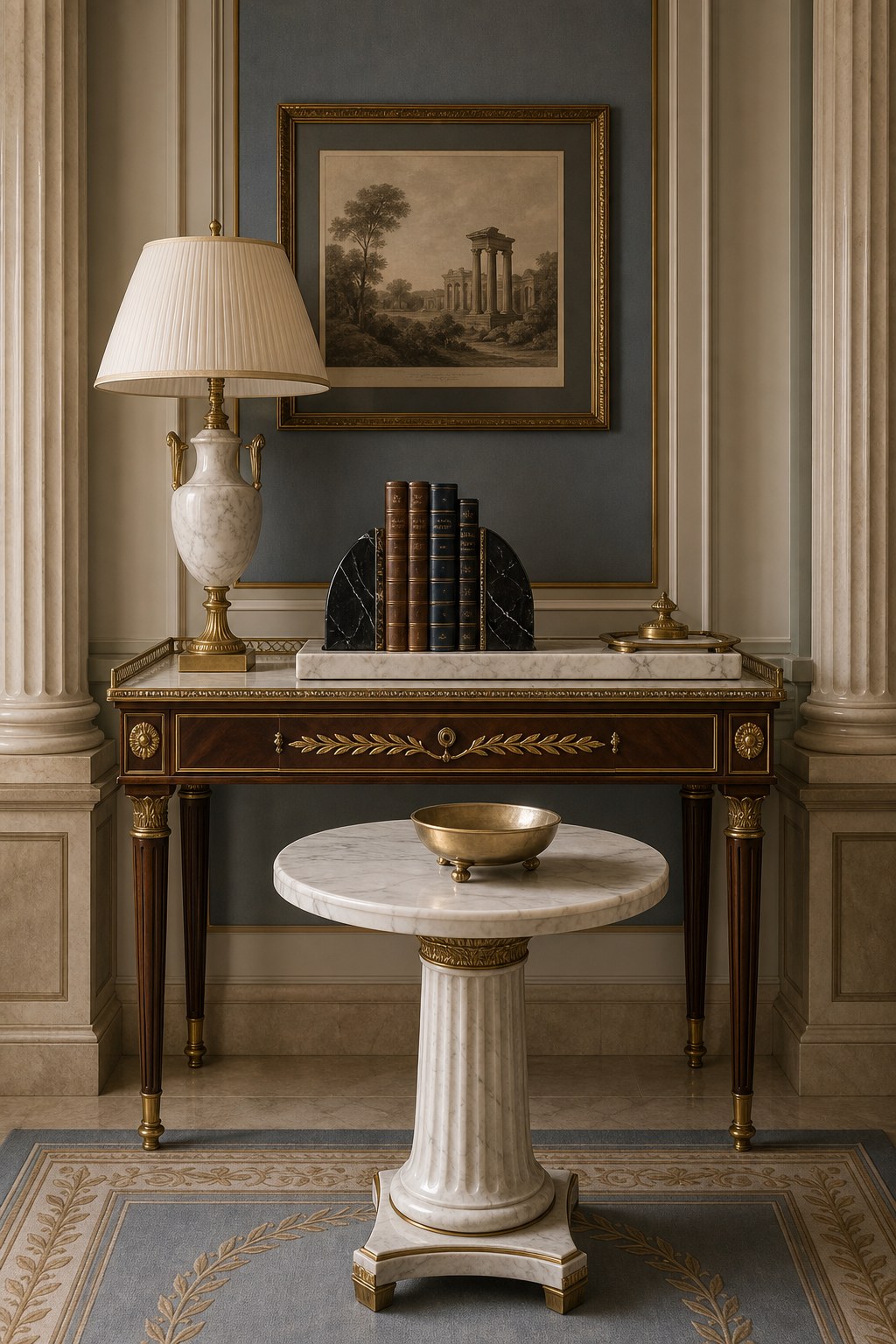
E2 Receipt - Marble Surfaces
Symmetrical Furniture Arrangement · $449.97
Symmetry in the organization of furnishings and architectural components around a central axis creates harmony and order. The design principle the style names first. In practical terms it means the sofa anchors the central axis, a matched pair of armchairs flanks it, and a single coffee table or pair of nesting tables closes the conversation group at center. No asymmetry: if one side table appears on the left of the sofa, it appears in the same position on the right. Neoclassical furniture is defined by clean straight lines, tapered or fluted legs, carved ornament limited to laurel wreaths, acanthus leaves, and Greek key borders, and upholstery in neutral ivory, sage, or dusty navy. The Klismos chair silhouette, saber front legs, curved crest rail, no arm, is the most architecturally specific neoclassical seat and the one that most buyers recognize as distinctly of-the-style. A console table with column-style legs placed against the dominant wall, centered on axis, functions as the room's formal gesture. A surface for symmetrical lamp placement and decorative objects arranged in matching pairs. Restoration Hardware is the accessible sourcing tier at scale. Column details on furniture are how neoclassical enters a modern home.
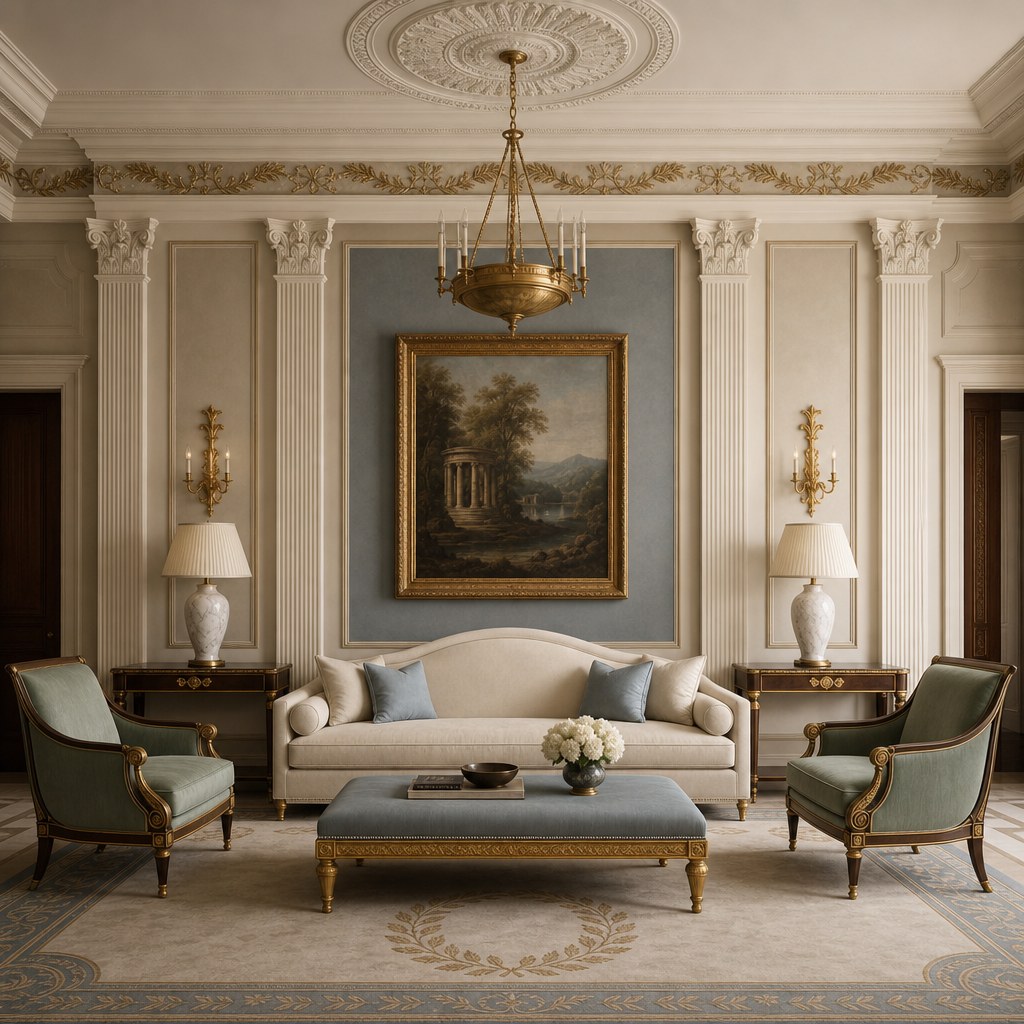
E3 Receipt - Symmetrical Furniture
Crystal Chandelier · $148.99
The chandelier is the room's center-axis punctuation. The only neoclassical element that must be hung at the geometric center of the ceiling plane, directly above the seating arrangement's central axis. "Classic-looking chandeliers with crystal accents" at "symmetrical placement" is the universal prescription. Neoclassical chandeliers draw from four classical forms: the tiered crown chandelier (multiple arms radiating from a central column in two or three descending tiers), the empire chandelier (flat circular frame with drops hanging at equal intervals), the candlestick chandelier (individual arms terminating in candle sleeves), and the Georgian lantern (enclosed glass box with brass fittings, for lower-ceiling applications). Crystal quality matters at ceiling distance: K9 optical crystal, the standard in the $100 to $400 range, produces adequate prismatic sparkle for residential ceilings up to 10 feet. Above 10 feet and for rooms wider than 16 feet, genuine Swarovski element chandeliers are the correct investment tier. Paired wall sconces in matching metal finish, antique brass or polished brass, at equal heights on either side of the fireplace or dominant architectural wall are the horizontal complement to the ceiling chandelier. The pair of sconces addresses the eye-level lighting layer that the overhead fixture cannot reach.
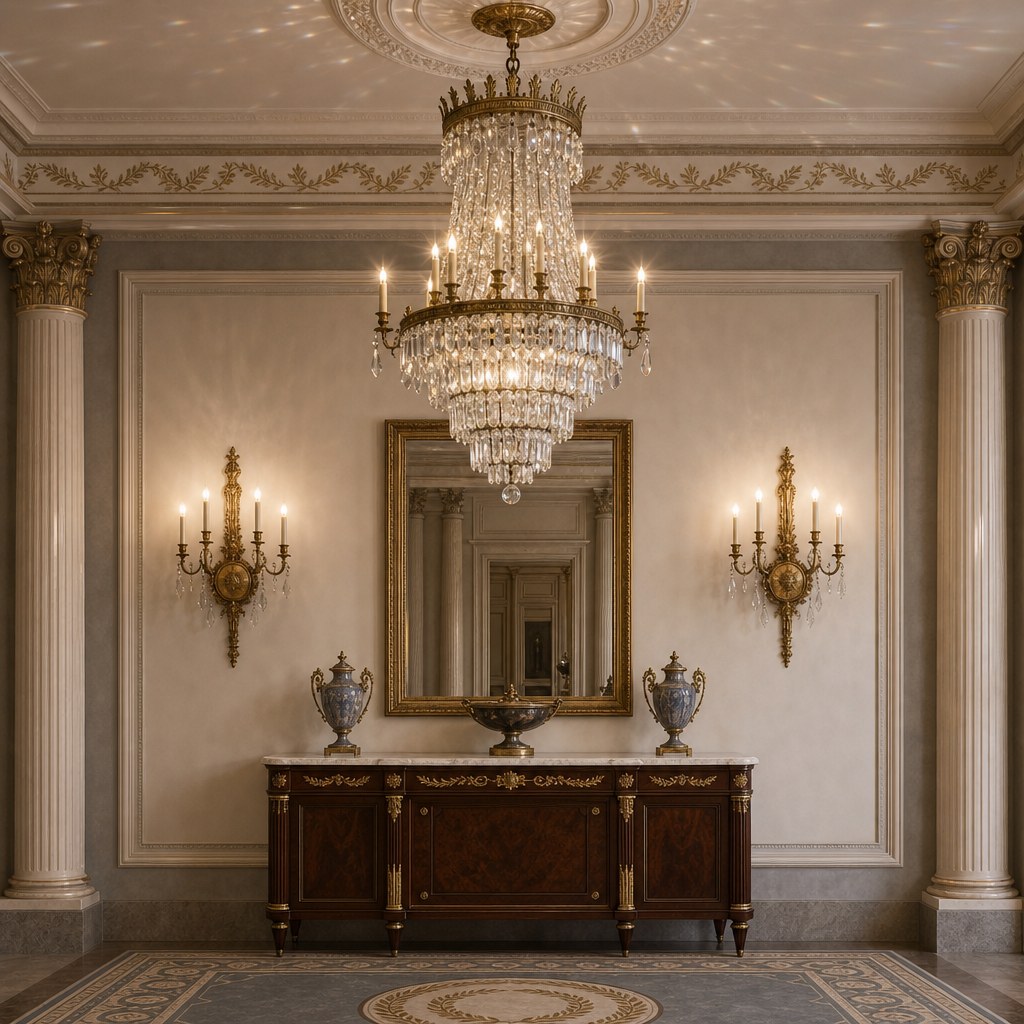
E4 Receipt - Crystal Chandelier
Velvet or Silk Upholstery · $77.97
Velvet and silk are the textile materials of neoclassical design because they share the same optical properties as the style's hard materials: both have surface depth (velvet through pile compression, silk through woven sheen) that reads differently under different light angles, making them behave like the crystal and gilded metal they accompany. "Floor-to-ceiling curtains in weighty materials (linen, velvet, silk)" are cited as the window treatment standard, because neoclassical window treatment is not decoration but proportion work: full-length drapery exaggerates ceiling height and reinforces the vertical emphasis of pilasters. The color palette for neoclassical upholstery concentrates in ivory white (the neutral match to marble), sage green and dusty blue (the muted jewel tones that read sophisticated against gold), and deep navy (the formal accent that closes the palette hierarchy against cream walls). Silk damask, a self-patterned woven silk with a satin sheen against a matte ground, is the most historically accurate neoclassical upholstery fabric, with classic patterns running to laurel leaf repeats, geometric medallions, and acanthus scroll borders. Velvet solid is the accessible contemporary equivalent: same surface depth, same palette range, at a fraction of the price. The velvet pillow cover is the entry-level neoclassical signal. Four ivory or sage velvet covers on an existing sofa, arranged in two matched pairs, establish the material hierarchy without any furniture purchase at all.
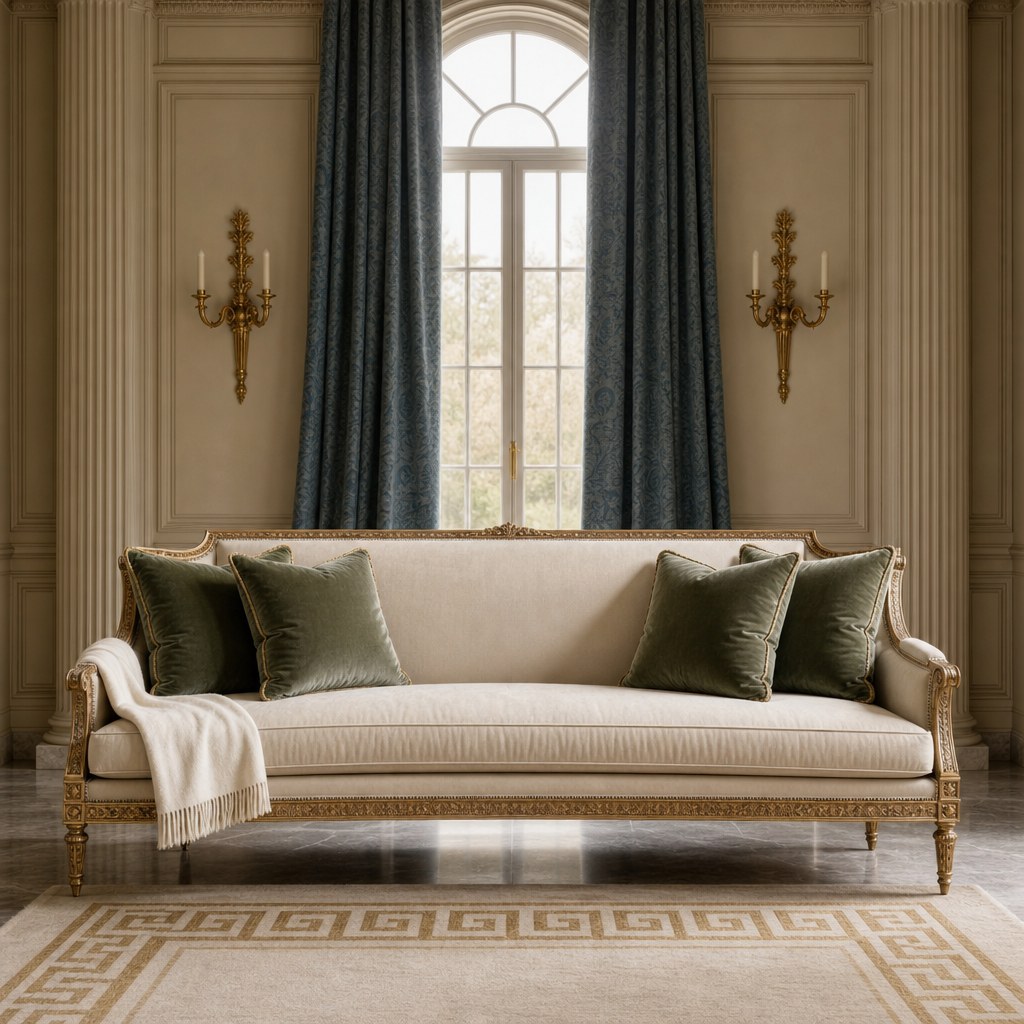
E5 Receipt - Velvet and Silk Upholstery
Neoclassical vs. Traditional.
The symmetry verdict.
The single decision that makes or breaks neoclassical is symmetry enforcement. Every other element - the marble, the crystal, the velvet - works in the service of the axis. A room with a crystal chandelier and marble surfaces but asymmetrical furniture is a formal room, not a neoclassical room. Start by drawing the central axis of the dominant wall. Everything pairs against that line. The chandelier hangs over it. The sofa centers on it. The console centers against the wall on it. Two chairs flank it at equal distance. Two lamps mirror each other across it. When the axis is established, every other element becomes obvious.
Neoclassical is also the style that most rewards the architectural approach to sourcing: spend on the permanent decisions (the millwork, the marble floor or counter if the renovation allows) and find efficiencies in the decorative layer (the foam pilasters, the engineered quartz tabletop, the K9 crystal chandelier). The architectural decisions compound over time; the decorative decisions refresh as the style evolves.
Three moves. No renovation required.
- Rearrange for bilateral symmetry. Identify the central axis of the main wall, center the sofa on it, and pair every other element symmetrically. Free. Takes one hour.
- Add peel-and-stick fluted pilaster strips flanking the doorway or centered on the focal wall. Renter-safe, paintable, and the single fastest move to an architectural neoclassical read. $34.99.
- Swap all throw pillows to ivory velvet, set of 4. The material hierarchy shift from cotton to velvet is the textile signal that anchors the upholstery layer. $32.99 on Amazon. Four covers, one delivery, done.
Frequently asked
What is neoclassical interior design?
Neoclassical interior design is an 18th-century-born movement that revives the architectural principles of ancient Greece and Rome - symmetry, proportion, and geometric order - inside residential and institutional interiors. It emerged as a direct reaction against the ornate excess of Baroque and Rococo, emphasizing clean lines, restrained decoration, and structural elegance. The five defining elements are architectural millwork (columns and pilasters), marble surfaces, symmetrical furniture arrangement, crystal chandeliers, and velvet or silk upholstery. Modern neoclassical applies these principles with contemporary materials and edited restraint, making the style accessible without a palace footprint.
What is the neoclassical color palette?
The neoclassical color palette runs on three tiers. The foundation is neutral and light: ivory white, warm cream, and soft grey - the canvas that makes architectural details readable. The secondary tier introduces muted color: pale sage green, dusty blue, and soft gold. The accent tier adds depth through gilded metallics, polished brass, and rich navy. Black-and-white marble floors are a classical signature. Jewel tone accents - sapphire blue, emerald green - appear in upholstery and drapery as deliberate punctuation, never as dominant fields.
What furniture defines neoclassical interior design?
Neoclassical furniture is defined by four characteristics: clean straight lines, tapered or fluted legs, pediment-top case pieces, and restrained carved ornament (laurel wreaths, acanthus leaves, Greek key borders). Key furniture types include the Klismos chair (saber legs, curved back), console tables with column-like legs, camelback sofas with exposed carved frames, and secretaire desks with architectural proportions. Upholstery runs in velvet, silk damask, or linen in ivory, gold, sage, or navy. Restoration Hardware and Pottery Barn are the dominant accessible sources for neoclassical reproduction furniture.
How is neoclassical different from traditional interior design?
Neoclassical and traditional design share classical roots but diverge on restraint. Neoclassical prioritizes symmetry, architectural purity, and deliberate minimalism - rooms have fewer objects, each placed with geometric intention. Traditional design allows more layering: pattern-on-pattern textiles, accumulated accessories, richer color, and a warmer, less formal atmosphere. The rule of thumb: neoclassical rooms feel like an edited museum; traditional rooms feel like a well-loved library. Neoclassical also references specific Greco-Roman architectural orders (Doric, Ionic, Corinthian) while traditional draws more broadly from European country house precedents.
What is the entry-level path to neoclassical decor?
The lowest-cost entry into neoclassical decor starts with three moves: add architectural detail through removable pilaster-style wall panels or peel-and-stick fluted molding strips (under $60); introduce a marble-look surface through a marble-contact-paper console table or genuine marble tray on an existing sideboard (under $40); and rearrange existing furniture into strict bilateral symmetry around a central axis. These three moves - architectural detail, marble signal, and symmetry - establish the neoclassical read before any major purchase. The full five-element build with a genuine crystal chandelier, velvet sofa, and marble coffee table runs $1,163 to $2,800 depending on sourcing.
Want the neoclassical room plan for your city and budget?
No spam. Unsubscribe anytime.