Table of Contents
Gothic Interior Design Explained.
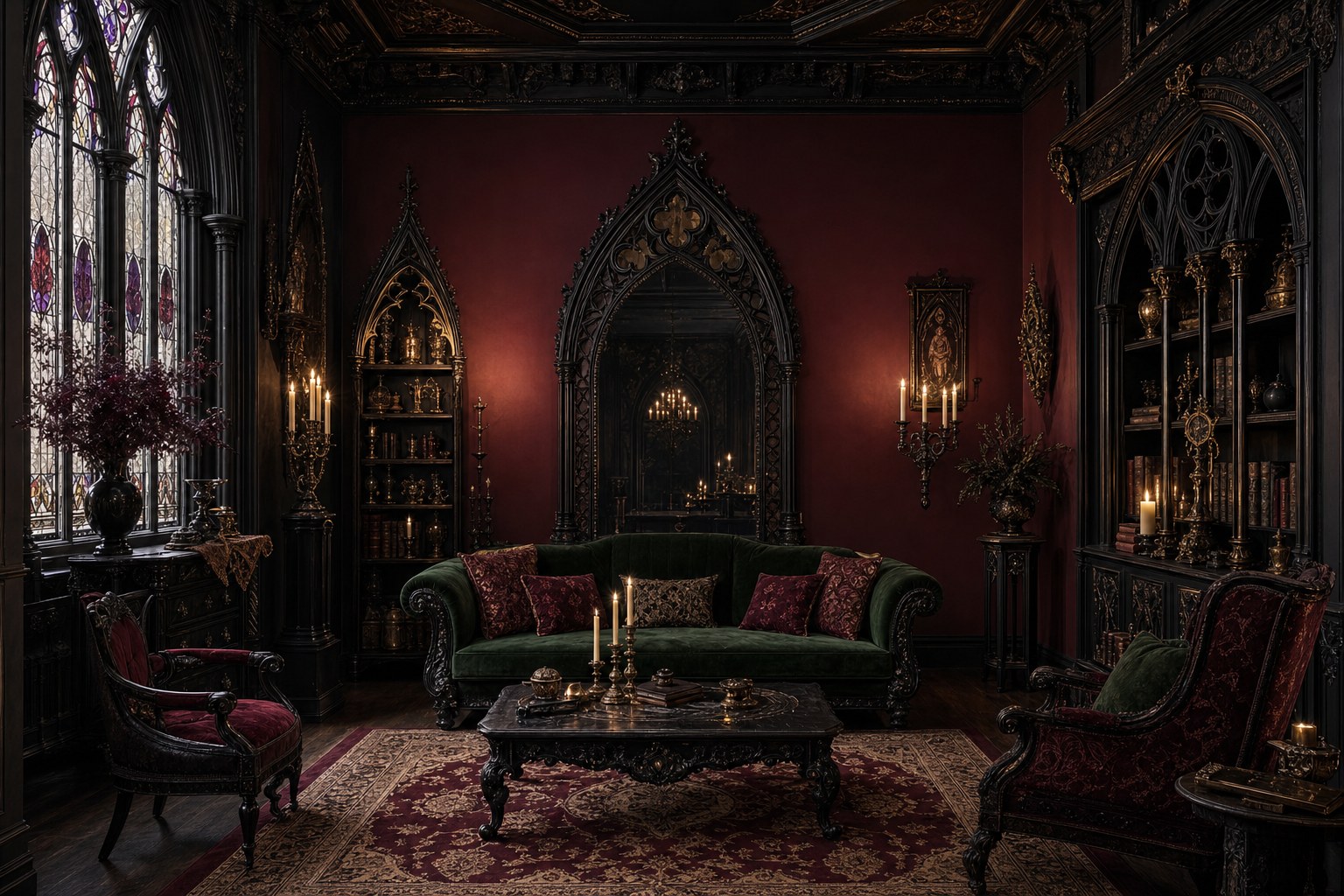
Gothic interior design is not an October project. The communities building these rooms - renters in student apartments, young professionals in shared flats, and homeowners with powder rooms and reading nooks - are working from a year-round vocabulary that draws from Gothic Revival architecture, Victorian ornament, and the contemporary dark romance aesthetic that softened Gothic for broader audiences. The residential language the design world has settled on: moody jewel tones on dark foundations, pointed-arch details deployed through mirrors and cabinetry rather than actual stone vaulting, wrought iron in the form of candelabras and hardware, velvet at every soft surface, and a deliberate collection of curiosities - dried botanicals, antique prints, raven figurines - that carry the atmosphere without requiring skull motifs or cobwebs.
The failure mode is well-documented by the community itself. Too many skulls. All-black without texture. Overhead white light left unmanaged. Missing the warm-dark spectrum - Gothic spaces should feel WARM and enveloping, not cold and harsh. Candlelight makes moody paint colors look even richer - and the principle applies beyond paint: amber-toned Edison bulbs, taper candles, and warm-toned chandeliers are what separate a Gothic room from a black box. The rental restriction problem (dark paint blocked by landlords) has a well-developed community workaround: dark textiles and removable wallpaper establish the palette without touching a wall.
Sourcing logic for Gothic follows the same antique-vs-new hierarchy as every material-forward style. Source the statement furniture - a carved wood high-back chair, a velvet sofa, an arched iron mirror - vintage where possible (eBay Victorian furniture, estate sales, Chairish) because age and patina reinforce the authenticity the style requires. Source textiles and candles new (Amazon, Target, HomeGoods) - velvet in deep jewel tones is widely available at accessible price points. Source curiosities wherever the find presents itself - the Cabinet of Curiosities logic demands that no two Gothic rooms look identical, and the best pieces are the ones that carry a provenance story.
Dark Moody Color Palette · $89.97
The dark moody color palette is the first decision in the Gothic interior design blueprint, and it is the element that earns or loses the room immediately. Build the palette in objects before committing to wall color: three palette layer items. A matte black throw pillow set, a deep burgundy velvet blanket, and an emerald green ceramic vessel. Establish the color story at a price point that is fully reversible if the landlord demands restoration. Gothic's palette runs on three tiers. The foundation is matte black, charcoal gray, and deep plum. The dark field that sets the room's base temperature. The jewel-tone accent tier adds depth without adding literal darkness: "Think emerald green, sapphire blue, ruby red, amethyst purple, citrine yellow," as Modsy defines the category. "gold, as a color and a finish, complements jewel tones beautifully" and is Gothic's most important counter-element against coldness. The balancing tier is what separates a sophisticated Gothic room from a black box: stone gray, warm beige, aged brass, and natural wood provide visual resting points that make the darkness feel intentional rather than oppressive. The critical color-use rule: use the dark foundation in solid matte blocks, and introduce the jewel tones through texture, velvet, glass, ceramics, rather than through pattern. A solid deep burgundy velvet pillow reads as luxury; a busy gothic-print pillow reads as costume.
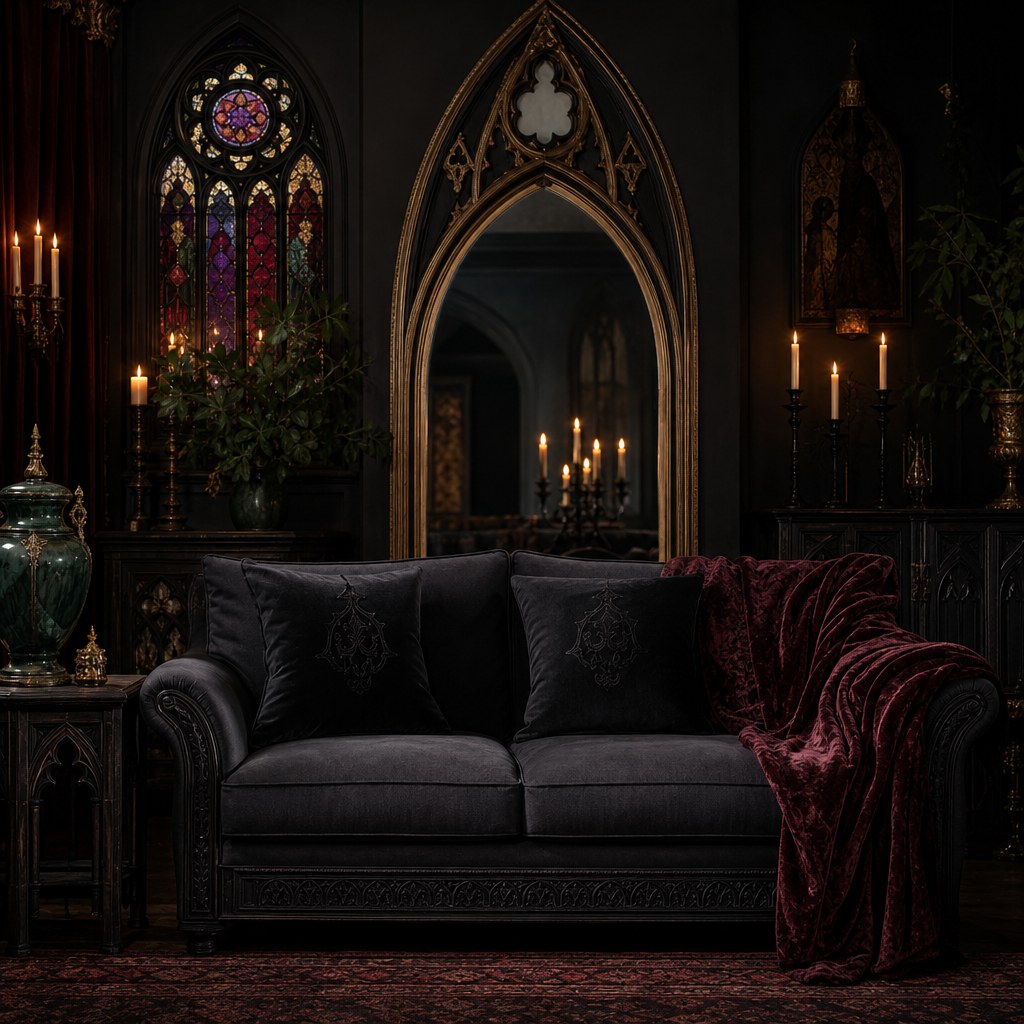
E1 Receipt - Dark Moody Color Palette
The Arched Mirror · $149.99
The arched mirror is the single most recommended renter-friendly Gothic element. And for good reason. Gothic Revival architecture is defined by the pointed arch: the visual signal that separates the Gothic tradition from Classical columns and Romanesque rounded arches. For renters and homeowners who cannot reshape doorways or install arched cabinetry, a tall arched mirror imports that architectural grammar into any room as a freestanding, removable, fully reversible piece. A mirror in a dark iron or antique brass frame, 65 inches or taller, leaning against a dark wall or placed opposite a window to reflect candlelight, accomplishes three things simultaneously: it introduces the arch motif, it reflects light in a space where darkness is managed rather than maximized, and it creates the illusion of additional spatial depth that small apartments require when deploying a dark palette. Mercury glass and smoked glass are the period-accurate mirror finishes for Gothic revival interiors. The slight distortion and age-darkened edges read as antique without requiring actual Victorian provenance. An arched mirror in a Gothic-influenced powder room is what prompts the most consistent compliment the style earns: "This is immaculate." Gothic done right is read as luxury.
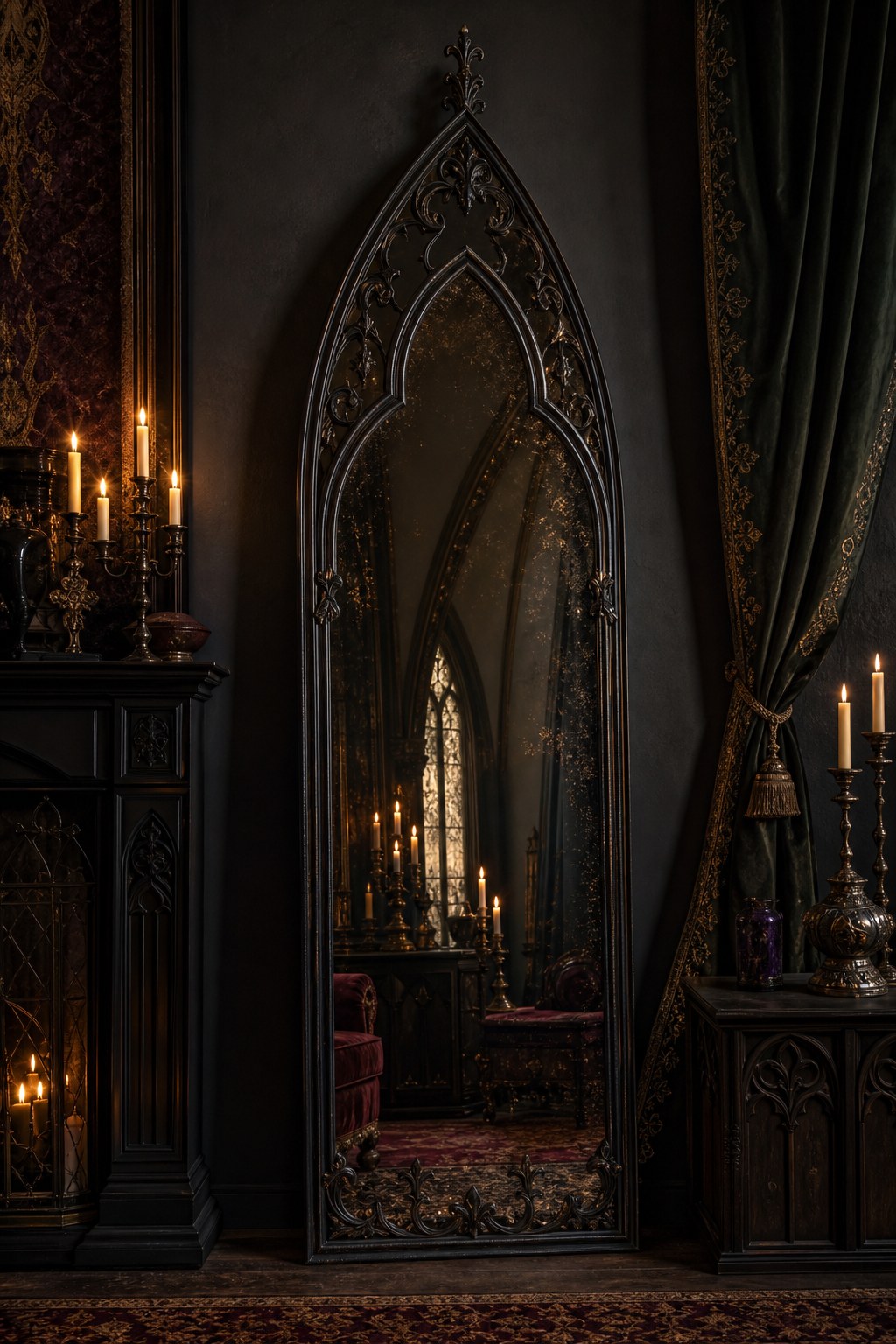
E2 Receipt - The Arched Mirror
Wrought Iron and Candelabra · $134.97
Wrought iron is Gothic's material signature. The dark, heavy, worked metal that appears in Gothic Revival architecture as window tracery, door hardware, gate grilles, and stair railings. At the residential accessory scale, wrought iron enters a Gothic room through three objects: the candelabra (the single most universally recommended Gothic atmosphere piece), the taper candle holder cluster (for mantel or console vignettes), and the black iron wall sconce (for rooms where ceiling work is not an option). The candelabra deserves particular attention: "Opt for wrought iron candelabras, brass candlesticks, or dripping taper candles, clustering them on mantels, dining tables, or beside a clawfoot bathtub," as The Coolist's Gothic decoration guide recommends. And the operative word is clustering. A single candelabra reads as decorative. Three clustered at different heights create the atmospheric effect that Gothic lighting requires. The warmth principle applies here with maximum force: Gothic spaces live and die by candlelight and warm amber sources. Overhead white light at 5000K destroys the mood faster than any color choice. Wrought iron paired with warm 2200K Edison filament bulbs in iron wall sconces, supplemented by actual taper candles in the candelabra cluster, creates the layered, low, directional lighting that is Gothic's most irreplaceable atmospheric condition. And requires no electrical work beyond a lamp switch.
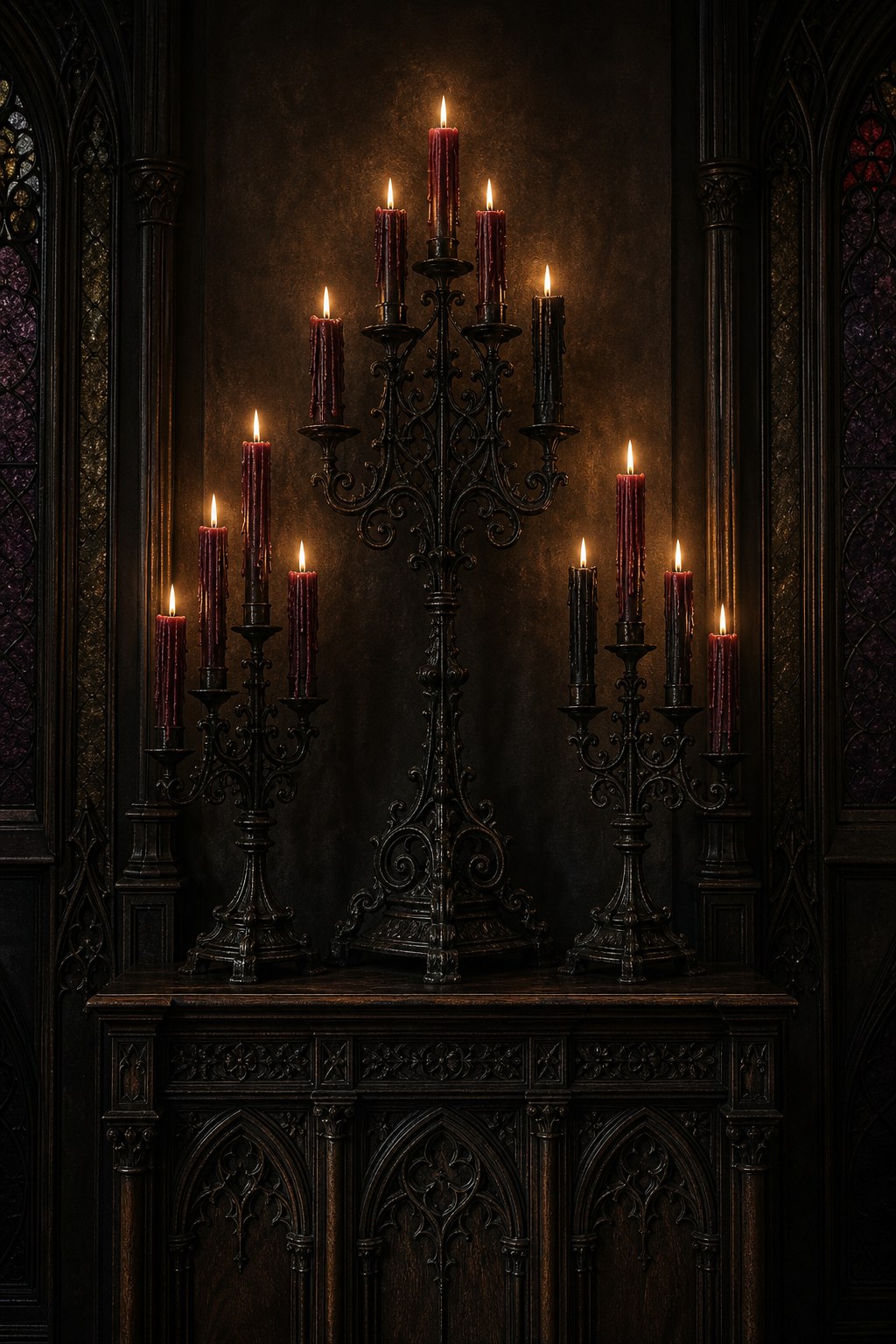
E3 Receipt - Wrought Iron and Candelabra
Velvet Draping · $219.97
Black velvet curtains are the single most-recommended Gothic gateway piece. And they function on multiple levels simultaneously. At the window, floor-to-ceiling black velvet curtains manage the daylight problem that Gothic spaces face: unmanaged daylight breaks the dark atmosphere, while blackout velvet curtains at 96 inches convert any window into a dramatic dark vertical that reads as intentional architectural weight rather than light control. The velvet pile catches and absorbs light differently throughout the day, deepening the room's perceived darkness in daylight and glowing with warmth under candlelight in the evening. The velvet sofa throw cover, a deep burgundy or forest green velvet sofa slipcover, is the renter's equivalent of reupholstery: it converts any neutral sofa into a Gothic statement piece at a fraction of the cost. Authentic Gothic upholstery fabrics historically include velvet, brocade, and damask. Pile weaves and pattern weaves that create visual texture rather than smooth modern upholstery surfaces. The velvet area rug is the floor's contribution to the layered softness that prevents a dark Gothic room from feeling cold: a deep charcoal or forest green velvet or plush pile area rug in a 5x8 format, placed under the seating core, converts the room's floor from a surface to a textile, adding the final material depth layer that Gothic's warm-dark balance requires. The quality test for velvet in a Gothic space: polyester velvet amplifies fakeness. Aim for velvet with at least some natural fiber content in any piece that will be touched frequently.
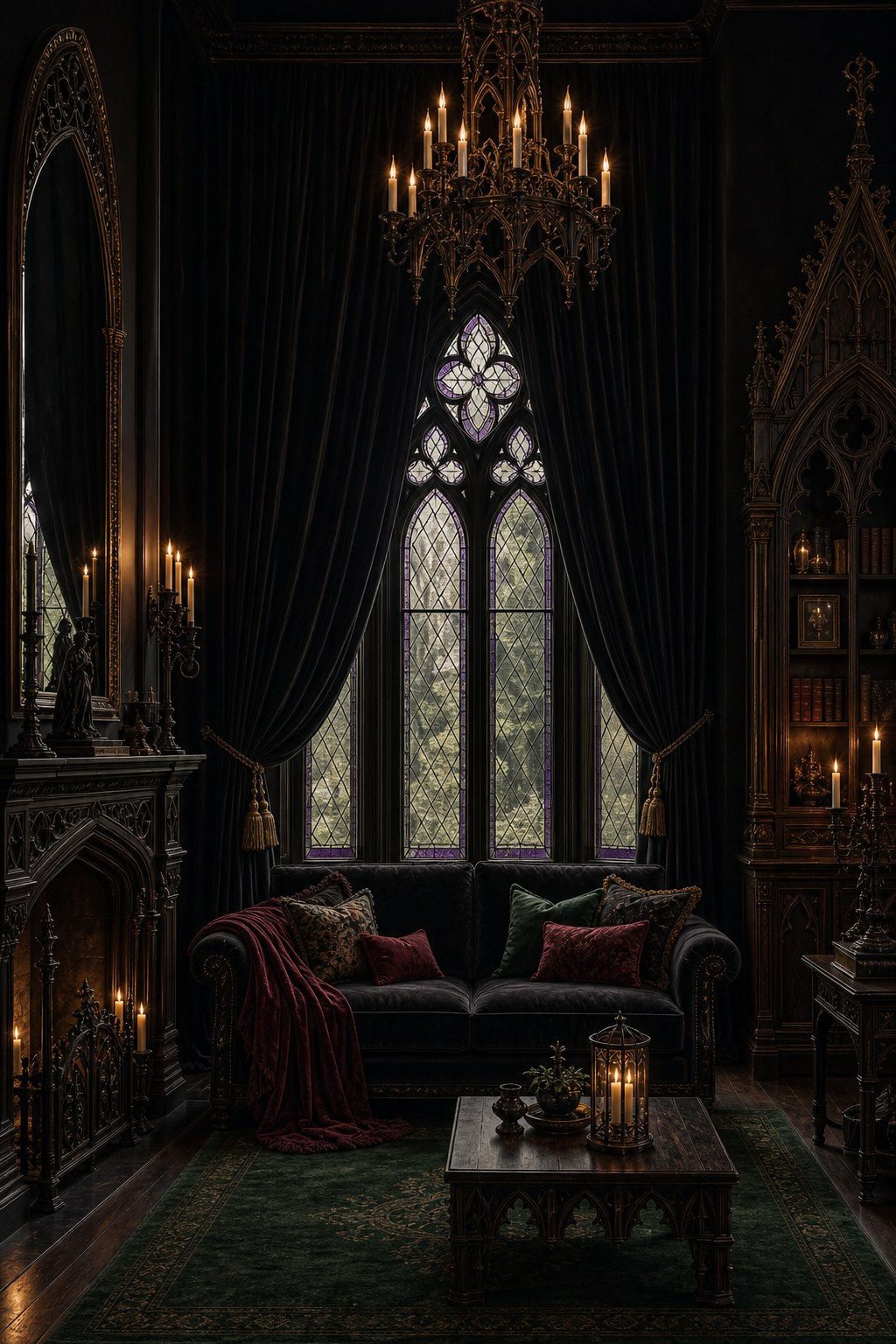
E4 Receipt - Velvet Draping
Curio Curiosities · $452.96
Curio curiosities are the layer added last because they respond to the palette, architecture, and lighting story already in the room rather than establishing it. The Cabinet of Curiosities. The Renaissance and Victorian tradition of collecting and displaying natural history objects, scientific instruments, and arcane specimens, is Gothic interior design's most distinctive and personal element. In 2025, homeowners are creating spaces resembling these cabinets of curiosity, embracing "antique and vintage elements, natural history objects, and a sense of mystery," as designer Dina Goebel identified in her 2025 dark aesthetic home decor trends report. The curio layer should be built around four categories: a raven or crow figurine (the Gothic avian signal that avoids the Halloween trap that skull motifs trigger), antique or antiqued botanical prints in dark frames (natural history without macabre overtones), a dried botanical arrangement or eucalyptus cluster (organic texture with a dark, dried palette), and a vintage apothecary vessel or dark amber glass collection (the warm jewel-tone counter-element that prevents the curiosity display from reading as cemetery rather than cabinet). The regret pattern is well-documented: "Too many skulls. Skull motifs tip from atmospheric to costume immediately." The substitution is raven figurines, antler art, Victorian butterfly displays in aged frames, and dark florals. Natural history that carries the Gothic atmosphere without the literal Halloween association. The curio display is where the Gothic room earns its personality. No two should look identical.
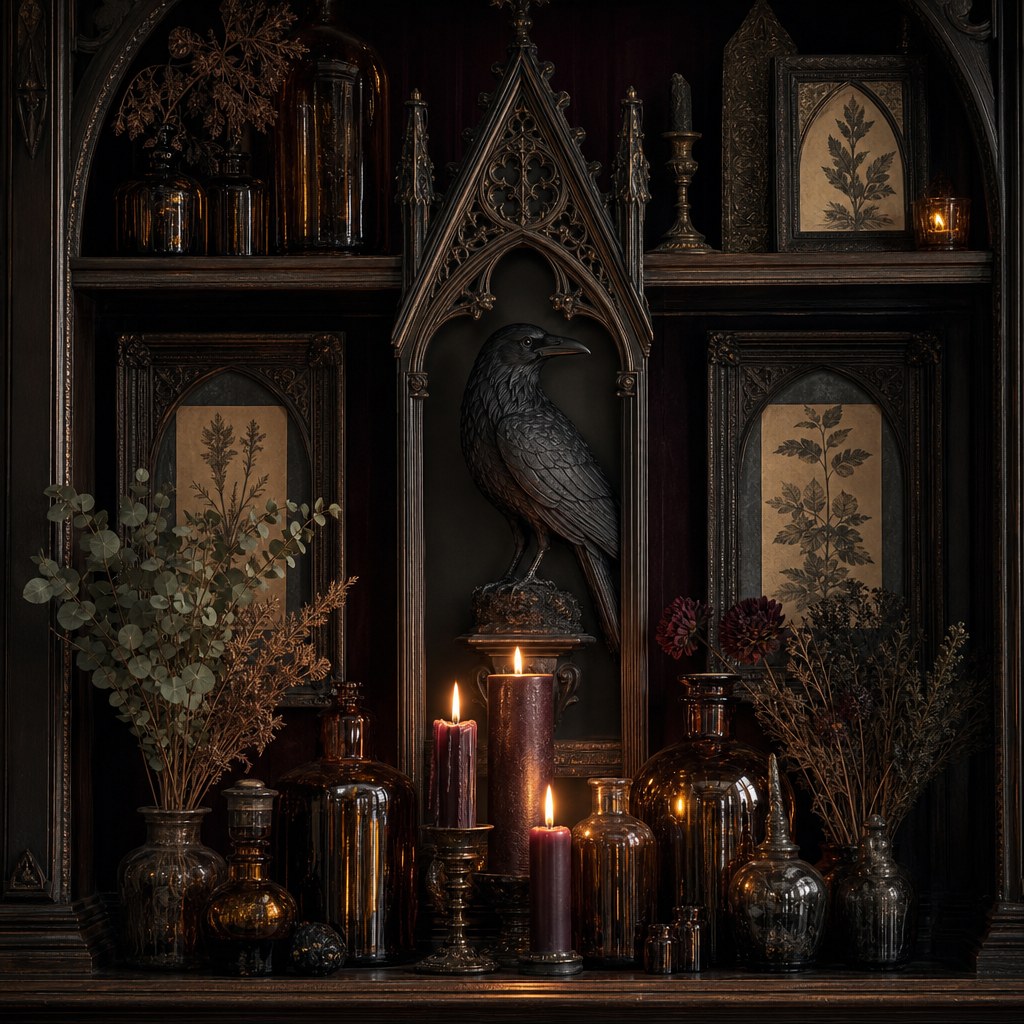
E5 Receipt - Curio Curiosities
Gothic vs. Dark Academia.
Both styles embrace darkness, which is why they are consistently confused by people searching for one and landing on the other. The distinction is the source and purpose of the darkness. Gothic draws from Gothic Revival architecture, Victorian ornament, and the dramatic tradition. The darkness is about atmosphere, sanctuary, and theatrical presence. Dark Academia draws from the Oxford library, the scholarly antiquarian tradition, and a particular literary nostalgia. The darkness is about seriousness, knowledge, and contemplative quiet. The easiest test: if the room features candelabras, arched mirrors, velvet draping, and a raven figurine, it is Gothic. If it features leather-bound books, globe collections, tartan textiles, and a reading lamp, it is Dark Academia. Both are legitimate. Neither is Halloween.
| Dimension | Gothic Interior Design | Dark Academia Interior Design |
|---|---|---|
| Source tradition | Gothic Revival architecture, Victorian ornament, dark romantic tradition, theatrical and atmospheric | Oxford library aesthetic, antiquarian scholarship, Romantic-era literary culture, contemplative and scholarly |
| Color palette | Matte black, charcoal, deep plum foundations with jewel-tone accents (emerald, ruby, sapphire) and gold metallics | Warm medium darks, aged brown, ochre, forest green, burgundy, with cream and aged white as balancing tones |
| Signature pieces | Arched iron mirror, candelabra cluster, velvet draping, wrought iron hardware, curiosity cabinet | Leather-bound book stacks, globe collection, tartan throw, wooden ladder shelf, antique desk lamp |
| Lighting approach | Candlelight and warm amber at low level. The darkness is managed, not eliminated; atmosphere over visibility | Warm task lighting. Reading lamps, desk lamps, library pendants; functional warmth rather than atmospheric drama |
| Textile vocabulary | Velvet (upholstery, curtains, rugs), brocade, damask. Pile weaves that catch light dramatically and add sensory warmth | Tartan, tweed, wool, aged leather. Woven textiles that reference British academic and country-house traditions |
| The confusion test | Feels like a Victorian salon. Theatrical, moody, warm darkness as intentional design rather than neglect | Feels like an Oxford don's study. Serious, book-anchored, warmth through knowledge rather than through drama |
The $89 entry path.
Three items that establish the dark moody Gothic palette in any room. No furniture replacement, no paint, no structural work required. The complete E1 serves as the entry path.
Frequently asked questions.
What is gothic interior design?
Gothic interior design is a dramatic, atmosphere-driven residential style defined by a dark moody color palette (matte black, deep burgundy, forest green, charcoal), pointed arch architectural details or arched mirrors, wrought iron and candelabra lighting, velvet draping, and curated antique or natural-history curiosities. The residential version draws from Gothic Revival architecture of the 19th century and the Victorian ornamental tradition, scaled down from cathedrals and manors to apartments and single rooms. The defining principle: Gothic darkness should feel warm and enveloping, not cold and harsh. Amber candlelight, velvet pile, and dark wood surfaces are what separate an elevated Gothic room from a dark box. The style is "far from gloomy" in its modern interpretation - it combines drama with coziness and "depth, texture and a sense of sanctuary," as Clare Paint's interior team notes of modern gothic interiors.
What colors are used in gothic interior design?
Gothic interior design builds its palette in three tiers. The foundation layer is matte black, charcoal gray, and deep plum - the dark field that sets the room's base temperature and is used in solid blocks across wall paint, large upholstery, and curtains. The jewel-tone accent layer adds depth without adding literal coldness: "Think emerald green, sapphire blue, ruby red, amethyst purple, citrine yellow," as Modsy defines the category - "gold, as a color and a finish, complements jewel tones beautifully" and is Gothic's most important warm counter-element. The balancing tier - stone gray, warm beige, aged brass, and natural dark wood - provides visual resting points that make the darkness feel intentional rather than oppressive. The critical rule: use dark tones in solid matte blocks, and introduce jewel tones through texture (velvet, glass, ceramics) rather than through pattern. Solid deep burgundy velvet reads as luxury; a busy gothic-print textile reads as costume.
How do I do gothic interior design without it looking like Halloween?
Three rules prevent the Halloween trap. First, replace skull motifs with natural-history curiosities - raven figurines, antique botanical prints, dried botanicals, and antique apothecary vessels carry the Gothic atmosphere without the costume-shop association that skull motifs trigger immediately. Second, control the warm-dark balance: Gothic spaces must feel warm and enveloping, not cold and harsh. Amber candlelight, velvet upholstery, and wood accents are mandatory counterweights against the coldness of a matte black palette. Third, eliminate three specific signals: orange accents, plastic or resin skulls in multiples, and synthetic cobwebs - these are the fastest ways to tip a year-round Gothic interior into seasonal decoration. The benchmark is a Gothic space that reads as "heavenly" - dramatic but elevated.
What is the difference between gothic and dark academia interior design?
Both Gothic and Dark Academia embrace darkness, but from different source traditions and with different vocabularies. Gothic draws from Gothic Revival architecture, Victorian ornament, and the dramatic tradition - the darkness is about atmosphere, sanctuary, and theatrical presence. Dark Academia draws from the Oxford library aesthetic, antiquarian scholarship, and Romantic-era literary culture - the darkness is about seriousness, knowledge, and contemplative quiet. In practice: Gothic rooms feature velvet draping, arched iron mirrors, candelabra clusters, wrought iron, and natural-history curiosities. Dark Academia rooms feature leather-bound book collections, globe displays, tartan and tweed textiles, and warm task lighting. Gothic is theatrical; Dark Academia is contemplative. The vocabulary overlap - both use dark palettes and antique objects - is why the two are "frequently conflated" by people searching for one and landing on content for the other.
Can gothic interior design work in a small apartment?
Gothic interior design adapts effectively to small apartments using three renter-friendly strategies. First, use dark textiles instead of dark paint - black velvet curtains, deep burgundy throw pillows, and a jewel-tone area rug establish the palette fully without touching walls a landlord will repaint. Second, deploy a tall arched mirror: it imports Gothic's defining architectural signal (the pointed arch) as a freestanding, removable piece while reflecting candlelight and creating the illusion of architectural depth - two functions that are especially valuable in small spaces deploying a dark palette. Third, layer candlelight rather than overhead fixtures: candelabras, taper candles, and amber-toned Edison bulbs create Gothic's most important atmospheric condition without any electrical work. A rental-scale proof: dark textiles, arched mirror, taper candles - the verdict was not "spooky" but "You made it YOURS."
More rooms like this
No spam. Unsubscribe anytime.