Table of Contents
What is chinoiserie decor?
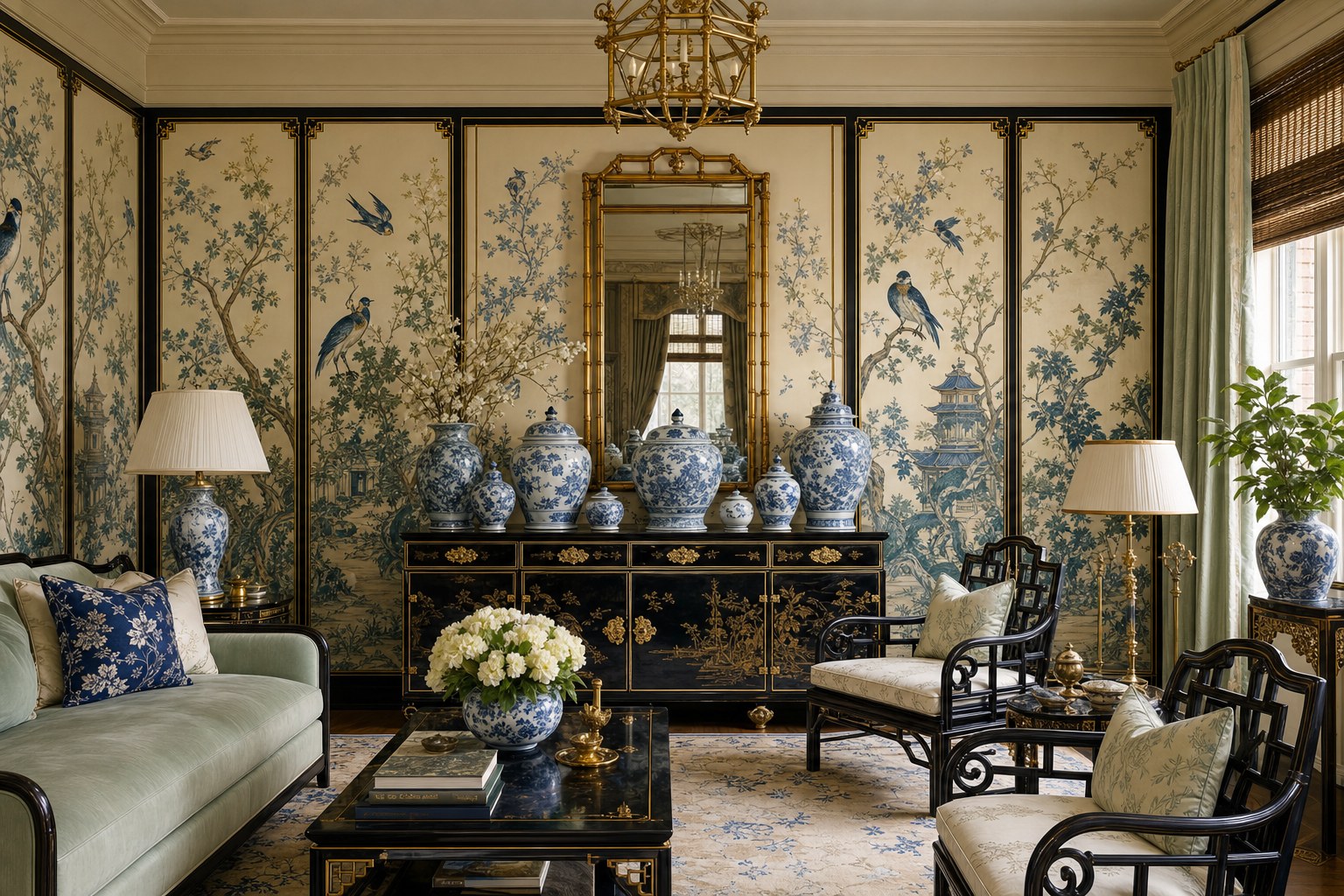
Chinoiserie is not a reproduction of Chinese design. It is something more specific and more culturally interesting: a European fantasy of Chinese and East Asian aesthetics, filtered through 17th- and 18th-century Western workshops and adapted to aristocratic taste. The word derives from the French "chinois," meaning Chinese, and the style's formative years tracked the expansion of trade routes that brought porcelain, silk, lacquerware, and tea into European ports for the first time. What designers and patrons found in those shipments - the translucency of porcelain, the depth of lacquer, the strange and beautiful asymmetry of hand-painted garden scenes - could not be reproduced by European artisan traditions, so they did the next best thing: they invented their own version, dense with cranes, pagodas, flowering cherry branches, guardian lions, and the cobalt-and-white color story that would become one of the most durable palettes in decorative history.
The style spread from Versailles (where Louis XIV installed Chinese-inspired rooms as status signals) to the English court (where Chippendale adapted faux-bamboo chair frames to the British appetite for the Eastern aesthetic) to American colonial homes, where blue-and-white Canton porcelain arrived as ballast in trade ships and became the dining room status object of the founding generation. Its staying power comes from a fundamental design quality: chinoiserie rooms feel theatrical and alive. The hand-painted walls move. The porcelain groupings shift in their arrangement. The lacquer surfaces catch light from different angles across the day. The wallpaper makes the room - everything else is supporting cast.
The sourcing hierarchy for chinoiserie follows the material logic of any pattern-forward style. Source the lacquered case piece at auction or through resale platforms like Chairish or 1stDibs - age adds authenticity, and the high-gloss finish wears with dignity on older pieces. Source the blue-and-white ginger jars and silk throw pillow covers new - quality in these categories is reliable at accessible price points, and the ginger jar market on Amazon and TJ Maxx is genuinely broad. Source the wallpaper in peel-and-stick or paste format for a single accent wall at $30-$80 per roll as the budget-accessible entry to the dominant element of the style - and understand that the de Gournay and Gracie versions exist at a completely different price tier for those for whom the full hand-painted experience is the point.
Hand-Painted Wallpaper Panels · $189.97
Chinoiserie wallpaper is the dominant keyword in the entire style cluster. 8,100 monthly searches, a volume that outpaces every other chinoiserie product category by an order of magnitude. And that search behavior makes the argument: the wallpaper is the room's defining element, and everything else supports it. At the top of the market, de Gournay produces fully hand-painted panels on silk with bespoke colorways; the price per panel reaches levels that exceed most furniture budgets. Gracie, the New York wallpaper house founded in 1898 and still family-owned through six generations of the same family, is the American equivalent: each 3-foot by 10-foot panel can take 75 or more hours to complete, and the papers have been installed in the White House and in America's most significant private residences. For the budget-accessible approach, peel-and-stick chinoiserie wallpaper panels in the $30-$80 per roll range from Wayfair and Spoonflower deliver the bird-and-branch visual pattern with a reversible format that works for renters. The entry path here is strategic: one accent wall in a bedroom or dining room, not all four walls, positions the pattern as the deliberate focal point and prevents the density of motif from reading as wallpaper rather than art. A paste-and-drape application on a single 8-foot wall takes three to four rolls; two peel-and-stick rolls placed symmetrically on either side of a bed headboard creates a panel-art effect for under $100.
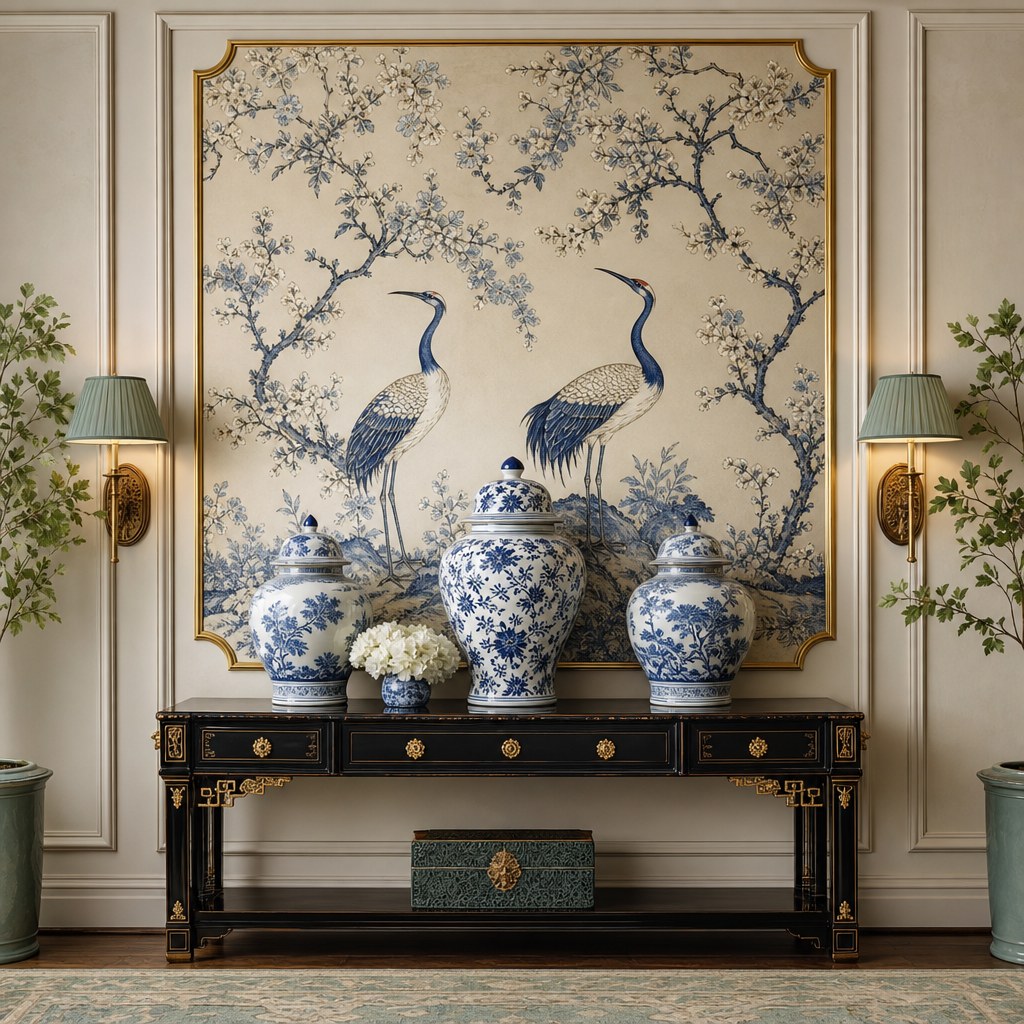
E1 Receipt - Hand-Painted Wallpaper Panels
Blue-and-White Porcelain Collection · $129.97
Blue-and-white porcelain is what European traders called "white gold" when the first shipments arrived from China in the 17th century, and the cobalt-and-white color story it established has not left the design canon since. The ginger jar. Originally a functional container for preserved ginger and spices during the China trade, is the most recognized form in the chinoiserie porcelain vocabulary, and it is the standard entry point for anyone building a chinoiserie room. The three-piece grouping is the canonical display format: one large jar (12 to 14 inches) flanked by two medium jars (8 to 10 inches) on a console, mantel, or open shelving unit. Mixed heights and patterns within the blue-and-white color family are period-accurate. The historic interpretation layered different Canton, Nanking, and willow-pattern pieces rather than matched sets. The quality range in the ginger jar market is genuine and wide: the difference between a $30 jar from HomeGoods and a $200 piece from an antique market shows in the weight, translucency, and precision of the hand-applied cobalt decoration. For visual impact on a shelf, the $30-$60 range is sufficient; for a mantel centerpiece that will be handled and examined, the investment in a higher-quality piece pays in tactile credibility.
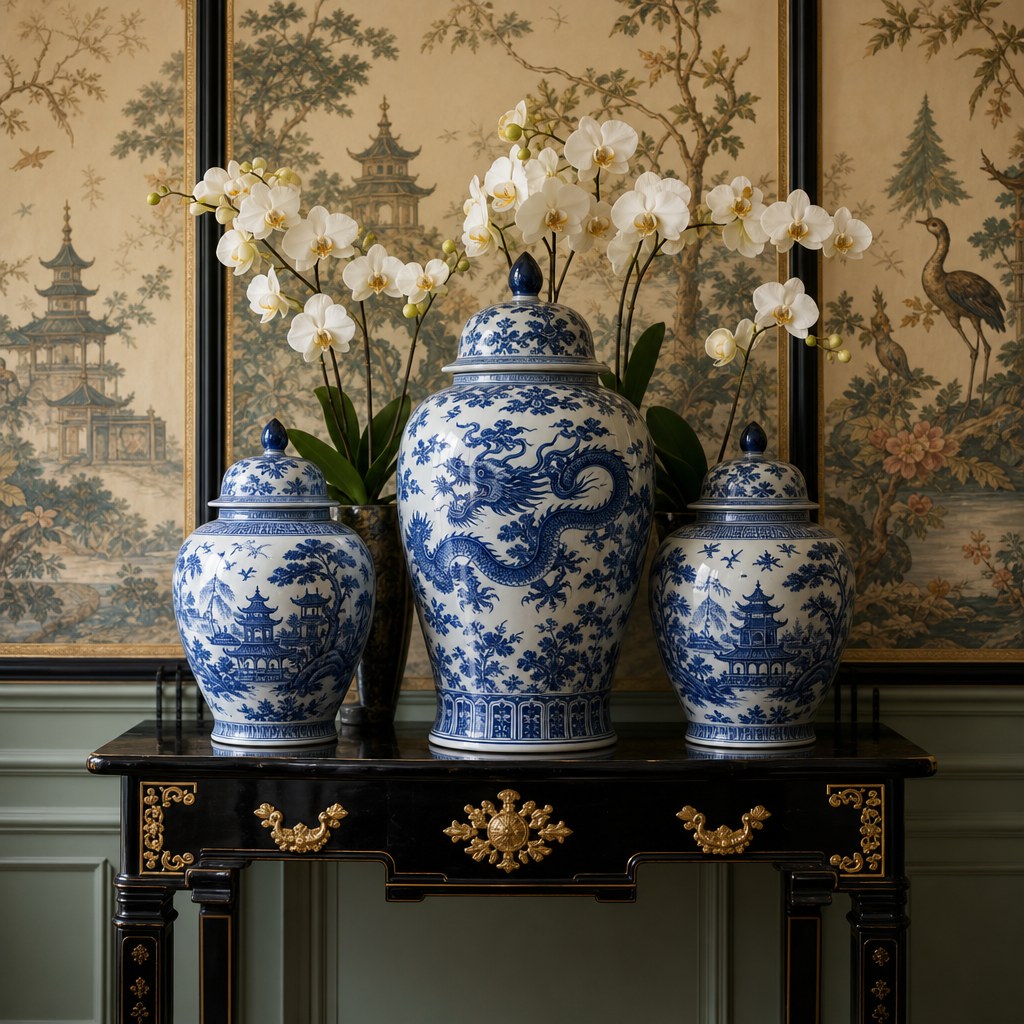
E2 Receipt - Blue-and-White Porcelain Collection
Lacquered Furniture · $279.99
Lacquer is the material that defines chinoiserie furniture above any other. More than silhouette, more than scale, more than hardware. The authentic lacquer process requires multiple coats of tree sap applied over a hardwood or bamboo substrate, each coat dried and sanded before the next is added, resulting in a surface with depth, translucency, and a glass-like finish that no synthetic alternative fully replicates. In the European chinoiserie tradition, lacquered furniture arrived as imported Chinese pieces (called "japanning" by English craftsmen who developed their own lacquer techniques to imitate the Eastern originals) and became the prestige surface material of 18th-century drawing rooms. The most common chinoiserie lacquer colors are glossy black with hand-painted gold or colored details, oxblood red, and deep navy. Each a high-contrast ground for the bird, branch, and figure motifs that distinguished the finest pieces. In contemporary use, a lacquered black console table is the single most versatile chinoiserie furniture investment: it becomes the display platform for the blue-and-white porcelain collection, it reads as sophisticated in any room that already has neutral walls, and it carries the lacquer material story without requiring the room to commit to a full chinoiserie treatment. A thrifted chinoiserie cabinet is the entry to the full case-piece experience at a fraction of new retail pricing. The lacquered serving tray and the lacquered decorative box round out the material story at the accessory level.
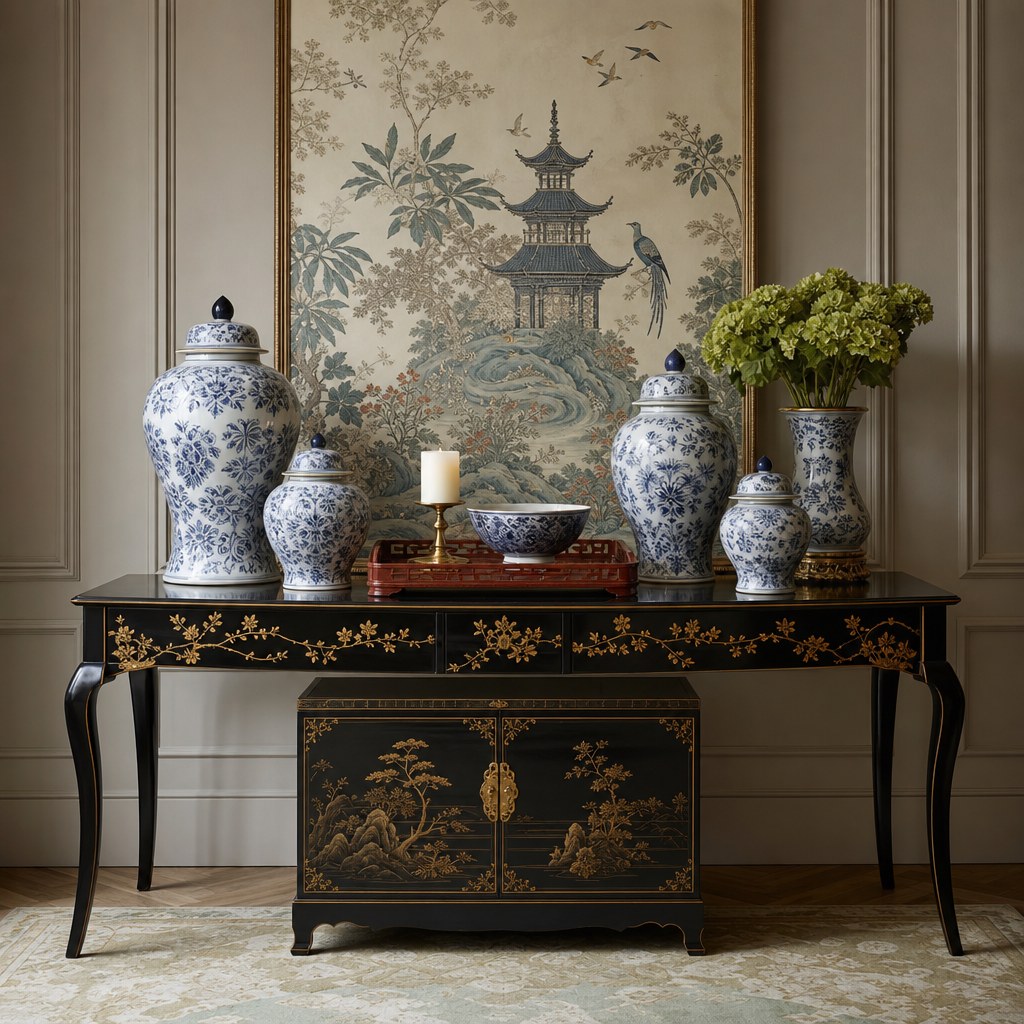
E3 Receipt - Lacquered Furniture
Silk Textiles · $219.97
Silk is the fourth element in the chinoiserie room, and its role is thermal and tactile as much as visual: it softens the high-gloss lacquer surfaces and the pattern density of the wallpaper with a material that catches light differently, moves with air, and introduces warmth into what is otherwise a room of hard, reflective surfaces. The traditional chinoiserie textile palette runs on cobalt and ivory (mirroring the porcelain palette), emerald green, ruby red, and warm gold. All in Asian-inspired motifs: cherry blossoms, bamboo stalks, crane pairs, and the chrysanthemum. In contemporary use, three textile categories carry the silk story with the most visual impact. The silk or silk-blend throw pillow covers, in cobalt blue with crane or peony embroidery, are the fastest route to pattern in a room that already has solid-colored upholstery. The printed silk or satin curtain panel, in a deep blue or jewel-toned ground with a chinoiserie floral print, adds the vertical column of color and pattern that the style favors. And the embroidered table runner. On a dining or console surface in ivory silk with cobalt or gold embroidery. Grounds the porcelain collection on its display surface and introduces the style's textile language at the smallest possible scale, which is useful when the room's primary surfaces are already occupied by pattern. For maximum impact: prioritize silk with Asian-inspired motifs, cherry blossoms, bamboo, geometric trellis, and layer throw pillows and drapes to build pattern depth without overwhelming neutral furniture.
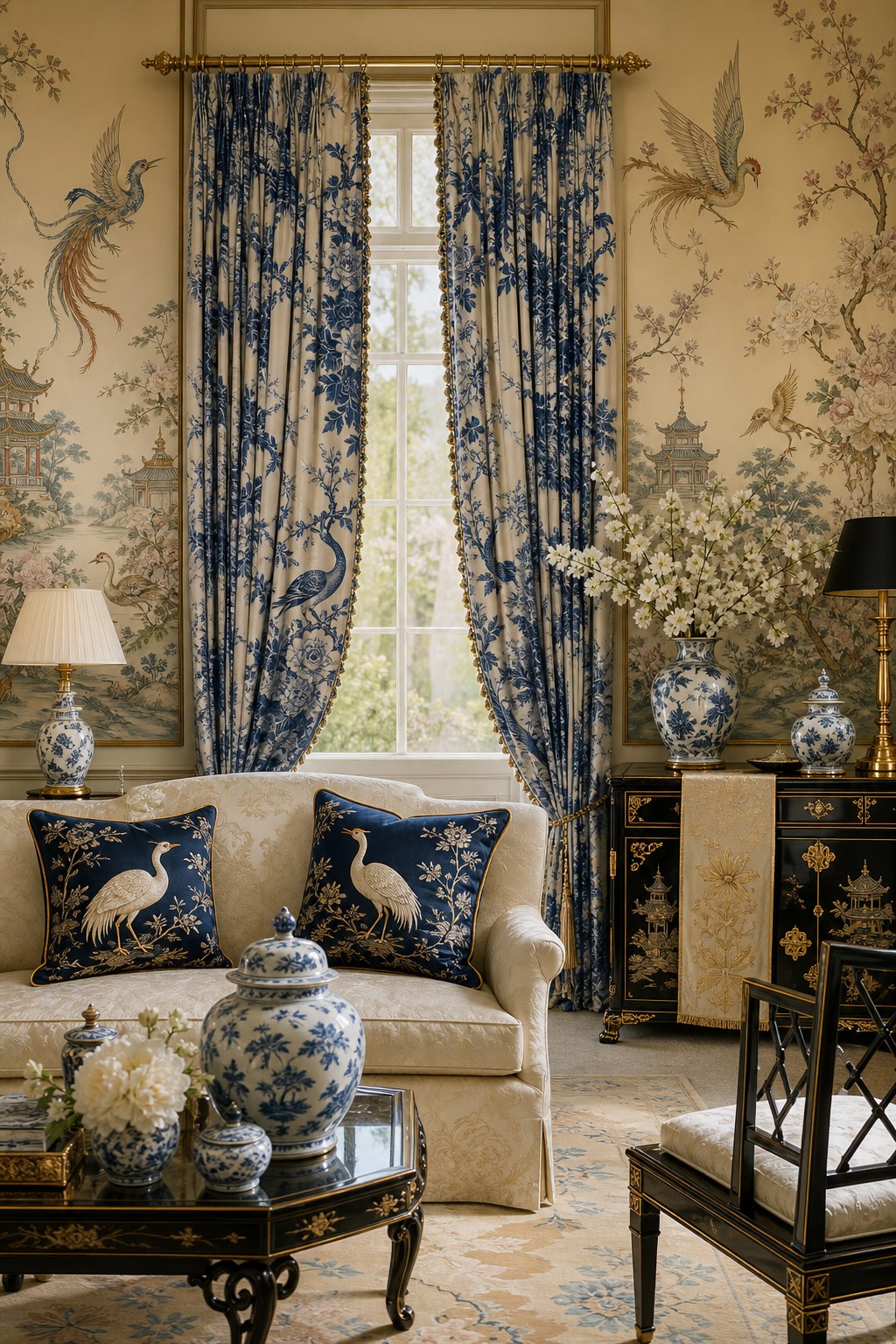
E4 Receipt - Silk Textiles
Pagoda and Bamboo Accents · $274.97
Pagoda and bamboo accents are the architectural vocabulary of chinoiserie. The elements that signal Asia as place rather than just Asia as color story. In the historic chinoiserie canon, the pagoda appeared as a miniaturized decorative object (a lantern, a garden ornament, a finial on a secretary desk), a wall motif in hand-painted wallpaper, and as a full-scale folly in English ornamental gardens. Kew Gardens' famous pagoda, built in 1762, is still the most recognizable Western chinoiserie architectural structure. Bamboo's role is structural and material: the European "faux bamboo" furniture technique. Turning chair legs and frames to mimic the node-and-internode structure of bamboo, was perfected by Chippendale craftsmen in 18th-century England and remains one of the clearest chinoiserie furniture signals available at modern retail price points. In contemporary use, pagoda-form accessories and bamboo-framed mirrors are the most legible entry points for both motifs. A pagoda table lamp, with a stacked-tier shade silhouette in cream or ivory silk, establishes the architectural motif in the room's light source. A bamboo-framed mirror reads as chinoiserie when paired with the porcelain and lacquer elements already in the room, and as organic-coastal when those elements are absent. Which makes it one of the most versatile investments in this element set. The rattan and bamboo accent chair brings the faux-bamboo furniture tradition forward in a form that works in bedrooms, reading corners, and living rooms without requiring a full furniture commitment.
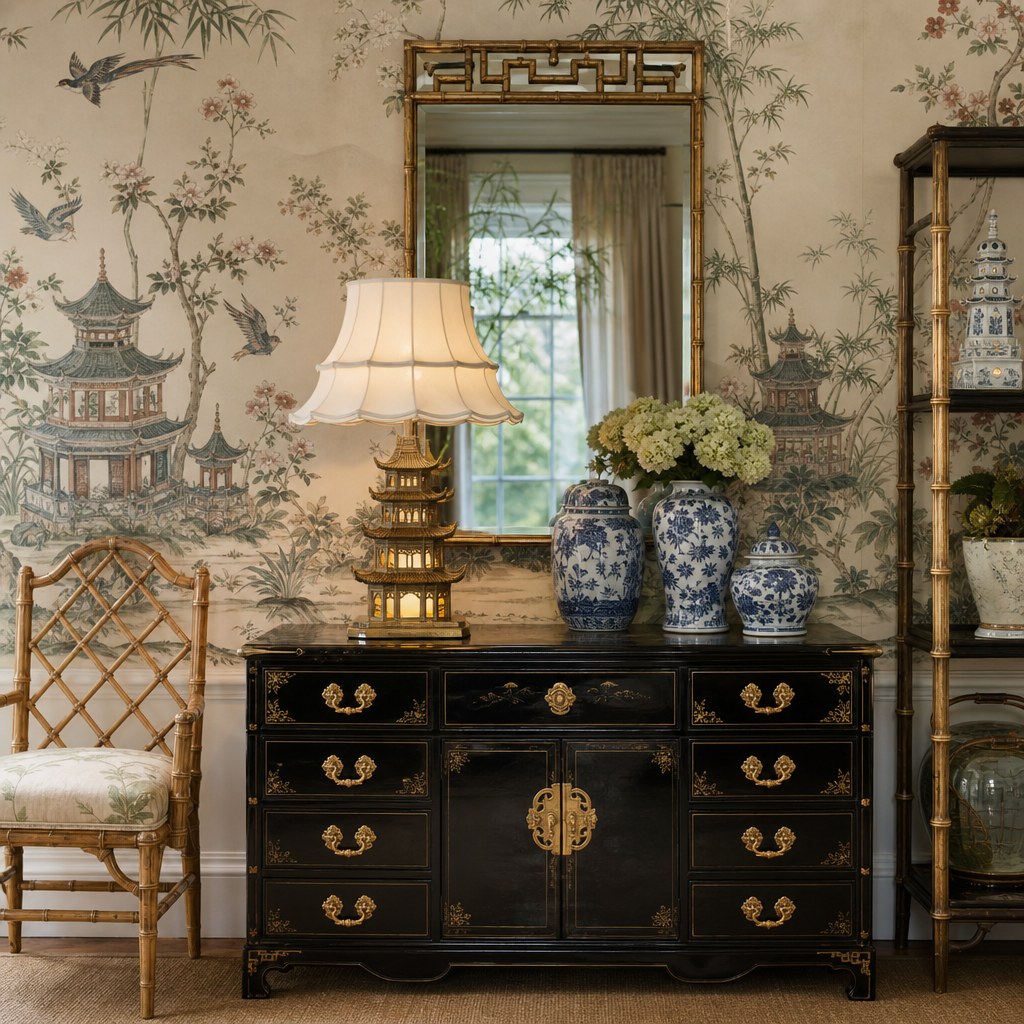
E5 Receipt - Pagoda and Bamboo Accents
Chinoiserie vs. Traditional Interior Design.
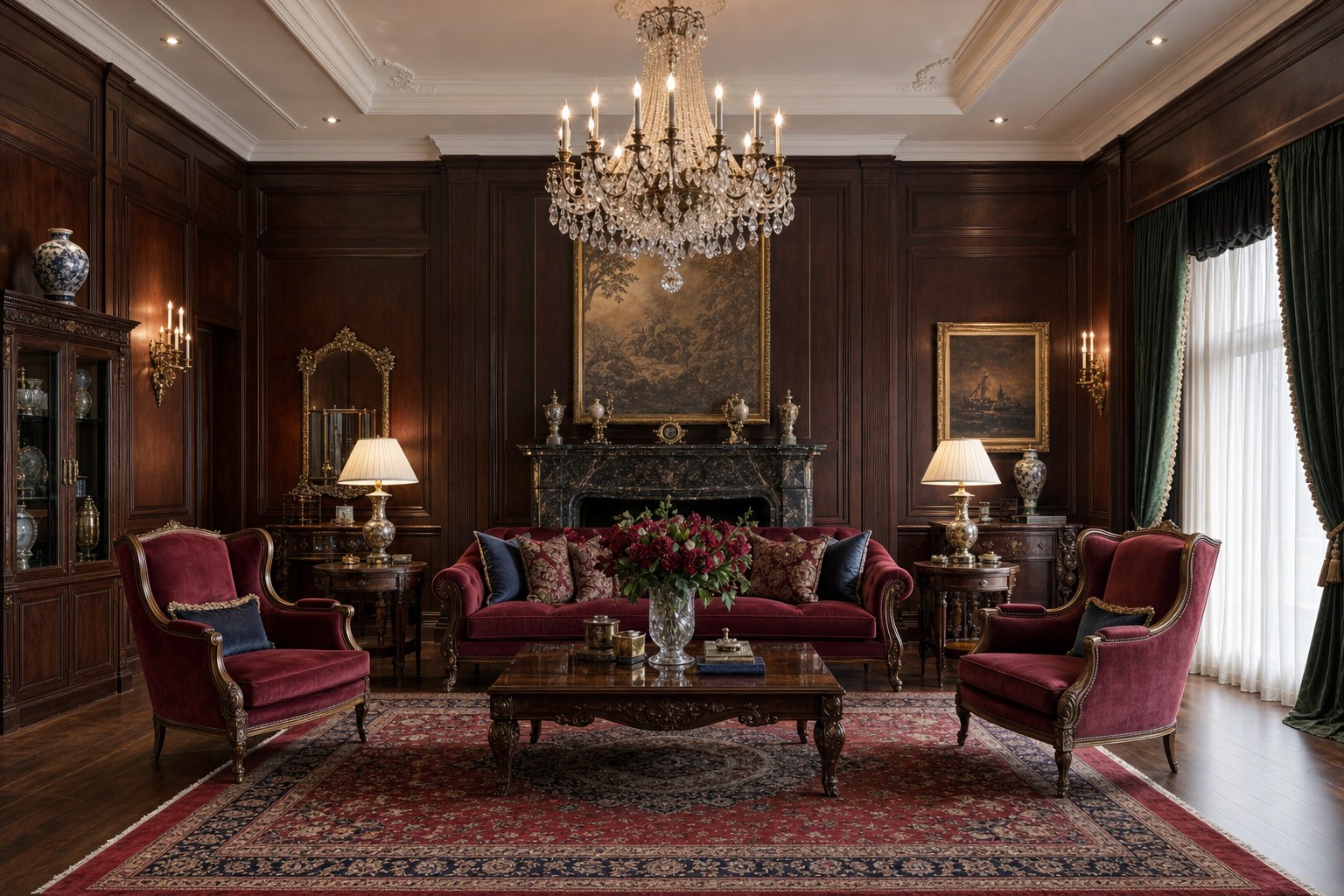
Chinoiserie and traditional interior design share many surface qualities. Formal symmetry, quality materials, layered accessories, antique or antique-inspired furniture. Which is why they are frequently confused or conflated. The distinction is specificity of cultural reference and material hierarchy. Traditional design is a broad category rooted in European aristocratic interiors across multiple centuries: it favors dark wood furniture, upholstered pieces in neutral or warm-toned fabrics, formal drapery, and classical architectural motifs (moldings, medallions, columns). Chinoiserie is a subcategory within that tradition with a specific point of departure: it substitutes high-gloss lacquer for dark-stained wood, blue-and-white porcelain for European ceramics, Asian-motif wallpaper and textiles for European damask and toile, and pagoda or bamboo architectural references for classical columns. The clearest test: a room that reads as formal and antique-influenced but has no Asian material reference is traditional. A room with lacquer, ginger jars, and hand-painted bird wallpaper is chinoiserie. Even if the surrounding furniture is otherwise conventional.
| Dimension | Chinoiserie Interior Design | Traditional Interior Design |
|---|---|---|
| Primary color story | Cobalt blue and white as dominant palette; lacquer tones (black, oxblood red, emerald green) as secondary | Warm neutrals (cream, camel, ivory) dominant; deep jewel tones or burgundy as accent |
| Surface material | High-gloss lacquer on furniture; hand-painted mural wallpaper; silk textiles; translucent porcelain | Dark-stained or painted wood furniture; wallpaper in damask or stripe; linen or velvet upholstery |
| Motif vocabulary | Cranes, dragons, pagodas, flowering cherry and peony branches, guardian lions, bamboo | Classical columns, medallions, European floral toile, damask, heraldic motifs |
| Ceramics | Blue-and-white ginger jars and Canton porcelain grouped as room focal points | European porcelain (Wedgwood, Meissen), transferware in blue or red, displayed in cabinet |
| Furniture signals | Lacquered case pieces, faux-bamboo Chippendale frames, antique Chinese altar tables | Queen Anne, Georgian, Federal, or Regency silhouettes in dark walnut, mahogany, or cherry |
| The room test | Feels theatrical. A room that references a romanticized elsewhere, full of pattern and surface depth | Feels formal and grounded. European heritage, symmetrical, quality materials without cultural specificity |
The $129 entry path.
Three blue-and-white porcelain pieces that establish the chinoiserie color story and collecting logic in any room. No wallpaper, no lacquer, no structural work required. The complete E2 serves as the entry path.
Frequently asked questions.
What is chinoiserie in interior design?
Chinoiserie is a European decorative style that emerged in the 17th century, drawing on romanticized interpretations of Chinese and East Asian aesthetics rather than authentic Asian design. The term derives from the French "chinois," meaning Chinese. Its signature vocabulary includes hand-painted wallpaper panels depicting birds, flowers, and garden scenes; blue-and-white porcelain in the form of ginger jars and vases; lacquered furniture with high-gloss finishes; silk textiles; and pagoda or bamboo architectural accents. It gained royal patronage across England, France, and the Netherlands and has never left the design canon - in 300 years of continuous use, the style has never faded.
What is the chinoiserie color palette?
The chinoiserie color palette runs on two levels. The dominant signature is cobalt blue and white - a combination that originated during China's Yuan dynasty and became the most recognized color story in European decorative arts - crisp, adaptable, and enduring across centuries. The supporting palette adds deep lacquer tones: glossy black, oxblood red, emerald green, and warm ivory or cream as the neutral base. Peacock blue, ruby red, and celadon green are also period-accurate accent colors. In contemporary use, the blue-and-white pairing is the most accessible entry point: a single grouping of blue-and-white ginger jars on a credenza delivers the full chinoiserie color signal without committing to a full room treatment.
What is chinoiserie wallpaper, and how much does it cost?
Chinoiserie wallpaper is a large-scale mural depicting Asian-inspired garden scenes, birds, flowering branches, and pagodas across a series of panels that wrap a room continuously. At the top of the market, de Gournay produces fully hand-painted panels on silk at prices that can reach several hundred dollars per panel. Gracie, founded in 1898 and still family-owned through six generations, produces hand-painted papers at comparable luxury pricing - each 3-foot by 10-foot panel can take 75 or more hours to complete, and the papers have been installed at the White House. Budget-accessible alternatives from Wayfair, Spoonflower, and Amazon offer peel-and-stick or standard paste formats in the $30 to $80 per roll range that deliver the visual pattern at a fraction of the cost. The strategic application - one accent wall, not four - makes the budget wallpaper approach work at room scale.
What furniture defines a chinoiserie room?
Three furniture categories define the chinoiserie interior. Lacquered case pieces - cabinets, credenzas, and chests finished in high-gloss black, red, or navy with hand-painted panel details - are the most distinctly chinoiserie furniture form. Faux bamboo frames, a Chippendale-era interpretation of Asian bamboo construction applied to chairs and side tables, provide a lighter structural note. Antique Chinese altar tables repurposed as consoles, and ornate accent chairs with gilded or lacquered legs, complete the room. The unifying material principle is surface treatment: lacquer and gilt finishes carry the chinoiserie signal more than silhouette does. A modern credenza in glossy black with blue-and-white porcelain on top reads as chinoiserie; the same credenza in matte white does not.
How do you add chinoiserie to a modern home without it looking dated?
Three rules for a chinoiserie room that reads as intentional rather than antiquated. First, let one statement piece lead - a hand-painted wallpaper on a single accent wall, or a blue-and-white ginger jar grouping on a console - rather than applying every element at once. Second, balance the ornate against the restrained: pair chinoiserie pieces with minimalist furniture or contemporary glassware to prevent visual overload. Select two or three standout pieces and layer accessories gradually. Third, use the blue-and-white palette as the anchor and introduce the lacquer tones and silk textiles as supporting layers. The contrast between a refined chinoiserie element and an otherwise contemporary surround is what makes the look feel intentional rather than costumed.
More rooms like this
No spam. Unsubscribe anytime.