Table of Contents
The Casual-Luxe Philosophy.
California coastal interior design is not a coastal theme applied to a California address. It is a distinct design philosophy that emerged from the specific physical and cultural conditions of the California coast: abundant natural light, the expectation of indoor-outdoor living, a post-hippie material culture that favored natural fibers and organic forms over synthetic materials, and a particular West Coast sensibility that treats visible luxury as vaguely suspicious. The result is a casual-luxe style - the marriage of upscale materials and laid-back execution. The furniture is generous and deeply cushioned. The palette is bleached and warm rather than crisp and nautical. The textiles are undyed linen and natural cotton rather than navy stripe and seersucker. And the room never contains a seashell motif, a ship wheel, or an anchor-print throw pillow.
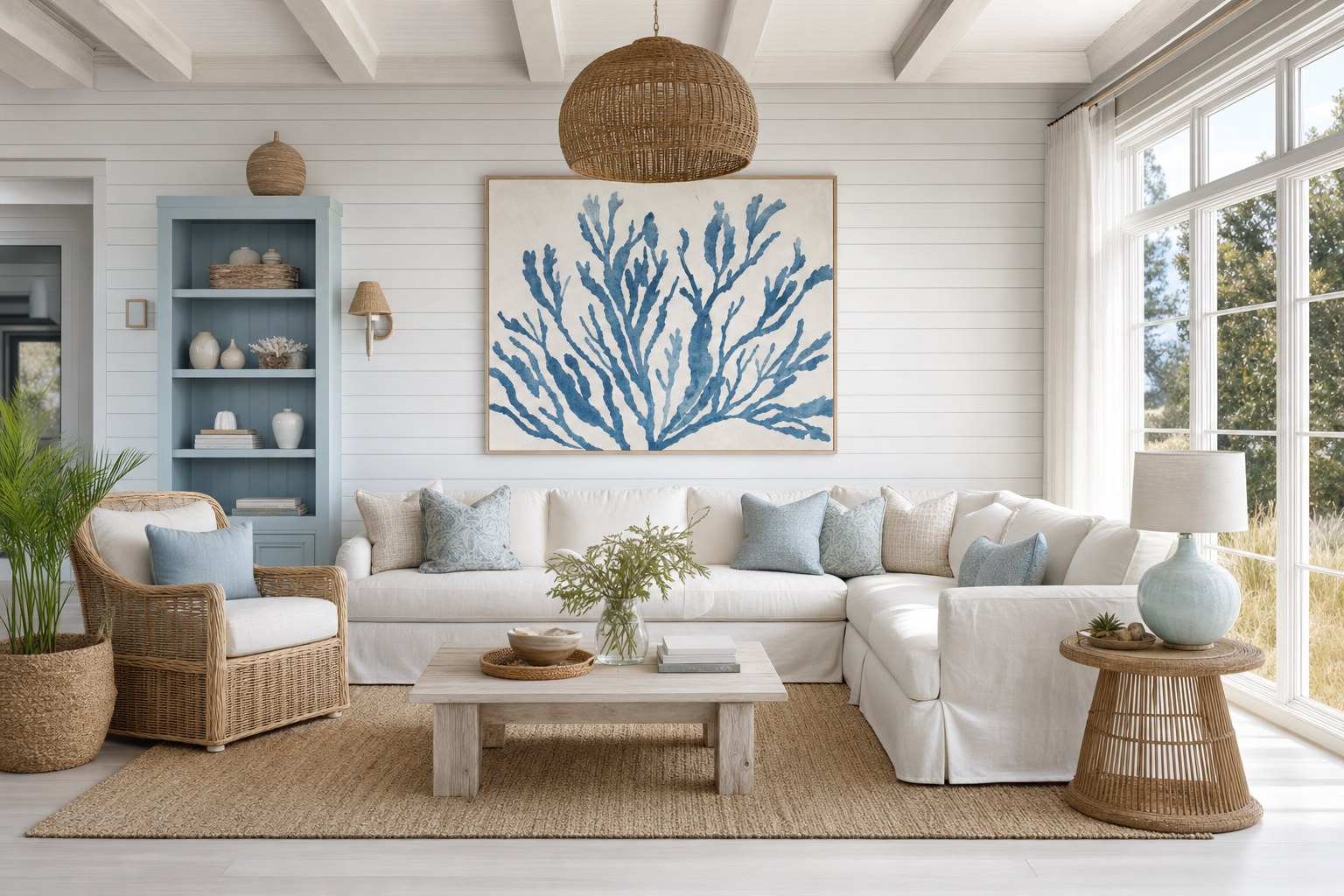
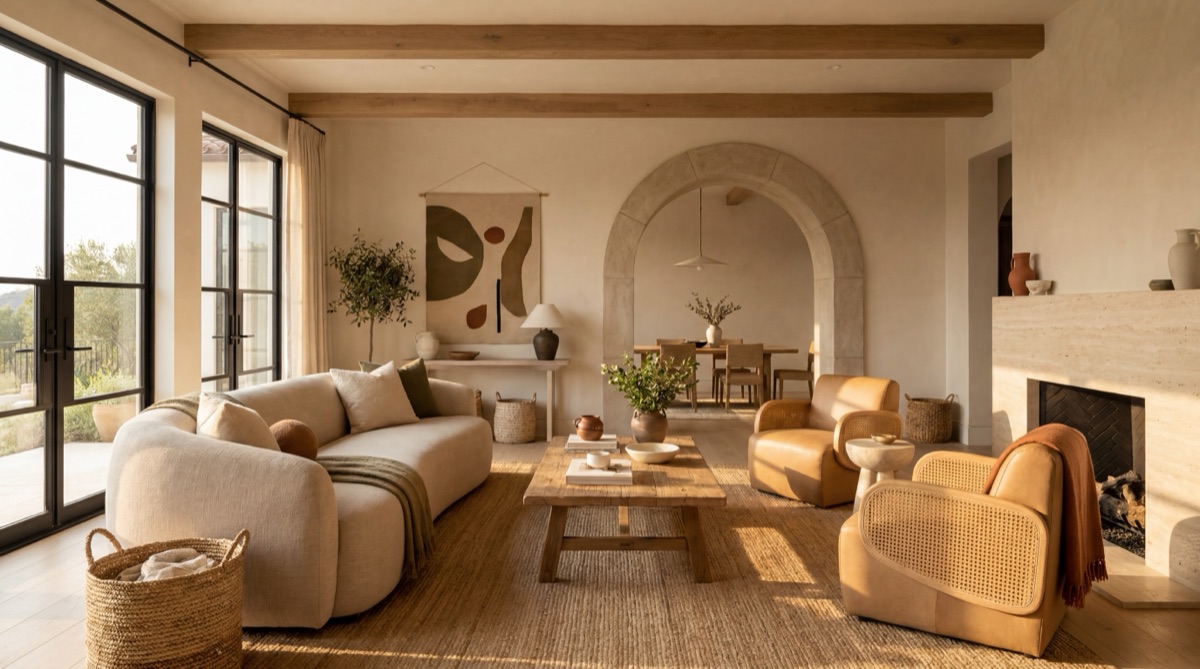
The distinction from traditional coastal design is structural, not superficial. Traditional coastal design is a theme: it uses ocean imagery - shells, coral, nautical stripes, porthole mirrors, sea glass collections in mason jars - as its primary signal system. California coastal design is a material language: white oak, undyed linen, rattan, jute, raw ceramic, and driftwood-finished teak establish the ocean connection through the actual materials the California coast produces, not through decorative references to it. Large windows, glass doors, and open floor plans blur the lines between interior and exterior - the indoor-outdoor connection is architectural in California coastal, not symbolic. The five elements below build the California coastal room in the order that prevents the look from tipping into either nautical theme or sterile minimalism: palette established first, linen-and-rattan texture second, wood layer third, indoor-outdoor connection fourth, organic accents last.
Budget logic for California coastal follows the material hierarchy of the style itself. Source the white oak furniture and rattan pieces at retailer scale - Article, CB2, West Elm, and Pottery Barn all carry credible white oak and cane pieces in the $200-$600 range that perform exactly as the style requires. Source the linen curtains, jute rugs, and ceramic vessels new (Amazon, Target, World Market) - these categories have excellent quality at accessible price points. Source any vintage organic pieces - a single driftwood lamp base, a hand-thrown ceramic bowl - wherever they surface: estate sales, Chairish, and local markets. One authentic handmade piece raises the material credibility of the whole room.
Bleached White and Sand Palette · $128.96
The bleached white and sand palette is the first decision in the California coastal blueprint, and it is what separates the style from every coastal adjacent that shares its material vocabulary. The palette is not bright white and crisp navy. That is Hamptons coastal, or New England coastal, or traditional beach house. California coastal runs warmer and softer: warm white or off-white walls with sandy or greige undertones as the foundation, then accent colors derived from the California setting rather than the ocean surface. Think dusty sage from coastal chaparral, muted terracotta from sun-baked earth, soft sea glass green from weathered bottles rather than tropical turquoise. Build the palette in objects before touching the walls: four palette layer items. Warm white linen throw pillow covers, a dusty sage ceramic accent bowl, a natural jute table runner, and a bleached cotton throw. Establish the color story across every surface at a price point that is fully reversible. The self-test before committing to wall paint: hold a piece of warm white linen fabric against the existing wall color. If the wall reads blue-white or cool gray by comparison, the paint needs to shift warmer before the palette layer items will read correctly. The California coastal foundation is always warm-neutral, never cool-neutral.
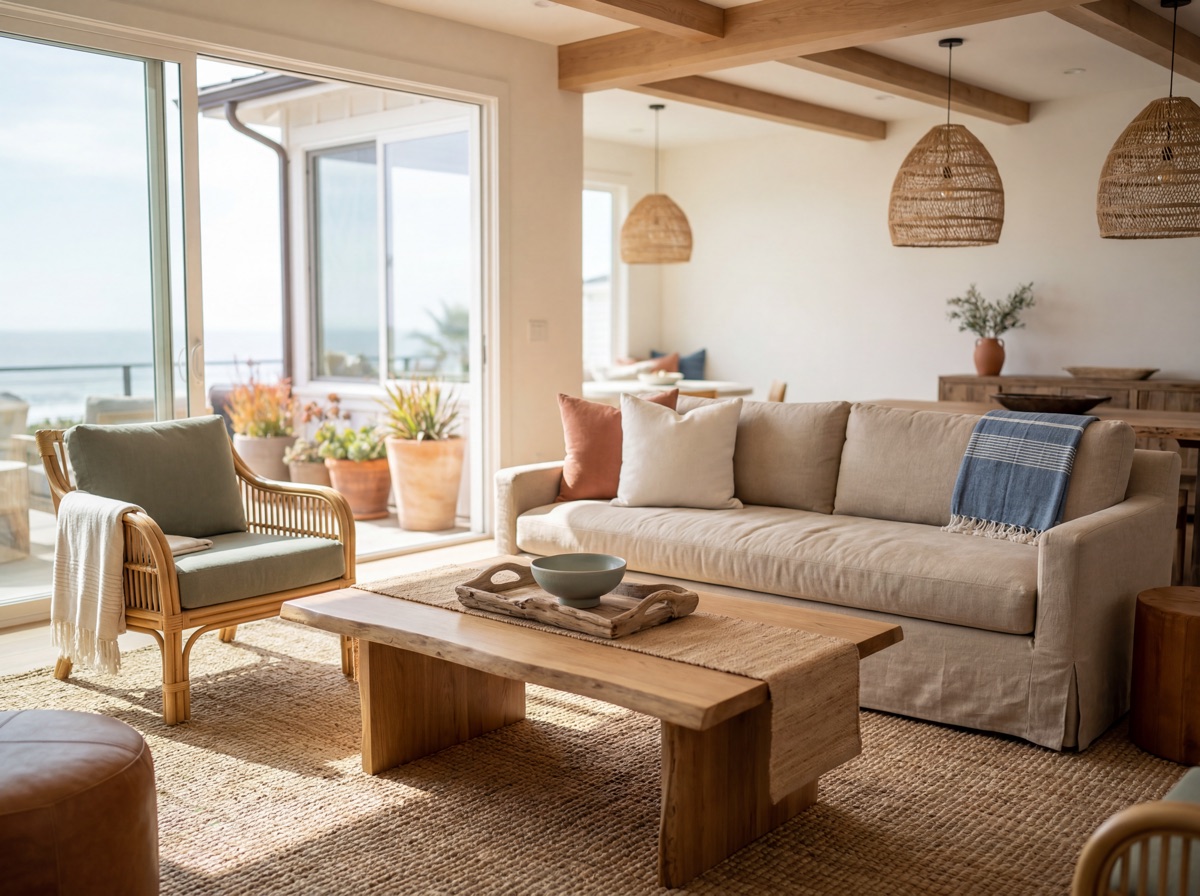
E1 Receipt - Bleached White and Sand Palette
Natural Linen and Rattan Layer · $279.97
Natural linen and rattan are the two signature materials of California coastal design, and for good reason. They share the same quality: both are plant-derived, both have visible texture from the fiber, both soften and warm in natural light rather than competing with it. Linen is the California coastal upholstery and window treatment material of choice precisely because it refuses to look formal: it wrinkles slightly, it has visible weave texture, it drapes naturally rather than stiffly, and its undyed or stone-washed color is exactly the warm neutral the palette needs. Sheer linen curtains in particular are one of the most frequently cited California coastal interventions. They replace heavy drapes with panels that filter bright afternoon light into the soft, diffused quality that is the style's ambient signature. Rattan. The woven cane or reed material used in chairs, pendants, side tables, and storage baskets, is the California coastal furniture signal that most reliably communicates the style to a viewer who cannot name why a room feels like the West Coast. The rattan pendant overhead, the cane-back accent chair in the corner, the woven basket under the side table: each piece adds the woven organic texture layer that distinguishes California coastal from Scandinavian minimalism or organic modern. The three linen-and-rattan layer items establish this material combination at an accessible entry cost.
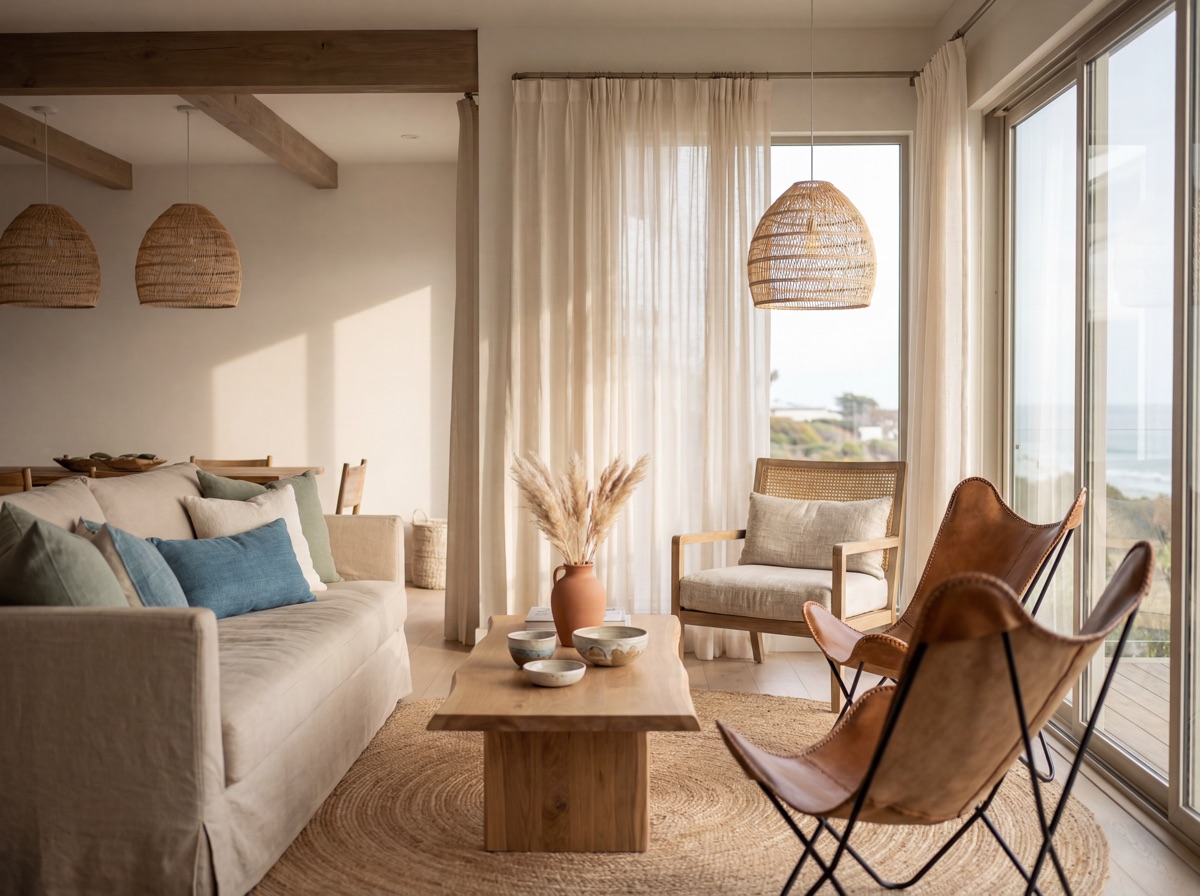
E2 Receipt - Natural Linen and Rattan Layer
The White Oak Wood Layer · $199.97
White oak is the defining wood of California coastal design, and it appears consistently across the style's design canon. The reason is specific: white oak in its natural or lightly whitewashed state has a warm honey tone with subtle grain that reads lighter than walnut (the 70s revival wood) and more organic than the blonde Scandinavian birch. It is the wood of California ranch architecture, of Malibu furniture, of the kind of beach house that has real furniture that has been there for twenty years and still looks right. White oak floating shelves, a white oak side table, or a driftwood-gray teak coffee table all carry this material signal at the accessory scale without requiring floor or furniture replacement. The driftwood finish. Gray-toned teak or acacia that has been treated to look sun-bleached and salt-washed, is the coastal-specific variant of white oak: warmer and more organic than gray-stained wood, with the look of material that has spent years near saltwater. A woven seagrass basket rounds out the organic material story, contributing the plant-fiber woven texture that rattan chairs establish vertically. The three white oak wood layer items build the California coastal material foundation at the storage-and-surface level: the floating shelves establish the wood-on-wall logic, the driftwood tray serves as the room's material reference point on the coffee table, and the seagrass basket handles storage while contributing texture.
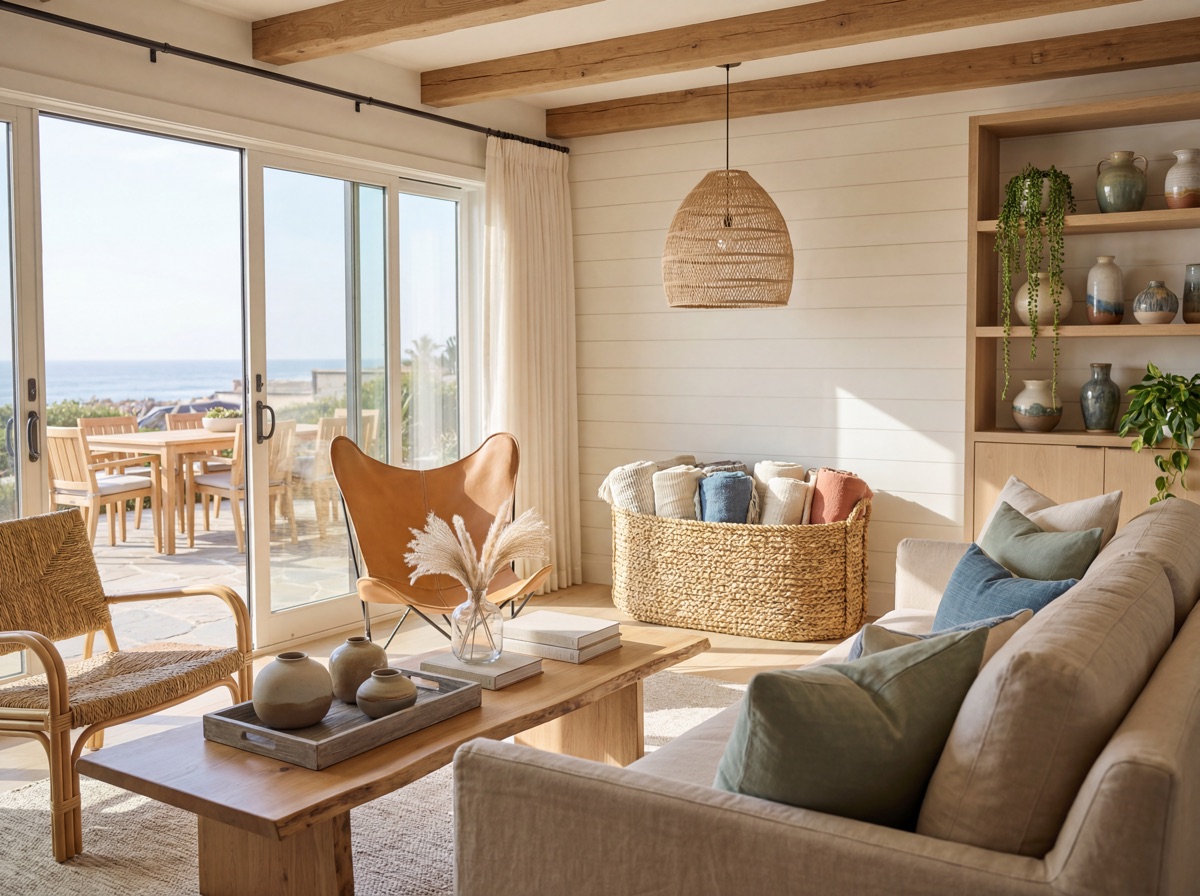
E3 Receipt - The White Oak Wood Layer
Indoor-Outdoor Connection · $229.98
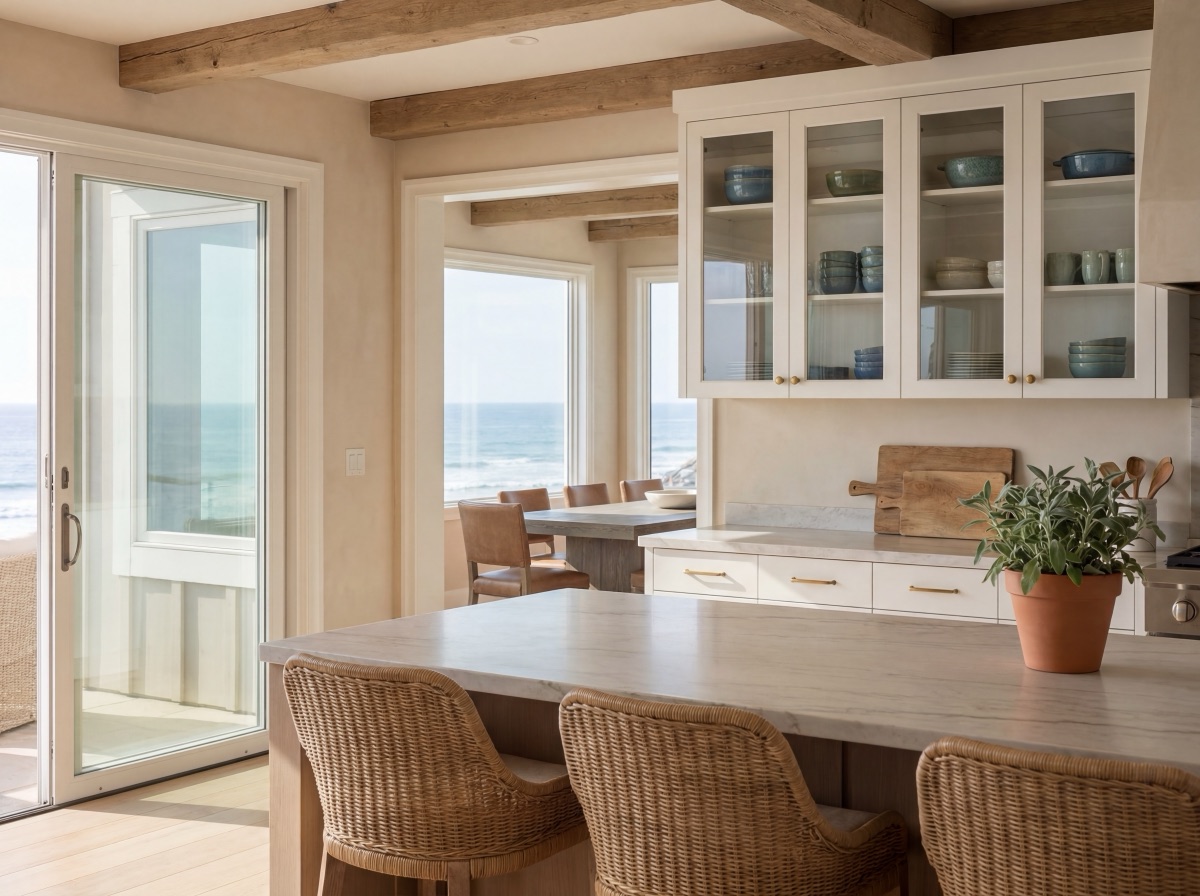
The indoor-outdoor connection is the most distinctively California element of California coastal design. It is the organizing principle that separates the look from any other coastal regional variant. In the original California coastal home, this connection is architectural: large sliding glass doors, covered terraces that function as outdoor living rooms, furniture that lives comfortably in both environments. For renters and apartment dwellers who cannot modify the architecture, the indoor-outdoor connection is achieved through two strategies: bringing outdoor plants inside at meaningful scale, and using materials in the interior that also work in exterior contexts. Teak, rattan, raw ceramic, jute. A large-scale indoor plant, a fiddle leaf fig, a monstera, a bird of paradise, at six feet or taller does the most work of any single object in a California coastal interior. It brings the vertical green of California's outdoor landscape indoors, it gives the room a living material that shifts and grows, and it establishes a scale relationship between furniture and ceiling that makes even a mid-sized apartment room feel more expansive. A ceramic cachepot in warm white or dusty terracotta elevates the plant from "houseplant" to "design decision." The teak outdoor lanterns. Weather-resistant, warm-toned, with glass panels that cast a warm glow in the evening. Bridge the interior and exterior literally, at a scale that works on a balcony, a patio, or an interior side table alike.
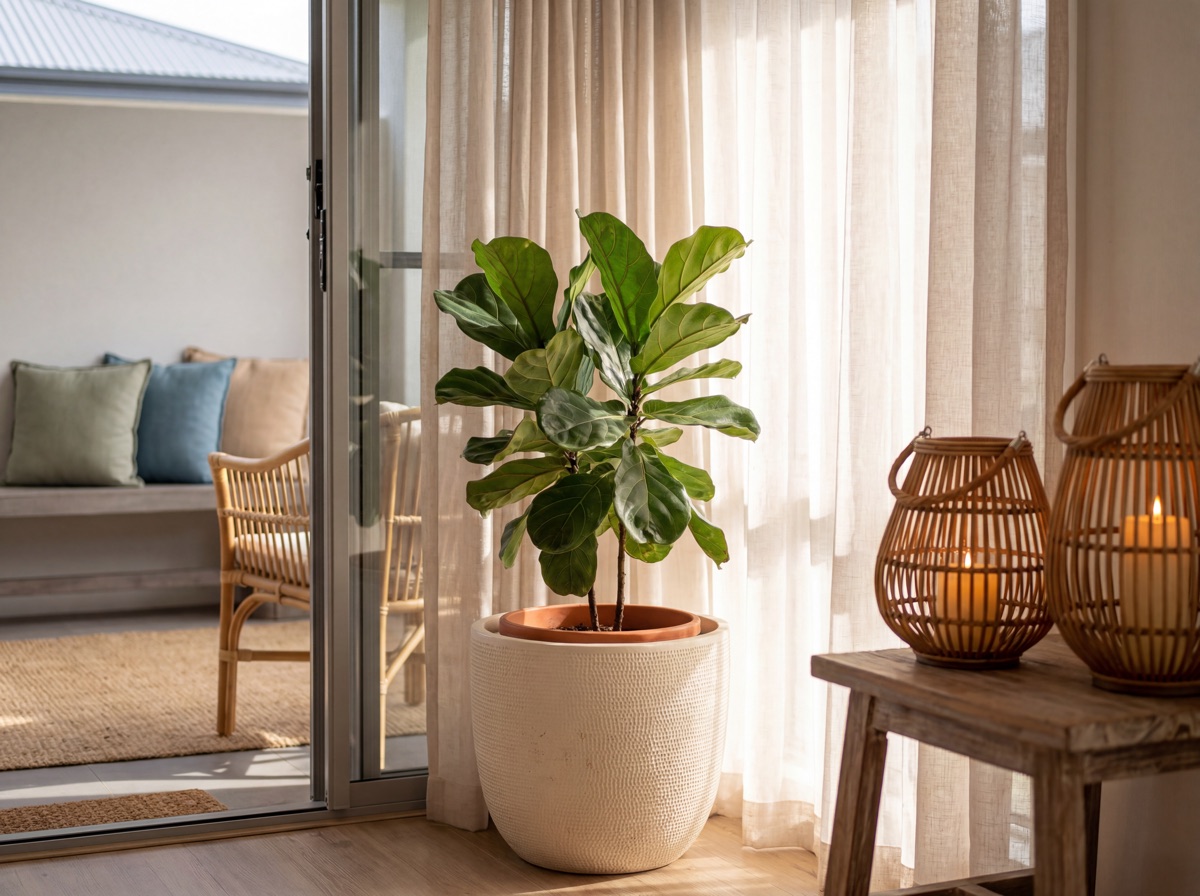
E4 Receipt - Indoor-Outdoor Connection
Sea Glass and Organic Accents · $249.97
Sea glass and organic coastal accents are added last because they respond to the material story already established in the room rather than setting it. This is the element where California coastal diverges most sharply from nautical coastal: the accent color palette is derived from weathered, found objects, sea glass, polished river stones, driftwood, raw abalone, not from maritime iconography. Sea glass green as a vessel color, for example, reads as California coastal because it is the color of weathered glass on a real beach, not the color of an ocean theme chosen from a paint chip. Raw abalone shell used as a small tray or dish carries coastal DNA without nautical reference: it is an organic material from the California coastline, not a decorative motif about the coastline. A jute and sisal area rug at 5x8 under the seating core is the California coastal floor treatment. Natural fiber, slightly rough underfoot, the opposite of the soft shag that anchors a 70s revival room. The sea glass pendant vase set, frosted or translucent glass in soft green or blue-gray tones, is the accent color's transparent indicator: placed on the white oak shelf in afternoon light, the colored glass casts the room's only hint of ocean-toned color without committing it to any surface. The hand-thrown organic ceramic vessels in warm white with a matte glaze are the room's handmade signal: one or two pieces that look genuinely handmade raise the material credibility of the whole interior.
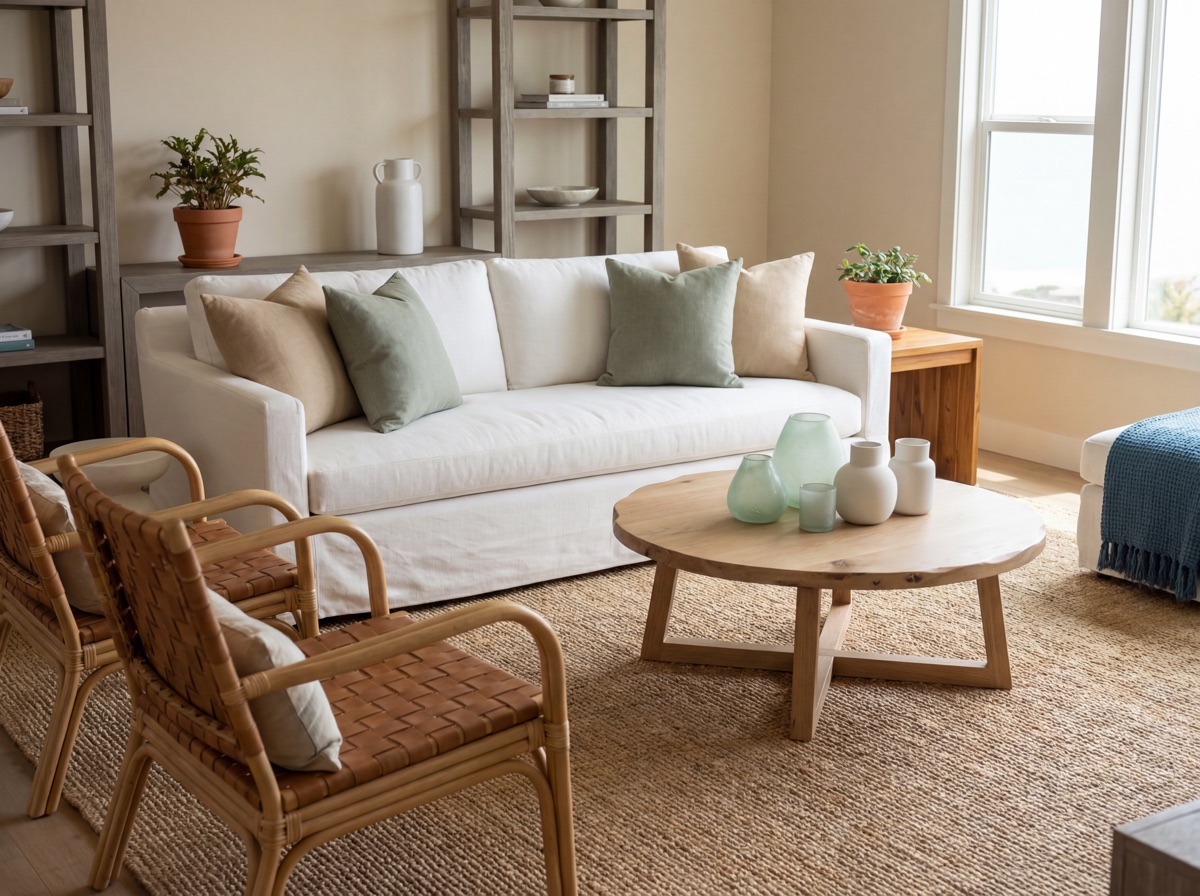
E5 Receipt - Sea Glass and Organic Accents
California Coastal vs. Coastal Style.
Both styles reference the ocean and use natural materials. Which is why they are consistently confused in search results and design publications. The distinction is both geographic and philosophical. Traditional coastal design is a theme: it uses maritime imagery and saturated blues to signal beach-house intent. California coastal is a regional vernacular: it uses the specific materials, palette, and spatial logic of the California coast to achieve a related but distinctly different aesthetic. The easiest test: if the room has a ship's wheel, an anchor motif, a navy-and-white stripe, or a seashell collection, it is traditional coastal. If the room has white oak, undyed linen, a rattan pendant, and a six-foot monstera, it is California coastal.
| Dimension | California Coastal Interior Design | Coastal / Beach House Interior Design |
|---|---|---|
| Color palette | Warm whites, sandy greige, dusty sage, muted sea glass, bleached and sun-softened | Bright whites and saturated navy or aqua blue; crisp contrast rather than warm softness |
| Motif approach | Zero nautical motifs. No anchors, stripes, seashells, or ship imagery; ocean connected through materials | Nautical motifs are primary signals. Stripe textiles, shell decor, porthole mirrors, maritime artwork |
| Wood tone | White oak (honey tone) and driftwood-gray teak, light, warm, slightly bleached finishes | Painted white furniture or whitewashed wood; sometimes reclaimed barn wood as rustic accent |
| Textile approach | Undyed or stone-washed linen, cotton, jute, no pattern, texture over print | Seersucker, ticking stripe, slipcovers in washable cotton, print and pattern are acceptable |
| Spatial philosophy | Indoor-outdoor flow is the primary spatial logic; rooms orient toward the exterior | Interior-focused; outdoor living is seasonal rather than year-round and structural |
| The distinction test | Feels like a Malibu bungalow. Organic, airy, sun-bleached materials, designed by someone who lives there | Feels like a Cape Cod beach house. Charming, themed, recognizably coastal from the decor alone |
The $129 entry path.
Four items that establish the bleached white and sand palette in any room. No furniture replacement, no paint, no structural work required. The complete E1 serves as the entry path.
Frequently asked questions.
What is California coastal interior design?
California coastal interior design is a relaxed, elevated residential style built on a bleached white and sand palette, natural linen and rattan textures, white oak wood surfaces, seamless indoor-outdoor connection, and sea glass or organic coastal accents. It is more minimal, modern, and organic than traditional coastal design - less seashells and anchors, more white oak, linen, and open air. The style is sometimes called California casual or casual-luxe: comfort-forward but never careless, with an emphasis on natural materials and abundant diffused daylight. The operative difference from all adjacent coastal styles is the complete absence of nautical motifs and the complete reliance on authentic organic materials to carry the coastal connection.
What is the difference between California coastal and coastal interior design?
The core distinction is elevation and restraint. Traditional coastal design leans on nautical motifs - stripes, seersucker, seashell artwork, anchor hardware - and brighter, more saturated blues and whites. California coastal strips those literal references out entirely. The palette goes warmer and more neutral: warm whites with sandy or greige undertones, accents of soft olive, terracotta, and muted sea glass rather than bright navy and crisp white. The material language is organic - white oak, rattan, undyed linen, jute, raw ceramic - not preppy. California coastal reads as casual-luxe; traditional coastal reads as nautical-themed. A useful test: if the room signals "Cape Cod beach house," it is traditional coastal. If it signals "Malibu bungalow," it is California coastal.
What colors define California coastal interior design?
California coastal runs on a warm, sun-bleached neutral foundation: warm white or off-white walls with sandy or greige undertones - not the crisp optic white of traditional coastal. The mid-tone layer introduces soft, nature-derived colors: dusty sage from coastal chaparral, muted sea glass green or blue from weathered glass, soft terracotta from sun-baked earth. Natural wood tones - white oak honey, driftwood gray - provide warmth without darkness. The palette avoids high-contrast navy-and-white combinations and saturated tropical blues; everything is softened by light, as if the sun has had years to bleach it gently. The self-test: hold a piece of warm white linen against the wall. If the wall reads cool or blue-white by comparison, the palette foundation needs to shift warmer.
What furniture and materials define California coastal style?
Four material signals define California coastal furniture: white oak (the dominant wood, in its natural or lightly whitewashed state), rattan and cane (for chairs, pendants, side tables, and storage baskets), undyed linen and cotton (for slipcovers, curtains, and upholstery), and raw or minimally glazed ceramics (for vessels, lamp bases, and tableware). Furniture silhouettes are low, plush, and slightly oversized for comfort - deep cushions, relaxed arms, generous seating. Clean lines replace the ornamental curves of traditional coastal. The effect is airy and grounded simultaneously, the way a well-designed Malibu bungalow feels: expensive in materials, casual in execution.
How do I get California coastal style in a landlocked apartment?
Three moves that import the California coastal feeling without an ocean view or open floor plan. First, replace heavy drapes with sheer linen curtains in warm white or natural - they diffuse existing light into the soft, sun-filtered quality the style depends on, and they work in any apartment without structural modification. Second, replace one piece of dark or painted furniture with a white oak or rattan alternative - a cane-back chair, a white oak side table, a rattan pendant overhead. The single material shift registers immediately. Third, add a jute or sisal area rug under the seating core - the natural fiber texture underfoot changes the sensory experience of the room and anchors the organic material story even without windows or water views. One large-scale indoor plant (fiddle leaf fig, monstera, bird of paradise) added at meaningful height completes the indoor-outdoor connection at zero architectural cost.
More rooms like this
No spam. Unsubscribe anytime.