Table of Contents
The Bauhaus principle.
The Bauhaus was founded in 1919 with a single radical objective: to coalesce all the arts - architecture, painting, sculpture, weaving, metalworking, typography, ceramics - into one unified design practice, and to make that practice serve the machine age. Walter Gropius wrote in the 1919 Bauhaus manifesto: "The ultimate aim of all artistic activity is building." The school moved from Weimar to Dessau in 1925, then to Berlin in 1932, and closed in 1933 when the Nazis, who viewed its internationalism and democratic spirit as a threat, pressured the final director to shut it down. Fourteen years. The school that ran for fourteen years still sets the material vocabulary of every modern apartment.
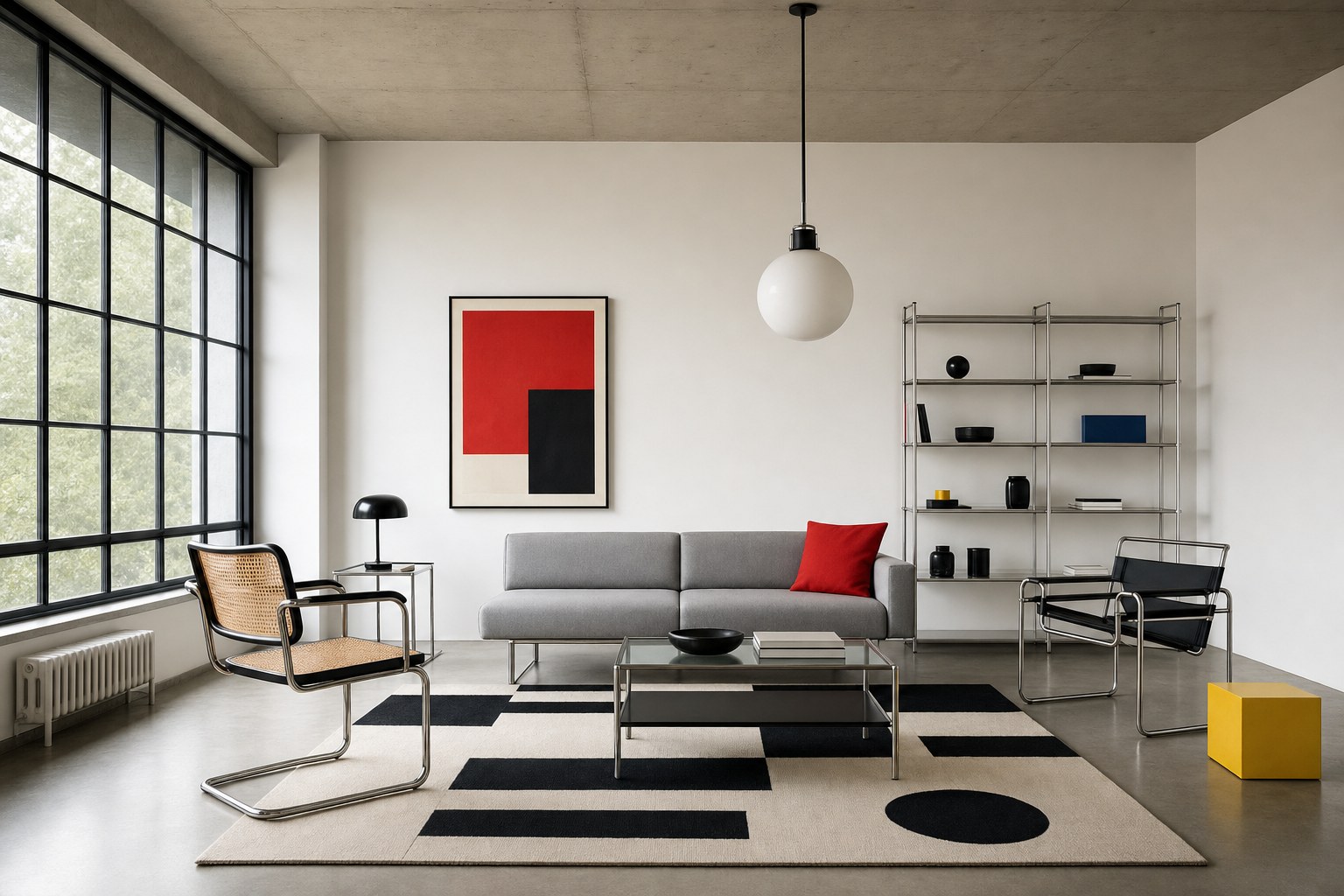
The interior design language that emerged from those workshops is defined by five commitments. First, form follows function: every object must justify its presence through use, not decoration. Second, industrial materials are celebrated rather than hidden - bent tubular steel, plate glass, concrete, and chrome express manufacturing honestly rather than concealing it behind ornament. Third, the color palette is primary and intentional: red, yellow, and blue against neutral white, black, and gray, used as accents rather than as room-wide washes. Fourth, geometric form governs shape - circles, squares, and right angles replace the organic curves of Art Nouveau. Fifth, craftsmanship at scale: every joint, weld, and seam in a Bauhaus-influenced room is precise enough to be visible and proud of being seen. The five elements below build the Bauhaus room in the order that prevents the look from tipping into sterile institutional minimalism: palette first, furniture second, steel accent third, textiles fourth, graphic art last.
The sourcing hierarchy for Bauhaus separates the authenticated from the adjacent. Authenticated Bauhaus originals - the Knoll Wassily Chair, the Knoll Barcelona Chair, the Tecta Cesca Chair - are investment purchases at $2,000 and above. Licensed quality replicas exist in the $200-$500 range for seating and provide the visual signal at a fraction of the cost. The Bauhaus pendant lamp, a simple opal glass globe on a chrome or black pendant, has been so widely replicated that it has become a design archetype available at any price point. The primary-color palette items, geometric textiles, and typography prints are entirely accessible at Target, IKEA, and Amazon price points - the democratizing-art-into-any-home logic that was Gropius's founding intent is still the correct sourcing framework in 2026.
Primary Color Palette · $89.96
The Bauhaus color system was defined by Wassily Kandinsky's preliminary course, which established the pairing of primary colors with geometric forms: yellow with the triangle, red with the square, blue with the circle. Kandinsky believed that certain combinations of color and shape carried innate psychological effects, and his color questionnaire. Which asked every incoming Bauhaus student to assign primary colors to the three basic shapes. Became one of the school's most enduring pedagogical artifacts. The contemporary application of the Bauhaus palette is more restrained than the original workshops: rather than primary-color walls, the current residential interpretation uses a white or warm-gray neutral foundation with one deliberate primary accent. A cobalt blue area rug, a signal red throw pillow cluster, or a chrome-yellow vase. Supported by black steel hardware as the unifying metal throughout the room. The rule that separates Bauhaus from a painted geometry classroom: use primary colors as punctuation, not as the dominant surface. One primary per room reads as intentional and sophisticated. Three primaries at full saturation simultaneously reads as a school hallway. The three palette items below establish that primary punctuation in any existing room without touching walls, furniture, or flooring. The cheapest and most reversible entry path into the Bauhaus visual language.
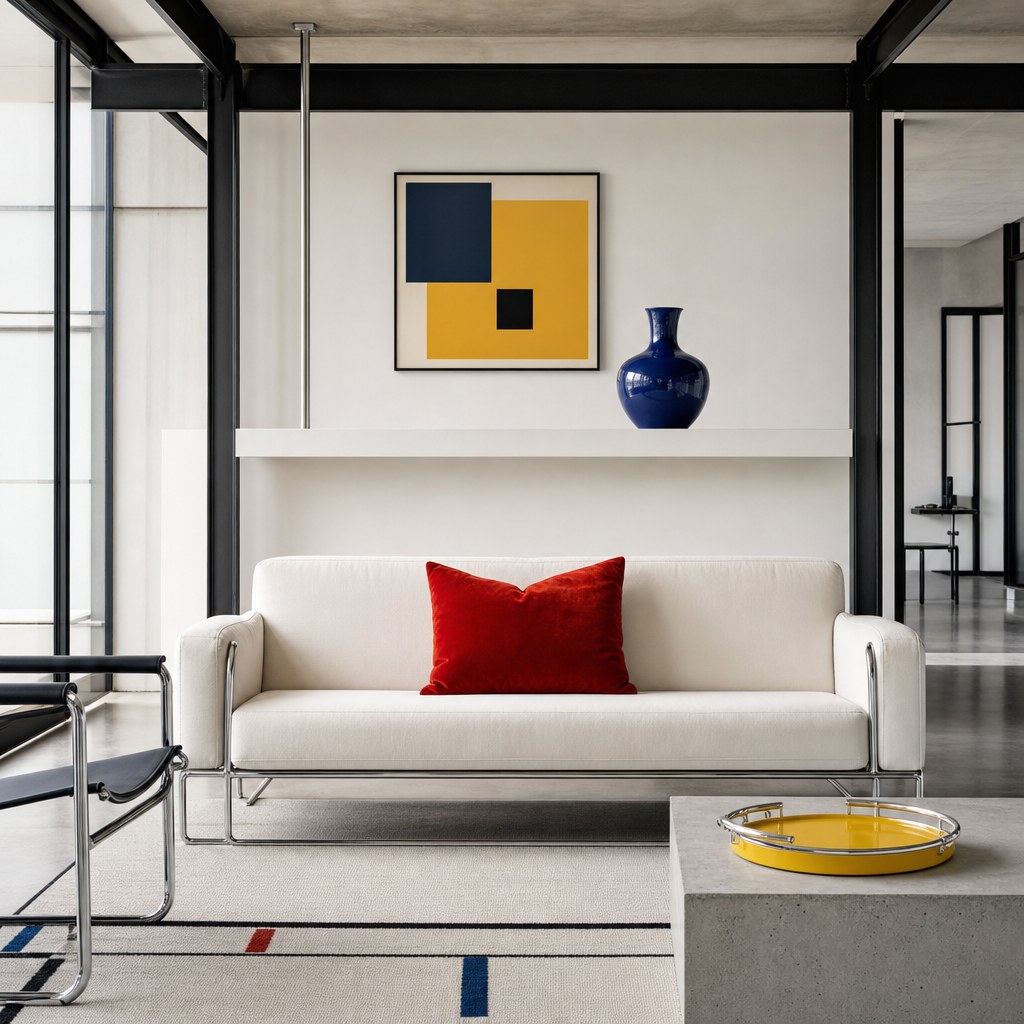
E1 Receipt - Primary Color Palette
Geometric Form Furniture · $298.97
The Bauhaus rejected the ornamental curves of Art Nouveau and replaced them with geometric discipline: circles, squares, and right angles are the approved forms, and every piece of furniture either embodies one of those geometries or is justified by the function it performs. The Cesca Chair, designed by Marcel Breuer in 1928 with its cantilever tubular steel frame and woven cane seat, is the most accessible of the canonical Bauhaus seating pieces and remains the first furniture recommendation for anyone building a Bauhaus-inspired room. It introduces the tubular steel logic, the geometric frame, and the honest material exposure that defines the style without requiring the $2,000 investment of the Wassily or Barcelona chairs. Worth noting: the Noguchi table is not Bauhaus. It was designed by Isamu Noguchi between 1939 and 1947, ten years after the school closed, and has no lineage to Bauhaus masters or workshops. A Bauhaus-correct coffee table is a clean rectangle or square in glass or solid black lacquer, with no organic curves and no decorative edge detailing. The platform side table in the receipt below follows this principle: flat top, geometric legs, no ornament, visible construction. Every piece justifies its presence by doing something the room needs.
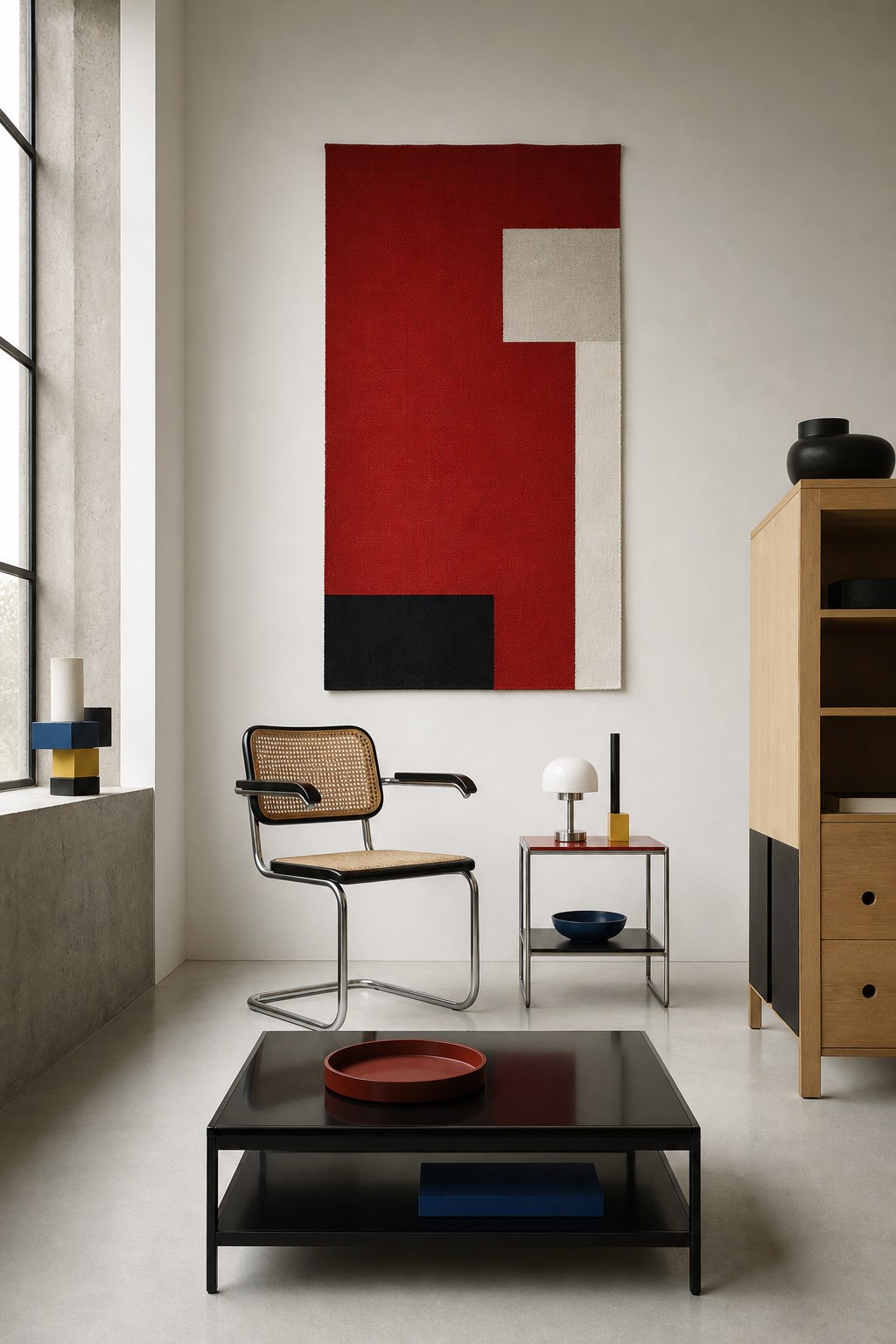
E2 Receipt - Geometric Form Furniture
Tubular Steel Accent · $219.98
Tubular steel is the material signature that separates Bauhaus from every other modernist style. Marcel Breuer pioneered its use in furniture in 1925, drawing direct inspiration from bicycle handlebars. The realization that thin-walled steel tube could carry structural loads while remaining visually light was one of the workshop's genuine technical breakthroughs. Breuer also helped pioneer cantilever technology: by removing the rear legs from a chair and letting the bent steel frame carry the load through spring tension, the Cesca Chair introduced a seating dynamic that no wood or upholstered chair could replicate. In a residential interior, the tubular steel accent is most efficiently introduced at the lighting layer and the shelving layer rather than in primary seating. A Bauhaus pendant lamp with an opal glass globe on a chrome pendant and a set of black steel floating shelves deliver the machine aesthetic at accessible price points, whereas an authentic Wassily Chair requires the $2,000+ investment tier. The Bauhaus pendant lamp has been so widely replicated. Appearing in thousands of commercial and residential interiors since the 1970s. That it is a design archetype, signaling the style immediately to anyone with design literacy. At the wall, black steel floating shelves serve the Bauhaus principle directly: they are purposeful (storage and display), industrial in material, geometrically clean in form, and require visible hardware that is proud of being structural rather than concealed.
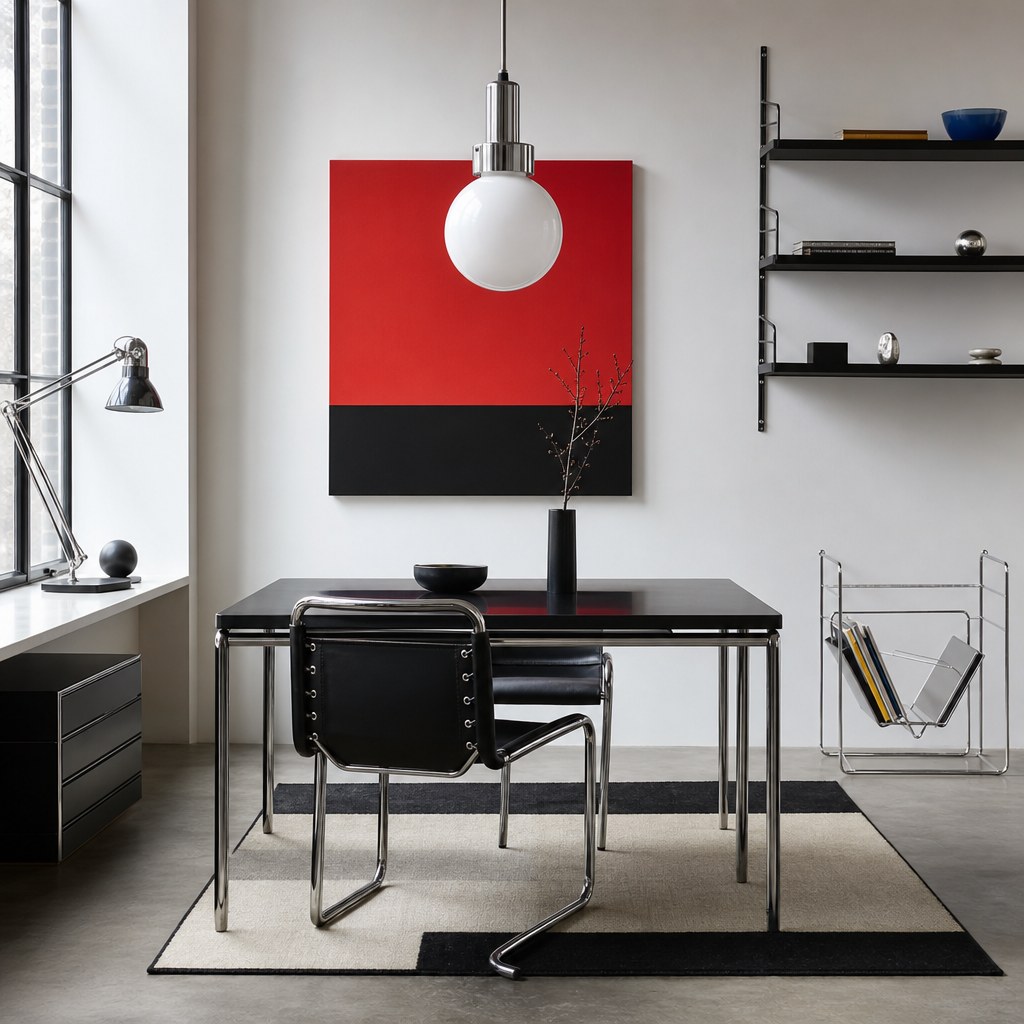
E3 Receipt - Tubular Steel Accent
Functional Textiles · $199.98
The Bauhaus weaving workshop, led by Gunta Stoelzl from 1926, produced some of the school's most commercially successful and widely replicated designs. And established the principle that textiles belong in the design canon alongside furniture and architecture, not as decoration subordinate to it. Anni Albers, who studied under Stoelzl and became the most recognized Bauhaus weaver, reduced the practice to a single directive: take a thread for a walk. The resulting Bauhaus textiles are defined by geometric grid structure, visible warp and weft, primary-color blocking within a neutral field, and the absence of representational or floral motifs. In a contemporary residential interior, the Bauhaus textile vocabulary is most usefully deployed at three points: the floor, the window, and the desk or bedside surface. A geometric flat-weave area rug in black, white, and one primary color anchors the seating zone while keeping the machine-aesthetic material logic on the floor. Blackout curtains in matte charcoal, no pattern, no sheer, no tassel, treat the window as a functional plane rather than a decorative opportunity. A woven cotton throw in a primary-color grid pattern on the sofa arm introduces the weaving-workshop textile tradition at the lowest price point in the Bauhaus build. All three textiles earn their place by doing something the room needs: thermal insulation, light control, tactile warmth. Form follows function, applied to fabric.
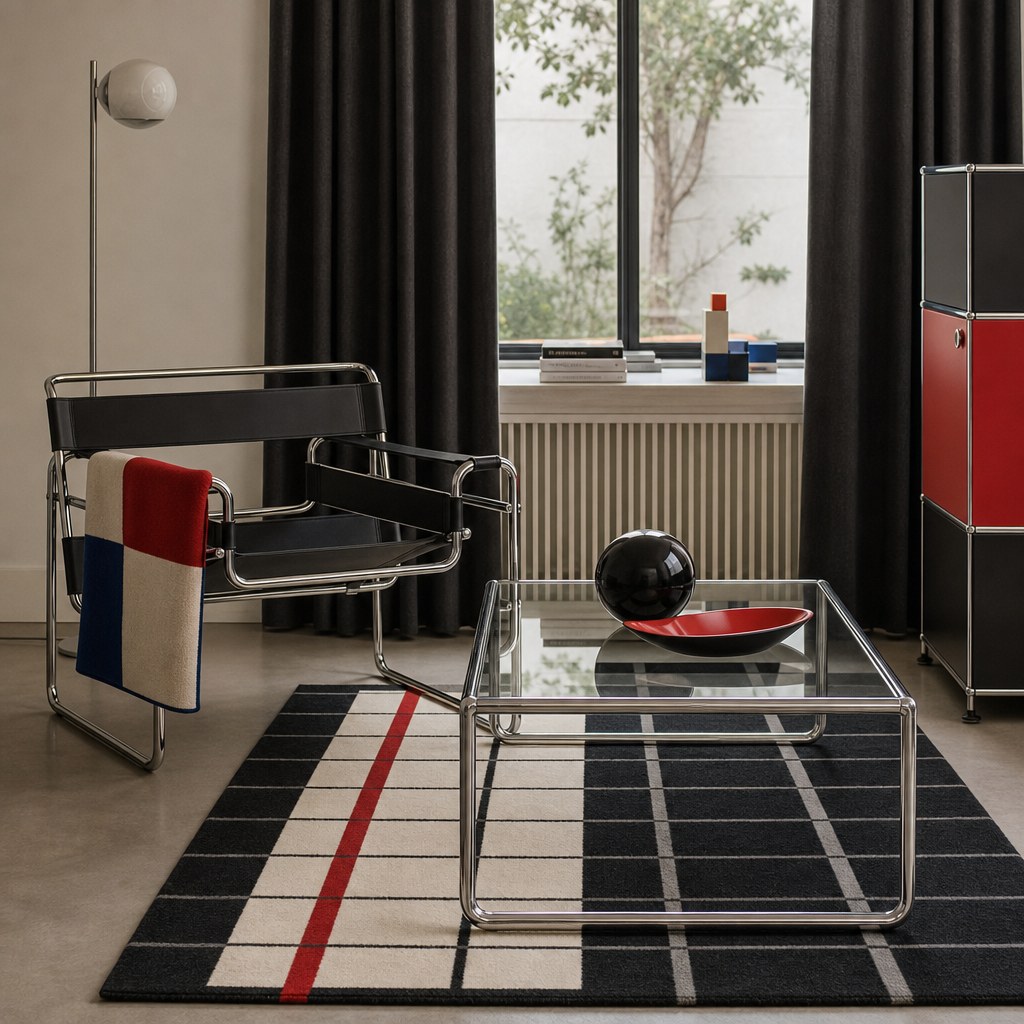
E4 Receipt - Functional Textiles
Typography Grid Wall Art · $287.97
The Bauhaus typography and graphic design workshop, led by Herbert Bayer after 1925, established a visual language that is still immediately recognizable: geometric sans-serif letterforms, grid-based composition, primary colors used as structural elements rather than decoration, and the alignment of type and image along mathematical axes. Bayer's "Universal" typeface, designed in 1925 as a fully lowercase geometric sans-serif, was the workshop's most radical typographic statement. The idea that capital letters were unnecessary ornament, and that a single geometric letterform could serve all communicative purposes. In a residential interior, the Bauhaus graphic tradition is most authentically expressed as a grid of three prints rather than a single large artwork: a primary-color Bauhaus geometric composition (Klee or Kandinsky-adjacent), a Bauhaus typography print with spare geometric sans-serif letterforms, and a Marianne Brandt-inspired metalwork line drawing that brings the workshop's metalworking tradition to the wall. The three prints are hung on a strict mathematical grid, equal spacing, equal frame size, aligned on a horizontal axis, because the grid is not a hanging technique in a Bauhaus interior, it is a design principle. A common mistake in Bauhaus-inspired rooms is decorative geometric wall art that ignores this internal logic: a triangle print in coral on a fashion-neutral background looks geometric but is not Bauhausian because the geometry is applied decoration rather than structural composition. The typography and grid composition of a Bauhaus wall arrangement should be legible as a design decision, not as a trend purchase.
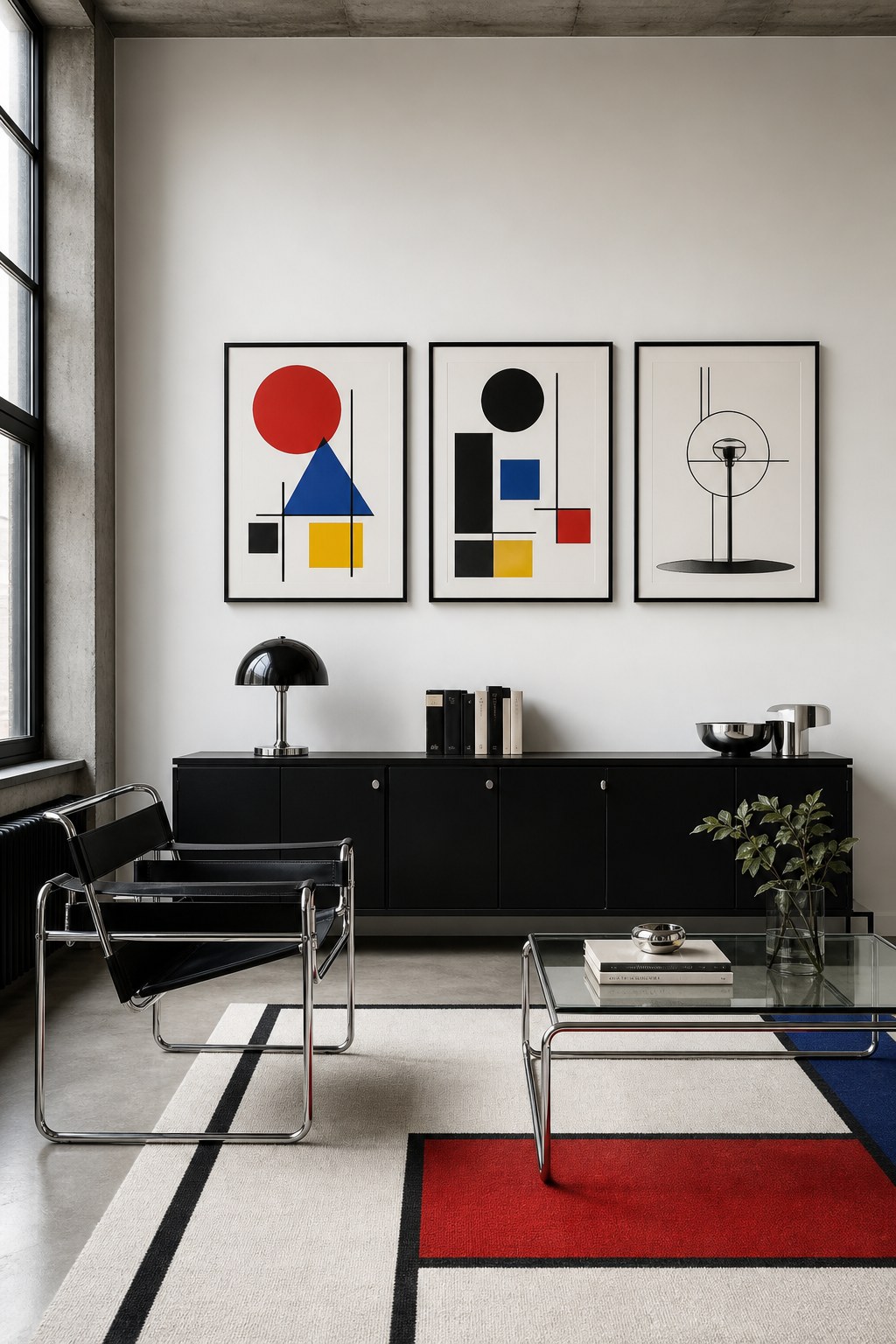
E5 Receipt - Typography Grid Wall Art
Bauhaus vs. Minimalism.
Both styles present spare, uncluttered rooms, which creates persistent confusion even among design-aware buyers. The distinction is origin and material specificity. Minimalism is an aesthetic attitude that can be executed in any material, in any color palette, in any era. Bauhaus is a historical design movement with a locked material vocabulary. Bent tubular steel, primary colors as accents, geometric weaving, opal glass, sans-serif type on a mathematical grid. That traces directly to fourteen years in Weimar, Dessau, and Berlin. The easiest test: remove every object from the room and look at what remains. A minimalist room is defined by what is absent. A Bauhaus room is defined by the specific things that are present and the internal logic they share. If the chair could not have been designed between 1919 and 1933 or by someone trained in that period, it is not Bauhaus. It may be minimalist, mid-century, or simply clean-lined, but it is not the school.
| Dimension | Bauhaus Interior Design | Minimalist Interior Design |
|---|---|---|
| Origin | Specific historical school, 1919-1933 Germany, defined material canon, traceable lineage | Broad aesthetic attitude. No fixed era, no fixed material, no required lineage |
| Color palette | Primary colors (red, yellow, blue) as deliberate accents against white, black, and gray, the Kandinsky color system | Any neutral range, white, warm gray, greige, black, with color generally suppressed or absent |
| Required materials | Bent tubular steel, plate glass, opal glass globes, woven geometric textiles, chrome hardware, the machine aesthetic | No required material. Concrete, linen, wood, marble all qualify if the room reads as uncluttered |
| Furniture logic | Every piece must perform a function; visible joints, welds, and construction are celebrated as honest craft | Every piece must not distract; hidden joinery and seamless surfaces are preferred for visual quiet |
| Wall treatment | White walls with a grid-hung typographic or geometric art arrangement. The graphic design workshop on the wall | Bare walls preferred, or one single statement object, art is incidental, not structural |
| The confusion test | Can trace every object to the workshop that designed it: metal, weaving, carpentry, typography, or graphics | Can describe the room by what is not there, no ornament, no clutter, no excess, rather than by what is |
The $89 entry path.
Three items that establish the Bauhaus primary color palette in any room. No furniture replacement, no painting, no structural work required. The complete E1 serves as the entry path.
Frequently asked questions.
What is Bauhaus interior design?
Bauhaus interior design is a functional, geometry-first residential style rooted in the German art school that Walter Gropius founded in Weimar in 1919 and that closed under Nazi pressure in 1933. The school's central principle - form follows function - means every object in a Bauhaus interior earns its place by doing something. Visual characteristics include open floor plans that expose structural elements rather than concealing them, industrial materials (bent tubular steel, plate glass, opal glass, concrete), a primary color palette of red, yellow, and blue used as accents against neutral white and black, geometric forms (circles, squares, right angles replacing ornamental curves), and the deliberate celebration of manufacturing precision: visible welds, exposed joints, and mathematical grid layouts. Though the school operated for only fourteen years, its principles laid the foundation for minimalism, modernism, and contemporary product design from Apple to IKEA.
What is the difference between Bauhaus and minimalism?
Bauhaus and minimalism are related but distinct. Bauhaus (1919-1933) is a specific historical school with a locked material vocabulary - bent tubular steel, primary colors, geometric weaving, industrial glass - rooted in the belief that good design should be democratic and machine-producible. Minimalism is a broader aesthetic attitude that emerged partly from Bauhaus influence but has no fixed material palette, no fixed era, and no required lineage. A Bauhaus room is identified by the specific objects present: the cantilever steel chair, the primary-color accent, the opal glass pendant, the geometric textile grid, the typography print hung in mathematical alignment. A minimalist room can be achieved in any material or color range as long as it is uncluttered. Bauhaus is a school. Minimalism is an adjective.
What are the key Bauhaus furniture pieces?
Four furniture pieces define the Bauhaus canon. The Wassily Chair (Marcel Breuer, 1925) was the first chair constructed from bent tubular steel - Breuer drew direct inspiration from bicycle handlebars to achieve a structural form that was visually light and industrially honest. Licensed originals from Knoll cost $2,000 or more; quality replicas exist in the $200-$500 range. The Barcelona Chair (Mies van der Rohe, 1929) pairs flat-bar stainless steel with leather cushions in a form that remains in continuous licensed production. The Cesca Chair (Marcel Breuer, 1928) uses a cantilevered tubular steel frame with a woven cane seat and back - the most accessible Bauhaus seating piece at new prices. A critical note: the Noguchi table is not Bauhaus, the Eames chairs are not Bauhaus, and Cranbrook Academy furniture is not Bauhaus. These pieces postdate 1933 and have no direct Bauhaus lineage.
What color palette does Bauhaus interior design use?
The Bauhaus color system was defined by Wassily Kandinsky's color theory course, which established the pairing of primary colors with geometric forms: yellow with the triangle, red with the square, blue with the circle. In practice, original Bauhaus interiors used red, yellow, and blue as deliberate structural accents against a neutral base of white walls, black steel, and concrete gray. The contemporary residential application is more restrained: one primary color per room, used as punctuation against a white or warm-gray neutral foundation, with black steel or chrome hardware as the unifying metal throughout. Every object in a Bauhaus interior earns its place by doing something - and that applies to color: every primary accent should be functional (a pillow that is also a color signal, a vase that is also a Kandinsky reference, a tray that is also a surface organizer) rather than purely decorative. One primary reads as intentional. Three primaries at full saturation simultaneously reads as a school hallway.
Is IKEA Bauhaus style?
IKEA is Bauhaus-adjacent but not Bauhaus. IKEA's founding philosophy - functional, affordable design for everyone - directly echoes the Bauhaus principle that good design should be accessible to all rather than reserved for the wealthy, an egalitarian and anti-elitist design position that Gropius articulated in the 1919 manifesto. Several IKEA product lines share formal characteristics with Bauhaus objects: flat-front cabinetry that celebrates the honest surface, tubular steel legs on select shelving and table lines, and geometric textiles that reference the weaving workshop's grid patterns. But IKEA pieces are not authenticated Bauhaus objects, which must trace direct lineage to a workshop or designer active between 1919 and 1933. The practical answer: specific IKEA pieces can anchor a Bauhaus-inspired room effectively - particularly case goods, storage, and geometric textiles - but the seating and lighting hero pieces benefit from choosing authenticated replicas of the Cesca, Wassily, or Barcelona to deliver the style's genuine material signal.
More rooms like this
No spam. Unsubscribe anytime.