Table of Contents
Art Nouveau: nature as architecture.
Art Nouveau is not a decorating style in the conventional sense - it is a philosophy about what buildings and the objects inside them owe to the natural world. The movement emerged in the 1890s as a rebellion against the rigid, mass-produced decor of the industrial age, insisting on handwork over factory output and organic form over standardized geometry. The guiding principle - stated explicitly in the era's manifestos and practiced by every major designer from Hector Guimard to Antoni Gaudi to Louis Comfort Tiffany - was that architecture, furniture, lighting, and hardware should not be designed separately but conceived as one unified interior, each element flowing into the next the way branches connect to a trunk. The design community captures the aspiration succinctly: "The architecture IS the decor in Art Nouveau."
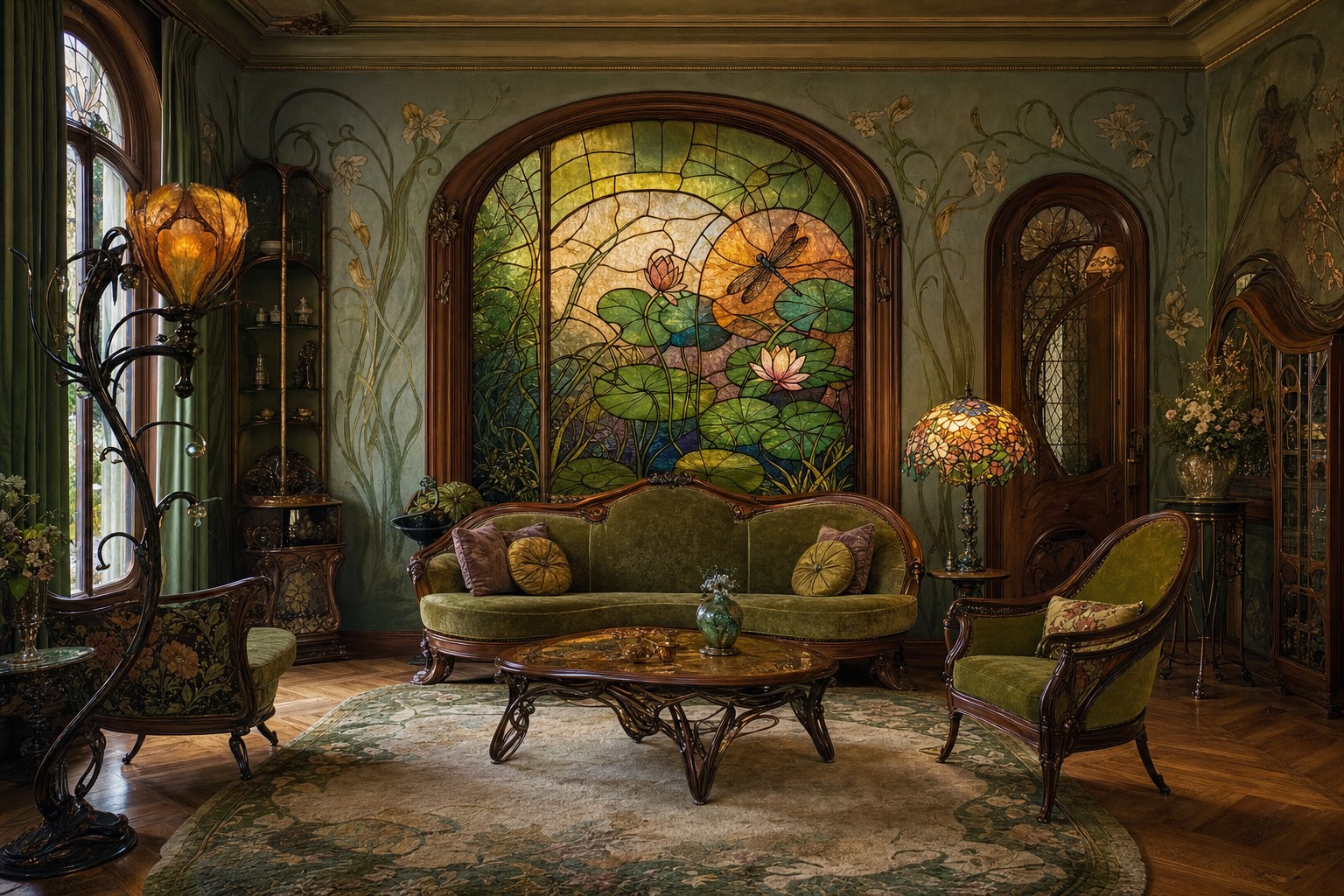
The visual language that results is defined by "sinuous, flowing lines inspired by natural forms such as vines, flowers, and tendrils," asymmetrical compositions, and botanical motifs drawn from irises, water lilies, dragonflies, and peacock feathers. The color palette mirrors the natural sources: earthy olive green, mossy botanical greens, warm amber, soft ochre, muted terracotta, and jewel-tone accents in emerald, deep blue, and garnet - all blended to create organic, flowing continuity rather than sharp contrast. The 2025 Art Nouveau revival is gaining significant momentum, fueled by the shift away from minimalism toward maximalism and richly layered interiors. The five elements below build the Art Nouveau room in the order that makes the philosophy legible: stained glass establishes the light quality first, botanical surface layer second, organic curves third, wrought iron metalwork fourth, nature-palette foundation last.
The sourcing hierarchy for Art Nouveau follows the style's own logic. Source wrought iron and carved wood hardware vintage - from estate sales, eBay, and antique dealers - because age and patina are authentic to the style's handcraft philosophy, and authentic pieces cost far less than reproduction furniture. Source botanical wallpaper new, from specialty wallpaper brands and Amazon: this is the category with the best quality-to-cost ratio in the entire style, and it is fully reversible. Source stained glass from Etsy studios for custom panels or from a Tiffany-adjacent lamp manufacturer for the entry-point piece. The reproduction piece that design communities have collectively validated as the most satisfying entry: "Start with one Tiffany-adjacent lamp - everything else follows."
Stained Glass Anchor · $89.99
Stained glass is the single element most closely identified with Art Nouveau. And the element that most decisively changes a room on its own. Louis Comfort Tiffany built his design legacy almost entirely on the material: his lamps and windows defined the American interpretation of the style, while European practitioners like Victor Horta deployed stained glass in stairwells, transoms, and dining room ceilings to transform ordinary light into something botanical and alive. Unlike heavy Victorian lead-lights, Art Nouveau stained glass favors swirling irises, dragonflies, and fluid ribbons of color that diffuse daylight into jewel-like pools. In the Art Nouveau design community, the stained glass piece is consistently identified as the gateway purchase: the item that anchors the room's character and makes every subsequent decision easier. A Tiffany-style table lamp with an iris or wisteria motif is the most versatile and lowest-commitment entry point. It can move between rooms, it requires no installation, and it establishes the style's amber-and-jewel-tone light quality immediately on a single surface. The lamp functions as what designers call a "color temperature anchor": every other piece in the room is subsequently evaluated against the jewel-toned light it casts.
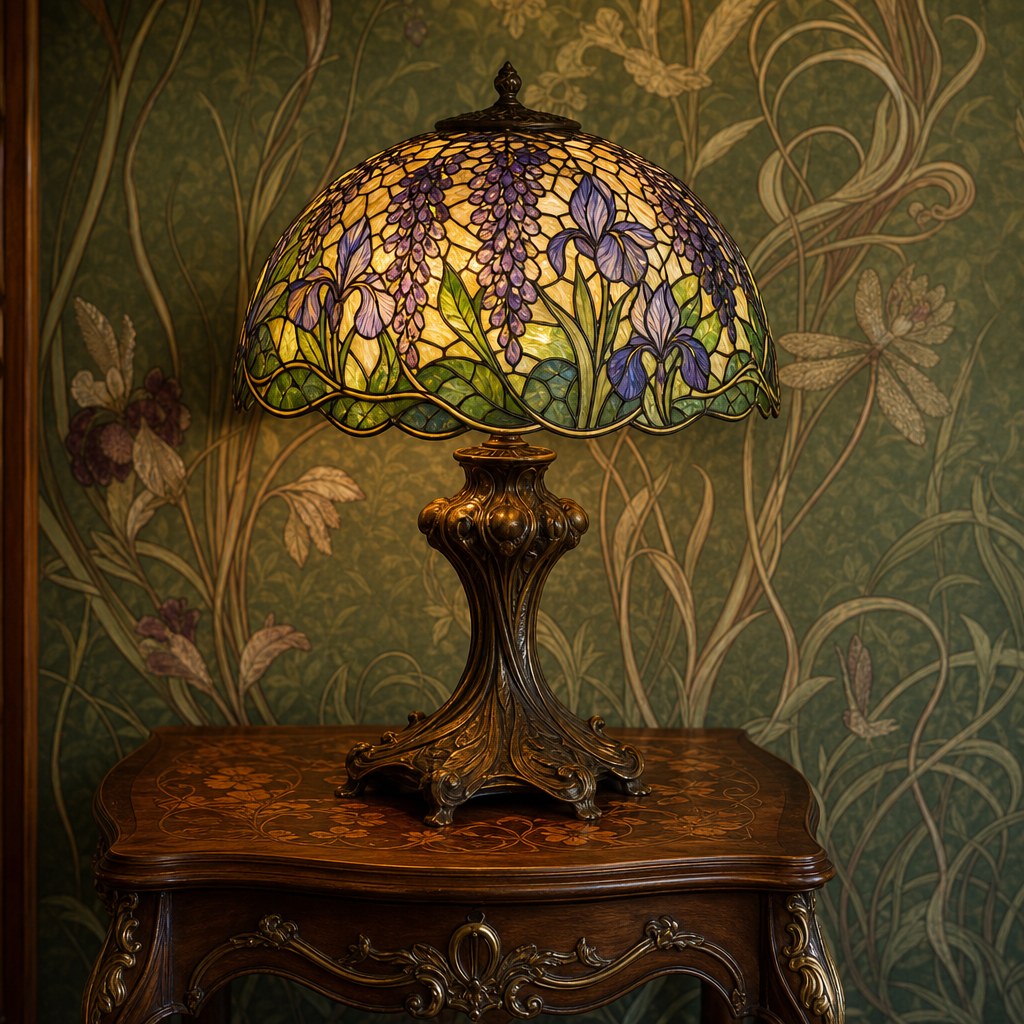
E1 Receipt - Stained Glass Anchor
Botanical Surface Layer · $174.97
The botanical surface layer is Art Nouveau's most immediate and reversible room signal. And the one with the best cost-to-impact ratio in the entire style. Botanical wallpaper (or a single botanical wallpaper panel on a feature wall) is the fastest way to establish the style's nature-forward visual language without touching furniture or lighting. Art Nouveau's botanical motifs are specific: irises, wisteria, water lilies, peacock feathers, and flowing vine patterns with sinuous whiplash curves. Not the graphic tropical prints associated with maximalism, but the more detailed, stylized naturalism of fin-de-siecle illustration. One feature wall in botanical wallpaper, flanked by two surfaces painted in the style's signature olive green, establishes the botanical character of the entire room. The ceramic botanical vase, hand-painted with floral motifs in the style's earthy palette, is the next piece: it brings the botanical motif to three-dimensional object scale and functions as the room's tabletop focal point. The Mucha-style art print completes the surface layer at the wall level: Alphonse Mucha's illustrations are the most recognized two-dimensional output of the Art Nouveau movement, and a well-framed large-format print in a carved or gilt frame doubles as both decor and style reference. The Mucha print and a curved dresser are a well-established starting point for an Art Nouveau bedroom. The print anchors the wall, and the dresser carries the organic line logic into three dimensions.
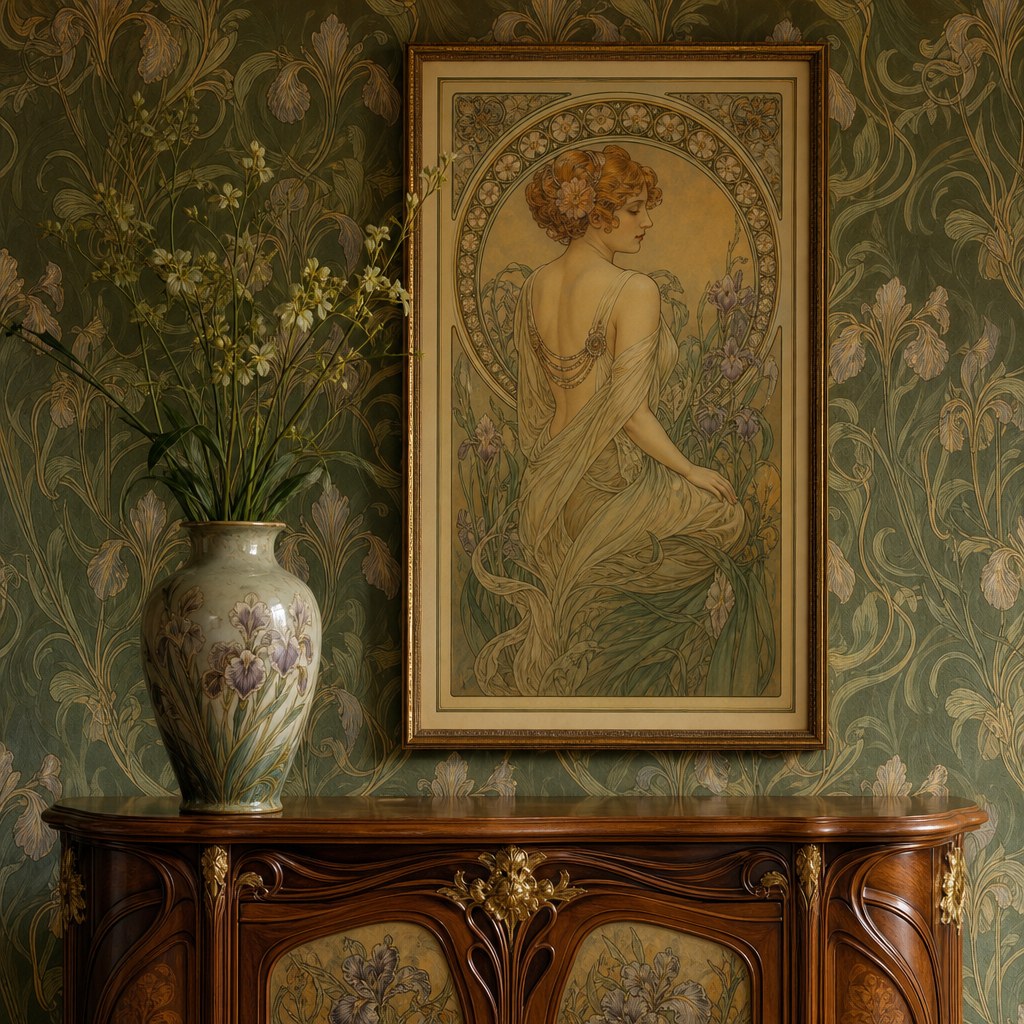
E2 Receipt - Botanical Surface Layer
Organic Curved Forms · $278.97
Art Nouveau furniture is defined by fluidity, asymmetry, and organic movement. Curved lines that reject rigid geometry in favor of forms borrowed from nature. The key phrase in period design texts is "whiplash curve": the sudden, energetic S-bend that appears in chair backs, table legs, mirror frames, and cabinet handles, mimicking the growth pattern of a vine reaching toward light. The style's most immediately recognizable element: everything curves. Even the furniture legs have S-bends. Building the organic curved forms layer requires three pieces at different scales. The carved wood accent mirror with a vine or floral frame is the wall-level piece: it establishes the organic silhouette at eye height and doubles as a light-multiplying surface. Hardwoods, oak, walnut, cherry, and mahogany, are the authentic Art Nouveau furniture materials, often left visible to highlight grain, veining, and natural variation. The organic curved occasional chair is the seating-scale piece: a chair with a sinuous back, visible wood grain in a warm finish, and upholstery in a botanical or solid earthy-tone fabric. The carved wood console table with curved legs is the room's horizontal surface anchor. The piece that establishes the organic line logic at furniture scale and provides the platform for the botanical vase from Element 2 and the wrought iron accessories from Element 4.
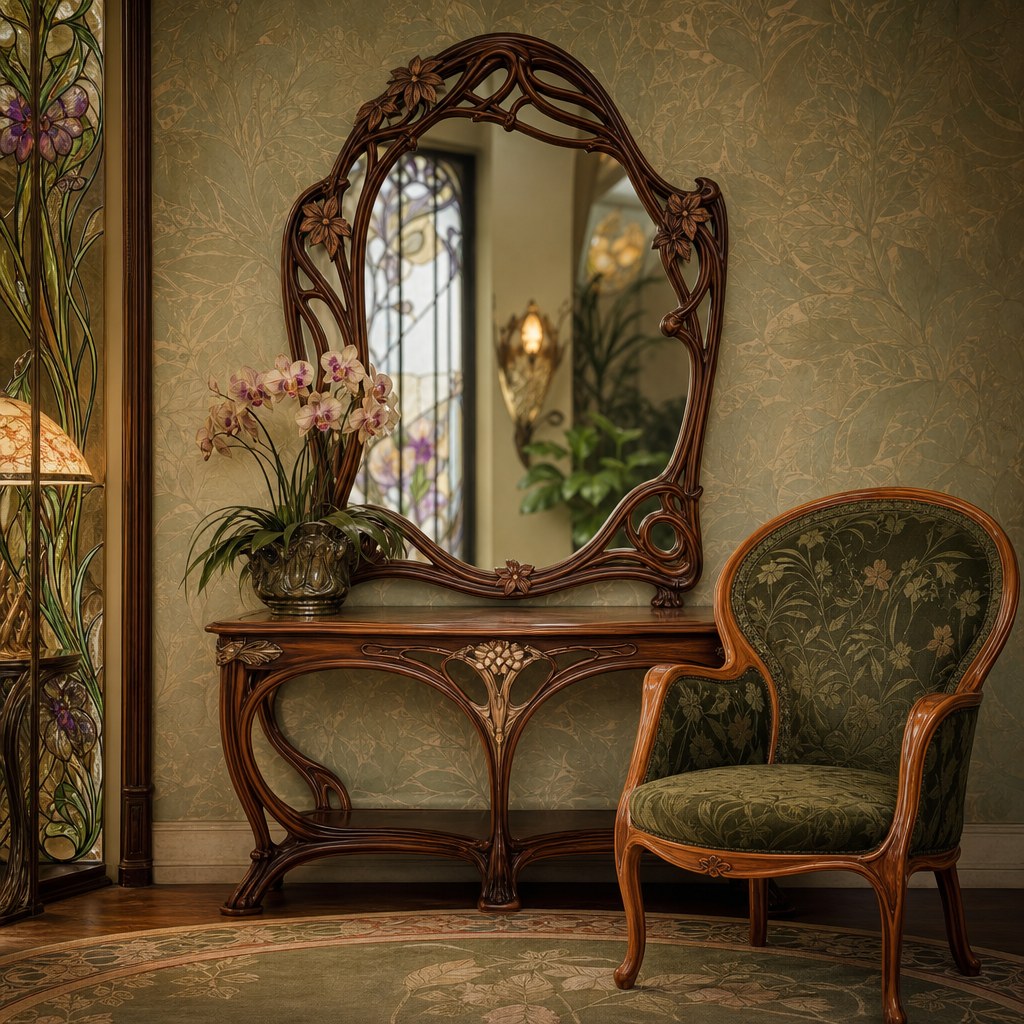
E3 Receipt - Organic Curved Forms
Wrought Iron Metalwork · $169.98
Wrought iron and bronze are the metals of Art Nouveau, chosen for their warmth, malleability, and expressive character. Materials that can be worked into vine tendrils, floral clusters, and the elongated whiplash curves that define the style's hardware language. Hector Guimard's Paris Metro entrances. Wrought iron shaped into organic plant forms so convincingly that they appear to have grown rather than been fabricated, are the canonical example of the style's metalwork philosophy taken to architectural scale. At the interior level, wrought iron appears in floor lamps with vine-stem shafts, curtain rods with botanical finials, cabinet and door hardware with floral engravings, and decorative wall hooks. Bronze and copper hardware develops depth and variation through natural aging. A property that aligns with the style's handwork philosophy and means the pieces improve with use rather than showing wear. The wrought iron floor lamp with a botanical or vine-pattern stem is the most versatile metalwork piece in the Art Nouveau room: it provides ambient lighting without ceiling work (essential for renters), its vine-form base establishes the organic metal logic at standing height, and the warm-bulb light it casts reinforces the jewel-toned quality already established by the stained glass anchor. The wrought iron wall hook set, three to five hooks with botanical or fleur-de-lis motifs, brings the metal language to a functional surface and is the lowest-cost authentic Art Nouveau hardware purchase available new.
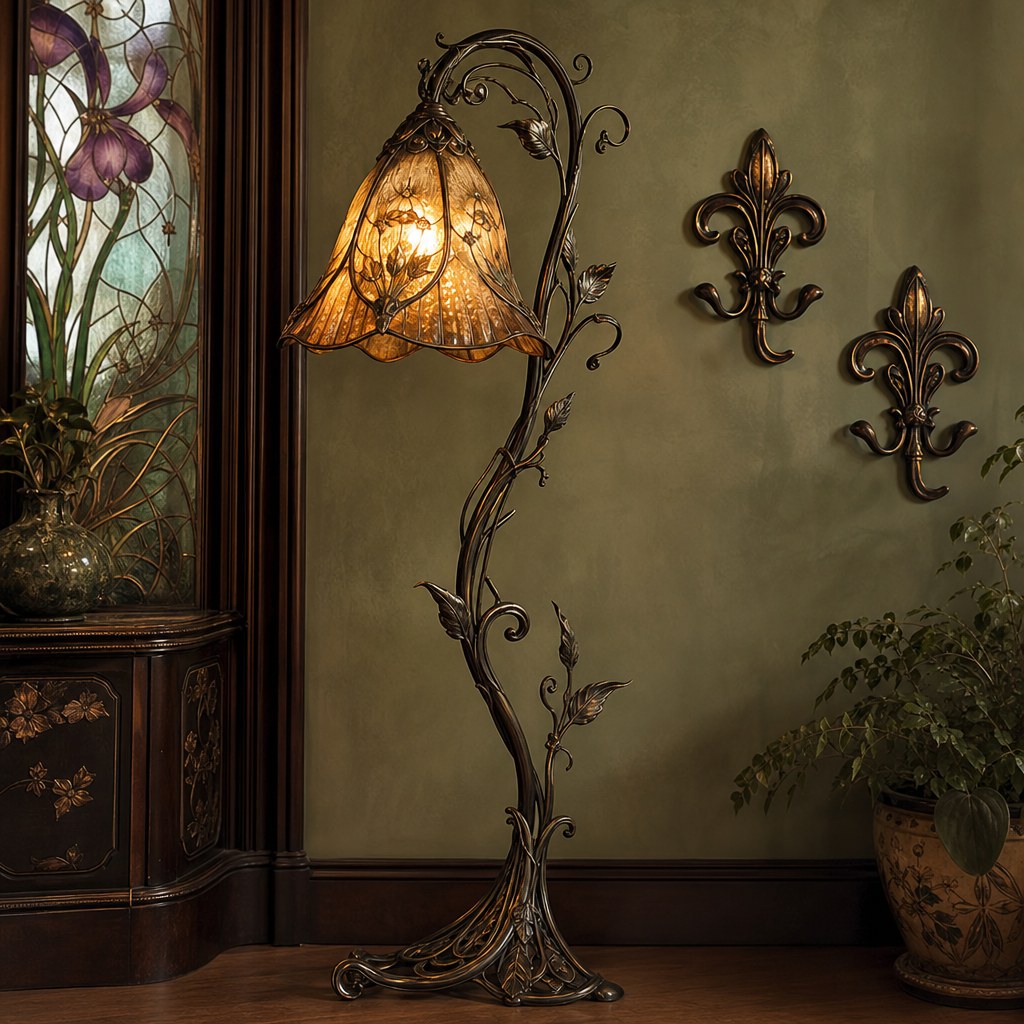
E4 Receipt - Wrought Iron Metalwork
Nature-Palette Foundation · $333.97
The nature-palette foundation is the layer that ties the room's individual elements into a coherent interior. Art Nouveau color is specifically anti-harsh: the palette runs on earthy tones including olive green, ochre, warm brown, and muted terracotta, complemented by jewel accents in emerald, deep blue, and amber, all blended to avoid harsh contrasts and create organic, flowing continuity. The palette-use rule that separates Art Nouveau from generic botanical decor: colors appear in naturalistic combinations, the same way a garden combines them, not in graphic contrast pairs. An olive green velvet cushion set belongs on the carved wood chair from Element 3; a deep plum or emerald velvet throw belongs on the sofa or daybed; a botanical-motif area rug in earthy olive, amber, and cream grounds the entire furniture arrangement. The botanical area rug is the room's single largest color surface and the piece that most completely establishes the style's palette at floor level: an Arts and Crafts or William Morris-adjacent pattern with stylized plant motifs is the period-accurate choice, and these rugs are available new from Wayfair, Rugs USA, and Amazon at accessible price points. Botanical print throw cushions (irises, water lilies, or stylized vines on a dark ground) bring the nature-palette story to the sofa and reading chair at the smallest accessible scale. Living plants, potted in ceramic or bronze vessels, are not merely decorative in an Art Nouveau room: they are the most authentic element the style provides, since the movement's entire visual vocabulary is borrowed from the natural world.
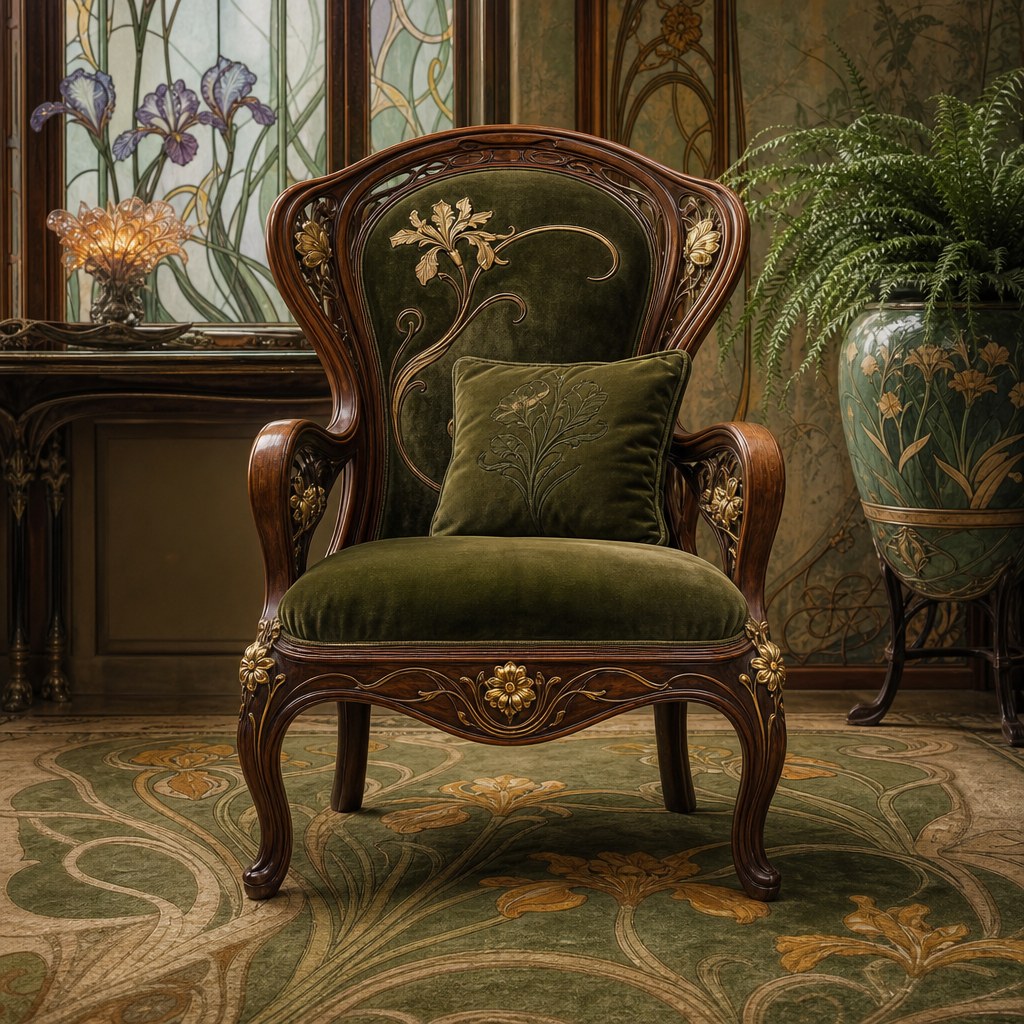
E5 Receipt - Nature-Palette Foundation
Art Nouveau vs. Art Deco.
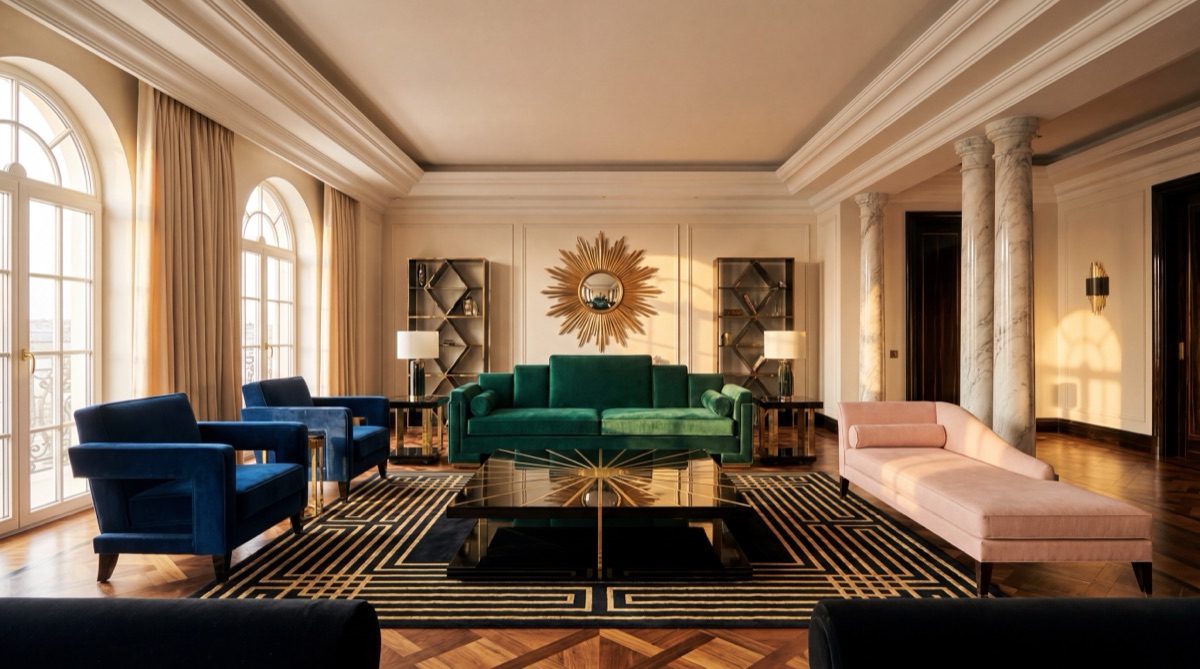
Art Nouveau (1890s to 1910s) and Art Deco (1920s to 1940s) are the two styles most frequently confused with each other. And also the two most frequently searched comparison in interior design forums. The distinction is a single philosophical shift: Art Nouveau draws from nature; Art Deco draws from geometry. Art Nouveau is softer, fluid, and made to linger in; Art Deco is sharp, geometric, and built for speed. Art Nouveau furniture curves like a vine; Art Deco furniture angles like a skyscraper. Art Nouveau color is earthy and muted; Art Deco color is saturated and high-contrast. The community disambiguation: "Nouveau is plants and biology; Deco is jazz and geometry." The fastest visual test: if the room's dominant lines are organic and asymmetrical, with motifs drawn from natural forms, it is Art Nouveau. If the dominant lines are geometric and symmetrical, with motifs drawn from machinery, sunbursts, and stepped forms, it is Art Deco.
| Dimension | Art Nouveau Interior Design | Art Deco Interior Design |
|---|---|---|
| Era | 1890s to early 1910s, pre-WWI, handcraft-focused, reaction against industrialization | 1920s to 1940s. Post-WWI, machine-age optimism, celebration of speed and modernity |
| Line logic | Sinuous, asymmetrical, organic. Curves drawn from plant growth and the human figure; the "whiplash curve" | Geometric, symmetrical, angular. Stepped forms, chevrons, sunburst patterns, hard edges |
| Motif source | Nature. Irises, vines, dragonflies, water lilies, peacock feathers, the human figure as botanical form | Industry and luxury. Machinery, Egyptian revival, skyscrapers, exotic materials, Aztec and Egyptian geometric motifs |
| Color palette | Earthy and muted. Olive green, warm amber, ochre, soft terracotta, with jewel accents in emerald and deep blue | Bold and high-contrast, black and gold, navy and cream, lacquer red, saturated and glamorous |
| Material philosophy | Handcraft over mass production. Visible grain, veining, handwork, and variation; materials left to show their natural character | Luxury materials at industrial scale. Chrome, lacquer, exotic veneers, mirrored glass; the machine as craft |
| The disambiguation test | Feels like a living greenhouse. Organic, asymmetrical, nature-forward, made to linger in | Feels like a jazz-age penthouse. Glamorous, geometric, bold, built for spectacle |
The $89 entry path.
One item that anchors the Art Nouveau room's character. No structural work, no furniture replacement, no paint required. The stained glass lamp functions as a complete style signal on its own.
Frequently asked questions.
What is Art Nouveau interior design?
Art Nouveau is a decorative style that emerged in the 1890s as a rebellion against the rigid, mass-produced decor of the industrial age, championing organic, nature-inspired designs that emphasize workmanship and flowing forms. In interiors, the style is defined by sinuous curved lines drawn from plant growth and the human figure, botanical motifs - irises, vines, dragonflies, peacock feathers - stained glass, wrought iron shaped into vine tendrils, and carved hardwoods with visible grain. The guiding principle: architecture, furniture, lighting, and hardware should form one unified artistic experience rather than separate objects in a room. The 2025 revival is gaining momentum as a reaction against minimalism, with the style's richly detailed, nature-forward character aligning with the broader shift toward maximalism.
What are the key colors in Art Nouveau interior design?
Art Nouveau color runs on three tiers. The nature-drawn foundation is earthy: olive green, soft botanical greens, mossy tones, warm brown, muted terracotta, and warm cream - the base that makes the style feel grounded rather than garish. The jewel accent tier introduces depth through amber, emerald, deep blue, garnet, and soft plum, typically arriving through stained glass, ceramic glazes, and velvet upholstery. The metallic layer - aged brass, warm bronze, gold leaf - carries through hardware, mirror frames, and wrought iron details. The palette-use rule: colors appear in naturalistic combinations the way a garden combines them, not in graphic contrast pairs. Deep jewel tones and muted pastels blended harmoniously to avoid harsh contrasts define the movement's signature color logic.
What is the difference between Art Nouveau and Art Deco interior design?
Art Nouveau (1890s to 1910s) and Art Deco (1920s to 1940s) share a period proximity but a philosophical divide. Art Nouveau draws its lines from plants, insects, and the human form - sinuous, asymmetrical, and organic. Art Deco draws its lines from mathematics and the machine age - angular, symmetrical, and geometric. Art Nouveau is softer, fluid, and made to linger in; Art Deco is sharp, geometric, and built for speed. Art Nouveau furniture curves like a vine; Art Deco furniture angles like a skyscraper. Art Nouveau color is earthy and muted; Art Deco color is bold and high-contrast. The community disambiguation: "Nouveau is plants and biology; Deco is jazz and geometry." The fastest visual test: organic asymmetrical lines with natural motifs means Art Nouveau; geometric symmetrical lines with industrial motifs means Art Deco.
How do you source Art Nouveau furniture and decor without spending thousands?
Authentic Art Nouveau period pieces cost thousands - wrought iron hall stands, carved oak sideboards, original Tiffany lamps. Reproduction is the realistic path for most budgets. The sourcing hierarchy: antique dealers and estate sales for wrought iron hardware and carved wood frames (these are the highest-value vintage finds at the lowest relative cost). Etsy specialty glass studios for reproduction stained glass panels and window inserts. Amazon, Wayfair, and Home Depot for botanical peel-and-stick wallpaper - the fastest and most reversible Art Nouveau signal in any room. IKEA's STOCKHOLM range and similar organic-curved lines carry the style's silhouette logic at accessible prices. "Antique dealers, eBay for hardware, and Etsy for the custom stained glass" is the community's three-source shorthand for building an Art Nouveau room on a realistic budget.
What is the signature entry-point piece for Art Nouveau interior design?
Stained glass is the entry-point piece that anchors Art Nouveau rooms more decisively than any other single item. A stained glass lamp - Tiffany-adjacent, with an iris, wisteria, or dragonfly motif - changes the quality of light in the room from neutral to jewel-toned and establishes the style's nature-inspired color language without requiring structural commitment. The design community validates this choice consistently: "Start with one Tiffany-adjacent lamp - everything else follows." At the wall level, botanical peel-and-stick wallpaper on a single feature wall is the fastest and most reversible Art Nouveau signal at the $50 to $80 price point. The stained glass lamp and one botanical wall panel together establish the style's two defining qualities - jewel-toned light and nature-forward pattern - for under $150 combined.
More rooms like this
No spam. Unsubscribe anytime.