Table of Contents
Open any home subreddit and you will find the same thread, posted again and again with a different photo: what do you call this style? A warm room, a few old pieces next to new ones, some millwork, a moody-but-comforting palette. People reach for "traditional, classic, moody" or "mid-century bohemian" and never quite land it.
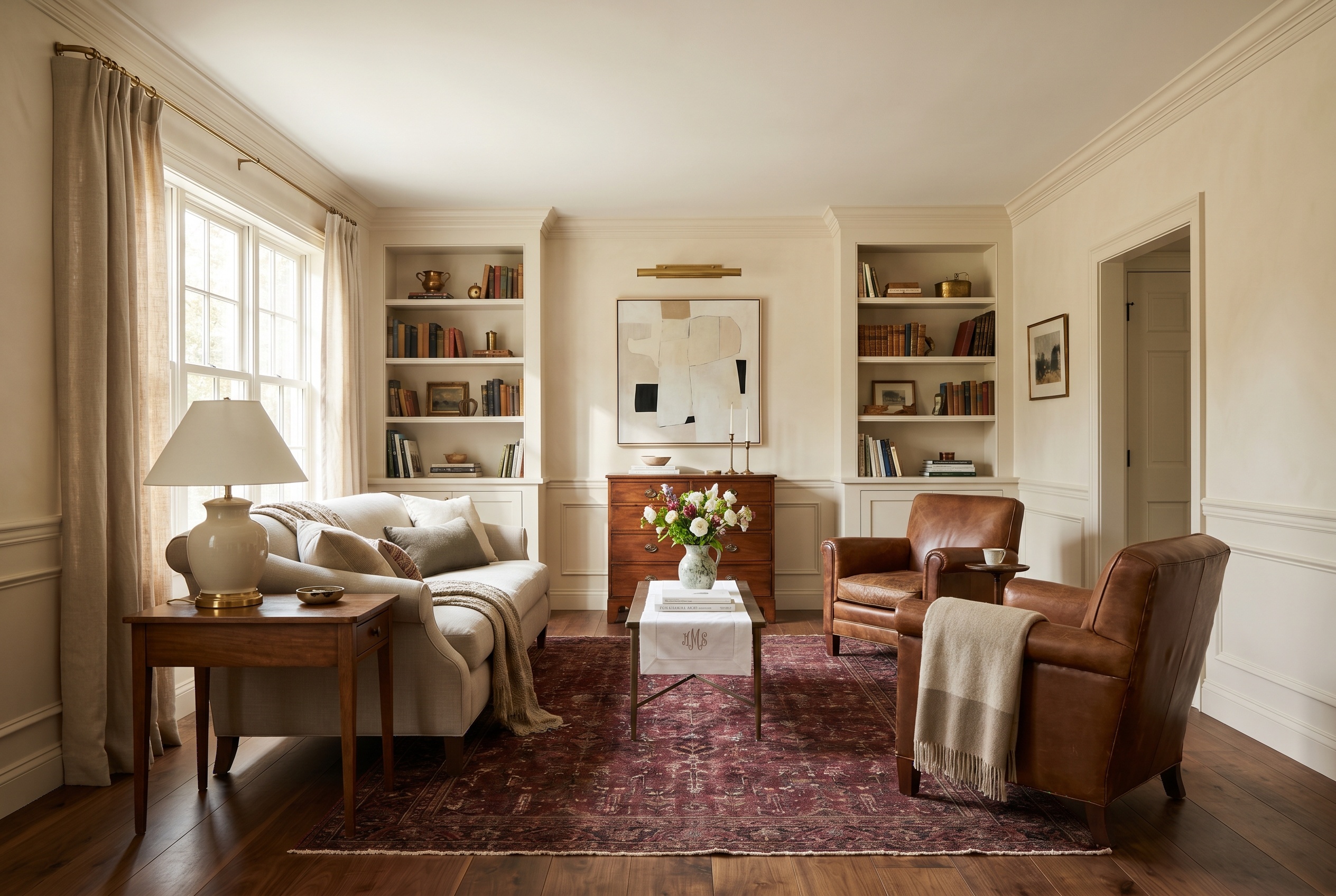
The name is Modern Heritage, also called New Heritage or Modern Traditional. It is the design approach of mixing old and new: contemporary furniture, often built today in traditional silhouettes, layered with a few genuine vintage and antique pieces, so a room reads fresh and modern yet rooted in history[1]. Studio McGee's house phrase is "rooted in tradition but designed for modern life," producing interiors that feel collected, comfortable, and effortlessly timeless[1]. The Brownstone Boys frame it as honoring the past while designing for how people actually live today, and they call the move "balance, not matching"[3].
Multiple major publishers have named it the breakout interior style of 2026[3][4]. It is explicitly framed as the warmer successor to Modern Farmhouse, and even Joanna Gaines, the Modern Farmhouse figurehead, is now decorating in this warmer, more collected direction[5]. This is not a one-season fad. The underlying shift toward warm, lived-in interiors has been building for roughly half a decade, and the runway is forecast at five-plus more years before the pendulum swings back toward minimalism[10].
What is Modern Heritage.
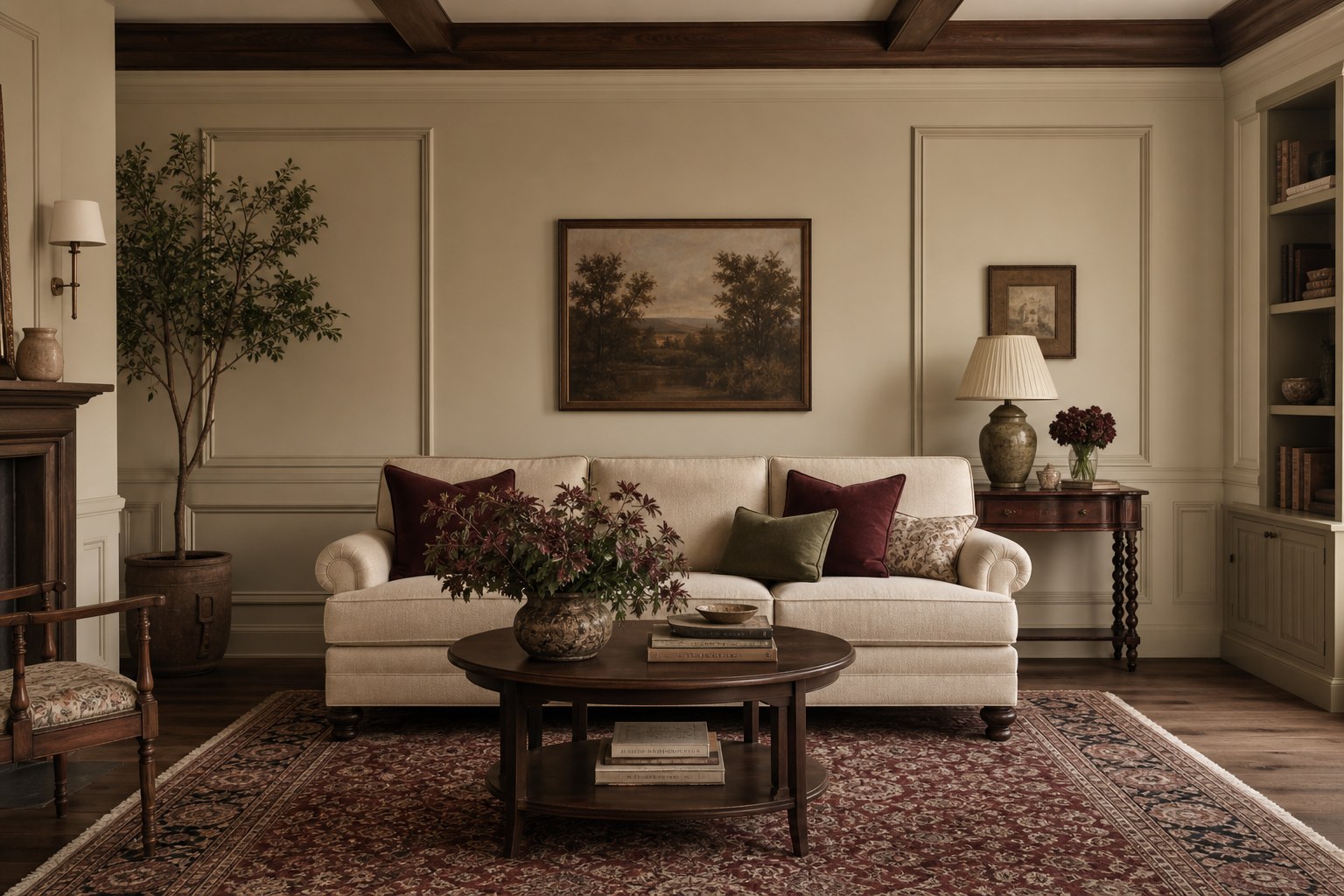
Modern Heritage is mostly contemporary furniture in traditional silhouettes, mixed with a few genuine vintage pieces and grounded in architectural millwork. It is warm, collected, and edited rather than formal or period-correct. Go too vintage-heavy and it tips into Traditional[2].
The reason the style needed a name is that it sits between three things people already know. It is not antiques-heavy Traditional, it is not rustic Modern Farmhouse, and it is not bare minimalism. The engine is contrast: a modern sofa next to a vintage side table, a vintage cabinet under a piece of modern art, crusty old vessels styled on a sleek console[3]. You do not need that contrast everywhere. A few intentional spots where old and new meet is the whole trick.
Why now? Designer Betty Ann Gilrain notes that online resale through 1stDibs and Chairish, plus Facebook Marketplace and estate sales, has made the vintage-mixing core of the style achievable for ordinary homeowners, not just designers[3]. The other driver is gray fatigue. After a decade of cool gray and builder-grade beige, people are reacting hard against it, and Modern Heritage's warm-neutral palette is the antidote.
The six ingredients.
No competitor publishes the style as a usable build list. Here it is, synthesized from the source explainer and corroborated across Studio McGee, Homes & Gardens, and House Beautiful[1][2][6]. Hit all six and the room reads Modern Heritage. Miss the first three and it reads like a furniture-store showroom.
Architectural character
Trim, built-ins, wall paneling, wainscoting, crown molding, and ceiling beams are the traditional backbone. Where they are missing, add them[6]. Shea McGee advises adding molding and trim even in modern rooms seeking historic charm, and designing built-ins to resemble furniture rather than standard cabinets[6].
A few vintage pieces
An antique chest, an old painting, a vintage side chair. Source them affordably from Marketplace, estate sales, flea markets, 1stDibs, and Chairish[3]. This is not antiques-heavy. Most of the furniture stays contemporary with classic silhouettes; the vintage supplies the soul.
Old-versus-new contrast
Intentional pairings are the engine: a modern sofa with a vintage side table, a vintage cabinet under modern art[3]. The Brownstone Boys call it balance, not matching. A few spots, not everywhere, or the room reads busy instead of collected.
Craftsmanship
Paneled cabinet doors, turned legs, framed drawer fronts, visible wood grain. A handmade feel over mass-produced pieces. The budget version: customize an IKEA cabinet with trim, paneling, new knobs, and paint to fake the millwork look[2].
Layering
Collected, lived-in, decorated just enough. Vignettes of stacked books, a ceramic lamp, a vase of flowers, framed photos, plus textiles like vintage quilts and patterned pillows. Monogrammed linens are having a distinct moment[1].
Texture and natural materials
Three to four textures per room: wood, fabric, metal, stone. Limewash and plaster walls add depth over flat drywall. Use natural materials only, with wood trending darker toward walnut, stained oak, and cherry[1]. Studio McGee names the mix: raw steel with terracotta, or grasscloth with travertine[1].
The signature palette.
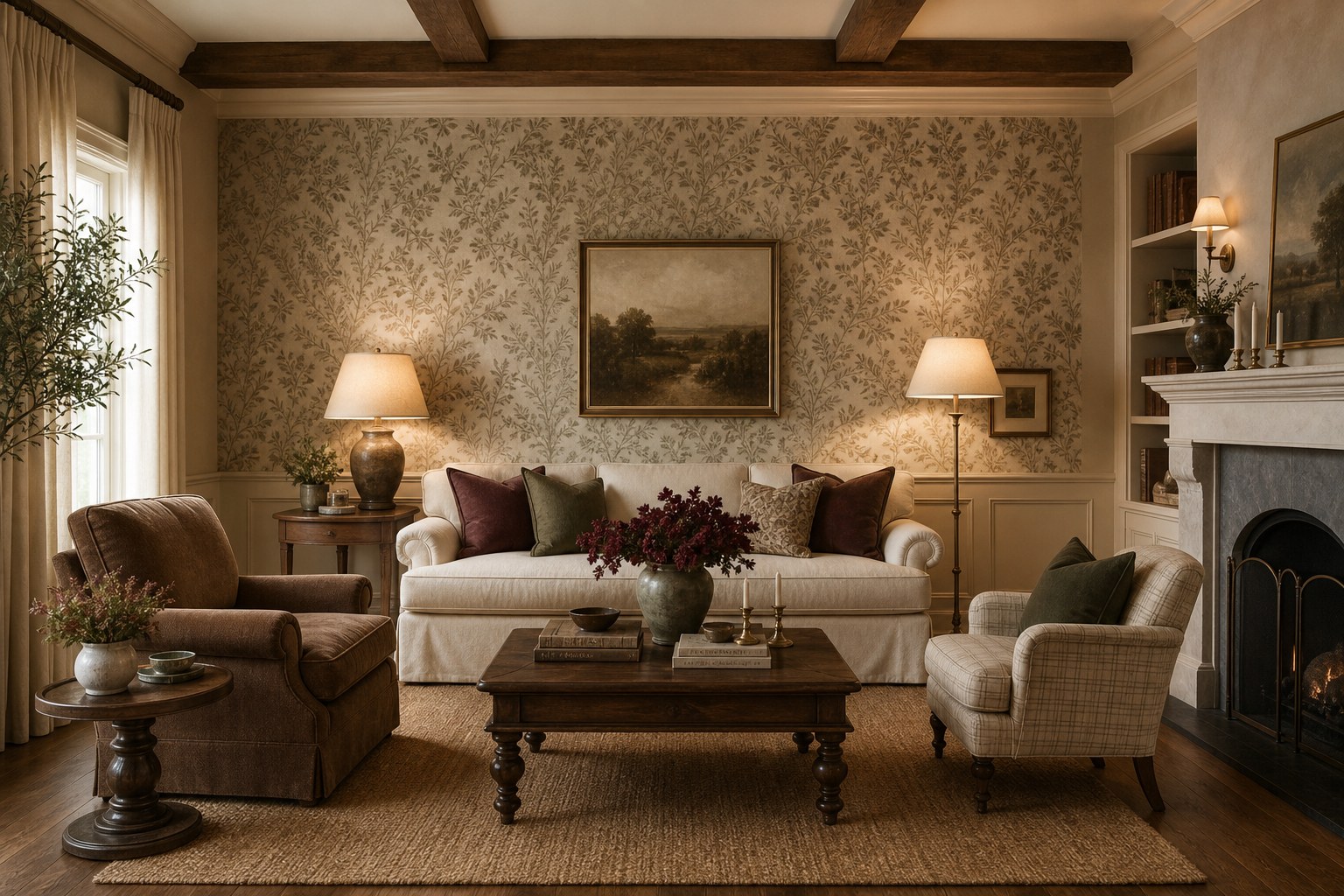
Palette is the number-one differentiator. The whole style reacts against the cool-gray, builder-grade decade. Warm neutrals carry roughly 60 percent of the room, a mid-tone greige covers 30 percent, and one deep heritage anchor plus a brass line do the last 10 percent[11]. Studio McGee's stated palette corroborates this: warm neutrals with accents of aged brass, forest green, and dusty rose[1]; House Beautiful names moss green and oxblood as the recurring rich hues[3].
Supporting accents, used one at a time and sparingly: Muted Olive #6B6A4B, Dusty Blue #8A9AA3, Terracotta #A6583F. For true contrast, use Soft Charcoal #2E2A26, not cool gray. Paint references: warm off-whites such as Benjamin Moore White Dove or Farrow & Ball Pointing; burgundy near Farrow & Ball Preference Red or Sherwin-Williams Carriage Door; greige near SW Accessible Beige[1][11].
Vs Modern Farmhouse and Traditional.
The trend story is literally "the style replacing Modern Farmhouse"[5]. The two share warm neutrals, white walls, wood accents, and a comfort-first feel, which is exactly why they get confused. Here is the line between them, and between Modern Heritage and the more formal Traditional[2].
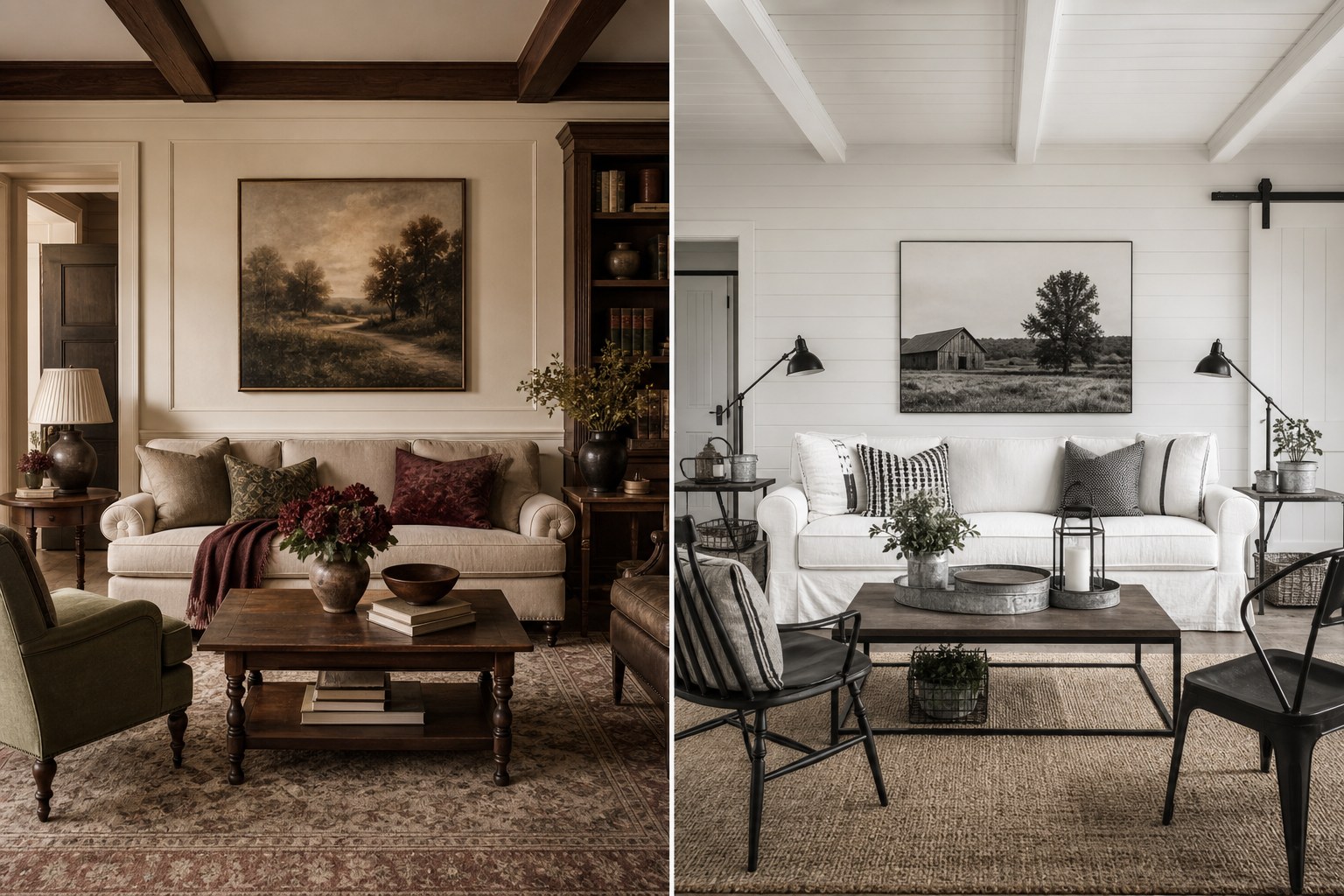
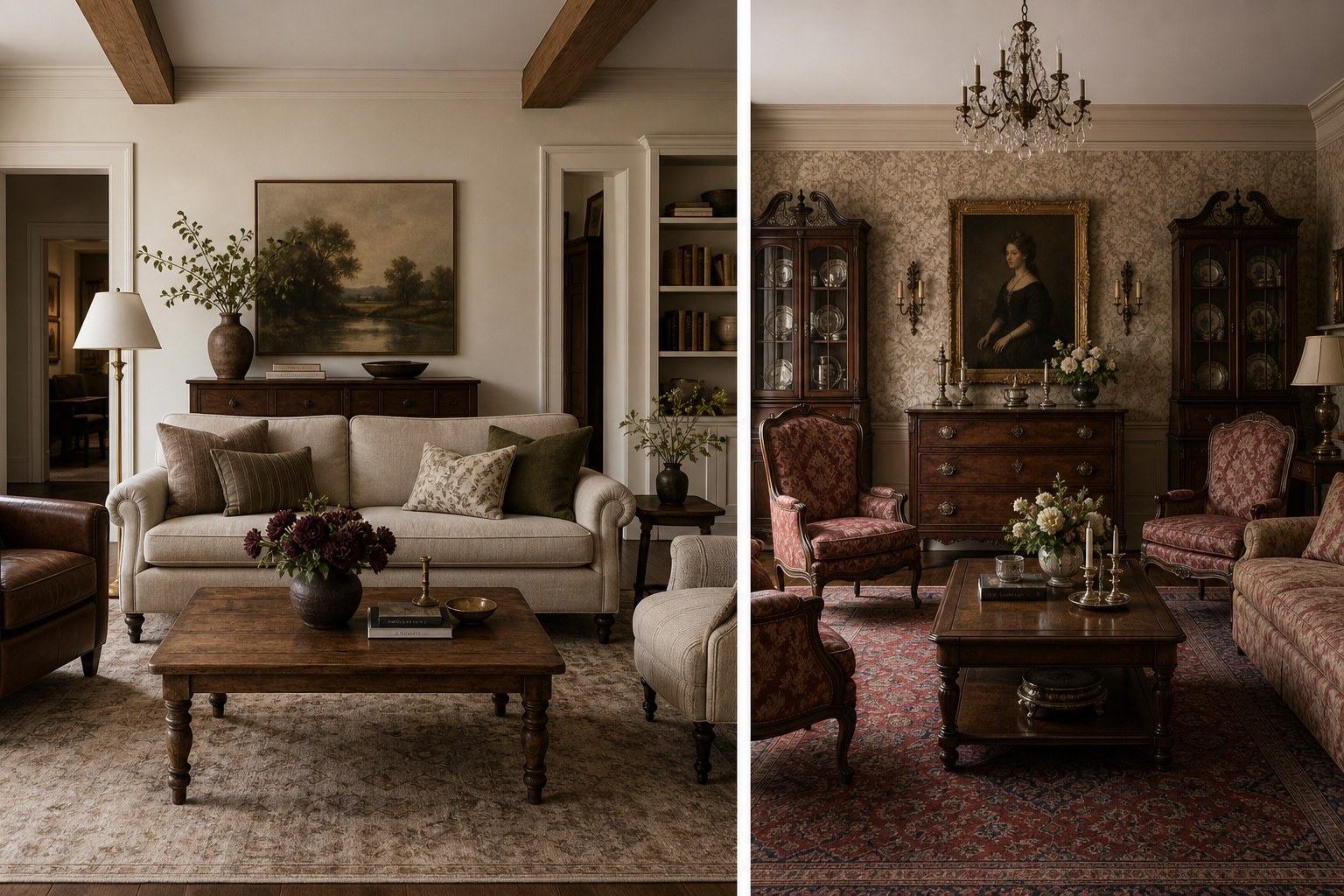
The simplest tell: Modern Farmhouse leans cool and rustic, Traditional leans formal and matched, and Modern Heritage sits warm and collected in between, with most furniture contemporary and only a few vintage pieces carrying the history.
The renter and budget angle.
This is the part the brand and designer blogs skip, and it is the most useful. Modern Heritage is one of the cheapest looks to fake well, because its two cheapest moves change the room the most: add architectural character and add affordable vintage.
The sourcing playbook readers and designers agree on: Facebook Marketplace, estate sales in neighborhoods like your own, yard sales, flea markets, buy-nothing groups, and thrift, plus a little furniture-restoration skill[3]. A single restored vintage piece, often well under a few hundred dollars, supplies more character than a room of new furniture.
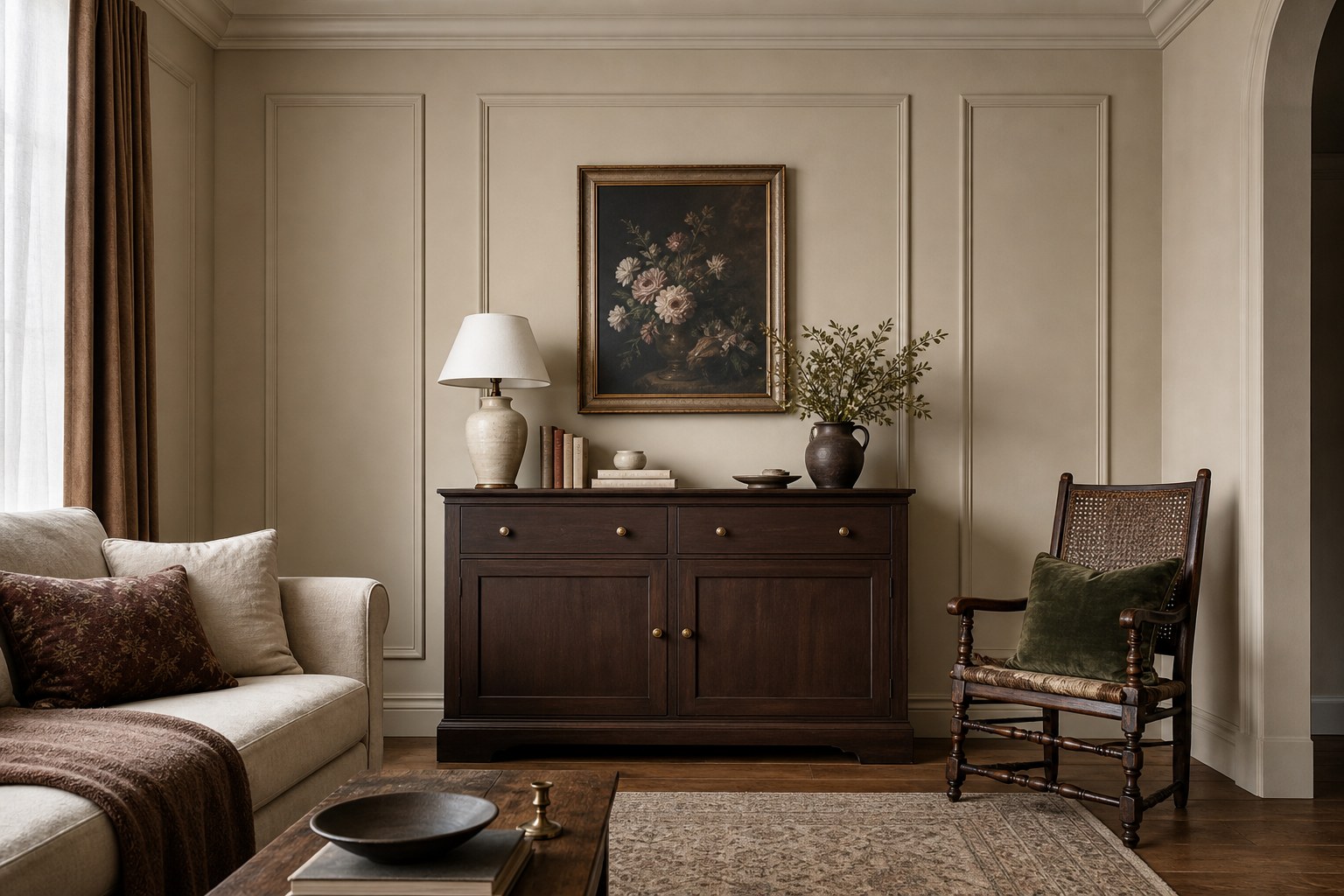
- Board-and-batten or picture-frame molding. The single best add for a flat builder-grade or new-build room. Renter-friendly, removable versions exist, and it gives the room its traditional bones[6].
- Customize IKEA to fake millwork. Trim, paneling, new brass knobs, and paint turn a plain cabinet into something that reads handmade[2].
- Buy one good vintage piece. An antique chest or a restored side chair from Marketplace anchors the whole old-meets-new contrast for the price of a flat-pack shelf.
- Swap to warm-neutral paint and brass hardware. The fastest way to de-gray a rental. Warm cream walls plus antique brass instantly read collected, not builder-grade.
The one rule that keeps it from reading cheap or staged: build it over time, piece by piece, rather than buying the whole look at once. A room assembled in a single haul reads like a showroom. A room assembled over months reads collected, which is the entire point of the style.
Common mistakes.
Keeping it gray. Bare white walls plus cool gray everything is the exact builder-grade look the style reverses. Warmth comes from undertone and material, not from adding more colors.
Over-lighting it. A warm palette under bright, cool, over-lit fixtures kills the moody, cozy mood. Layer warm lamps instead of relying on a single bright ceiling fixture.
Going too vintage. Load up on antiques and the room stops being Modern Heritage and becomes formal Traditional[2]. Most of the furniture should stay contemporary.
Geometric wallpaper. Pattern enters this style almost entirely through traditional botanical and floral wallpaper, never geometric. A William Morris print belongs; a bold geometric does not[11].
Frequently asked
What is Modern Heritage style?
Modern Heritage, also called New Heritage or Modern Traditional, is the design approach of mixing old and new: mostly contemporary furniture built in traditional silhouettes, layered with a few genuine vintage pieces, so a room reads fresh and modern yet rooted in history. It is built from six ingredients: architectural character, vintage mixing, old-versus-new contrast, craftsmanship, layering, and natural texture.
What is a mix of traditional and modern called?
It is called Modern Heritage, New Heritage, Modern Traditional, or Transitional. All four names describe the same idea: contemporary furniture in classic silhouettes mixed with a handful of vintage and antique pieces, kept warm and edited rather than formal or period-correct.
What is the 3-5-7 rule in decorating?
The 3-5-7 rule is a styling guideline for grouping objects in odd numbers: arrange a vignette in groups of three, five, or seven items rather than even counts, because odd groupings read as more natural and collected. It pairs well with Modern Heritage layering, where surfaces hold stacked books, a ceramic lamp, and a vase of flowers in odd-numbered clusters.
Is Modern Farmhouse out of style?
Modern Farmhouse is being widely replaced by Modern Heritage as the dominant warm style in 2026. Designers frame Modern Heritage as the warmer, more collected successor, and even Joanna Gaines, the Modern Farmhouse figurehead, has shifted toward this richer, more traditional direction. Farmhouse is not banned, but the mass-market momentum has moved to Modern Heritage.
Why does my all-gray room feel cold and how do I fix it?
Cool gray and bare builder-white read flat because they remove the warm undertones that make a room feel inviting. Swap to warm neutrals such as Heritage Cream #EFE7D7 and Putty Greige #C7B7A1, add one deep heritage anchor like Aged Burgundy #6E3640, and bring in solid walnut wood and antique brass. Warmth comes from undertone and material, not from adding more color.
How do I add character to a builder-grade or new-build house?
Architectural character is the single best add. Board-and-batten, picture-frame molding, wainscoting, and crown molding give a flat builder-grade room the traditional bones the style needs. These are renter-friendly and DIY-achievable, and they cost far less than new furniture while changing the room the most.
How do I get the collected look without it reading staged or cluttered?
Build the room over time, piece by piece, rather than buying one matched set. Use the old-versus-new contrast in only a few intentional spots, keep most furniture contemporary, and add vintage one piece at a time from Facebook Marketplace or estate sales. Decorated just enough beats fully decorated.
Can I do Modern Heritage on a renter or small budget?
Yes. Affordable vintage from Facebook Marketplace, estate sales, and flea markets supplies instant character, and IKEA pieces can be customized with trim, paneling, new knobs, and paint to fake craftsmanship and millwork. Renter-friendly board-and-batten and removable molding add architectural character without renovation.
References
- The Field Guide to New Heritage Style · Studio McGee, 2026
- The Top Design Trends for 2026, According to Shea McGee · Homes & Gardens, 2026
- The Verdict Is In: Modern Heritage Is the Hottest New Design Style of 2026 · House Beautiful / Good Housekeeping, 2026
- Modern Heritage is the Hottest Design Style of 2026 · Good Housekeeping, 2026
- The Hottest Design Trend of 2026 · AOL / House Beautiful, 2026
- Shea McGee's Top Tips for Blending Historic Details with Modern Charm · Homes & Gardens, 2026
- Modern Heritage: The Interior Design Style Blending Past and Present · Woodgrain, 2026
- Heidi Caillier's Rooms Feel Like a Warm Hug, Here Is How to Get the Look · The Expert, 2026
- The Interior Style Everyone Is Copying Right Now · RenderedbyDesign source analysis, 2026
- RenderedbyDesign internal style canon · locked Modern Heritage palette and pattern rules, 2026
Get the Modern Heritage palette card
One printable PDF with all five warm hex codes and the paint references. Free, sent straight to your inbox.