Table of Contents
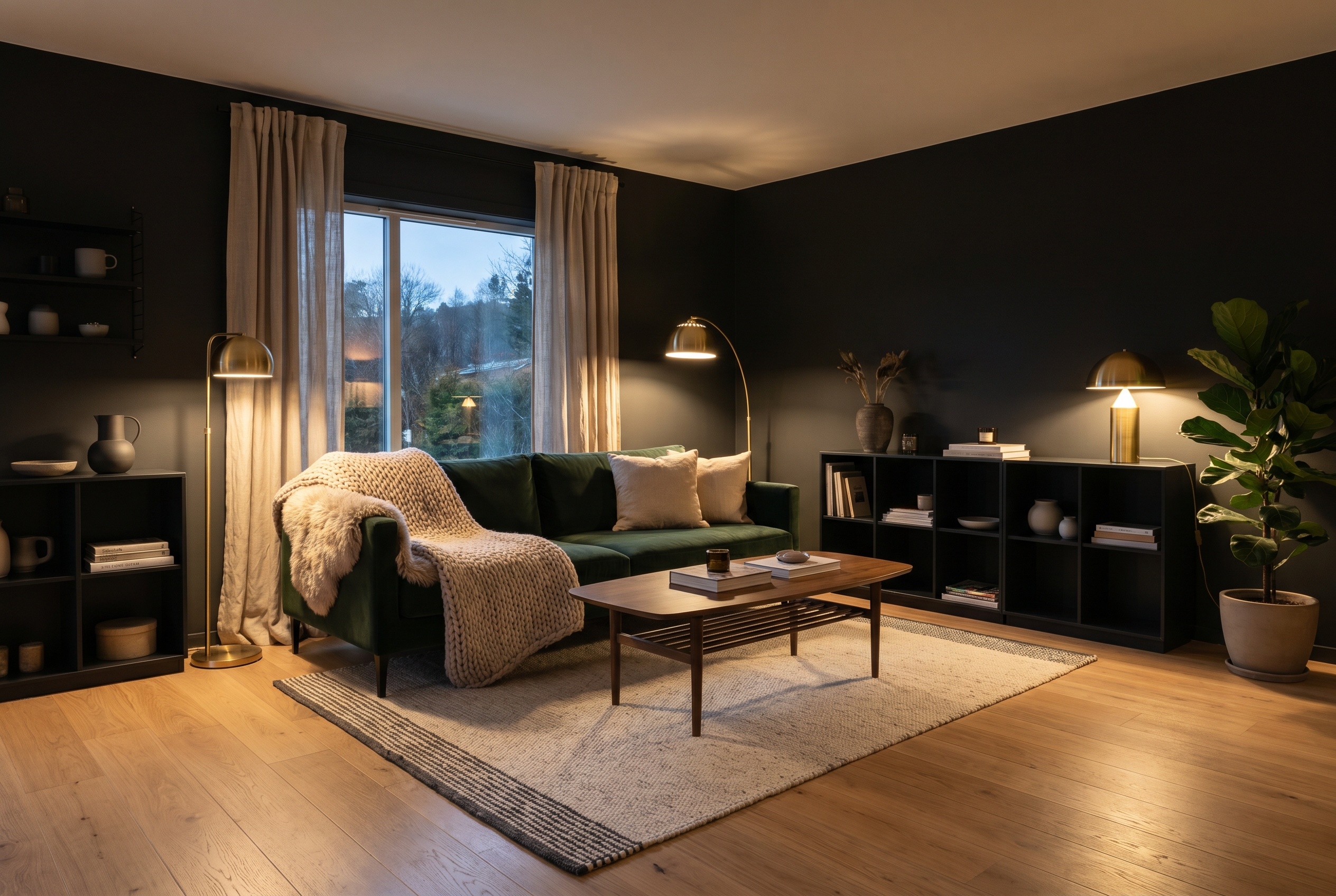
For years the advice was the same: never paint a room black. Then a cold, dark winter arrives, the all-white room feels like a hospital waiting area, and the question flips. What if the dark is the point? Nordic Noir leans into the shadows on purpose, and done right it reads grounding and calming, the shadows wrapping like a winter coat.
This is the part most guides skip: the difference between a room that reads cocoon and a room that reads dungeon is not the wall color. It is wood, light, and one specific rule about how much of the room stays bright. Here is the whole system, with the named hex codes, the paint references, and the math.
What Nordic Noir is.
Nordic Noir, also called Dark Scandinavian or Scandi Noir, is the moody evolution of Scandinavian design. It keeps the Nordic discipline, clean lines, craftsmanship, and functional restraint, then inverts the mood: charcoal, black, and deep-green walls, dark woods, and warm pooled lighting, kept cozy through deliberate balance[1]. The look emerged in the 2010s as designers pushed back against all-white minimalism, and it reached momentum in the 2020s alongside the broader moody-minimalism trend[6].
The name is borrowed directly from the Nordic Noir television genre, the atmospheric Scandinavian crime thrillers like The Killing and The Bridge, and repurposed to describe the darker side of hygge[1]. That phrase, the dark side of hygge, recurs across nearly every authoritative source: where traditional hygge features warm whites and light woods, Nordic Noir introduces darker, moodier colors to create a dramatic yet cozy atmosphere[1][6].
The built reference designers point to is The Audo in Copenhagen, by Menu and Norm Architects, with dark moody finishes throughout, moody plaster and paint, concrete, and warming brass accents that lift the architecture, following a deliberate arc from raw and industrial up to intimate and warm[8]. That arc, dark shell warmed back up, is the whole style in one building.
Three drivers pushed the look mainstream: the long, dark Nordic winters that reward leaning into darkness rather than fighting it; a backlash against cold all-white and millennial-gray minimalism; and brands broadening the Scandinavian palette beyond the whites and greys it had been boxed into[3][6].
The 5-hex palette.
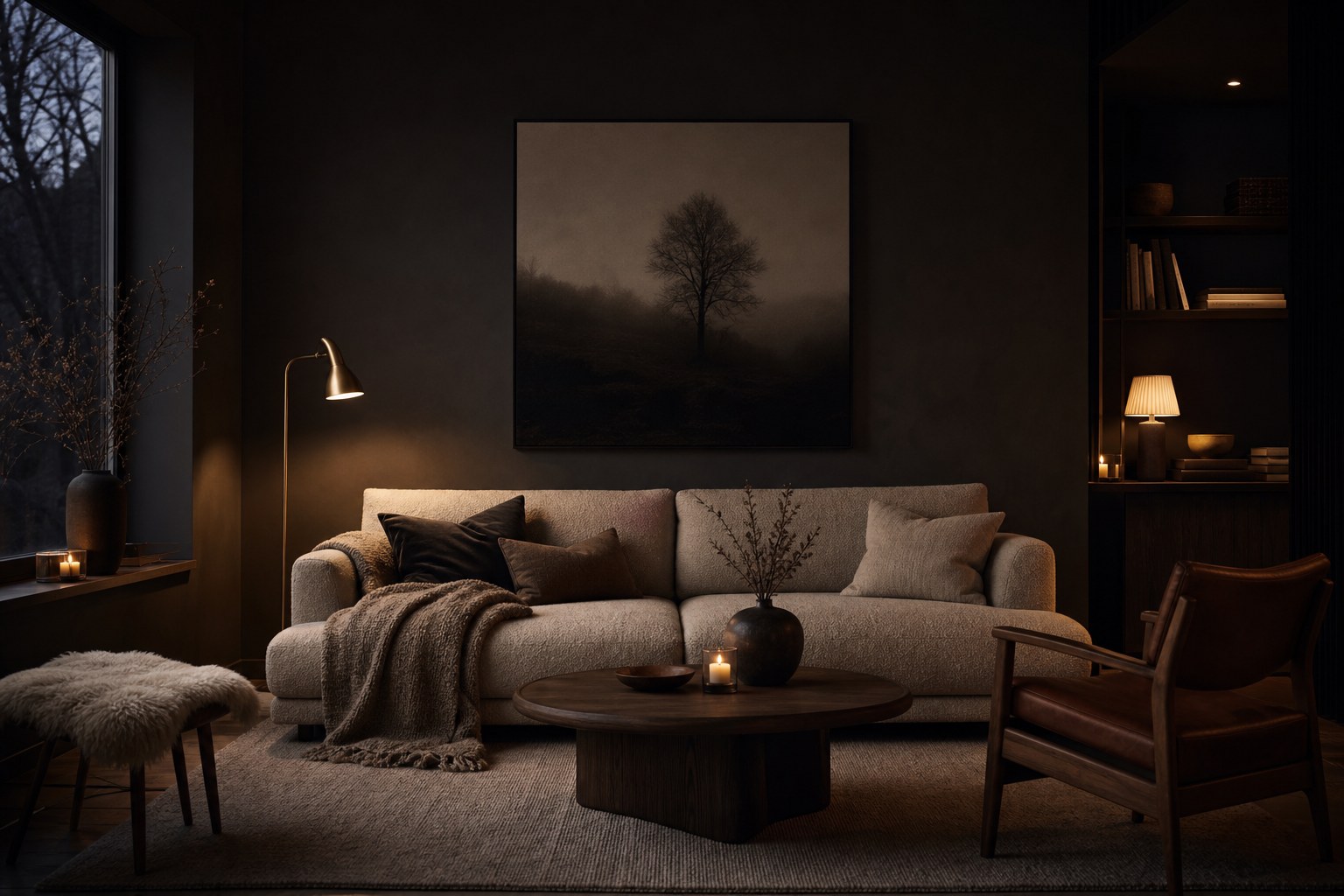
Nordic Noir runs on five colors. One dark dominant, two light rescue neutrals, one warm dark wood, and one warm metal. Walls sit in the 20 to 40 percent LRV band, dark enough for drama but not so dark they go flat[7]. Charcoals with warm brown undertones read better than cold blue-greys, which is exactly the move away from millennial gray that started the trend.
For an accent, pick one and use it sparingly: Obsidian Green #283129 (the Little Greene green-variant wall), Forest Velvet #33433A, or Aged Cognac Leather #7A4F33. Green is the safest first move here, because the touches of green keep a room feeling earthy rather than cold, which is why it reads as the gateway into dark walls.
Paint colors: Railings and Obsidian Green.
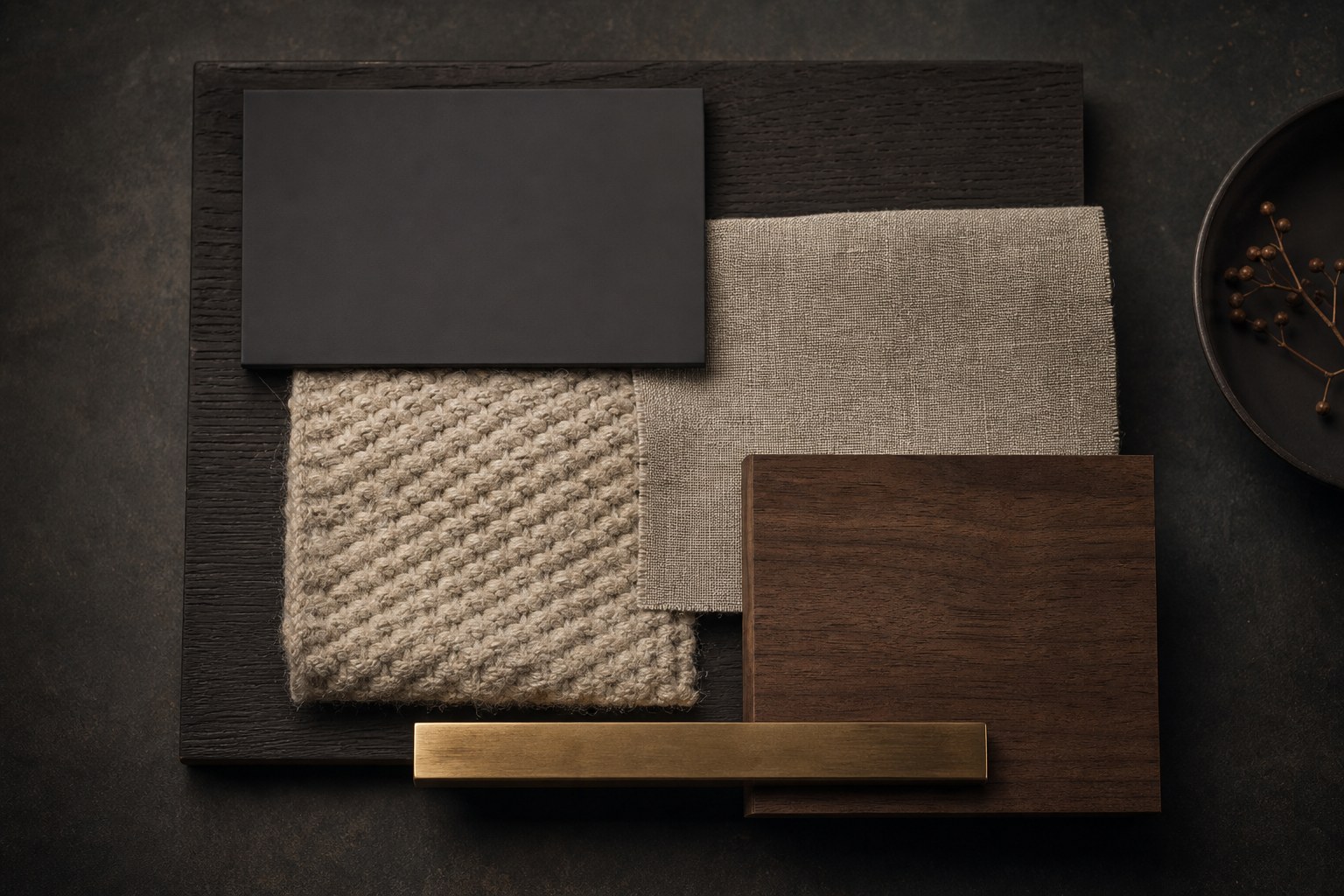
Farrow & Ball Railings (No. 31) is the signature Nordic Noir wall color, a deep charcoal-black around 20 to 35 percent LRV. It is a named member of Farrow & Ball's Nordic Edit, the 24-color Scandinavian palette assembled by Jannik Martensen-Larsen of the Danish design house Tapet-Cafe to prove that Nordic design goes well beyond the whites and greys it gets associated with[3][4]. The Edit's other dark members include Grate Black, Arsenic, Pantalon, and Copenhagen Roof, plus a run of deep greens[4].
Little Greene Obsidian Green (No. 216) is the green variant, a classic off-black deep green with an LRV around 6, very dark and nearly light-absorbing. It has historically been used to frame natural wood and earthy tones, and pairs well with metallics like gold or copper and light neutrals for contrast[9].
The cross-source rule for walls: charcoal greys, deep blues, black accents, and deep greens at roughly 20 to 40 percent LRV give depth without coldness[7]. Warm brown-undertone charcoals read best, and the dark surface should always be balanced by warm wood, brass, and light neutral textiles, which is the next rule.
The balance rule.
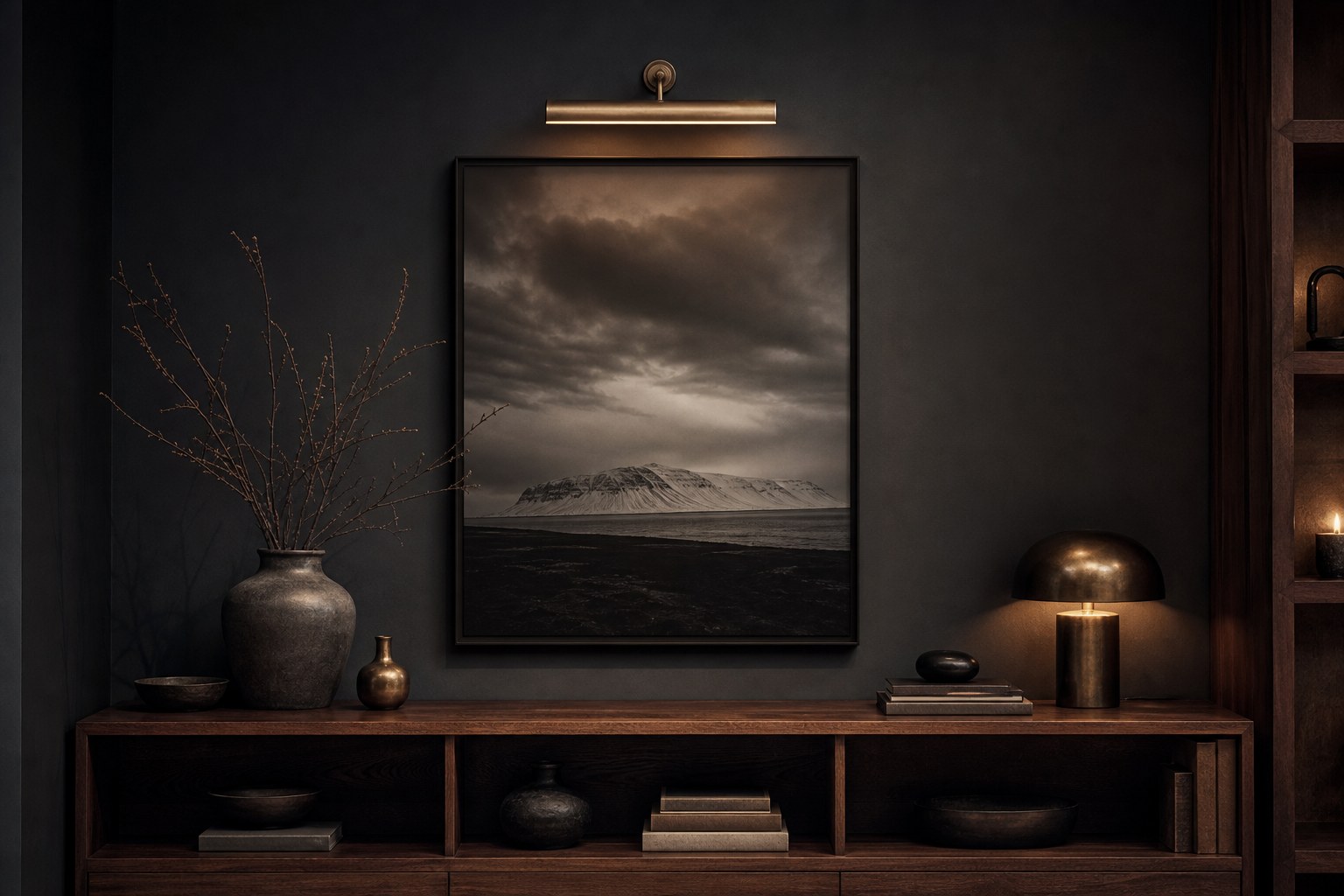
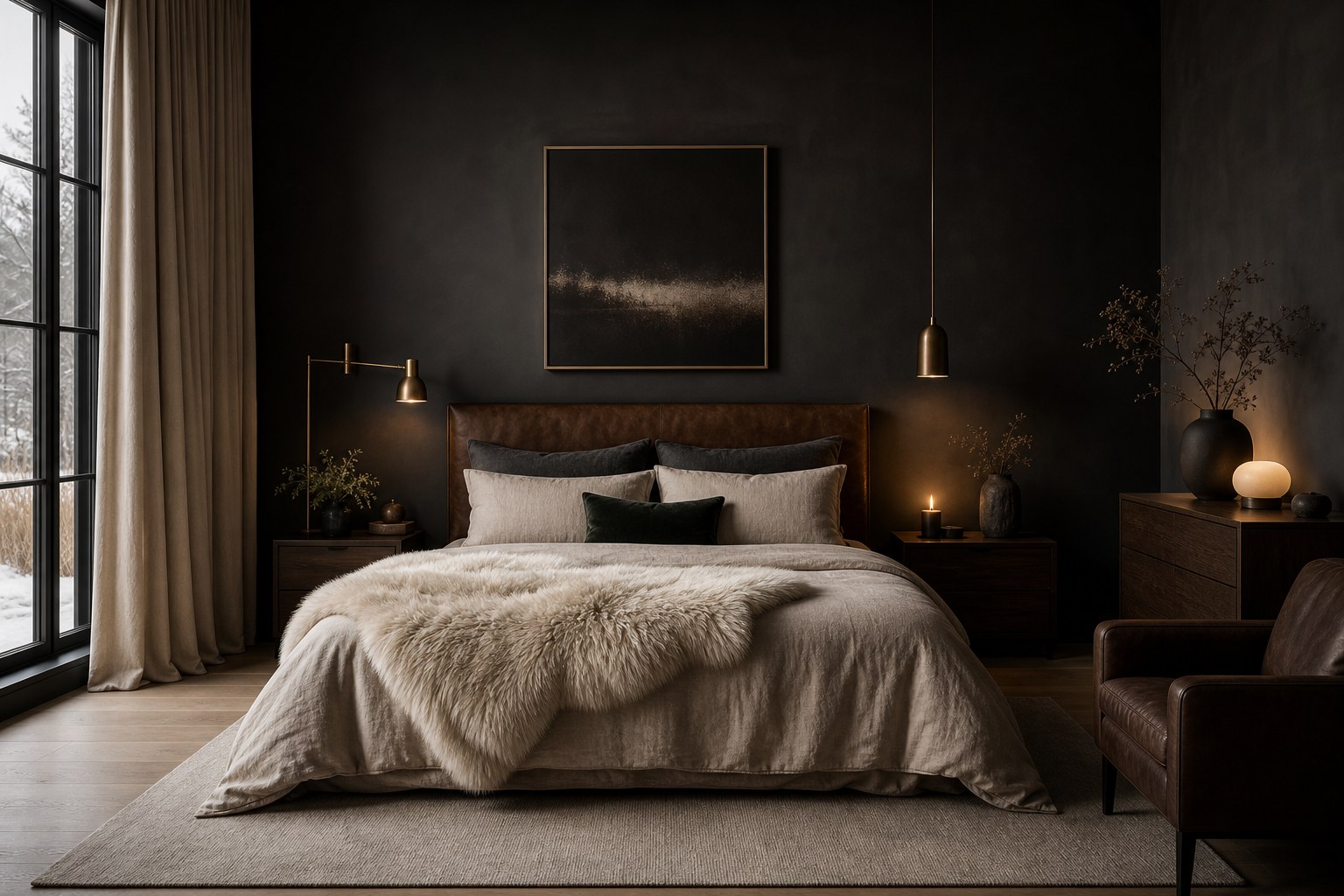
This is the single most important execution principle, and the one people get wrong most. To avoid a gloomy, cave-like result, always rescue dark walls with light neutral floors, furniture, and window treatments, oat, cream, or ivory, plus warm wood and brass. The dark surfaces should feel enveloping and intentional, never oppressive[1][7].
Why it matters: when the rule is ignored, dark walls do not read dungeon so much as commercial. Skip the wood and the warm light and a room starts to read like a gym, a club, or a restaurant, the failure mode that reads as too monotone and cold. Add the warm wood back, layer in the oat and ivory, and the same walls read grounding and calming. That wood is what makes it work; the light neutrals are the counterweight that keeps it from going flat.
The lighting rule.
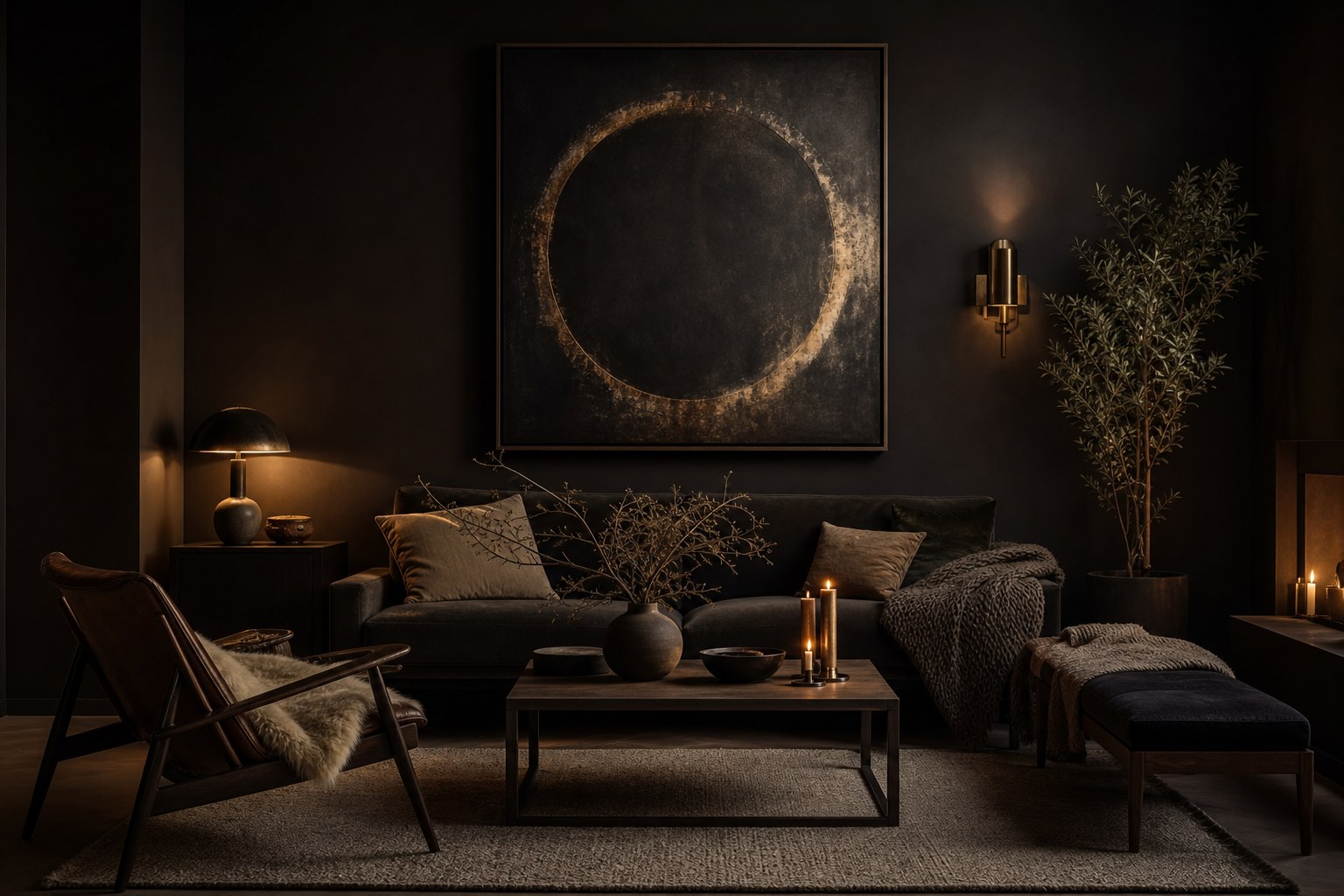
Dark walls absorb roughly 60 to 80 percent of available light, versus 80 to 90 percent reflected by white walls. So a Nordic Noir room needs about double the lumens of a traditional Scandinavian room. The target is roughly 300 to 400 lumens per square meter for dark-walled rooms, against 150 to 200 for a light or traditional Scandinavian room[7]. General lighting guidance corroborates the direction: dark walls and woods absorb light, so a dark living room needs more lumens than a bright white one[10].
Use warm-toned bulbs at 2700 to 3000K to flatter wood texture and keep the room cozy[7]. And deliver the light as many small warm sources, never one bright overhead. This is the part most people fail at: lamps, not the big overhead light. Table lamps, wall sconces, candles, and layered pendants pool warm light against the matte dark walls, where a single bright cool ceiling fixture flattens the whole mood and tips the room toward gym or office.
- Aim for about 300 to 400 lm/m², roughly double a light room.
- Spread it across at least three to five small warm sources.
- Hold every bulb at 2700 to 3000K.
- Tall ceilings and large windows let daytime light penetrate the dark scheme.[6]
Dark woods and Nordic brands.
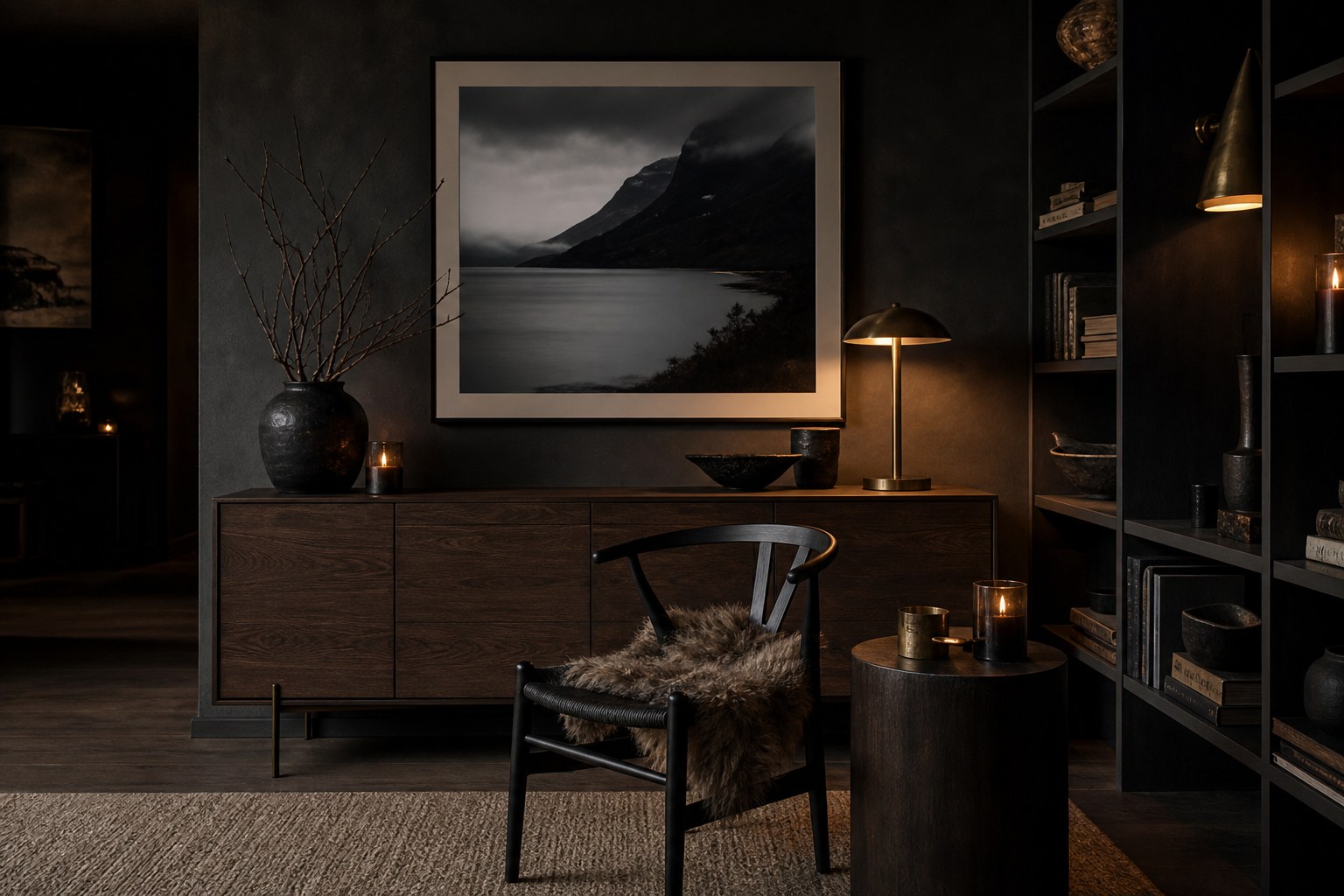
When walls go dark and saturated, texture carries the visual interest, layering materials like sheepskin, chunky knit, and brushed linen to keep a muted room from going flat[2]. The wood does the heaviest lifting. Smoked or fumed oak darkens throughout into grey-brown tones; walnut brings rich dark warmth to tables and shelving; black-stained ash and oak give chairs a noir finish[7].
The defining pieces and the makers behind them:
- Black-stained Wishbone chair (CH24) from Carl Hansen & Søn, the classic Wegner Nordic chair in a noir finish, the number-one archetype.
- Low-profile charcoal or deep-green sofa in boucle or velvet on clean Nordic legs, from Audo Copenhagen, Gubi, &Tradition, or Muuto.
- Dark-oak or smoked-oak sideboard, the warm-dark storage hero, from Audo Copenhagen, Frama, or New Works.
- Sculptural pendant and warm sconces from Gubi, &Tradition, Audo Copenhagen, or Louis Poulsen.
- Black powder-coated modular shelving from String Furniture, the dark counterpart to the white Scandi classic.
- Aged-leather accent chair in cognac or black, the patina piece against the dark wall.
Contemporary Nordic brands with strong dark and moody catalogs include Audo Copenhagen (formerly Menu and by Lassen), Gubi, Ferm Living, &Tradition, Muuto, Carl Hansen & Søn, Fritz Hansen, String Furniture, New Works, and Frama[8]. For a tighter budget, IKEA pieces in black-stained finishes, or plain oak restained darker, get most of the way there.
Nordic Noir vs Scandinavian, Dark Academia, and Japandi.
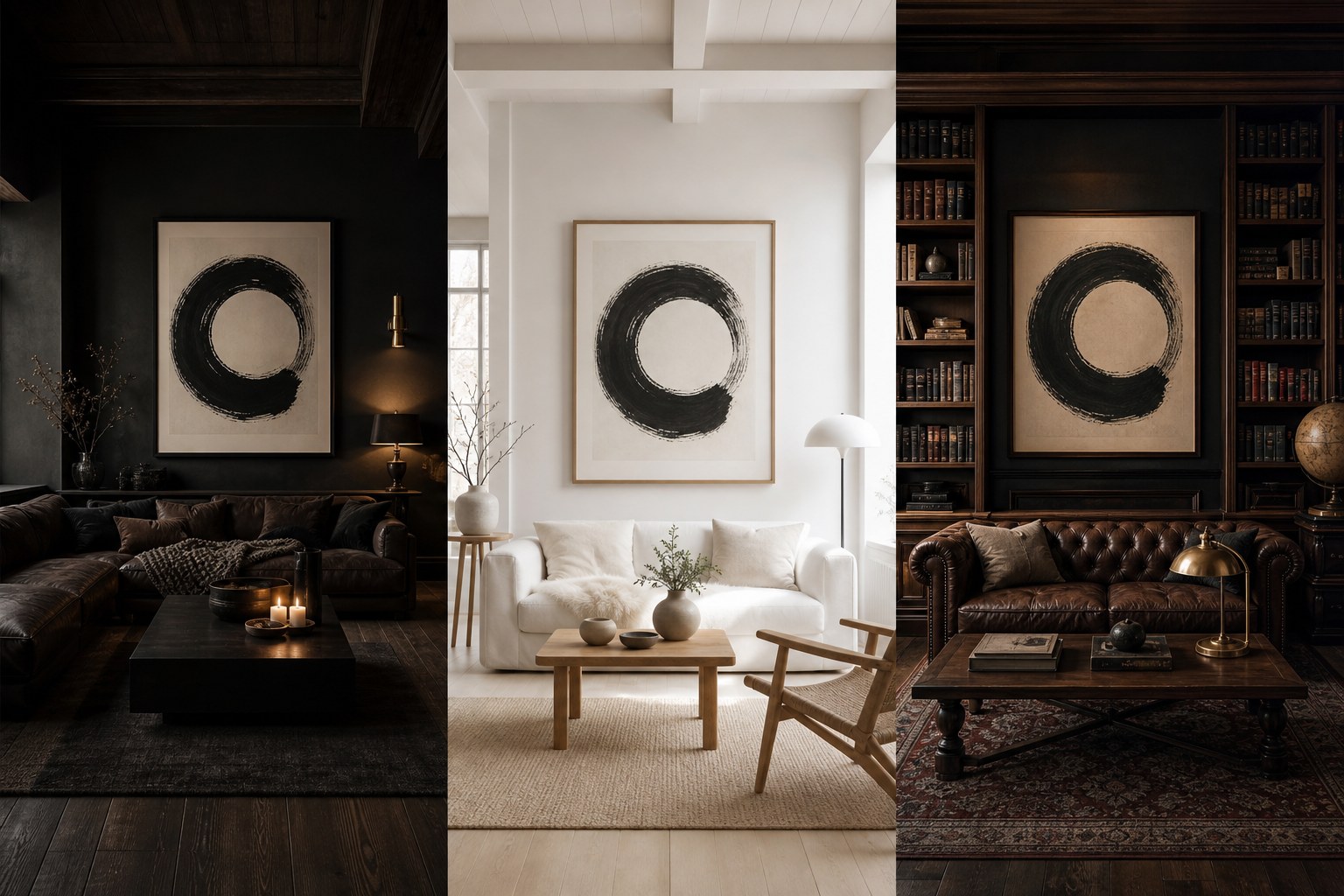
Readers confuse Dark Scandinavian with three neighbors. The fastest way to place it: same Nordic bones, the mood turned down, minimal rather than ornamental.
The budget and renter angle.
Here is the good news for anyone watching their money: charcoal paint is the cheapest dramatic move in the whole style. A single gallon of dark paint runs about 40 to 60 dollars and changes the entire read of a room, which is why almost every transformation starts with someone who finally got the guts to go dark, not someone who bought designer furniture.
Three levers, cheapest first:
- Paint one wall charcoal. One 40 to 60 dollar gallon. The biggest visual change per dollar in the style.
- Restain or swap wood dark. A plain oak IKEA piece restained in a smoked or walnut tone, or a secondhand dark-stained find, supplies the warm-dark counterweight for a fraction of designer prices.
- Add warm light. Two or three plug-in table lamps and a few candles deliver the lighting rule without an electrician.
Most leases allow repainting to the original color before move-out, so a charcoal wall and a 40 dollar gallon of the original white at the end is the math. If you cannot paint at all, peel-and-stick options, secondhand dark-stained wood, and plug-in warm lamps get the same cocoon without touching the walls permanently.
And the fear worth answering directly: will dark walls make a small room feel like a cave? Dark walls blur the edges of a room, so the boundary between wall and ceiling disappears and the space reads deeper and cozier, not necessarily larger. The cave only happens without warm wood and warm layered light. With them, it is not a dungeon, it is a cocoon.
Frequently asked
What is Nordic Noir interior design?
Nordic Noir, also called Dark Scandinavian or Scandi Noir, is the moody side of Scandinavian design. It keeps Nordic clean lines, craftsmanship, and restraint, then inverts the mood with charcoal, black, and deep-green walls, dark woods, and warm pooled lighting. The name is borrowed from the Scandinavian crime-drama TV genre, and the look is often described as the dark side of hygge.
Will dark walls make my small room feel like a cave?
A dark room reads cave-like only when it skips warm wood and warm layered light. With smoked or walnut wood, oat or ivory textiles on 40 to 50 percent of surfaces, and many small warm sources at 2700 to 3000K, dark walls blur the edges of the room so it reads deeper and cozier, not smaller. The fix is the balance rule plus the lighting rule, not a brighter overhead.
What is the difference between Scandinavian and Nordic Noir design?
Same bones, opposite mood. Classic Scandinavian maximizes light with white walls, light woods, and a cool-bright palette, so it reads airy and bright. Nordic Noir uses charcoal, black, or deep-green walls, dark woods, and warm pooled light, so it reads cozy and cinematic. Both keep clean lines, craftsmanship, and clutter-free restraint.
How do I light a Nordic Noir room when the dark walls eat the light?
Dark walls absorb roughly 60 to 80 percent of available light, so aim for about 300 to 400 lumens per square meter, versus 150 to 200 for a light Scandinavian room. Deliver it with many small warm sources at 2700 to 3000K, table lamps, wall sconces, candles, and layered pendants, rather than one bright cool overhead.
What paint colors are used for Dark Scandinavian rooms?
Farrow & Ball Railings, a deep charcoal-black around 20 to 35 percent LRV, is the signature wall color and a named member of the brand's Nordic Edit. Little Greene Obsidian Green, a near-black green around 6 LRV, is the green variant. Keep walls in the 20 to 40 percent LRV band, and choose charcoals with warm brown undertones over cold blue-greys.
Is dark paint a mistake for renters?
Charcoal paint is the cheapest dramatic move in the whole style, often a single 40 to 60 dollar gallon, and most leases allow repainting to the original color before move-out. Renters who cannot paint can use peel-and-stick options, secondhand dark-stained wood, and plug-in warm lamps to get the same cocoon effect without touching the walls permanently.
Dark green or charcoal, which is the safer first dark room?
Dark green is the gentler entry. A deep green such as Little Greene Obsidian Green reads earthy and natural, which keeps a room feeling grounded. Charcoal-black like Railings is the most dramatic option and rewards more warm wood and more layered light to stay cozy.
References
- Nordic Noir in Interior Design, Algedra, 2024
- Nordic style interiors: secrets to dark and dramatic vibes, Real Homes, 2024
- The Nordic Edit: 24 Scandinavian Colors by Farrow & Ball, The Nordroom, 2023
- What are Scandinavian Colors? The Nordic Edit from Farrow & Ball, Scandinavia Standard, 2023
- Nordic Noir Design Style, Kitchen Barn, 2024
- Nordic Noir: Incorporating Dark Woods and Deep Tones, Petalwood Interiors, 2024
- The Audo, Copenhagen (Menu + Norm Architects), Dezeen, 2019-06
- Obsidian Green (No. 216), Little Greene, 2024
- Lumens Per Square Foot, The Home Depot, 2023
Get the Dark Scandinavian palette card
The 5 named hex codes, the balance rule, and the lighting math on one printable page. Free.