Table of Contents
The most-shared cleaning thread among renters opens with a sentence that resonates universally: "Yeah I'm not getting my security deposit back." That post is the real driver of every cleaning search. Most people are not Googling "apartment cleaning checklist" because they want sparkling counters. They are Googling it because they are afraid of a walkthrough, a parent visit, or a date who can smell the trash can. The visible state of the apartment is downstream of that fear.
Here's why most generic cleaning content fails this audience. It assumes bleach is on the table (most apartment leases forbid it). It assumes the reader owns the place (so it skips the line items that landlords actually deduct for). And it dumps 100 tasks on one weekend, so the schedule collapses by month two. So this guide is built around the four cadences that hold up: a 5-minute daily reset, a 70-minute weekly schedule, a monthly deep clean, and a move-out walkthrough punch list. Every line item in the printable PDF maps to one of those four cadences and to a verb a renter can actually perform.
What your landlord actually checks at the move-out walkthrough.
Here's the lens that changes everything: clean to the property manager's clipboard. Not because every visit is hostile (most are not), but because the standard walkthrough form is the same in roughly 80 percent of leases nationwide. Once the line items are known, the cleaning stops being guesswork and starts being a checklist. The catch is, almost no renter ever sees that form until move-out, when it is already too late. Print it now and the deposit stays in the bank.
Kitchen line items.
Oven interior (broiler tray, racks, glass), stovetop (drip pans or sealed surface), range hood filter, microwave interior, fridge gaskets, freezer (defrosted and dry), cabinet faces around the handles, sink drain, garbage disposal cleanliness, and any cabinet shelf liners you added. Most deductions in the kitchen are oven and fridge. Run the monthly deep clean and they stay clean.
Bathroom line items.
Tile grout (white and free of pink mildew), tub or shower base (no soap scum ring), toilet base and behind, exhaust vent grille, vanity drawers (no hair, no spilled cosmetics), mirror edges, faucet hardware (no calcium spots), and any caulk lines. Grout is the silent deposit-killer. Reseal it on the 6-month rotation.
Living and bedroom line items.
Carpet condition (vacuumed, no stains), baseboards (no scuffs from couch corners or shoes), wall scuffs (Magic Eraser handles most), light fixture covers (no insect carcasses), HVAC vent grilles, blinds (slats wiped, no broken pieces), window sills, smoke detector (test button works, batteries fresh), closet shelves and rods, and any holes you patched. Patching is its own art. Use a putty knife and matching paint, not toothpaste.
The five items that show up on every walkthrough form.
- Oven interior including racks and broiler tray.
- Bathroom grout free of mildew and pink stain.
- Carpets vacuumed with stains pre-treated or steam-cleaned.
- Baseboards and trim wiped down (the most-skipped item).
- Refrigerator interior and gaskets, fully defrosted freezer.
The 5-minute daily reset.
Here's the single biggest predictor of whether an apartment stays clean past month three: the daily reset has to survive. Five minutes, every night, before bed. Not a deep clean. A surface clear. The threshold is keeping the kitchen counters and the bedroom floor visible. Renters who hold this line never face a "where do I even start" Sunday.

Two rules protect the daily reset. First, do not stack. If you skip a night, do not double up the next. Just resume. The point is a streak of presence, not perfection. Second, do the reset before screens. The moment a phone or TV starts, the reset will not happen.
The weekly cleaning schedule.
Here's the rhythm: 10 minutes a day across 7 days, with a clear theme per weekday. The day-of-week labels exist for one reason: roommate splits. Two people divide Mon/Wed/Fri versus Tue/Thu/Sat with Sunday rotating, and the work distributes itself without a weekly negotiation. Total weekly time is roughly 70 minutes spread across the week, never more than 10 in any one sitting.
How to run the weekly schedule when you live alone.
Solo apartments often skip the weekly because no one is watching. Anchor it to an existing daily ritual: post-dinner kitchen wipe, post-shower bathroom pass. The most resilient solo schedule is the one paired with a podcast or a 10-minute episode you only watch while cleaning. The trade is: cleaning earns the entertainment.
How to run the weekly schedule with a roommate.
Write the assignment on the printable. Mon/Wed/Fri to one person, Tue/Thu/Sat to the other, Sunday alternates. The single biggest cause of roommate cleaning resentment is informality, where one person drifts into doing 80 percent of the work and stops talking about it. Day-of-week labels make the ledger visible.
The monthly deep clean.
One Saturday morning per month, roughly three hours. Here's the work the weekly rotation does not touch: fridge interior, oven wipe, cabinet faces, baseboards, ceiling fan blades, mattress vacuum, HVAC filter, smoke detector test. Skip the monthly and the move-out becomes a crisis. Six months of skipped baseboard wipes equals a full Saturday of catch-up cleaning the week before the walkthrough, when there's no margin to spare.
The 6-month rotation, twice a year.
Twice a year (April and October work for most leases) layer in the longer cycle: closet purge, dishwasher descale, oven baking-soda overnight treatment, grout reseal if needed, washing-machine drum clean, mattress flip, HVAC filter, smoke-detector batteries. Four hours per cycle, two cycles per year. Renters who run this rotation almost never lose a deposit on cleaning grounds.
Cleaning for smell, not just sight.
One of the most-shared cleaning threads among renters opens with: "She mentioned that she can tell a guy lives here from the smell." The comments below it are not about Lysol or Glade. They are about HVAC filters, drains, fabric, and the trash can rim. The audience is asking how to control how others experience their space, not how it photographs.
The five smell sources most people miss.
- HVAC filter. Replace monthly during heavy use, every 90 days otherwise. A clogged filter recirculates kitchen and pet odor through every room.
- Kitchen sink drain. Half a cup of baking soda followed by a kettle of boiling water once a week. The food trap in the disposal is the second most common culprit.
- Trash can rim. Wipe with disinfectant when you change the liner. The plastic absorbs smell and re-emits it for hours.
- Fridge gaskets. Wipe the rubber seal monthly with vinegar. Mold grows where the seal meets the door.
- Fabric reservoirs. Couch cushions, throw blankets, rugs, and curtains all hold smell. Vacuum the cushions with the upholstery attachment monthly. Wash blankets every other week.
Why air freshener fails.
Here's the trap. Spray air fresheners stack scent on top of smell rather than removing the source. Within an hour, the freshener evaporates and the original smell returns slightly stronger, because the room is now humid. Source-elimination wins every time. The only legitimate use of a spray is the 30-second window before a guest arrives, and even then it should layer on top of an apartment that has already been cleaned, never instead of one.
Cleaning without bleach (because your lease forbids it).
One renter's question captures the problem: "Apartment complex does not allow bleach." The comments are 90 percent generic "use bleach" replies that do not work for the audience. Every cleaning routine in this guide assumes a bleach ban, because most modern leases include one. The substitutes are stronger than they sound.
Hydrogen peroxide.
3 percent hydrogen peroxide handles mildew on grout, lifts white-fabric stains, and disinfects bathroom surfaces. Pour it into a spray bottle, leave on grout for 10 minutes, scrub with an old toothbrush. Same routine every week and pink mildew never returns.
Baking soda plus white vinegar.
The classic. Baking soda paste lifts grease from stovetop and oven interior. White vinegar dissolves calcium spots on faucets and shower glass. Use them sequentially, never mixed (the foaming reaction neutralizes both).
Oxygen bleach (sodium percarbonate).
Sold as OxiClean or Sun Oxygen Cleaner. Apartment-safe, non-chlorine, brightens grout and fabric. Mix per the bag and let sit for 30 minutes before scrubbing. Best single substitute for bleach in the entire toolkit.
Magic Eraser.
For wall scuffs, tub rings, and the hard-to-reach grout corner. The melamine foam is mildly abrasive, so do not use on glossy paint or polished surfaces. Keep one in the cleaning caddy and replace every 6 weeks.
The move-out checklist for the deposit.
Here's the cleaning event everyone fears. It does not have to be a marathon. If the daily reset and the monthly deep clean ran on schedule, the move-out is mostly a punch list. The order below is the sequence professional turnover cleaners use: top to bottom, dirty room first, dry room last. Same order, every time, even at 11pm the night before the walkthrough.
Day before move-out.
- Empty fridge and freezer, defrost, wipe interior plus gaskets.
- Oven baking-soda paste overnight (rinse next morning).
- Grout treatment with hydrogen peroxide (10 min, scrub, rinse).
- Patch any nail holes with putty, paint over with the leftover landlord-supplied paint if available.
Day of move-out (after furniture is out).
- Wipe baseboards, trim, and door frames (Magic Eraser handles scuffs).
- Vacuum and steam-clean carpets if owned (or rent for the day).
- Clean light fixture covers and ceiling fan blades.
- Wipe inside of all cabinets, drawers, and closet shelves.
- Final pass: floors mopped, windows wiped, walls spot-cleaned.
- Photograph every room, every appliance interior, and every closet for your records before you hand the keys back.
Photos are your deposit insurance.
The single most useful action on move-out day is photographing every surface after the clean. Date-stamped images of a clean oven, fridge, grout, and baseboards are usable evidence if any deduction shows up. Most disputes are resolved when the tenant produces date-stamped photos and the property manager produces none.
The 6 products that replace your whole cabinet.
Here is a pattern among renters: people listing 12-plus cleaning products they own and use four. Single-purpose cleaners are a money waste, and they take up the entire cabinet. The list below covers about 95 percent of apartment cleaning, costs under $50 total, and fits in a single under-sink caddy.
- White vinegar (gallon). Glass, hard water, fridge gaskets, descaling kettle, descaling dishwasher.
- Baking soda (3 lb bag). Stovetop scrub, oven paste, sink drain refresh, fabric deodorizer, mattress refresh.
- Hydrogen peroxide (16 oz, two bottles). Grout mildew, white-fabric stain lift, disinfectant on counters, bathroom surface clean.
- Dawn or any blue dish soap. Dish duty, plus a teaspoon mixed with a quart of warm water makes a safe all-purpose floor and surface cleaner.
- Microfiber cloths (12-pack). Wash and reuse for 18 months. Color-code one set kitchen, one set bathroom, one set glass and dust.
- Magic Eraser (4-pack). Wall scuffs, tub rings, baseboards, sneaker soles. Single most cost-effective cleaning tool sold.
Optional adds for households with specific needs: oxygen bleach scoop (laundry and grout), an apartment-safe all-purpose spray for the daily reset, and a cordless stick vacuum for pet households. Skip Fabuloso, skip Lysol spray as a smell solution, skip every "as seen on TV" product.
The one habit that protects every other one.
Here's the one rule that holds the rest together. Of the four cadences, the daily reset is the only non-negotiable. When the daily reset survives, weekly and monthly are forgiving. When it slips, the rest collapses inside two months. Print Page 1 of the PDF even if nothing else gets printed, and put it on the fridge where it cannot be ignored.
For the cleaning supplies you need on day one in a brand-new apartment, see the first apartment essentials shopping list. For the apartment inventory checklist that pairs with this cleaning routine, see the first apartment checklist. To track cleaning supplies inside your monthly budget, the monthly budget planner has a household-essentials line item built in.
Frequently asked
What does my landlord actually check at the move-out walkthrough?
Property managers check the same line items every time: oven interior and stovetop, fridge gaskets and seals, grout in the shower and around the tub, baseboards and trim, behind the toilet, range hood filter, blind slats, carpet condition, and any wall scuffs. Those are the deductions on the standard walkthrough form. The 47-point checklist hits all of them on the monthly and 6-month rotations so they never pile up.
How do I clean my apartment when the lease forbids bleach?
Hydrogen peroxide handles most bleach jobs (mildew, grout, white fabric). Baking soda plus white vinegar dissolves grease and lifts soap scum. Oxygen bleach (sodium percarbonate) whitens fabric and grout safely. Magic Eraser handles wall scuffs and tub rings without chemicals. None of these void a standard apartment lease and they cover roughly 90 percent of what bleach is used for.
Why does my apartment smell even after I clean it?
Most cleaning routines target visible surfaces and miss the smell sources. The five most common are: HVAC filter (replace monthly), kitchen sink drain (baking soda plus boiling water weekly), trash can rim (wipe when liner changes), fridge gaskets (wipe with vinegar monthly), and fabric reservoirs like couch cushions and rugs (vacuum and rotate). Air freshener masks the issue. The checklist puts each of these in a recurring slot.
I have not cleaned in weeks. Where do I start?
Start with one zone, not the whole apartment. Pick the kitchen sink. Empty it, scrub it, dry it. That single visible win typically generates enough momentum for the next zone. Skip the deep clean for now. Run the daily reset (5 to 10 minutes) for one full week before adding the weekly rotation. The checklist is built to scale up from zero, not to assume you are already maintaining.
Can I split this with a roommate?
Yes. The weekly rotation uses day-of-week labels so two people split Mon/Wed/Fri versus Tue/Thu/Sat with Sunday alternating. The monthly deep clean splits by room: one person takes kitchen plus living room, the other takes bathroom plus bedroom. Write the assignment on the printable so it does not become a renegotiation every week.
What cleaning products do I actually need?
Six items replace a full cabinet of specialty cleaners. White vinegar, baking soda, Dawn dish soap, hydrogen peroxide, microfiber cloths, and a Magic Eraser. Add an apartment-safe all-purpose spray and an oxygen-bleach scoop and you cover 95 percent of cleaning. Most renters own ten-plus single-purpose cleaners and use four of them. Skip the rest.
What if I have a pet?
Add 5 minutes to the daily reset for pet hair using a damp microfiber cloth or a single-zone vacuum pass. Include "wash pet bedding and scratch pad" in the 6-month rotation. Vacuum the couch cushions weekly instead of monthly. The hair compounds fastest in fabric, so frequency beats intensity.
Is the cleaning checklist really free?
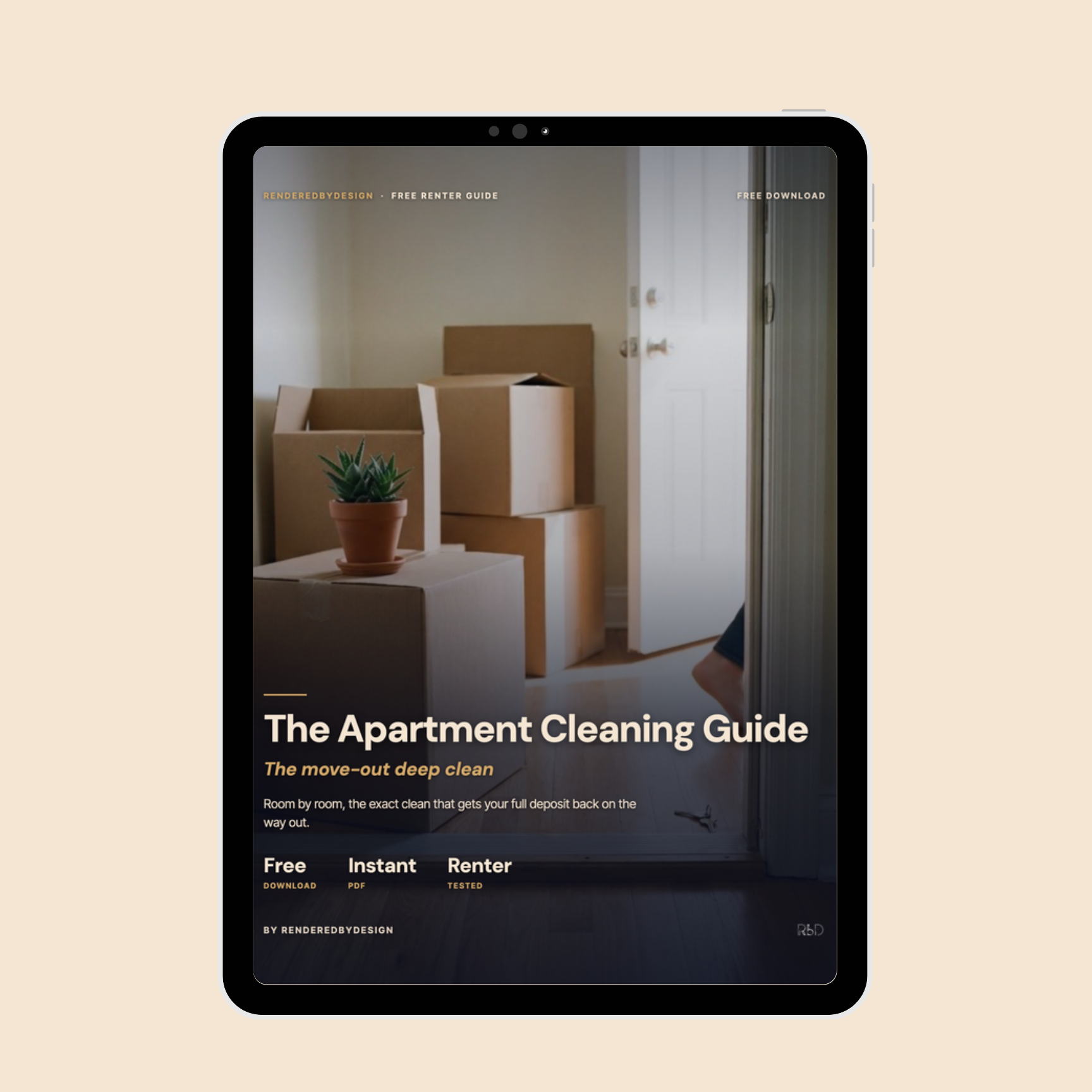
Yes. The PDF arrives by email in under five minutes. No credit card. The lead-magnet covers daily, weekly, monthly, 6-month, and move-out tasks across 47 line items, plus the landlord walkthrough checklist. Direct link: RbD-Apartment-Cleaning-Guide.pdf.
Get the 47-point cleaning checklist free
Daily reset, weekly schedule, monthly deep clean, and the move-out walkthrough punch list. Apartment-safe, no bleach. Sent to your inbox in under five minutes. Direct PDF: RbD-Apartment-Cleaning-Guide.pdf.
Send me the checklist