Table of Contents
The Handmade Home.
The Arts and Crafts movement is the only major design philosophy in Western history that began as a moral argument. William Morris - textile designer, poet, and the movement's founding voice - believed that industrial mass production was spiritually corrosive: that factory workers who made things without pleasure produced objects without meaning, and that homes filled with those objects were impoverished regardless of price. The remedy was handwork: objects made by hand, from natural materials, by people who understood what they were making and why. The Arts and Crafts Movement centered on unique design that celebrated quality workmanship, natural textures, and nature-inspired motifs - and that founding argument is exactly what 10,000-upvote Craftsman bungalow restoration threads are still making when they specify Motawi tile over subway tile and Stickley-adjacent mission furniture over IKEA HEMNES.
In the United States, the movement's residential peak ran from approximately 1895 to 1920. Gustav Stickley dominated American production through his Craftsman Workshops in upstate New York, publishing The Craftsman magazine to disseminate the philosophy alongside the furniture. Charles and Henry Greene built their most celebrated California houses - the Gamble House in Pasadena (1908) among them - as total-environment experiments in the Arts and Crafts idea: joinery exposed at every corner, leaded glass in every door, and tile around every fireplace. The Craftsman bungalow house type that spread across American cities in the 1910s and 1920s was the popular democratization of that vision, and the homeowners of those houses today are the core audience for everything that follows.
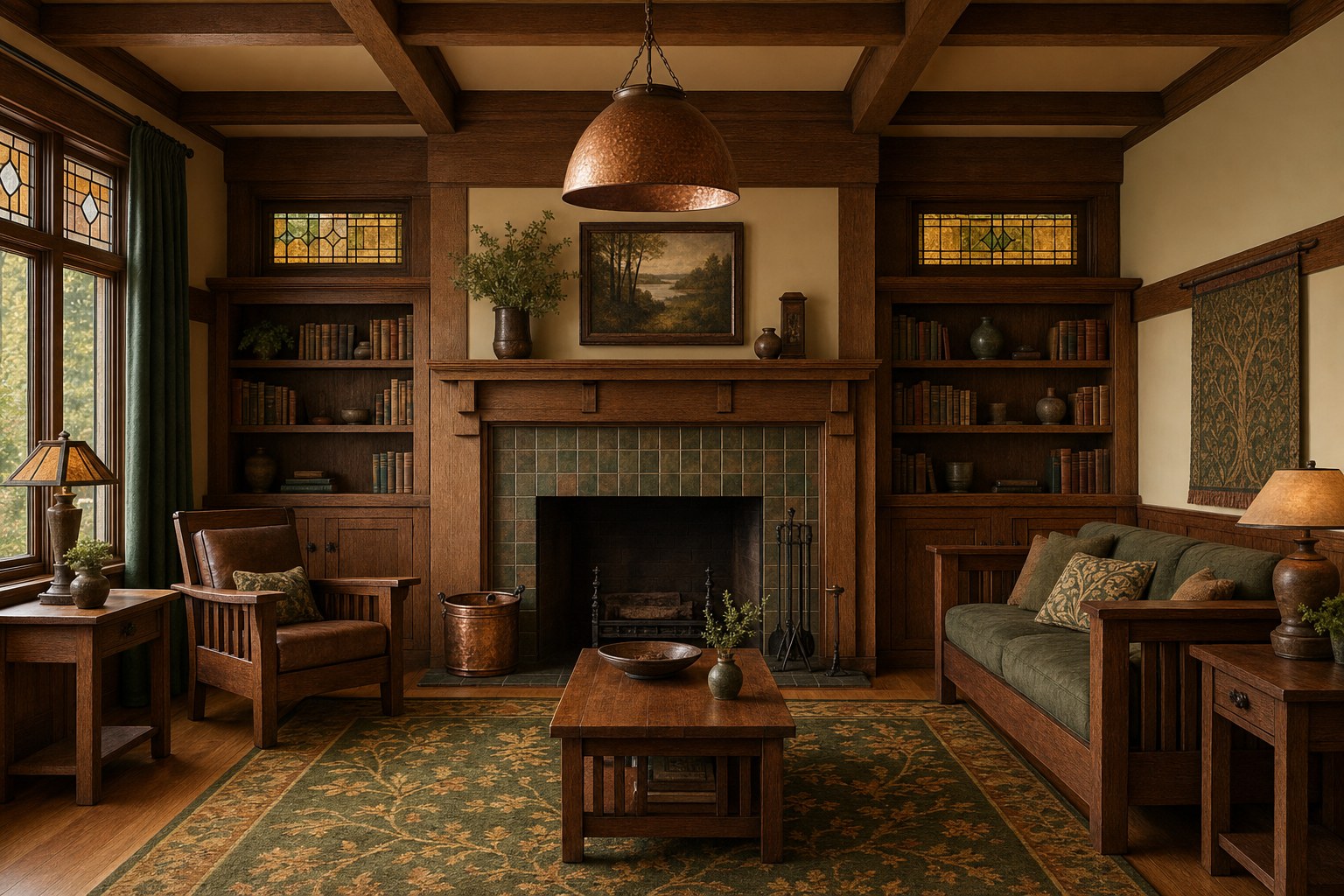
The sourcing logic for Arts and Crafts follows the authenticity hierarchy the movement built into its own philosophy. Source the mission furniture at the high end (Stickley, L&JG Stickley, or regional furniture makers) for the dining room and living room primary pieces - age, provenance, and hand-cut joinery are visible and matter. Source handcrafted tile (Motawi, Pratt and Larson, or the Grueby matte green palette for fireplace surrounds and kitchen backsplashes) as the next highest-signal investment. Source nature-inspired textiles - wool throws, botanical-print linen pillow covers, Morris-pattern fabric curtains - at accessible price points from specialty sources: the pattern and weave read as authentic even at moderate cost. The five elements below build the Arts and Crafts room in the order that makes the philosophy legible from the first object placed.
Exposed Wood Joinery · $179.97
Exposed wood joinery is the Arts and Crafts movement's most radical formal gesture, and it remains the single fastest way to signal the style in any room. In conventional cabinetry and furniture making, joints are hidden: the goal is seamless surfaces that conceal how the object was assembled. Arts and Crafts reverses that logic entirely: mortise-and-tenon joints, exposed dowels, and dovetails are not hidden but celebrated as evidence of the maker's skill. The Craftsman interior signature is built-in furniture with wood artistry featuring exposed joinery and precision cuts in oak, cherry, and maple with natural stains or clear varnishes that let the grain read clearly. Quarter-sawn oak is the wood the movement claimed as its own: cut across the growth rings rather than tangentially, it produces the distinctive ray-fleck figure, a silver-gold shimmer running across the face of the wood, that is visible in every Stickley piece and in the millwork of every authentic Craftsman bungalow. The three exposed-joinery items below build the material foundation without cabinetry installation: the mission bookcase with visible tenons is the gateway piece, the quarter-sawn oak floating shelf establishes the wood-on-walls vertical logic, and the mortise-and-tenon console table brings the joinery into the room's primary circulation zone.
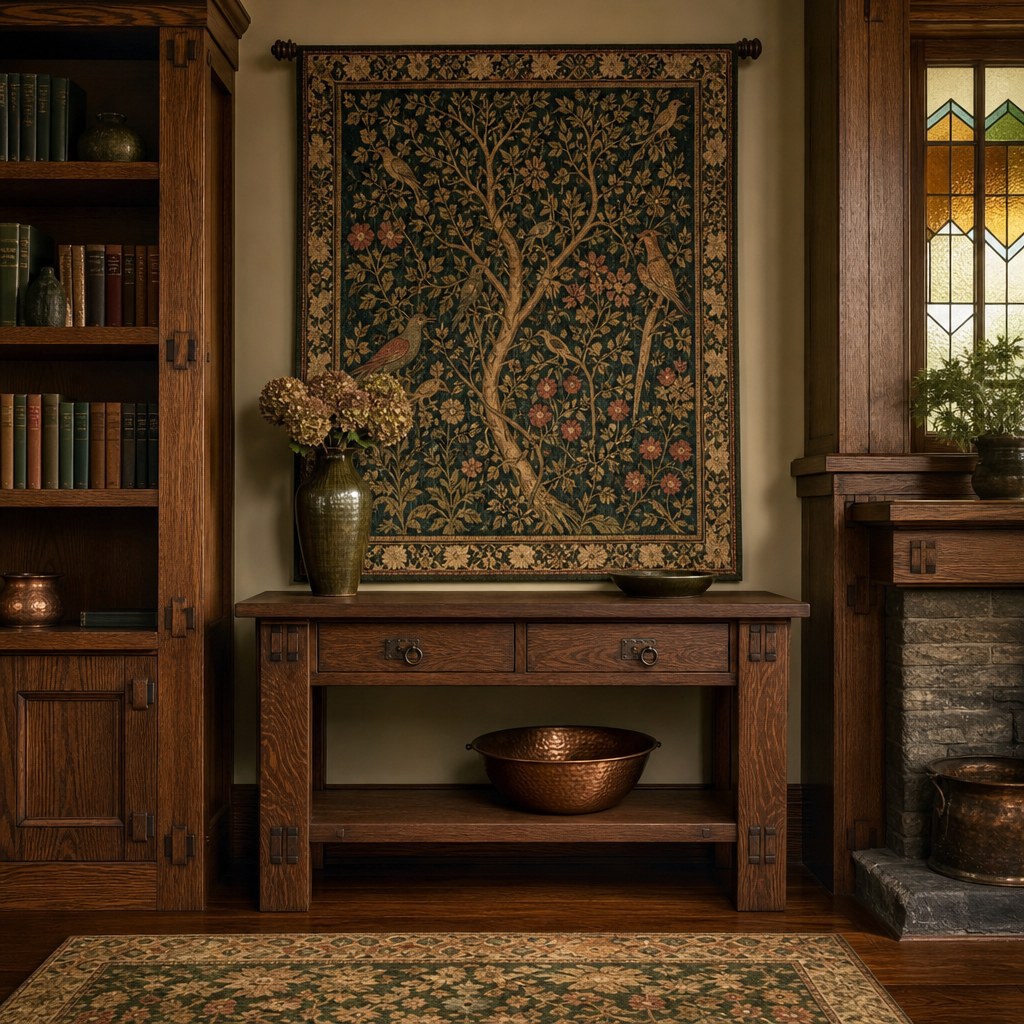
E1 Receipt - Exposed Wood Joinery
Handcrafted Ceramics and Tile · $149.97
Handcrafted ceramics are the Arts and Crafts element with the clearest buying-intent signal from the design community and the most specific product vocabulary of any category in the style. The movement's ceramic tradition was built by Grueby Pottery (signature matte green glaze, hand-applied leaf and organic relief), Rookwood Pottery (matte glazes in amber, brown, and sage), and William De Morgan (vibrant blues, reds, and symmetrical botanical patterns). "Motawi tile is the gold standard, but Pratt and Larson for those on a budget" is the direct sourcing hierarchy from design communities. Mapping precisely to the movement's founding distinction between the authentic hand-made and the accessible reproduction. What all three pottery traditions share is the core sensibility: handmade and glazed pots that read as made by a human, not a machine: specifically the slight unevenness of the glaze, the variation in color across the surface, and the visible brush marks or hand-formed edges that factory production cannot reproduce. The three ceramics and tile items below build the handcraft material signal in the room's most visible threshold zones: the fireplace surround (the Arts and Crafts room's highest-signal surface), the kitchen backsplash, and the open shelf vignette.
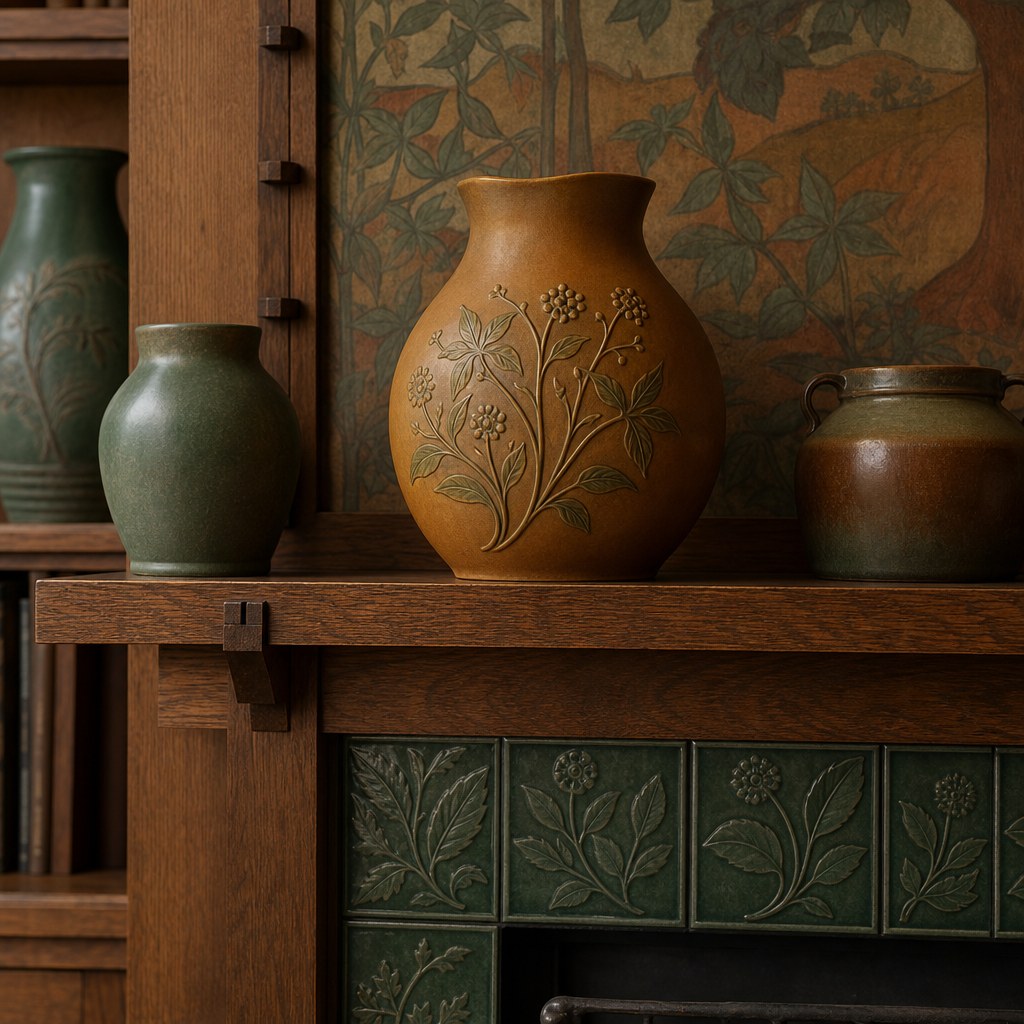
E2 Receipt - Handcrafted Ceramics and Tile
Built-in Cabinetry Layer · $219.97
Built-in cabinetry is what separates the Arts and Crafts interior from adjacent styles with similar material vocabularies, and it is the element the Craftsman community identifies as most definitional. "The built-ins transformed it from just 'old house' to intentional Craftsman". That direct quote from a 2,911-upvote before-and-after post captures exactly why this element carries the most identity weight of the five. The Arts and Crafts movement's embrace of built-ins was not merely aesthetic: it was a philosophical rejection of Victorian clutter. William Morris and his contemporaries believed that furniture filling a room's floor area created visual disorder that was both unattractive and morally incoherent. Built-ins resolved the clutter problem by making storage part of the architecture. In a Craftsman bungalow, the window seat beneath a bay window, the bookshelf flanking the fireplace, and the dining room sideboard built into the wainscoting are original design intentions, not renovation upgrades. For rooms without structural built-ins, the four items below simulate the built-in logic through freestanding mission cabinetry placed flush against the wall, open bookcase units that read as architecturally fixed, and wainscoting panels that establish the horizontal datum line the Craftsman interior uses to anchor its woodwork.
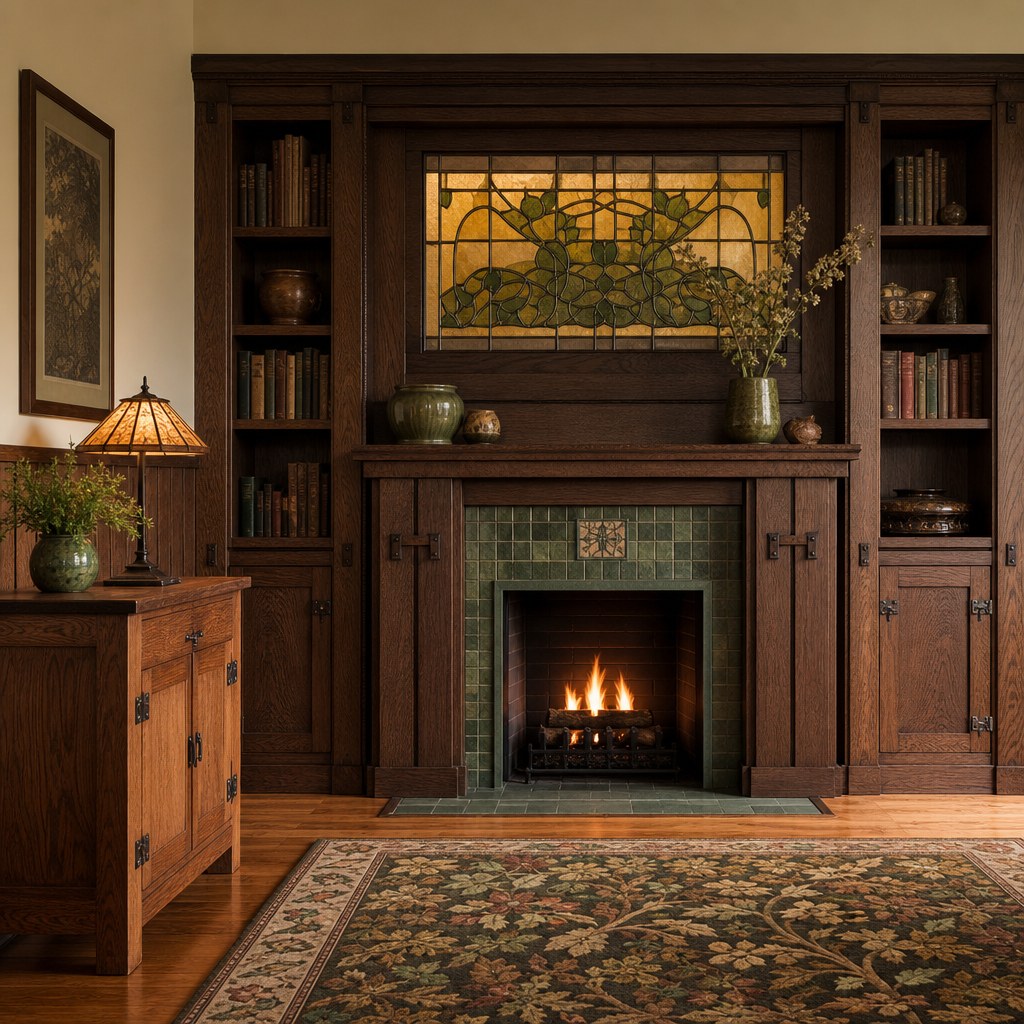
E3 Receipt - Built-in Cabinetry Layer
Nature-Inspired Textiles · $209.97
Textiles were where William Morris made his most lasting contribution to Western design. Morris and Co.'s repeating botanical patterns, Willow Bough, Strawberry Thief, Acanthus, were among the first manufactured objects in the movement that achieved the hand-made ideal at accessible scale. The Morris pattern logic is still the reference point for Arts and Crafts textiles: nature motifs (stylized leaves, birds, berries, flowing botanical forms) rendered in a controlled, symmetrical repeat on a flat background, in a palette of earth colors, russet, greens, ochres, browns, with stone whites as the neutral ground and stronger blues and teals as a foil. The textile strategy for the Arts and Crafts room: layer warm-colored rugs, pleated lampshades, and plenty of pattern, with hand-woven or hand-embroidered upholstery as the tactile signal. The three textile items below build this layered foundation: the botanical-pattern wool throw is the room's most portable Arts and Crafts signal, the Morris-adjacent linen pillow covers bring the repeating nature motif to the seating plane, and the wool area rug in moss green and ochre grounds the entire material story on the floor.
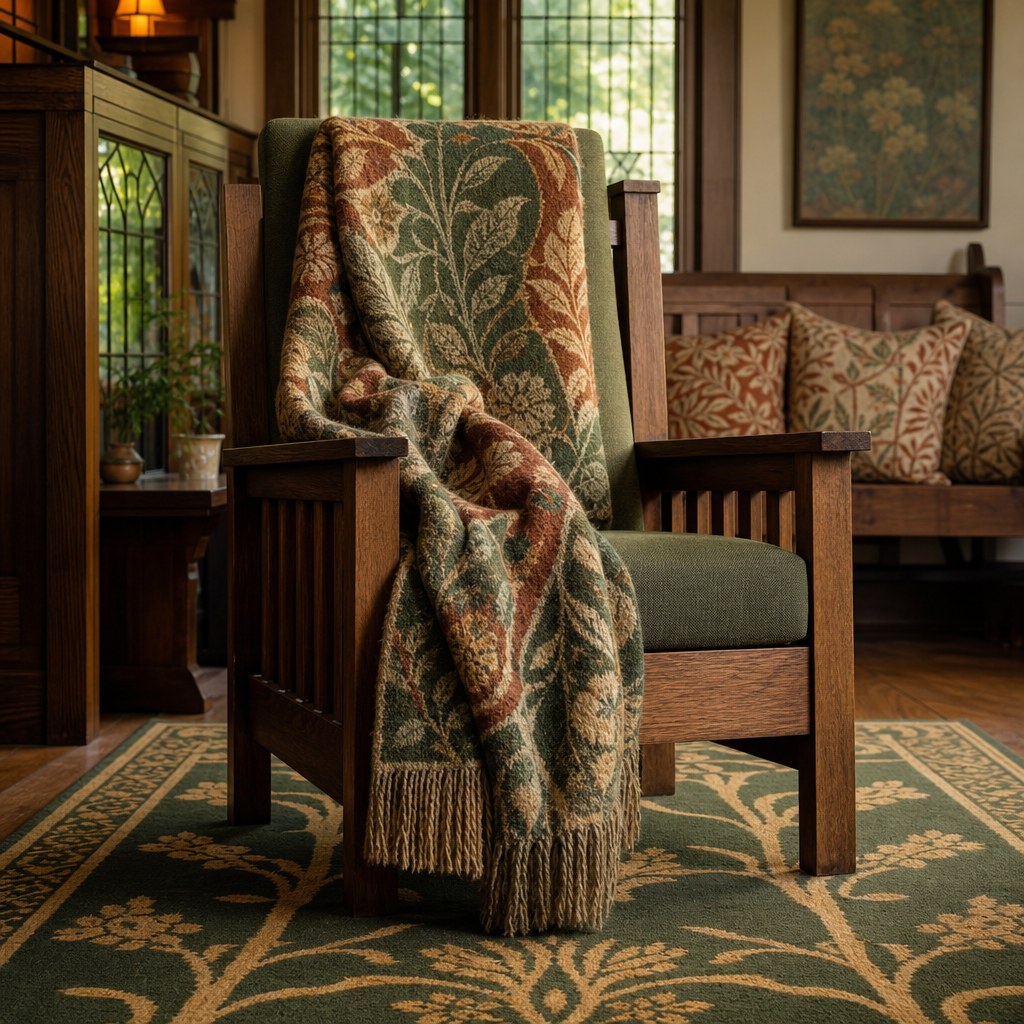
E4 Receipt - Nature-Inspired Textiles
Leaded and Stained Glass · $289.99
Stained and leaded glass is the Arts and Crafts element with the highest aspirational status in the design community and the longest sourcing discussion of any single product category. "Finding original stained glass is the holy grail" and "custom Craftsman glass is worth every penny, it defines the room", direct quotes from a 4,234-upvote post about a Craftsman stained-glass window find at an estate sale. The movement's embrace of stained glass was philosophically coherent: by the end of the 19th century, Arts and Crafts ideals had transformed stained glass from a purely ecclesiastical medium into a domestic decorative art, applied to doors, interior partitions, cabinet inserts, and lamp shades. The characteristic Craftsman glass vocabulary is geometric and nature-inspired. Lead lines forming stylized prairie grasses, tulips, or simple geometric borders. Rather than the representational figures of Gothic ecclesiastical glass. Ambers, deep greens, warm golds, and muted blues are the period-accurate palette for Craftsman glass, colors that translate warm natural light into the room's color story rather than blocking it. For rooms without original windows, two practical applications bring the stained glass element into the space without structural work: a leaded glass panel lamp (a tabletop or floor lamp with a geometric stained-glass shade in the Craftsman palette) and an art glass suncatcher or decorative panel mounted in an existing window frame.
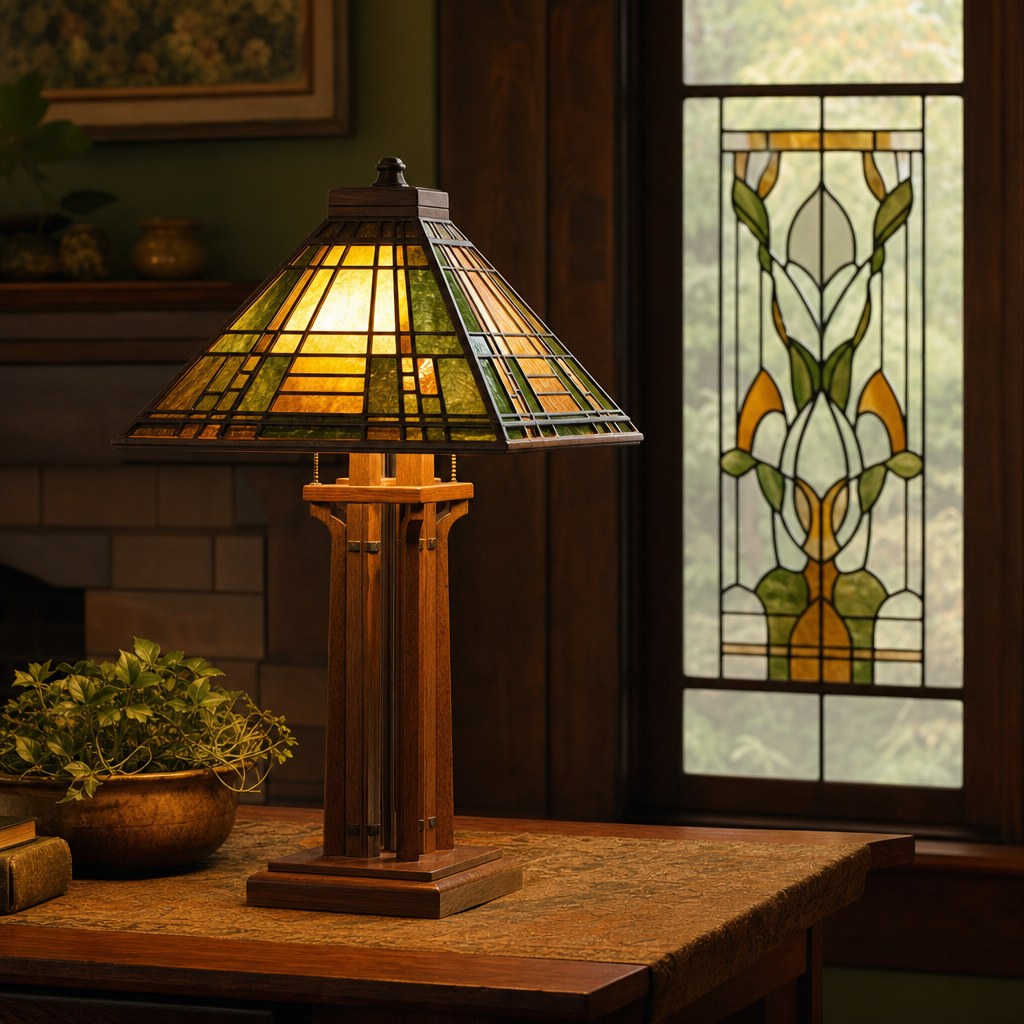
E5 Receipt - Leaded and Stained Glass
Arts and Crafts vs. Mid-Century Modern.
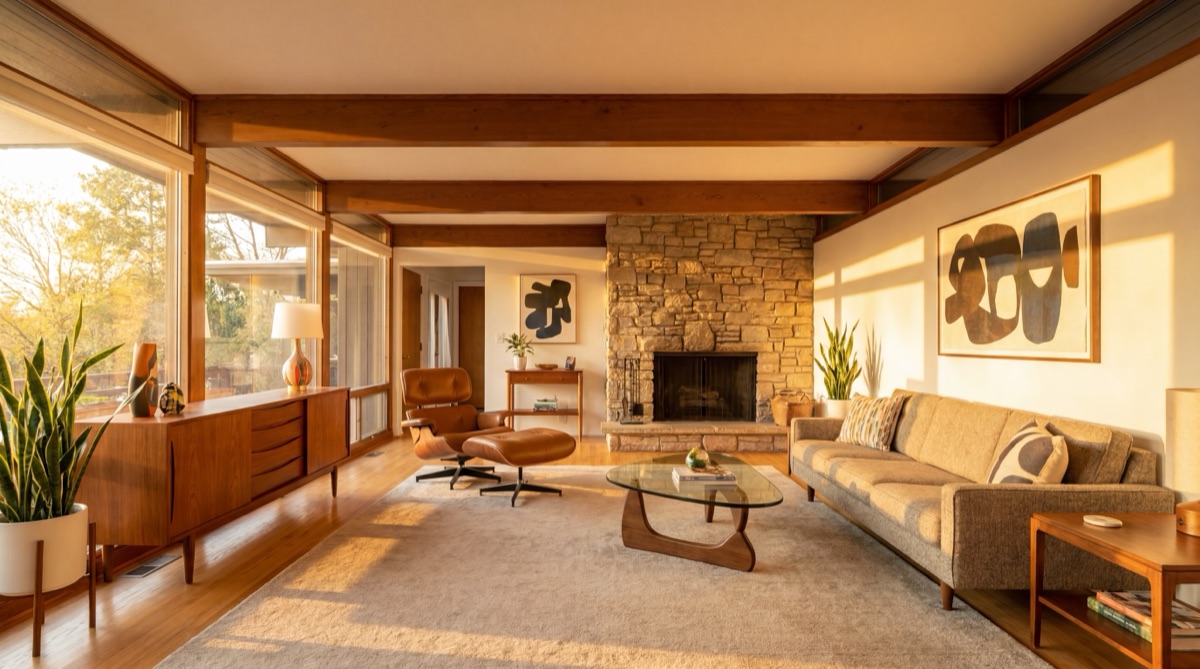
Both styles use warm wood prominently and reject Victorian ornamental excess. Which is why they are consistently confused in sourcing and inspiration boards. The distinction is the relationship to craft and to nature. Mid-century modern is a designer's style: it celebrated industrial production, new materials (molded plywood, fiberglass, steel), and the machine aesthetic applied with taste. Arts and Crafts is a maker's style: it celebrated the hand, natural materials only, and visible construction as the marker of quality. The easiest test: if the wood surface hides its joinery and the furniture could have been produced by a factory in 1960, it is mid-century modern. If the wood surface shows its mortise-and-tenon at every corner and the tile has a glaze applied by hand, it is Arts and Crafts.
| Dimension | Arts and Crafts Interior Design | Mid-Century Modern Interior Design |
|---|---|---|
| Production philosophy | Hand-made from natural materials; visible construction is a quality marker, not a flaw to hide | Industrial production celebrated; molded plywood, fiberglass, and steel are legitimate design materials |
| Wood use | Quarter-sawn oak with exposed mortise-and-tenon; natural stains; built-in cabinetry as architecture | Teak, rosewood, walnut in furniture; wood is furniture, not architecture; veneer and formed wood acceptable |
| Color palette | Earth tones drawn from nature: russet, moss green, ochre, clay red, warm brown, stone white | Cooler and more restrained: white or off-white walls, teak furniture, pops of olive or burnt orange as accent only |
| Textile approach | Layered botanical and geometric patterns in wool and linen; William Morris repeating nature motifs; hand-woven weaves | Restrained. One quality rug, clean upholstery fabric; textiles subordinate to furniture silhouette |
| Glass and light | Stained and leaded glass as domestic art; geometric Craftsman patterns in amber, green, gold; warm ambient lamp light | Lighting as sculptural objects (Arco lamp, Nelson bubble); natural light favored through large unadorned windows |
| The confusion test | Feels like a Craftsman bungalow. Handmade, warm, built for the specific life inside it; every surface has a maker behind it | Feels like a design museum piece. Clean, intentional, every object selected for line rather than craft or feeling |
The $89 entry path.
Four items that establish the handwork material signal in any room. No built-ins, no tile work, no structural changes required. Mix authentic ceramics with modern reproductions: balance cost with authenticity at the shelf and textile level before investing in tile or cabinetry.
Frequently asked questions.
What is Arts and Crafts interior design?
Arts and Crafts interior design is a warmth-first, handwork-centered residential style that emerged between 1880 and 1920 as a direct reaction against Victorian mass production. Its defining principle - articulated by movement founder William Morris - is that every object in the home should be both useful and beautiful, made by hand from natural materials by someone who took pleasure in the making. The five structural signals of the style are exposed wood joinery, handcrafted ceramics and tile, built-in cabinetry, nature-inspired textiles, and leaded or stained glass. In the United States, the movement found its fullest residential expression in the Craftsman bungalow, driven by Gustav Stickley and the Greene and Greene architecture firm in California. The movement centered on unique design celebrating quality workmanship, natural textures, and nature-inspired motifs - a description that maps directly to the style's five structural elements.
What colors define Arts and Crafts interior design?
The Arts and Crafts palette is drawn directly from the natural world. Earth tones anchor the style: russet, warm greens, ochre, deep brown, and clay red form the primary layer, with creamy off-whites and stone neutrals providing breathing room against the dominant warm wood tones. The period palette is earth colors - russet, greens, ochres, browns - with stone whites as the neutral base and stronger blues and teals as a foil for accent surfaces and stained glass inserts. The palette-use distinction that separates an Arts and Crafts room from a generic "earthy" room: the colors arrive through materials, not paint - the green comes from the hand-glazed tile, the ochre from the wool rug, the russet from the botanical pillow cover. Stained glass introduces ambers, deep greens, warm golds, and muted blues as the room's color through light rather than surface, which is unique to this style.
What furniture defines Arts and Crafts interior design?
Three furniture forms define the Arts and Crafts interior. Mission-style chairs and settles - most associated with Gustav Stickley, whose Craftsman Workshops produced pieces from 1895 to 1915 - are built from quarter-sawn oak with mortise-and-tenon joinery left deliberately visible rather than concealed. Mortise-and-tenon joints, exposed dowels, and dovetails are not hidden but celebrated as evidence of the maker's skill - that is the movement's core furniture philosophy. The Morris chair - a large, reclinable armchair with a wide flat arm, square leg, and exposed wooden frame - is the single most recognizable Arts and Crafts seating form. Built-in furniture (window seats, inglenooks, dining sideboards, bookshelves flanking a fireplace) is the category that most separates the Arts and Crafts interior from adjacent styles: the built-in is not a renovation upgrade, it is an original design intention of the movement. "Built-ins are the number one upgrade in a Craftsman house" is a direct community consensus - but the authentic truth is that in original Craftsman homes, they were never upgrades at all.
What is the difference between Arts and Crafts and Craftsman interior design?
Arts and Crafts is the parent movement - a British-originated design philosophy founded by William Morris in the 1860s and 1870s, which celebrated handwork, natural materials, and opposition to industrial mass production across furniture, textiles, ceramics, metalwork, and architecture. Craftsman is the American residential expression of Arts and Crafts principles, popularized by Gustav Stickley's magazine The Craftsman and fully realized in the Craftsman bungalow house type built across the United States between roughly 1905 and 1930. Every Craftsman home is Arts and Crafts in philosophy; not every Arts and Crafts interior is a Craftsman bungalow. The distinction matters for sourcing: Arts and Crafts tile (Grueby, Rookwood, Motawi) applies to both contexts; Craftsman furniture (Stickley, L&JG Stickley, mission-style oak pieces) is the American Mission variant of the broader handwork furniture tradition. Greene and Greene California houses and Frank Lloyd Wright's prairie style are both Arts and Crafts-influenced without being Craftsman bungalows in the popular sense.
How do you add Arts and Crafts style to a modern home without a full renovation?
Four entry points work without structural changes. First, handcrafted ceramics: a matte-glazed vase with botanical relief and a handmade bowl in ochre or sage on a floating oak shelf is the style's most portable and fully reversible signal - under $90 total, and visible from across the room. Second, nature-inspired textiles: botanical-print linen pillow covers and a wool throw in moss green or ochre establish the Morris palette on any sofa or chair without any installation at all. Third, mission-style furniture: one mission oak bookcase or console table with visible corner tenons frames the style's furniture vocabulary without committing the whole room - Stickley-adjacent pieces from Amish furniture makers run $200-$400 for genuine quarter-sawn oak construction. Fourth, a stained-glass lamp: a mission-style table lamp with a geometric amber and green stained-glass shade is the style's lighting signal and requires only a table and an outlet. Mix authentic antiques with high-quality modern reproductions: balance cost with authenticity at the shelf and textile level before investing in tile or cabinetry.
More rooms like this
No spam. Unsubscribe anytime.